
- Jul 21 2026
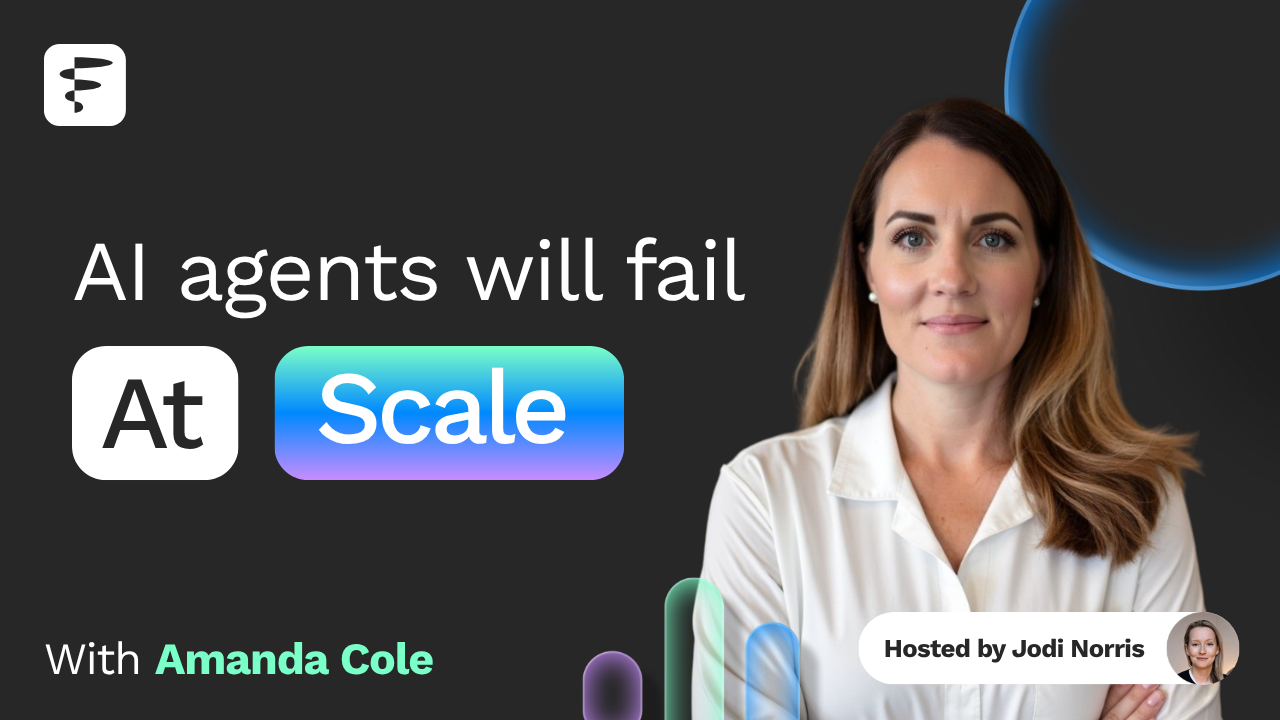
What if the biggest risk in marketing isn't failing, it's being too afraid to?
In this episode of the FINITE Podcast, Jodi Norris sits down with Amanda Cole, CMO at Bloomreach, to unpack why building a culture that tolerates, and even expects, failure has never mattered more. As AI reshapes how marketing teams operate, Amanda argues the old playbook no longer applies. Instead, the marketers who thrive will be the ones comfortable saying "that didn't work" and moving on fast.
The conversation explores what happens when decision-making shifts from humans to AI agents, why scale changes the stakes of every mistake, and why Amanda believes the real risk isn't moving too fast, but forgetting to bring your whole organisation along with you.
Amanda Cole has spent over 20 years building B2B marketing functions from the ground up, starting in direct mail and rising to CMO at Bloomreach, where she leads global marketing, technology partnerships and pipeline generation. Known for her candour and appetite for risk, she's built a reputation for pairing bold experimentation with hard-won lessons on leadership and change.
Inside you’ll find…
The Finite by Clarity Podcast is sponsored by Clarity, a full-service digital marketing and communications agency. Through ideas, influence and impact, Clarity empowers visionary technology companies to change the world for the better.
Jodi (00:01)
Hi Amanda, thank you for joining me on the Finite podcast today.
Amanda Cole (00:05)
Hey Jodi, thanks for having me.
Jodi (00:07)
It's great to have you here. We've only talked briefly before, but I was very enchanted by your topic suggestion and what you're thinking about at the moment. I think I don't want us to get too negative in this podcast. I hope that we can take an optimistic spin, but it's important to be realistic as well, which I think we're going to be. I'm really excited to hear your thoughts on the industry at large and how you're managing failure or the fear of failure. So before we get started.
Amanda Cole (00:37)
I've never been described as someone feeling enchanted before either.
Jodi (00:47)
I'm sure our listeners will be as well. Enchantment, that's what it's about. Okay, so why don't you enchant us with your background and your experience today? I know you have a super impressive career so far. So yeah, how did you get to Bloomreach and your CMO position?
Amanda Cole (01:05)
Yeah, well, super impressive career is a very, very nice way to word it. I think if anything, it's been, this part of what we talked about, it's been a series of failures that have led to successes. But I've been in B2B marketing and the technology space for over 20 years. And every job I've gotten has been the result of a network or someone who I worked with previously who brought me to their company. So I've had the very fortunate experience of starting in marketing in direct mail over 20 years ago. And my job was bringing the responses from nonprofit direct mail solicitations and looking at what drove the most donations. And so my illustrious marketing career went from that to now CMO at Bloomreach, where we do AI-driven personalization for B2C brands looking to connect with consumers.
Jodi (02:05)
Cool, yeah, that's definitely a big leap. And I'm sure we can get into more of those kind of lessons learned along the way and how you pivoted into tech. Why don't we also hear a bit about your role at Bloomreach and your team as well, your team structure, who you manage and things like that.
Amanda Cole (02:25)
Yeah, so I'm the Chief Marketing Officer here. I'm also responsible for our global technology relationships and how we think about generating pipeline through our agencies and our SDR team as well. And inside the marketing organization, it includes product marketing, demand generation, field marketing, where we're connecting with customers and prospects for events and dinners and things like that. And also operations, paid media, and really the traditional email marketing and nurture and customer marketing — the traditional B2B marketing structure.
Jodi (03:05)
Yeah, sounds pretty traditional, pretty standard, but I know that you're taking a really interesting approach to it all. And I would say an interesting philosophy to it all. You told me that you're enabling your teams to feel really comfortable with failure, which is a really interesting take. Why do you think it's so important right now, more than ever, to be emphasizing that with your teams and prioritizing that kind of mindset?
Amanda Cole (03:34)
So sorry to do this, but that was such a great question. I need to shut my window. There's somebody — I don't know if you can hear it.
Jodi (03:39)
Yeah, that's fine. Yep, we can cut that. That's fine. I can hear it a little bit. Our editor can take it out. So if it's annoying you, then shut your window. But it's all good from an audio perspective.
Amanda Cole (03:48)
It is just getting louder. I think the lawn is here. Okay, sorry. Can you ask again?
Jodi (03:58)
Yeah, that's better. Yes. Okay. I'll probably use the first question, but I'll lead us in. Why do you think it's more important now more than ever to be enabling your teams to get more comfortable with failure? Why do you think it's such an important mindset to have at the moment?
Amanda Cole (04:24)
Yeah, the playbook is being rewritten. There's not a right answer. So I think part of what I struggle with when it comes to education in schools is that it teaches you that you get a good grade for finding the right answer. But often in business, and definitely in marketing, there is not a right answer. The process of failing itself is what actually brings you the opportunity to deliver outcomes. And most of what we do — I mean, this is a made-up statistic, but I say 80% of marketing is failure. Most of what you do doesn't work the way that you thought it would. And so that's why tracking and KPIs and really understanding what outcome you're trying to drive is so important. Because if you're not driving the intended outcome, you need to move on and pivot very quickly. So I think it's important for marketing to know there is not a right answer. That's even more important now because the entire world is changing. The way technology works is changing. How consumers, if you're on the B2C side, or how buyers are actually thinking about technology on the B2B side, is changing every day. So really building that muscle to say 'that didn't work, I'm okay with it, I'm moving on' is super important for marketing.
Jodi (05:39)
It's interesting you say that, because a lot of the CMOs I talk to are almost assuming that marketing is more objective than ever. We have mass amounts of data and this data-driven decision-making lens. We've got CMOs building agents who are making those decisions because they're not really decisions to be made — they should just be next steps driven from data. How much of marketing do you think is still that kind of test-and-learn and creative pushing and failing, as opposed to this almost engineering kind of approach to decision-making?
Amanda Cole (06:24)
I think marketing is absolutely a combination of both, but I think marketing will always be test and learn. It is an ever-evolving space. Let's just talk about the example of an agent interacting with a consumer and delivering specifically for that consumer what they're looking for. The Taylor Swift phenomenon, let's start there. Or the Barbie movie, where pink just all of a sudden started coming out of nowhere. Agents would not have had the context that pink was associated to Barbie — they would have started to see a trend very quickly that pink was becoming a dominant colour in searches. And so they likely could surface or do better product recommendations for pink. But the story and the connection to the market moment of Barbie, or the sparkles related to Taylor Swift, requires that human connectivity and ingenuity. That's an example of something very obvious that I think we were all able to arrive at. But in B2B, where the context is nuanced — maybe this is too technical of an example, but it's one that I'm dealing with today — we have a technology called Contextual Bandits. It's something in AI and ML that helps you connect elements of a product catalogue with a different data set, like a customer profile. Contextual Bandits is the engineering name. When we launched it at Bloomreach six years ago, we came up with a super creative name called contextual personalization. Let's just say it still was not a very sexy way to describe it. Since then, the industry has moved forward, and some great marketer called it AI decisioning. So when you look at how we would train our agents — if we loaded an agent with our taxonomy to understand our business language, we would describe the solve to a problem as contextual personalization. But the moment that's happening in the market, similar to Taylor Swift, is a description of AI decisioning. So as a marketer, as a marketing team, that's an example of something we failed at. We failed at coming up with a name that would resonate with the market and build a really great story around describing something very technical but with significant business impact. Someone else solved that problem better than we did by calling it AI decisioning. That's not a problem an agent is going to fix for you though. Does that make sense as an example?
Jodi (08:54)
Yeah, absolutely. I think so many leaders go on about how it should be AI with a human touch. And I think that really brings it to life — an example of how humans and AI interact, and in those kind of hyper-personalised, one-to-one interactions, yes, you can be data driven, but in those really structural, systemic or branding, creative-led moments, that should be contextualized with the industry. That's a really good example of where humans should be leading the loop. Do you think AI will ever be able to contextualize in that way itself, and be able to read the market on a day-to-day basis and make decisions from there as well?
Amanda Cole (09:45)
Absolutely. If you think about the kind of data that we can give AI — we can give it weather data, we can give it news information. It can and will be able to start to build correlations between these things. And you can either choose for it to surface it to you as insights, and it could say something like: maybe over the weekend it could say we're seeing a tremendous surge in pink products, we also see a whole bunch of news articles about how well the Barbie movie is doing — do you think Barbie and pink are related in some way, and should we change the taxonomy about how we describe the products? That is absolutely something you could begin to build and think about as the combination of a context and agent layer. But thinking through what are the things that I want to know and understand and track with agents is what I think the value of the business leader of the future is going to be. What are the context points? What matters to my audience, to my intelligence, to how I operate my business? And what are the areas in which I need to build that specialized context? Much in the same way you would with your human org — you would think about what are the tools, capabilities, data sets, information that they need to have access to and understand. You will need to be doing that same thing for your agent workforce.
Jodi (11:03)
Well, this is what I think is interesting, and it's good that we're talking about agents so much — this is a key example of something completely new within the marketing world that there's not a playbook for. And within agents themselves, there needs to be room for that failure too. Yes, it could be the AI agent doing the failure, or it could be the human behind it failing with that agent, because the agent doesn't have accountability or responsibility. Is that what you're enabling your team to get comfortable with as well?
Amanda Cole (11:41)
Yeah, it's very, very scary when, for example, you turn over decision-making to someone else, even in the human world. I hired my very first marketer 20 years ago — I'll tell this example, if she hears this she would laugh, she works for me still today, so maybe it was 15 years ago, I don't want to age her in any negative way — but I had done marketing most of the time as a marketer of one. I brought her on to really run our digital marketing — email marketing, landing pages, those kinds of things. And back in the day there was an app that, when you loaded a browser only on the local browser, it would change a word to something else. Maybe this isn't appropriate for a podcast, but this is an example of failure. I was editing a landing page in HubSpot, and of course at that time everything was about transitioning from on-prem to cloud. So this page, on my back-end view, had multiple examples of the word 'cloud'. I published the page — well, of course, the source of that content had been changed to a different word, because of this app she had hilariously installed as a Chrome extension. And it actually published and became a landing page with the wrong word everywhere. We had a prospect send me an email saying, 'not sure if you know this, but your landing page says [the wrong word] everywhere.' So this is an example of where even turning decision-making over to a human is very scary, and the outcomes can result in failure. That's obviously very low-impact failure, but the process of turning over decision-making, and the fear behind that, is not unique or new. The difference is the scale and the volume of decisions that can be made with an agent within a matter of minutes. Taking that example, an agent could have done that to a million pages within five minutes instead of just one page. So that's where the feedback loop matters — human in the mix — you need a period of time in which you're checking the work, making sure the outputs are correct. But the point should not be to build a process where you're inserting humans consistently over time. It should be a period of validation that then removes the human, because you validated the work is correct, and you let the agent execute. That is scary, no matter whether it's humans or agents.
Jodi (14:18)
Yeah, absolutely, that's a really great example. I guess the pressure's on the scale — the effectiveness, the efficiency at the moment is wild. So I guess it's keeping humans in the loop to get it started, to get it going, to check. And that's how you ensure these failures don't have a hugely significant impact on your marketing.
Amanda Cole (14:46)
And you keep checking. You have weekly check-ins, quarterly reviews. You make sure the data and the metrics and the things are managed very similarly to how you would train, deploy, and enable a human co-worker.
Jodi (15:08)
When you're enabling your team to set up these agents and test and learn, is that really where the creativity lies as well? Are you asking them to go big and go bold and expect this not to work? Or would you rather it be more iterative and cautious?
Amanda Cole (15:29)
Ooh, I'm definitely on the high-risk end. I think there are very, very few things in marketing, especially on the B2B side, that would cause major long-term issues. So no, I would say I definitely go for 'let's go for broke.' What I'll say I've done poorly is actually bringing people along. I think I've attached to a group that are moving fast, that want to break things, that are pushing boundaries, but I haven't been sensitive enough to the way that impacts the rest of the organization. I was actually on the phone with another CMO recently, and she said, 'our job is not just to get to the finish line — our job is to make sure we start at the starting line together, and that we all finish together.' In reflection, that's it. While I have been super excited about AI and transformation, and we've done a ton of incredible things, I have failed at making sure to be intentional about bringing the organization along. If that means I need to slow down a little bit, then I should be more sensitive to that. My natural inclination is to say go big, but I think my responsibility is to bring everybody along with me.
Jodi (16:42)
Everybody within your team itself, or the wider organization at board level as well?
Amanda Cole (16:48)
Yeah, the whole company. And as much as I even hate to say that — it feels disingenuous to my DNA — I do see it. For example, we started a program where we wanted to automate: when somebody's on our website looking for information, how do we give them the information they're looking for and engage them to request a demo? And then, if they do request a demo, how do we automatically take them through the qualification process, without having to speak to a human — use our AI SDR to do that, book a meeting with a sales rep at the point they're actually ready to see a demo. That sounds like a great process, right? Most of us do not want to talk to a sales rep just to get information we want, or to book a calendar meeting. What I did not do well was talk through with the organization why it matters, what it's going to impact, how it would improve the customer experience, how we were going to test it — giving validation to the company on why this was the right decision. In my head it just made sense and was something we should do, and I discounted the feelings and emotions of other people in the company. I hope I have learned from that experience, but that was something that, in hindsight, I definitely could have done better.
Jodi (18:08)
I think it's interesting because marketers have always been prone to shifts in the industry, prone to their jobs evolving and moving, digital transformation — if you go even further back — and then this move towards community. There are just so many different steps every single year, so much to keep on top of, that marketers are used to that fluidity. But I guess within the wider organization, they might not be used to that same lack of structure and tradition. So how do you actually go about getting them more comfortable with failure and creativity and big pushes?
Amanda Cole (18:52)
Well, I think I have done a terrible job of doing it. I don't have the answer for telling you what I did — that should be the next podcast, and I'll listen to that one. But the same way I was speaking with — I thought the analogy was incredible — you need to be intentional about getting everybody to the starting line first. My takeaway from that was: the next time we do this, I need to do a much better job of level-setting where we are and where we're going.
Jodi (18:59)
Lessons learned.
Amanda Cole (19:22)
Now, I don't know the best way to do that because I haven't done it successfully, but — where are we and where are we going? And then, as we're going — this was the other thing she said — you've got to start together and you've got to finish together. I need to be very sensitive to the pace of the rest of the organization. Are they still with me, or am I really far ahead, or am I behind where the organization is? Do I need to catch up? That analogy is something I hope I proactively apply in future projects.
Jodi (19:53)
Yeah, thank you for your candidness, that's really great. So I guess getting to the starting line is one thing, getting to those checkpoints is another. Figuring out if you're on the right path, figuring out if you're veering completely off course. Is there even a finish line at all? How do you know when to let something go, or to keep pushing, knowing it will work? It sounds like you're really confident with your own instincts, and you have such a great network to learn from, and you're very confident in leading these big moves. Have you ever hit the brake and completely swerved?
Amanda Cole (20:38)
Yeah, my husband is a trauma therapist, and he actually came up with another great analogy. He said there was something we had been doing, and I really wanted it to work — of course AI has blown up and changed a lot of our lives — and he said, 'this is a bit like you've been running a marathon, and 12 miles in you realize you went the wrong direction. And so you can either keep running, or you need to start over.' You know when something's not working, but the mental energy, the physical energy it takes to accept that and basically say, 'these last 12 miles that I ran, they did nothing, and I need to start over' — that is where the really difficult decision comes in. That's where the discipline and the grit come in, to say, 'I know this isn't working, I'm not going to keep pushing, I'm not going to keep running' — to not end up at the finish line I set, I'm going to start over. So I genuinely believe we know when something is not doing what we expected, but it's really hard for us to give it up.
Jodi (21:54)
The sunk cost fallacy. But I guess when you're aware of that bias, you can override it and just try and suck it up and turn back. That analogy of the marathon — 12 miles in — I couldn't deal, I think I would give up.
Amanda Cole (22:09)
Oh, if it was a marathon, well, I wouldn't run a marathon to begin with, but if it was a marathon, I would 100% give up.
Jodi (22:13)
Yeah, to be fair. Do it another day, next month maybe. But that's what marketing is, especially when you're scaling — you go so fast in one direction over such a short period of time these days. To turn back and walk back with your tail between your legs takes even more courage.
Amanda Cole (22:32)
That's right. And it is exhausting, even though we're not actually physically running a marathon. There is a mental and emotional tax to these things. That is part of marketing — grab your glass of wine, get that piece of chocolate cake for the night, and get back to it the next day.
Jodi (22:54)
Exactly. But it is funny how marketers, as I say, are used to it, and the mindset of a marketer will do us well for a long time to come. But the day-to-day is just changing so much. How are you seeing the marketing role evolving, especially those within your team? What new things are you asking from them? What new skills are you looking for? What new skills are you hiring for, if you're hiring? How is the marketing trajectory changing?
Amanda Cole (23:33)
Yeah, I don't think what I hire for would be different. I have a very non-traditional background — I didn't graduate from college, I became a mum as a teenager, and I had a lot of missteps and took jobs, honestly, because of school districts that provided for me or different things like that. I never had this mapped-out career path that was going to help get me to X. It was always: I'm going to do whatever I can to be successful, to achieve what I need to achieve — honestly, primarily for my kids, and they might say otherwise. But what we now call 'grit' — there's even a book called Grit — figuring out any problem, overcoming any obstacle, thinking creatively, and not operating from a very defined set of structure or objectives in order to achieve the end result — that is what makes someone great at marketing. And honestly, that's what I've always hired for. That skillset now — I'll give you an example — the best way to interview someone to understand how they think and operate is to give them a problem or question they likely don't know the answer to. There are three ways they'll manage this: they'll act like they know and tell you the answer even though they don't; they'll ask you to go through the process and tell them how to find the answer; or they'll go and Google it out on their own, probably ask you some questions, and come back with an answer. That last example, in marketing, is a very good behavioural attribute to have. If you're a doctor, definitely don't do that — please do the second one.
Jodi (25:43)
Absolutely, so it's all about adaptability, I guess, and moving with the wave. I do wonder about those marketers who went into marketing to write amazing messaging and content, and suddenly they might need to be engineers. I do wonder about the limitations of our own inherent skillsets and talents, and how far those stretch. But where there's a will, there's a way — I completely agree.
Amanda Cole (26:13)
I don't think that's different from — I was in marketing when we were talking about moving from on-prem to cloud, and the idea of connecting to the internet, putting in a username and password, and running an application yourself, was not believable for a lot of people. Then you get to mobile phones — we started with flip phones, then screens, that was easy, and everybody said there would be a generation of people who don't use mobile phones. That's turned out not to be true at all. And now we're moving towards technology that's right now technical. I actually vibe-coded an entire marketing strategy application over the weekend in Lovable. I know nothing about engineering, but because you can now communicate with a computer using something familiar to all of us — just language — you can build things without needing to be an engineer. You just need ideas, and nobody has more ideas than marketing.
Jodi (27:14)
That's so creative. Absolutely, you're totally right — we don't necessarily need to be engineers, we just have to have ideas and communicate, and still retain that creativity, I guess.
Amanda Cole (27:25)
And I'll go back to your earlier point about people who are incredible with words, or storytelling, or visualization. We all know this at this point: AI does not creatively explain things. It explains things with the largest common language set it can find. So those people who are incredible with words are absolutely still completely necessary. I'm thinking of someone who's one of the best storyteller-wordsmiths I've ever met — he is absolutely more important than ever. Our creative team, they develop incredible brand assets. AI cannot replicate the nuances of even the spacing between text — a text and a button, the amount of rounding you put on a button, the difference between light and dark so you're feeling emotion in an image. AI can replicate, it can copy — but to actually come up with that unique, owned visual still requires absolute human creativity.
Jodi (28:31)
It's not there. I can't feel the final product — I just can't feel it. Okay, cool. Well, that's a really inspiring note to end on, Amanda. I've had such a lovely time chatting with you today. I hope you've enjoyed it as well.
Amanda Cole (28:37)
That's right. I have — thanks for having me.
Enjoy our most recent B2B marketing podcast episodes:
.png?width=478&height=269&name=Finite%20YouTube%20thumbnail%20(3).png)
.png?width=478&height=269&name=Finite%20YouTube%20thumbnail%20(4).png)
.png?width=478&height=269&name=Finite%20YouTube%20thumbnail%20(1).png)

