Find the full transcript here:
Jodi: Hi Carol, thank you for joining me on the Finite by Clarity Podcast. We're here in the Cohesity offices in London in front of a beautiful view. We're here to talk about your journey over the past couple of years at Cohesity. You've got an amazing background in B2B tech marketing, strategy and leadership, and I'm really looking forward to hearing how you've navigated the challenges of a scaling business. Before we do that, please take us through your background — how you got to where you are now.
Carol: I've been super fortunate. I've been working in technology for coming on 30 years, in very large companies like Google and VMware — where I was CMO — and also in some very small startups where we were literally putting together our desk furniture. I feel so privileged to have had these experiences.
I haven't always been a marketer, and I think that's what makes me a better one. I've run sales, been a general manager, and I also naively took a CEO role at a very small startup. We turned it around and sold the company, and that's when I realised I don't really want to be a CEO. But it's made me a better CMO in terms of relating everything back to business outcomes. I've had wonderful mentors along the way, and I feel very grateful.
Jodi: Do you feel like each role helped you figure out your specific niche and what you're really passionate about?
Carol: Yes, exactly. I started my career in tech at Apple as a product manager. At that time there was a philosophy that you cannot market a product unless you understand what it is — and that's a tenet I've carried through my career. I tend to lean into the product, to understand what the tech actually does, in order to convey the benefits and outcomes. That was one of those crucible moments that really shaped how I look at go-to-market strategy.
Jodi: Tell me about your role at Cohesity — your team, your leadership style, your focus areas right now.
Carol: About 18 months ago, we acquired Veritas — a very large company with a significant history in the valley and across tech. It came with people and processes, and any time you put two fairly large organisations together — we're now around 5,800 people — the easy part is the balance sheet. The hard part is the people, the culture, and the transition you need to take everyone through.
The first thing we worked on as a team was: how can we work together effectively? Cohesity was a very startup-like culture — as one of my colleagues would say, ready, fire, aim. Veritas, being a more long-standing company, was ready, ready, ready, fire, aim, aim, aim. So much more thoughtful and planful. When we came together, the challenge was how do we get the best of both worlds? The deep thought, and then the rapid execution.
That's a challenge for any company that's scaling. At places like Google and VMware, you get to a certain mass and you need to break those laws of physics. You need to say: yes, we are still going to move with speed. We are still going to reduce the number of people in meetings, calls and decisions. A lot of what we've been working through is how do we move with both scale and speed?
Jodi: So it's effectiveness in terms of productivity — getting the most out of your team and making the biggest splash in the market with the greatest ease. Does that have a direct impact on your ability to achieve growth goals?
Carol: That's right. Trust is always the foundation that ladders up to accountability and high performance. Building that kind of trust across the team — following through, being accountable, showing up when people need you — that's the foundational element, and I believe we've made good progress there.
On effectiveness — a few quick examples. One is the effectiveness of our demand gen funnel. In B2B marketing, the lifeblood is how do you drive pipeline, acquire customers effectively, with the highest ROI and the least cost? And we have a lot of antiquated notions of what a funnel should look like. We often draw it on a slide as a linear progression, and we all know it's not. I just heard a stunning stat that buying committees today require over 160 touches before a B2B enterprise purchase. A touch can be a website visit, a webinar — but it requires a lot of energy and effort.
So we look at effectiveness in terms of engagement from customers, and how quickly we can move them through a journey so they can reach a yes/no buying decision as fast as possible. And stepping back, it's about moving the needle on what we're held accountable for: awareness, engagement, and pipeline. Engagement drives loyalty, usage, and commitment from customers and partners — it's just as important as pipeline.
Jodi: The effectiveness of brand awareness efforts does seem complex. How do you numericise that at a more tactical level?
Carol: Over the past decade, you can numericise it. There's the traditional approach — do a survey, pre and post the brand campaign, across channels. And AI has enabled new ways to go out and scrape across the web to measure brand awareness and consideration. We use several tools, including Blue Ocean and Dianta. For example, we launched a brand campaign when our awareness was quite low compared to competitors — a score of around 20-something from Blue Ocean. After a year of working on our brand in specific markets, it's now in the mid-to-high thirties. There's also brand consideration and brand preference, which is what we all want to get to. You can also do simpler things like sampling through LinkedIn.
Jodi: I'm getting the sense that you're really in the weeds in a positive way. A lot of the CMOs I speak to are thinking at top-level strategy, board relations, their own market profiling. I love that you're so invested at the campaign level. It's fascinating. How did you bridge the gap between that big, slow-moving enterprise and the fast-paced agile startup — and how has AI been involved?
Carol: Marketers, we are really good at running up and down the stairs faster. And what I told the CEO when I started — and what I've shared with the team — is: we're not here to run up and down the stairs faster. We're here to build an elevator to get to the hundredth floor. There's no other way to do that without automation.
What AI has done for us has just supercharged everything we do. Cohesity's mission is to protect, secure, and provide insights from data — and we also apply that internally. Data is incredibly important to us.
On how we use AI: we tried a top-down approach initially. We're a Microsoft Office shop, so we started with Copilot, then lobbied IT for ChatGPT about 18 months ago. But what we've seen over the last year is that the bottom-up approach — putting tools out there and letting the team take advantage of them — produces the best ideas. We now have Enterprise Claude, Enterprise ChatGPT, Enterprise Copilot, and Gemini in use across pockets of the team. We said: use them, and see what comes up.
A few things have bubbled up. One is an AI translation tool. Historically, translation was linear and laborious — create materials, send to a translation company, wait. The team came back and said they'd created something called Localize (LAICE), which has our brand guidelines and tone of voice baked in. It's really good for short content, still a learning journey for longer pieces. We also have Brandy — a bottoms-up tool where people can run their slide decks through it to check for on-brand tone and voice, with recommendations.
Jodi: It sounds like your team is technically savvy. You're not just enabling them to choose which AI model writes the best LinkedIn post — you're enabling them to vibe code and create their own solutions for unique problems.
Carol: We're trying. Not everyone wants to be a builder, and that's okay. In that case, the ask is: bring us ideas and other people will implement. It's all about curiosity and willingness to try.
Our teams are incredibly busy. Here in the UK, for example, we have a very busy team trying to cover a lot of ground with a demanding sales force. We've doubled our resources in the UK and they're still stretched. The biggest question my team asked was: how do we give people time to explore and play with the tools? We haven't fully solved it, but what we've tried to do is ask every manager to carve out time — whether that's Wednesday afternoon for two hours or Friday at the end of the day. And they come up with great stuff.
Jodi: That's good mid-to-long-term thinking. Teaching people to fish rather than giving them fish. It takes more time upfront, but the long-term gains are significant.
Carol: Totally. One framework we're using is looking at all the work we do in three buckets: strategic work, execution work, and anything that should be outsourced or automated. We want to lift everyone so they can do more strategic work — which is what people want. They want time to think, to come up with bigger ideas. And AI on the automation front is a game changer.
Jodi: What is the actual business case for AI? I've had guests come on and say they're cutting costs, reducing headcount, and investing in AI — without knowing what roles will be created. What's your end goal with automation?
Carol: AI is incredibly important because it frees up time, but our big driver has not been cost. Our big driver has been scale and speed. We had a board member say in a meeting just a few days ago: a week is like a quarter now. And I've taken that and said to my team: a week is like a year. Everything has accelerated. Every week there's new competition, industry changes, new threats — in our space around data security, you hear about something new constantly.
For us, it is absolutely about speed. You cannot sit still anymore. How do we move faster? How do we make decisions faster? How do we get data sorted faster so we know what to change?
An example: we've discovered our sales cycle is about six months for a customer to decide they need Cohesity. We believe we absolutely need to shorten that — because the money in the door matters, but more importantly, our customers are at risk. We help secure the data for 70% of the Global 500. All that data is being attacked constantly. We cannot sit still.
So we looked at the pipeline and said: how do we move customers through faster? We've applied AI with our SDR team using outreach.ai, where one SDR does the work of 60. The emails, the follow-up, the nurture streams — it used to all be manual. And it's paying off. We've seen a doubling of our MQL to TQL conversion rate, from around 3.5% to 7% and growing.
Jodi: It used to feel like the link between scaling and slowness was inevitable. It really feels like that's being completely deconstructed. You've managed to map out how you've sped up both your team and the buying cycle. How big is your team?
Carol: About 130 strong. We operate in 140 countries and focus on a top-ten country list with tiers. We have agencies and extended support in some regions, but I don't think we need to grow the way we used to — where more content created meant more headcount. The strategic, outsource and automate model can carry us quite far.
Jodi: I wonder about the balance between efficiency and effectiveness. Automating so much — could it reduce the quality of those touch points? Could audiences lose trust?
Carol: I've talked with my CFO about this — I think the relationship between the CMO and the CFO is incredibly important, because marketing is a business driver. I've often thought the role should really be called Chief Market Officer, not Chief Marketing Officer, because it's about penetrating markets and gaining share.
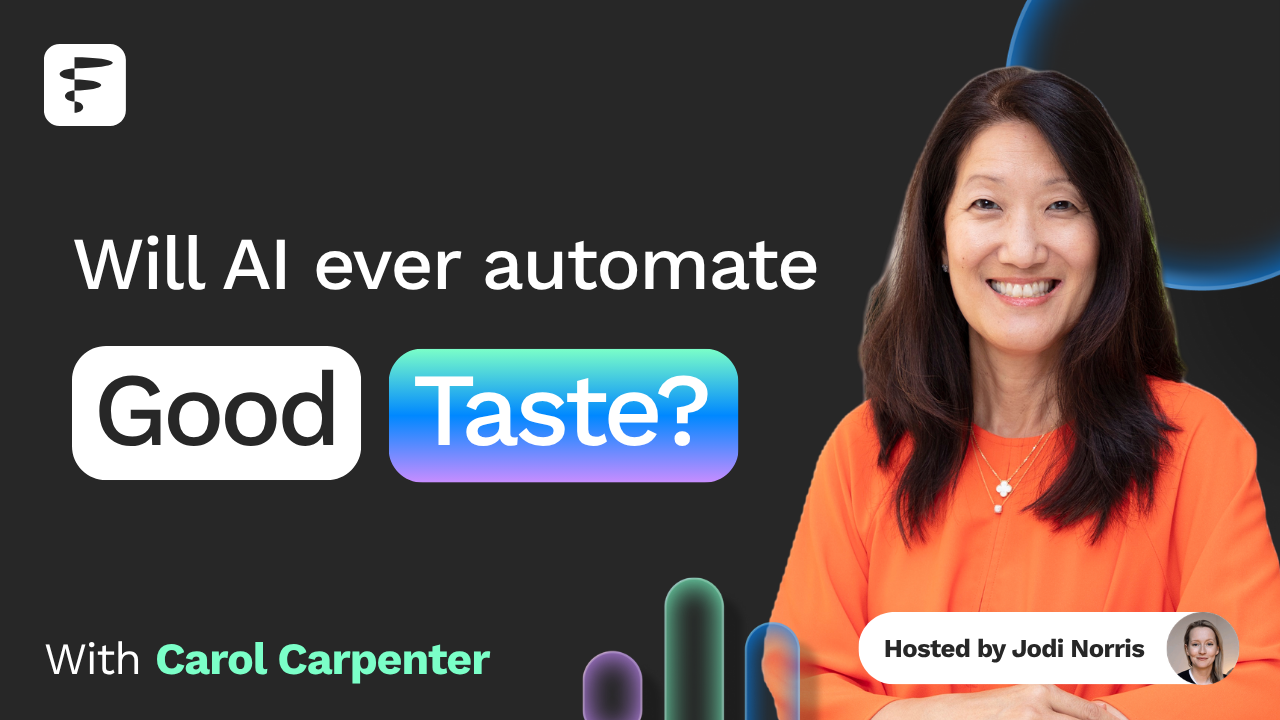
He's looking for efficiency, and we are too. But we don't want to be more efficient just to save costs — it's about having our team do more strategic work. And there are two things you cannot outsource or automate: creativity and good taste. That's where marketing has a huge role. AI tools are not perfect — there are still hallucinations and mistakes, and you need people with wisdom, good taste, and creativity to spot them.
My general rule: effectiveness is how we're moving the market metrics that matter — awareness, pipeline, and so on. Efficiency is whether we're hitting our ROI target of one to fifteen. We don't always hit it, and that's okay. We're learning and iterating. And I emphasise to my CFO: you can't look at marketing in days. You need to look at it in weeks and months.
Jodi: I'm noticing a hard line between CMOs who believe creativity can't be automated — that good ideas are what make a splash — and those who say marketers need to be engineers, data-driven, everything automated. How do you get that balance in hiring?
Carol: I just spent a day in an on-site with our creative teams and agency, talking about how AI is being used — and the honest answer is that a lot of what comes out is still not very good quality. That's where taste and creativity come in.
For any role, it's extremely important to find people who are smart, passionate, and curious. My favourite interview question right now is: tell me about a prompt you recently used. What problem were you trying to solve, and how did you iterate on it? Because no one's a great prompter right away. I end every one of my own prompts with: how could I have prompted you better to get to this outcome? It teaches you.
The answers range enormously. I had someone in communications tell me he has different AI personas set up as agents, and runs every earnings script through them — they represent investors who follow their stock — to see how they'll react. He also has the AI pull from the last quarter of financial analyst reports to compare his write-up against ones that took the stock in a positive direction. It was quite an elaborate prompt, and pretty impressive.
On the other side, I had an interviewee share a personal story about helping their child with history homework — comparing World War One and World War Two. Just as interesting. When people share how they prompt, it reveals how they think, what questions they're asking, and how they layer in data.
Jodi: Those are really interesting examples. You're looking for curiosity and drive — and a kind of opportunistic thinking about how to solve meaty challenges in day-to-day work.
Carol: I'd have characterised it as a growth mindset, but opportunistic thinking works. And I think having that mindset, plus a genuine passion for the business and industry, makes for great success. Those are the people who are going to teach us.
I heard a CEO say he doesn't want to hire anyone over 26 — which is a bit extreme and obviously ageist. But I understand the point: we want people who can think outside the box and who aren't as shaped by how things have always been done. That's where the gains come.
I call it AI 1.0 — using AI to make ourselves a little more productive. AI 2.0 is when you look at workflow and actually change it. That's what we're in the midst of. Workflows become hardened with time — this is how we go to market, how we work with the channel, how we price and package. Those are the walls we want to break down.
Jodi: That's interesting — everyone says they want flexible generalists, but you still see very rigid job roles, very defined structures. CMOs can be quite hesitant to actually put their money where their mouth is when it comes to soft skills.
Carol: You need a combination. In some areas — like SEO, AEO, AIEO, whatever we're calling it today — there's genuinely no one with existing expertise. That's where soft skills matter most: how do people think, how do they approach problems? In other areas, like pipeline generation, you do need hard skills and a solid understanding of how enterprise customers buy. The fundamentals never go away.
Jodi: That's all we have time for today. It's been an absolute pleasure, Carol. I've learned so much.
Carol: Thank you for having me, Jodi.



.png?width=478&height=269&name=Finite%20YouTube%20thumbnail%20(4).png)
.png?width=478&height=269&name=Finite%20YouTube%20thumbnail%20(3).png)