- Some additional information in one line
- Jul 7 2025
Podcast: The Marketing Priorities of a Global Enterprise in 2025 with Rebecca Stone, SVP, Revenue Marketing at Cisco
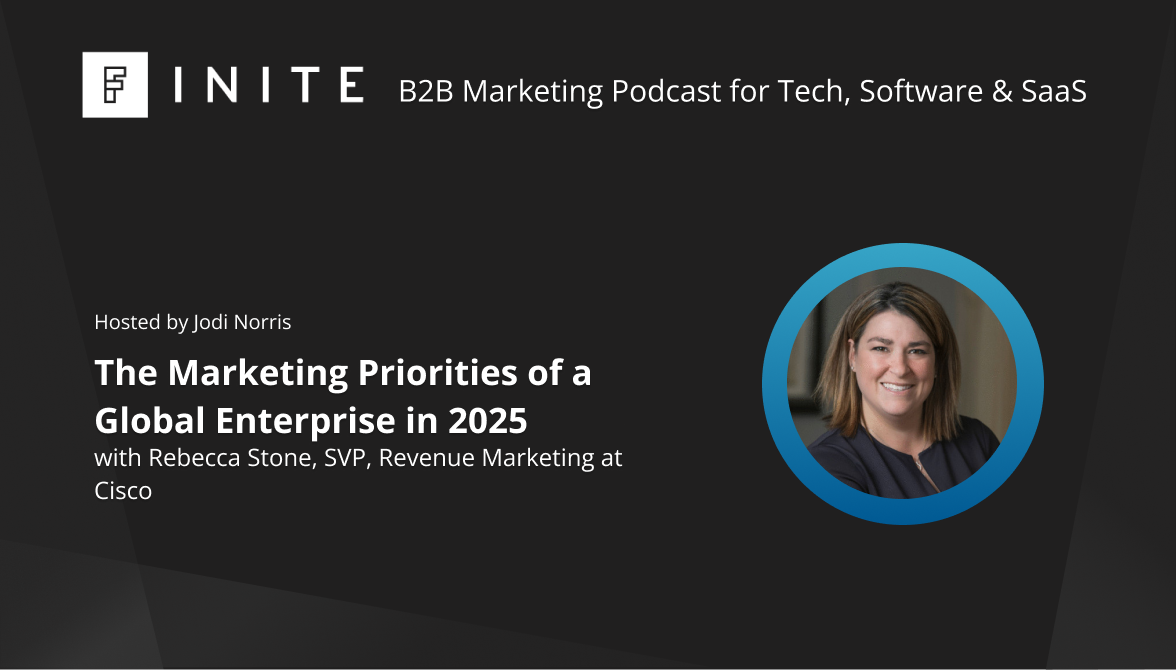
Get an inside scoop into the marketing priorities of global enterprise, Cisco. Their fearless leader, Rebecca Stone, comes on the podcast to discuss her approach to data, and their ambitious project to integrate all internal data sources into a unified platform for every team.
We also discuss Rebecca’s unique approach to team structure, where a unique matrix ensures a high level of productivity all of the time.
Listen below, on Apple Podcasts or Spotify
Or watch on YouTube
And once you’re done listening, find more of our B2B marketing podcasts here!
The FINITE Podcast is sponsored by Clarity, a full-service digital marketing and communications agency. Through ideas, influence and impact, Clarity empowers visionary technology companies to change the world for the better.
Find the full transcript here:
Hi, Rebecca. Welcome to the Finite Podcast. Thank you so much for having me. It’s a pleasure to be here. It’s a pleasure to have you today to talk at a more strategic level about your experience at Cisco, coming in as their Senior Vice President of Global Revenue Marketing and learning some key lessons from that experience.
But before we dive into the topic, I’d love to hear a bit more about your personal background, how you got into marketing, a bit more about your marketing career and how you landed at Cisco.
Sure. Thanks for asking. I just, from a background perspective, I am a mom of two wonderful daughters who are 12 and almost eight.
So I’m right in that sweet spot of having kids who still like to hang out with mom. Um, and, uh, and we live in the Bay area, uh, have lived here for most of my career.
Uh, and, um, and really when it comes to marketing, it is the thing that I have always done. I knew in college that I wanted to be a marketer. I was actually a comms major at UC Santa Barbara, go gauchos.
And, um, and really, really just loved the blending of art and science that is marketing because there is, especially now with all of the marketing technology that exists, there’s, there’s so much math and analytics that are involved and, and data that is involved, but there still is a little bit of that special secret sauce that, uh, that you don’t really, can’t really put your finger on, can’t do any math around.
Um, that is part of, the marketing messaging and the art of marketing that I just love. Yeah, awesome. Do you think that balance between art and science has shifted more to science over your time as a marketer?
I think that there’s always been science involved in terms of how you target your audience, how you segment your audience.
And that has always been a science. But the data that you have to make those decisions is is just more prevalent now.
And you’re able to do it in a way that, um, that feels like you are getting more of a precise outcome maybe than you have in the past.
Okay. Awesome. Yeah, I totally agree. Um, so looking at your current role, could you tell us more about your time at Cisco and your team that you lead and your main strategy?
Yeah. So I have been running the revenue marketing team reporting into our CMO, Carrie Palin. for about nine months now. That revenue marketing team involves three different distinct groups within my organization.
Three core groups are the integrated marketing team and the planning team around creating an actual campaign plan.
The second team is our MarTech and digital technology team, and that includes our social media, our digital advertising, and our dot-com sites, as well as the full MarTech stack for the business.
And the last is our virtual demand center, which is what we call our sales development, our sales lead generation team and qualification team.
And so when you think about it, it really is stitching a campaign plan to a digital customer journey, to the team that qualifies those leads when they come in from one of those digital channels.
Awesome. Sounds like a very integrated team, especially having a sales function alongside those. Um, and cool names as well. I might ask, I might add. Um, so we’re going to be talking about your journey at Cisco and how you’ve come into this complex, large organization, um, and made an impact really.
I really wanna unravel the key insights that you learned, the biggest challenges that you’ve faced along the way and how it’s led you to where you are now and successes with that.
So starting at the beginning, I’d love to know about when you first came at Cisco, what met you, what your first observations were and your first instincts.
Yeah, so I’ve been at Cisco for about six years. Like I said, I’ve been in my current role for about nine months. Prior to that, I was leading, I was CMO of the Meraki business unit, which was a business unit that was acquired by Cisco.
And I did that for about two years. And then from there, I moved into the broader business unit that Meraki was under, the networking business unit.
That networking business unit accounts for for roughly 60% of Cisco’s revenue. We were really responsible for that core business, that legacy business that has been the core driver of Cisco for 40 plus years.
In both of those roles, there was some work that needed to be done to modernize the way that the marketing was running.
you talked a little bit about that digital journey and the analytics and the math. That’s one of the key things that we’ve been really focused on for the last five years is trying to drive a better outcome and focus data driven approach to the things that we are doing.
And that involved reimagining the tech stack for Meraki. And then we merged the Meraki tech stack into the larger, what was then known as customer solutions, marketing, uh, business tech stack and process across the entire networking business.
And then now we’re doing it again at the, um, at the full Cisco level. So it’s, it’s been a six year journey of helping to manage, um, that digital journey, the idea of a revenue driven marketing focused operations team, uh, as well as the messaging around that and the focus on, um, on how we do that through, um, through the channels that we’re, we’re working through.
All right. Awesome. So it’s really being data centric and aligning your tech stack with that goal. And you’ve done that in multiple functions. Um, we’re still working on it.
We’re still working on it in the current role. There’s a lot of work that needs to be done where we’re working on, um, consolidating right now we have.
I think eight different, uh, automation platforms that we are trying to work through consolidating.
Uh, and that doesn’t even, uh, you know, that’s just the core consolidated, you know, consolidation of the automation.
There’s lots of other texts that is overlapping that we’re really trying to work to simplify the process so that it’s easier for marketers to run campaigns and to get the data out of those campaigns.
Um, One of the core foundations for that is a new marketing data lake where all of the data from all of these different automation platforms, technology platforms are going to be pumped into so that we really have a core one standard set of data that everyone across the organization is pulling from.
That’s one of the things from an analytics perspective that we talked about a little bit earlier that I’m most excited about working on.
Yeah, awesome. So I can imagine there are plenty of challenges that come with that from a more practical level.
Looking into the future a little bit, like how do you see your entire organization relying on this platform, both from like, are you building your own tech platform for this?
Is it going to be, is it bespoke? Are you using a vendor to platformatize? Yeah, I mean, it’s a it’s a combination where we’re definitely using a few vendors for both the data storage as well as the visualization of that data.
And it will depend on how the data is being used for some of our teams that data is being used to understand the customer better.
For some of our teams, the look is really to be able to understand that journey and how individuals are moving from channel to channel and within those channels so that we can optimize them.
It just depends on how the data is being used. We want to have the same data set that everybody can pull from, but then give everyone the flexibility to pull the data in the way that they need to.
My head of marketing ops really does call it the democratization of the data so that we have more access, which allows, hopefully, for more insights.
I think from a future perspective, in addition to how the team is working and using that data, I’m also very excited about the use of AI within some of the things that we are doing.
We’ve been using big data models for quite some time. Our analytics team is actually starting to layer AI data models on top of those big data LLMs and, sorry, big data models and then LLMs on top of that so that we can really start to see things in a completely different way and in a transformational way than we have done before.
That’s on top of then being able to use that data in tools that drive more of a customized focus via.
the optimizations that we’re able to get from the data as well as the tools having AI in them as well.
Yeah, I was actually going to ask about AI. I know data overload is something that the marketers, B2B marketers particularly, have been talking about for a while.
We are not starved of data anymore. Organizations have millions of data points. And how do you filter those, especially when lots of teams are using it?
How does each team interact? pull the right data, be able to like streamline the data to actually find key insights, which, which fuel the art as we said at the beginning.
But, um, do you, so is AI, is it kind of going to be like a chat gbt for your data set where someone from say customer marketing comes in and asks like, what do our customers like best about this product?
And then the AI is going to pull from the data. Well, I think there will be a combination of things that we’ll use the data for.
One of them is exactly what you said. For our average field marketer who doesn’t have the analytic skills of a data analyst, let’s say, or data scientist, we need to make that easier.
That is where the LLMs come in. I just need to know about X company and what products they’re using and When was the last renewal date and when was the last time that they interacted with us?
You can use an LLM on top of the data that we have in order to deliver in a more conversational way that information to your average marketer.
There’s thousands of marketers within Cisco and so not everyone is going to have the skill set to go deep.
But then we have those AI models that are really for our data scientists where they are diving deep into the data and trying to put connections together.
One of the examples of that is every organization has a hard time getting every single salesperson to attach the right contact to an opportunity.
We are exploring using AI models in order to actually do that for the salesperson so that we can understand just by mere fact of the number of conversations that they’ve had over email with a particular person, specific words that they might be looking for in that email, like we can tell them, Hey, this person is, is, um, might be the right contact to attach to the opportunity.
And we do that in a, in a privacy safe way so that we’re only looking at specific words rather than a whole email where we’re looking to pull them out.
You know, we’re, making sure that those interactions are done in a in a way that um doesn’t like i said doesn’t um reveal the individual.
It’s much more an anonymous way to be able to attach the human to the opportunity. The importance of that though and and being able to do that together is to actually understand what’s working and what’s not working so that we can refine our time and be a little bit easier um i think the third way that we’re thinking about using ai is actually in the interactions with the customers.
Even though we have our virtual demand center, our virtual demand center is global, we don’t have every language in the world covered.
We don’t have every language in the world 24 hours a day, seven days a week covered. And so how do we help deliver information to our customers at a time when someone who speaks that language or speaks that language in the right timeframe that the customer is looking for it?
to be delivered is delivered. And that’s where we might use an AI bot or some sort of example of AI interactions through chat on our website to deliver information in a conversational way can help with that kind of use case.
And so I think there’s multiple ways that we’re thinking about using AI in order to both and simplify as well as provide a better experience for our customers.
Interesting. Yeah, that reminds me of this very controversial tube ad that was on the London Underground recently that probably made it to your LinkedIn, even though you’re in the US.
It was this ad saying, don’t hire humans. And it was advertising AI BDRs. And I think from an inbound perspective, everyone’s very normalized to AI responding to chat, like in a chat bot, even sales inbound.
How do you see AI interacting with outbound sales and outbound customers? Yeah, I mean, I don’t know if I’m quite ready to make that leap yet, but I think the inbounding and seeing how the inbounding goes is probably our first step in Because I think what we’ll learn from that is what are the most common questions?
Where are the areas where we do need a human to interact and we don’t have enough data in order for us to be able to provide things?
Then maybe an outbounding experience could be tried. I see a world in where it’s possible. I just don’t think that we as an organization have done enough of that foundational work yet in order to be able to try it.
But You never know. I mean, I think it’s a brave new world that we’re moving into. And there’s lots of new possibilities that are opening up every day that even six months ago, I said probably wasn’t going to be possible for a while.
So I’m excited to see how it goes. Yeah, definitely. I think it is interesting because all marketers and sales agents want to be tech enabled and but all the advice that I see for BDRs, not like I’m a sales person, but all the advice I see is like make these really hyper bespoke outreach emails that talk about the customer’s challenges and like a really human in a way.
So it will be interesting to see if that tide turns. We’ll have to see. All right. So we’ve talked a lot about tech and tech enablement. It’s a huge, huge undertaking to transform the entire database of an organization and enable every single team.
So we could talk about that some more, but I did have some more questions about your wider marketing strategy.
I’ve heard that you have an approach of maintaining agility with your marketing leadership. And I wondered if you could talk more about that. Yeah, I think, you know, we talked a little bit about the technology piece.
I have a real belief in the three core foundations of people, process, and technology. And from a process perspective specifically, with an organization the size of Cisco’s marketing team and the matrixed way that that organization operates, it’s really important to be able to think about new approaches and new ways to organize yourself And so about two years ago, we started on a journey to move towards an agile marketing motion.
You know, a lot of big organizations around the world are using an agile process for their marketing.
And Cisco has not historically. We’ve been more focused on a traditional waterfall approach. And for those who may not be familiar with what’s the difference between waterfall and agile marketing, Waterfall is very much the idea that, Hey, you move from one thing to the next thing, to the next thing in a very aligned motion.
Um, and, and that works great up to a point when you are, have so many different irons in the fire that, um, that you start to move more and more slowly.
It’s like, think about like, if there’s water rushing through that waterfall and then all of a this wood and like debris starts to pile up, you start to get a dam instead of water free flowing.
And, and so the, the idea of agile is that you’re actually running all of your projects and all of your processes and all of the work that you’re doing concurrently.
So rather than, Hey, I, I write copy and then that copy gets sent to design. And then that design gets sent to a copywriter. And then that copywriter sends it to the production team to, um, to put it in an email or on the website and you do each one of those things at the same time, or at different times, you’re actually doing each of those things at the same time.
So the copywriter and the copy editor are working on things concurrently to write and edit at the same time.
The designer and the production people are working on things at the same time so that they are designing almost in production rather than as a static piece that then gets handed off to production.
each one of those pieces and processes, by pulling them in and working where you can parallel to each other instead of almost horizontal to each other, is significantly cuts down the time to delivery.
And so we have really been in the full motion for about nine months. And in that nine months, we’ve started to see a pretty dramatic decrease in time to market.
So webinars that used to take two months to get out the door are now taking two weeks. Emails are dropped from three to four weeks of production time to less than a week.
And you have to imagine, I mean, this is a big organization with hundreds of webinars and emails and blog posts at the same time.
So getting those out faster and faster is actually better for us in terms of how quickly we can support all of the different parts of the organization that we need to.
And it allows us to better react to changes that we’re not anticipating, whether they be industry changes or a product line moves up their timeline or moves back their timeline.
We’re better able to adapt to those things because we have this motion in place. Is it perfect? No, there’s lots of things that we’re still working through.
It’s a big mindset shift for people. It’s not just about, like I said, the process piece. It is a people piece and a change management piece and a re-education and a re-architecture piece as well.
That is a very, very heavy lift. But like I said, we are seeing the results in how quickly things are coming to market and how much the team is working more in a unified way rather than in the silos of each of the parts of the organization that they work in today.
Wow, yeah, I think that’s a really fascinating approach. You hit the nail on the head. These huge complex enterprise organizations are always said to be slow and clunky.
And this is a very streamlined, efficient, I’m imagining this like multi-helix, like beehive where everyone’s just like always, always going at the same time.
I’m just wondering about the actual pragmatic processes that you had to put in place in order to make this happen.
could you outline a few of those? Um, I did not call out at the beginning. I called out my three core, um, parts of the marketing team, but I do have a few others that are in the team.
One is our content team. And the second is our, uh, our programs and, and, uh, project management organization. It, if we did not have a strong project management organ organization that, um, that really was filled with individuals who are either experts in this agile motion or becoming experts in this agile motion, we would not be successful.
They are the lifeblood of the work that we are doing and are really the architects behind us being able to do any of this in the way that we are and the way that we have been successful, particularly in the last six months.
So I just want to make sure to shout out that team and my deep gratitude for the work that they do in a fairly thankless way, to be honest with you, every day, because they’re the ones who are cracking the whip and saying, hey, we really, you know, this deadline is this deadline.
How do we speed things up? How do we make things go faster? How do we force you guys to work together in a different way and to think differently?
If it wasn’t for them, we wouldn’t be able to do it. I think on top of that, I talked a little bit about management. We have really focused in two areas on change management.
One is what I alluded to a little bit earlier in terms of education. There are a lot of people who come into marketing who don’t have that traditional marketing background, to be honest with you.
They haven’t gone to school for it. Sometimes they come from sales and sales engineering. Sometimes they come from product. And they know a little bit about it from the organization that they’ve worked in.
But they haven’t gone to school for it and learned the discipline that is marketing. And so we have created a few programs. It’s an 18-month program that our entire team goes through.
to really focus on the true discipline of marketing and the aspects of marketing that you would learn if you were in a college course and getting a degree on it.
And so that’s one area. Every single person, regardless of training, has to go through that and understand how we as an organization think about marketing and the best skills and best practices for that.
The second thing that I talked about is just pure change management for change management’s sake. How do we, communicate to our team members in a more consistent way about things that are important?
How do we provide ways for them to learn? Because oftentimes what happens is, you know, leadership sends out one announcement and you tend to, you’re like, well, everybody’s read the announcement, so we’re good to go.
But you don’t have the chance to ask questions if you’re just sending out an email announcement. You don’t have the chance to really think through it.
What about the people who are out on PTO or leave for the week that that email went out? They miss it. What about the new people who come in after the email that you sent out?
It is a constant refreshing of basic skills. And so our change management team is really focused on thinking through that.
How do we make sure that everybody is educated, not necessarily on the pure scope of marketing, but how do we make sure that they’re educated on just artwork?
organization and how our organization is set up and some of the things that we’re announcing as changes or some of the things that are coming or learning skills that other people are using.
I think AI is a great example of that. We’ve had a couple of trainings recently on how to use our internal AI tools. It’s called Bridge IT. We don’t use ChatGPT. It’s an internal Cisco tool called Bridge IT.
And how do you use Bridge IT for some of the AI work that you’re doing in a way that’s successful, you know?
And, and so I think those are the two areas that I would, I would really point out to you as our key focus from that people, people perspective.
Yeah. Awesome. That sounds much more attainable now that you’ve laid it out step-by-step such a, yeah, another huge undertaking, but you’ve got these team leaders that are, are, goal oriented and able to push the right buttons with their team.
And you’ve got these teams who have not only uniformity of skills, marketing skills, but uniformity of expectations, I guess, which is the most important thing.
And I think that that’s the point of agile is, you know, when you think about a traditional way that a marketing team works, there’s a lot of process within each project where there’s a lot of process within each team that but there’s not a lot of process for how those teams work across.
And the idea of agile is to put that wrapper around the entire process and make it much more structured from an entire process end to end perspective.
And then that allows for more freedom actually within the process itself to be adaptive because you have the overall process rather than, oh, like, The copywriting is just a process.
The design is just a process, you know, going back to that example that I used a little bit earlier.
Yeah, definitely. Do you have any specific examples of ways in which this agile marketing has made your marketing more agile?
Any kind of campaign optimization or strategy optimization, anything like that? Yeah, I think one of the ways is just the overall how we approach the customer journey.
In the past, we have looked at when a new product launches, everything needs to be new. You need to create new blog posts, you need to create new web pages, you need to create new emails.
We’re actually now looking at how do you optimize the existing pages that you have? If Cisco already has 150 or 200 Wi-Fi pages, why are we creating two more rather than cutting down the number of pages that we have today?
and making sure that those are updated. So making sure that the process and the programs are simpler. The other thing that I think is happening is just that there’s a lot more thought and creativity going into some of the campaigns that we’re running because we have more of an open opportunity to do things in a different way.
And so I think that that is, I really love the creative ways that people are working together. Hey, I know- this thing that’s happening over in product that could be kind of cool as a marketing tool, you know, let’s use this feature, this new feature in this product in a different way than we thought to use it before.
Let’s do a demo in a different way. You know, um, how do we use new programs and new channels in a way that we’ve never done it before?
I think that is the creativity that I’m seeing is really kind of exciting and renewed because, There’s less focus on, I just got to get this thing out the door.
It’s more, what are the right things and when can we get them out the door? That has changed for us. Yeah, awesome. And I think that’s a great note to end on.
Back to the art and science of marketing, science enabling art and art enabling science. So thank you so much, Rebecca, for coming on. It’s been a fascinating chat. And I hope to- Thank you so much.
Thank you.