- Some additional information in one line
- Mar 31 2020
Podcast: Using tech & AI to support B2B marketing with Cindy Atinault, VP of Marketing at Senseye
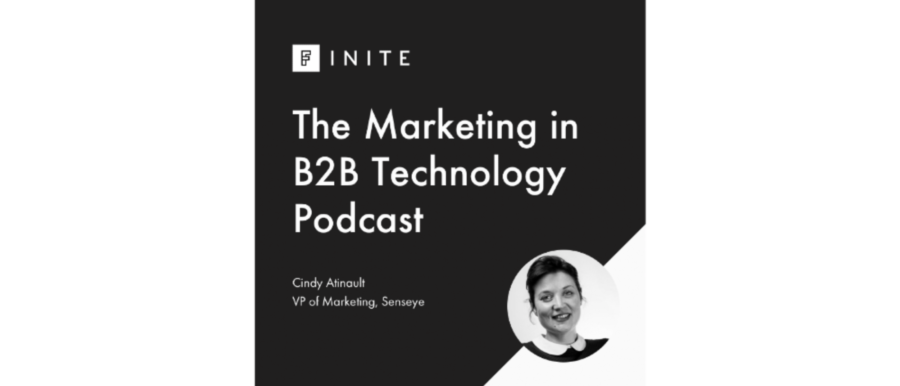
Cindy Atinault is VP of Marketing at Senseye, an enterprise B2B tech company providing a predictive maintenance solution that drives forward innovative automated industrial operations through AI technology. Cindy has worked across a number of different B2B technology companies and has shared a some of her insights in this episode.
FINITE podcast host Alex Price sat down with Cindy to explore her role at Senseye and how the latest MarTech and AI tools can help to empower marketers, get results, drive ROI and more closely align with sales.
This episode covers:
- Cindy’s career in marketing so far
- The marketing function at Senseye
- Planning a MarTech implementation strategy
- Budgeting for marketing technology
- What stage should you start to invest in MarTech
- Blending the IT and marketing function
- What intent data is and how you can use it
- Specific AI tools you can use for interpreting data
- Keeping a clean database
- Future trends in B2B
Listen to the full podcast here:
And once you’re done listening, find more of our B2B marketing podcasts here!
Full Transcript:
Alex (00:07):
Hello everybody and welcome back to another episode of the FINITE podcast. I’m really looking forward to sitting down with Cindy Atinault. Cindy is the VP of Marketing at Senseye, an enterprise software business helping industrial companies with predictive maintenance, a fascinating area of complex industrial manufacturing for loads of big companies and really driven by the whole industrial internet of things revolution that’s taking place.
Cindy’s worked across all kinds of different B2B software technology companies and we’re going to be talking about using marketing technology, AI, really the whole kind of MarTech landscape and how that looks for Cindy at Senseye, but also tips for how others can look at their MarTech roadmap and the MarTech landscape and adopts the newest and latest technologies. So I hope you enjoy.
FINITE (01:01):
The FINITE community and podcast are kindly supported by 93x the digital agency working exclusively with ambitious fast-growth B2B technology companies. Visit 93x.agency to find out about how they partner with the marketing team and B2B technology companies to drive digital growth
Alex (01:23):
Hi Cindy, thanks for joining me.
Cindy (01:25):
Hi Alex, Thank you for the invite.
Alex (01:26):
No problem. I’m looking forward to talking with you, I guess as we always do, it’d be great to make a start with hearing a little bit more about your background, a bit about Senseye and how everything works. So I know you’ve worked across a number of different, I guess kind of broadly B2B technology businesses, but yeah, tell us a bit more about how you go into marketing and what that journey looked like.
Cindy (01:47):
So I’ve started my career more than 15 years ago. It’s a long journey, but very interesting. And one of the particularity in my journey is actually, I worked both in sales and marketing, so already before focusing on marketing, but always value my, experience that I had in sales because, sales and marketing are very link jobs and I’ve been , in their shoes, like I say, really helped me understand their challenge and, really help me to, address some of the questions they may have and really understanding their world. So going into software and B2B was really something of interest because I always have been interested in technology and I always find that a software industry, its a very dynamic worlds, so very turned to the future.
Cindy (02:45):
And so, yeah, very, very good. And Senseye, a very interesting company because on top of AI and machine learning technology, they also have data science and they have a very specific story. So initially, actually as the founders, they were working in condition monitoring activities for aerospace industries. And so it was very intense activity, very heavy, time consuming. And they had to deliver a custom solution for the field and they wanted to find a solution. So how with data science, how with technologies they could come up with a standout solution for all the other industry? Because it’s true that usually the aerospace industry is very well advanced when it comes to quality programs to engineering because there is no room for mistakes there. So when you compare, quality programs in aerospace and difference and quality program in manufacturing usually, it’s not the same range, but they wanted to leverage on the best practices they learned and bring it to other industries.
Cindy (03:57):
So that’s what they did. And their profile is very interesting because half of them are coming from these technology and AI worlds and the other half, have more of an engineering. So really to link actually reality and the context, of the machine with the technology. So that’s why I find it very interesting. And my role at Senseye is really to lead all the global marketing activities with the headquarter. So being based in the UK and deploying their strategy, globally. And so I view my team very different.
Alex (04:36):
Yeah, tell us about the structure a bit more.
Cindy (04:38):
Yeah, very different, approach. Because I’ve been there as well. I’ve been a marketer myself doing a bit of everything and anything but the problem when you do that is so it’s good because you can touch on anything, any digital events, partner activity, as well PR activity, really everything.
Cindy (05:00):
But the problem is you can’t really specialize yourself, and at some point you get a bit frustrated because you can’t spend really any time on anything because you just need to move to the next, different thing. So I’ve built my team actually by array of expertise. So I’ve got a lead for digital, a lead for content creation because the same you need content, to drive people to your website and as well to understand your expertise and what you do. A person as well for event activity. And I’ve got other plans in the future, to have other specialists in my team but I really want them to own their area and ready to push the boundary of their own expertise and to have more time as well, for them to learn new stuff. Because as we’re going to discuss, for example, technology is very embedded now in the new marketers role. So they need to learn the new thing.
Alex (06:00):
And to have time to do that. And if you do everything, you just don’t have time to do that.
Alex (06:06):
Yeah, absolutely. And I imagine the nature of like your marketing and your sales, given the industries that you’re targeting is you’re kind of in the enterprise space and it’s, is it almost like an account based marketing approach? I mean in terms of like the number of accounts that you’re actively targeting is everything kind of just got that edge to it because you don’t have like a specific ABM person and as such and your, I guess your enterprise only. So I’m imagining a very content fueled journey that takes a certain amount of time?
Cindy (06:37):
Yes and no. So actually we try to apply ABM on all these different areas and having, because we are not a large company, so we have to remain very focused to be sure that we’re efficient. So we do have this ABM approach, so on an account base, but as well we need to tackle some of the specific verticals. So we’ll have as well some vertical campaigns or specific activities. But no, we do apply ABM and we do apply ABM on all these areas as well.
Alex (07:08):
And just so the listeners have a sense of I guess the length of the customer journey as such. And how many decision makers there are, imagine if you’re selling into the aerospace industry, there’s a lot of people that want to know the Senseye’s the right solution and that the sales journey is anywhere from, I don’t know, you tell me, but from months through to sometimes years potentially?
Cindy (07:29):
Could be. It depends on the size of the project usually. So we have to speak with different stakeholders, depending on the company if it’s someone, driving the project from the headquarters and then working with a specific plant for example, to make sure that all the end users are happy with the project. Because sometimes there is some culture change resistance. So usually we try to work with the most innovative plant, from the group because they will be less resistant to change, and the ways of change. For example, at Senseye the way the application has been built is not a solution to give you more work. It’s actually a solution to help you take faster decisions. So in this sense it’s really helping the end user to get better and as well to make more of their time useful.
Alex (08:30):
I’d say. Yep. Cool. So we’re going to talk about technology and how technology and AI can support modern B2B marketing. I guess the area we were going to start with is talking about really understanding for you how you view the MarTech landscape. And I’m sure everybody listening has seen the huge infographic that grows every year with the number of, I think 7,000 and the last one or more. It’s a huge marketplace to navigate any marketer. I’m interested in how strategically you really think through like a MarTech roadmap and whether there’s kind of planning that goes into marketing technology or whether it’s like a vendor reaches out, they happen to get you at the right time where you’ve got a particular pain point and you think, yeah, I’ll give that a go. Like how much thought and planning goes into that roadmap versus being, I guess being reactive.
Cindy (09:18):
So, first I think the great thing with this industry or revolution as well for marketers, because before we didn’t have all these tools is it’s really unlocking us at doing better, and getting more stuff done. For example, ABM has been around for a while, but the thing is, before I was it was very difficult because you couldn’t do any personalization or it wasn’t really tailored and it was requiring a lot of time and sometimes you need one person to do that. And usually, marketing teams we all have the same challenges. We have a lot to do, but not a lot of resources. So the technology actually really helps you to scale. So that’s really the point here. But after, yes, you need to focus because now there are thousands and thousands of applications available for marketers.
Cindy (10:15):
But how you’re making the choice. So yes, first of all, focus on what you’re trying to achieve. Are you trying, for example, to approach ABM at scale, are you interested in creating, copyright messaging and to get all of your employees, to get on board with that, are you trying to understand your account, digital logins appetite for example. As they are ready for your solution because sometimes, they are not ready. How do you know if they are, so some of the tools out there can help you to do that. So I would say before , assess as well already what you have because I’ve seen in different, as part of my experience that sometimes the tools that you already have, they are not really leveraged, so already fixed. I’ve seen some integration sometimes already working. So from a CRM platform to a marketing automation platform, sometimes there are some data issue as well.
Cindy (11:14):
For example, I’ve seen an integration problem when a marketing submission platform was deleting some records and it’s not really something you’re, you want to do. So first assess your current technology check if there is anything to fix, start with what you have. Then with what you’re trying to achieve on top just identify the right tool because there are loads of them. So do you need a solution which can run, which can be run as a standalone or do the solution to be integrated usually. So the same in marketing we are very cautious because, we don’t have a lot of budget so I would say like any other marketing activities, start small and then, scale further, if you see a further need. Let’s start with small initiatives at the beginning
Alex (12:09):
I think those are good tips in terms of, yeah, really working back from an objective and starting small. It’s a safe way to go. I guess the rest sometimes, and maybe an observation on my part, seeing a lot of B to B tech companies that you can get too bogged down with so many different tools and it’s often so easy to sign up for a free trial and it’s a one click integration into HubSpot or whatever else you use. And in theory it all looks thanks to some good product marketing from the MarTech vendors. Nice and easy to adopt. But actually I think with all the, everything technology related people and process are as important as just the technology in itself. Is there a risk that people in process, both gap bogged down and overloaded by too much technology and the marketing role moves up closer towards being an almost a technology role. Is it a tricky balance for you to kind of maintain, not get too drawn into just tech?
Cindy (13:04):
Yes, that’s true. And I’ve seen at a previous company actually sometime you even need one dedicated resource for your CRM, one in sometime even one dedicated or even two resources for your marketing automation platform. So yeah, it depends really on how you’re consuming your tools. And so level of customization, you’re requiring and as well who are the different stakeholder because, so yeah, marketing is a big part of it, but sometimes sales as well, because they will have specific requirements. Sometimes they will rely heavily on the CRM system to provide all the sales template, for their sales cycle, etc. So yeah, marketing is a big user of this platform, but we are not the only user. So after the, depends really on the size of your company and how you’re leveraging the technology. But for marketers, be careful not to jump on, any technology opportunity. Really, stay focused on, your objective and your overall corporate plan and the strategy and just try to optimize. So what has been working, so check and maybe start from there. So start tracking your ROI, from the different activities, what’s working, what’s not working, what you need to stop, what you need to decrease, what you need to put more budget on. And because if you don’t measure you can’t, track success and you can’t improve.
Alex (14:31):
Yeah I guess it’s a bit of a chicken and egg situation which is like which one comes first cause you need some of these tools to get the data sorted but you need the data to be good before you use more tools and it’s, I guess it kind of feeds into the next question which is around building the business case for these tools and when the marketer puts forward a plan to, as part of a wider budget and says, we want to spend X thousand dollars per month on this piece of technology. Is that something that you’ve have run into difficulty doing in certain businesses or currently, and I guess does it rely on others in the business and others on the, C-suites to be open and receptive to understanding the value of these tools? I think in a kind of cutting edge technology company like the one that you’re working in. I imagine that people are more open to technology generally. But I think a lot of marketers struggle with just building that business case and getting the budget kind of sign off to play with these things. So have you been through that? Any tips?
Cindy (15:28):
Yeah, so actually even when you’re working for a software company, you would be amazed that yeah, you’re still struggling sometimes to get, approval and buy-in as well from other stakeholder because even, we all work for example in the software industry. Marketing world is very different from the product world, from the sales world. We understand all these tools, but the thing is, probably for others they don’t really understand, the value of it. I remember from previous companies that, I had to showcase to my MDs the value of a LinkedIn Sales navigator for example. Which is a pretty straightforward tool. And we had to build up a case and actually here we did team up with sales people to make sure that we were getting, everybody on board with the project.
Cindy (16:28):
So sometime, yeah, you have to be resourceful and if you believe in your case that its gonna deliver a value to the business, you have to build a case together probably the best is to bring, your key stakeholder in the room to understand their concerns and address their concerns and reassure them that it’s going to be a step-by-step project and that you wont revolutionise the full technology stack and, that at any time it can be switched off and that, you’re going to be cautious anyway in your approach.
Alex (17:10):
yeah, the usual things to take people on the, on the journey and I think any change has to be a journey for everybody right.
Cindy (17:17):
Yeah. But just the same start small. So usually what I’ve done and where I’ve seen success is, so you start at a small scale when you can involve someone from sales as that’s great because usually, it’s a great sponsor as well, within the company. And then to present the results and get as well as the sales person or some of the service team who collaborated on this project to explain their story and to explain the success as well to the users. So if she want to take it, for example, for another branch of the business, if you’re working in a very large organization, so the success of one branch will resonate with the other branches. And so you can, move forward. But yeah, start with one thing at a time and show the success, but then communicate about the success to then scale your project.
Alex (18:10):
Yeah, that’s a good tip. I’m interested in whether you think there’s a certain sense of, or certain level of maturity needed within a marketing team. And I guess by maturity I could be talking about skills. I could be talking about size, I could be talking about defined processes, but again, I’ve probably spoken to two or three businesses in the last couple of months who’ve all had Pardot, which they’re paying for and all they’re using it for is to send emails. Like they’re literally doing nothing else. So they could be doing that for free with MailChimp. Right. So a good example of adopting a tool and spending quite a bit of money on a tool, but not having the people or the processes to get the most out of it. When you’re looking at vendors and MarTech products, are you also thinking about how I got the team to run this and who’s going to be involved and I guess, if one of my listeners is a marketing team of one and that kind of generalist role that you described, jumping a bit between everything, is that too soon start investing in all these types of technologies?
Cindy (19:08):
Yeah, I guess so. Because one person is already running after and is trying to do everything you can’t ask us then on top to investigate about this new technology, etc. And yeah, I think you need to start by the basics. So making sure your processes are right, making sure you have the right specialists because you can rely on your specialist making sure they are trained on the tool because you were saying that, is you are using a marketing automation platform just to send email. Yeah. Maybe you didn’t get it as a right platform because yeah, a free version would have been easy to use and would have done the job that you wanted to get. So make sure that, your team is really trained and to allocate some time for them to get trained and to stimulate them as well for them to attend like conferences or some workshop and awkward stuff out there and as well like listening to podcasts to make sure the same day, they are still enjoying as well their work.
Cindy (20:12):
But at the same time they are pushing themselves to raise the understating of the tools that they are using and how they can get better. And we are, I’m seeing even, for example, our digital lead is now trying to learn coding because they see that, it can help him make his job better. Our content lead who is as well, our lead for our CRM and marketing automation platform is actually our tech lead for the stores because he’s got a very good handle on the technology. And I really encourage him as well to keep training himself and developing himself so he gets better and better. And this way we have as well one point of reference, for the company in terms of technology. Which is important.
Alex (20:58):
Yeah, absolutely. I do think that we touched on it a little bit, but will we see the rise of that kind of marketing operations type role and someone just owning MarTech in the same way that most companies have an IT person, right? That’s managing all the computers and what we see almost an equivalent role supporting the marketing function. Because I think in bigger businesses I say it more and more often and I see it coming up more and more. But I just wondered whether you think it will be something that continues to grow as a role.
Cindy (21:27):
I think, yes. So especially in larger organizations, the only concern I will say sometimes this person can be a bit disconnected. If the person is not part of the marketing team, a part of the more technology it team, it might be a bit disconnected to what we are trying to achieve. Because for example, if you don’t have the right field in your CRM, how will you be able to report the right information. And as well it’s based more on the processes. What are the processes marketing is trying to put in place, what other processes that sales needs to put in place as well to get the right information. So having one person dedicated to that is great. I think it’s great to have now you need this person as well to be connected with a business and especially as the business and the processes.
Alex (22:21):
I’m interested in talking a bit about intent data, which I think is a fascinating area of the B2B world. I guess you want to start by just explaining some people that I think is an area that people might not all be familiar with really like what it is and how it works and a bit about how you’ve been starting to use it yourselves.
Cindy (22:39):
So intent data is something usually you call digital appetites. Understanding the digital appetite of your prospects so it’s ready to understand where they are on their journey. Because marketers, we have all this amazing customer journey roadmap where we start with the awareness phase and then, we progress with them very linearly and the problem is sometimes we address them with not the right contents, because we don’t know where they are and how we can know where they are.
Actually that kind of tool, intent data that can really give you some good insights. So what it does is it will track the use of specific keywords on specific portal, media and consumption to understand if actually your audience is consuming the keywords that you guys are a part of. So for example, if you are delivering digital transformation projects in a specific area, you can track the consumption.
Cindy (23:46):
And the beauty of this is actually you can even go a level lower. So not only based on industry for example, but based on account name. And this is very powerful because you can actually couple that kind of tool with an ABM approach. And this way you will position the right content to them at the same time. So I delivered these when I was working at the GE Digital and here we had a list of accounts that the sales team gave us to penetrate.
So based on their expertise, on their knowledge of the account as well on the feel if they had a specific level of relationship with them or notes. And as we wanted to understand, OK, all these accounts are ready for the kind of technologies that we are trying to position. As well are we missing any accounts because 250 accounts seem very specific.
Cindy (24:51):
But are we missing any accounts? And when we did assess these accounts with a tool, already it gave us a lot of insight. First and I can’t, which has been identified for Europe sometimes actually there was good engagement from this accounts but not in Europe. Sometimes actually it started by another region. So he could have been to Asia or the U.S. So for example, if we engage with this account on the different regions here, we have more chances to get compassion and the same we did, discovered at some accounts, on the list, we are not at already because they were not making any search at all. And we did discover additional ones. So who were super hot and we were like, okay, so it’s good. We did check because we would have completely miss out on this account.
Cindy (25:44):
And after we did, cross checked again with the sales team and they were happy with the research. Because it’s a great way to focus, because with marketing we can do everything but the same, we don’t have so many resources, we don’t have some so much budget, etc. So you need to make sure that where you’re going to invest your budget, you’re going to create an impact because we know the sales cycle can be long and you’re gonna see the results. Even, you’re getting a conversion tomorrow, the results might be in 12 months. So you have to make sure you’re making today’s the right investment. So I kind of think the intent tool is actually a superpower.
Alex (26:26):
Yeah, it’s really fascinating. And so as I understand it, the media companies and the portals and everything are basically selling the IP address data to certain companies. Bombora is one of the products that can be used for this and that basically then allows them to tell you, for example, this company, someone at this company on this IP has been Googling for X or Y. And certain keywords. And, and so the assumption then is that they’re, I guess they’re almost maybe even before the awareness stage or they’re at potentially higher up the funnel.
Cindy (26:56):
Yeah. After, it depends on the keywords as well because the same, you can rank your keywords based on where they are on their journey. Are they like general keywords. So here ‘s more, say I’ll just get started. Is there a specific keywords and there, so yeah, that actually is, they are getting very close to the final a potential buyer lists.
Alex (27:24):
So a lot of intent data products from my perspective and what I’ve seen have often this type of data has been fed straight into sales and it’s gone straight to kind of business development and outbound. And that’s a good sign that someone should knock on the door or pick up the phone and try and get a meeting. Now I think it’s going more towards marketing generally. So you know that a potential account is in the market for a particular solution. I guess what’s, what’s next? You mentioned kind of an ABM approach, is it kind of display advertising, LinkedIn audiences? I know there’s all kinds of things you can build off the back of intent data, but have you been experimenting with it more from a marketing perspective than a sales one?
Cindy (28:00):
So once we got the insights, we decided to reteach our approach. Because the same one region or one industry won’t actually react the same. And our work is actually to test and try and see and adopt. So yeah. So, and the same with a lot of accounts, if you have a limited budget, you have to focus. So digital is a great way, because you can actually gather similar companies. So for example, from a specific industry, which is usually the same pain point, so you can drive them, through a specific journey and the same, provide the right content, following where they are on their journey after you can leverage other channel, like telemarketing for example, to try to reach out to them. Especially for the ones who are the oldest ones, who are super ready. So really I think you need to adapt your marketing strategy to where they are on their journey, but not only do one thing.
Cindy (29:03):
You need to test different approaches, especially because after, it depends if you have only one market, but if like myself, our main user, you have multiple markets to manage. They are all different. And sometimes I know, I suppose I could choose, I would prefer to receive a call. Sometimes they will prefer even to receive a letter, C-suite. It is a very traditional approach, still works. So sometimes I’m amazed, maybe some countries still use fax, I dont know, but sometimes you just have to just to go back to basics and some markets are very, very different. In Germany print advertising and print press is still working very much. Other , many other countries are all fully digital but other countries are resisting and , you need to adapt to these countries, especially if, that’s one of your target audience.
Alex (30:02):
Yeah. So that was a couple of other tools. You mentioned more kind of AI and so infer was one of the tools that you mentioned citrate as well in terms of cross-sell and prioritization. Tell us a bit about those as tools and how they kind of fit into the bigger picture.
Cindy (30:18):
So infer was very interesting tool because a was creating kind of a wind profile. Okay. So because first of you will have your intent data and then with your wind profile you are able to check, okay, so we have these accounts based on the historic data that we have on the accounts and our now customer as a matching on it. Do they have kind of the same kind of characteristics?
Alex (30:48):
This is similar size, industry, just all the data points you’ve got. Do they match up?
Cindy (30:54):
And the same. It helps you to prioritize on a specific account rate as a win rate. Potential win rate is actually very low. Would you put some budget on it or would you bet on the best chances? Usually you go on your best chances and citrate solutions. So having a few actually in one of them is very interesting. First one is around lead scoring because marketing automation platforms offer very good lead scoring mechanisms but it’s only based on demographic and behavior and it’s not based the same on your previous and on your customer base. So their approach is actually too much to cross match as well with your historic data and on your customer accounts. So actually you’re going to have another prioritization of your leads and to make sure as well your sale development team is focusing on the right person.
Cindy (31:55):
And the other tool they had which was as well, very interesting. Especially for very large organizations, where you have a lot of different product lines and where you need to do, cross-sell, or up-sell marketing programs, this one as well, are very complicated for marketing people because sometimes you don’t know where to start. How do we select the right accounts? Okay, so these ones were going to up sell these products. Okay, we just going to target our entire install base and try to up-sell the customers who are not choosing this product yet. So, and the same you are doing, and the approach you are a bit blinded really. So he has a technology they have is very interesting in the sense that the same it will take into consideration customers who already did the, the jump to understand the attributes to understand what makes them, specific profile and to identify other accounts in your database who got exactly the same attributes. So actually you can focus on them here. You can focus on the one who has the best chances to combat.
Alex (33:10):
Interesting. I think the thing that strikes me is all of this relies on a really tidy CRM that’s well managed, that has kept up to date, has the right fields, right? Because without this it’s not going to work.
Cindy (33:20):
Of course. So you need to first start with your data, make sure, so in the same AI and all these technologies, it’s as well usually you have to enter a large volume of data if you have a very small database or, if you are not managing multiple product lines, probably is not the right fit for you. So it really depends on, what are your challenges, what you need to address. And yes, I will be a technology solution but first yeah, check what you already have and then assess if you need a new technology,
Alex (33:55):
Do these tools, and actually this question, thinking about it makes even more sense given that you say you were working on the sales side as well. Obviously sales and marketing alignment is something that is always near the top of people’s lists. Do you see these kinds of technologies helping to more closely align marketing and sales?
Cindy (34:14):
Yeah. And so its the same. I’ve done it depends, on the organization, so outside trade, I found it amazing that sales and marketing, we are one team. So really I work closely with a sales VP. Sometime he is the one actually reaching out to me saying, Oh, Cindy I found a new tool and this is AI and you will see it’s very powerful, I believe it, can help the sales team, etc. So that’s very positive that salespeople want to try as well, this new technology. So on our side I think we help as well sales team to understand if, okay, so these tools can help provide NQA’s or leads, whatever you want to call them. But what is a cost per acquisition? Because for us, that’s a big requirement to understand if, okay, you’re going to get some very useful contacts, etc. You’re going to get some good engagement. But what is the cost? Because bottom line is, what is the cost by acquisition. I don’t know, if it’s £1000 or $1,000. Maybe it’s a bit expensive and probably, doing another tactic without technology might be wiser.
Alex (35:29):
Yup. That makes sense. One last question and it’s really just around, I guess, how you see the rest of 2020 and beyond panning out. Are there trends, are there challenges that you see related to the marketing tech landscape or more generally as a B2B marketer these days?
Cindy (35:46):
Well, I think there will still be, so many, and I think that’s a great thing about technology is, every day there is a new disruptive technology on the market. Which is great because the boundaries are pushed every day, so this is good. So this is very exciting and I’m very glad, to be at this time where we are at the moment, rest of 2020 with, the current situation I will say it is probably might be a black year for events, but it will be a great year for digital. So I’m really looking forward to it. And, digital is a very strategic area. And so same here. You need to have, so we were talking about technology. You need the right platform and you need the right tools ready to be strong because here that can make a difference.
Alex (36:43):
It’s been a pleasure talking. I think that’s some really actionable, useful insights for anyone that’s expanding their kind of marketing tech horizons. So I’m grateful for your time and good to talk. Thank you very much.
FINITE (36:55):
Thanks for listening. We’re super busy at FINITE building the best community possible for marketers working in the B2B technology sector to connect, share, and learn. Along with our podcast, we host a series of events here in London, so make sure you had to finite.community to subscribe and keep up to date with upcoming events.