- Some additional information in one line
- Mar 6 2020
Podcast: Psychology of Marketing with Steve Mann, CMO, ThetaRay
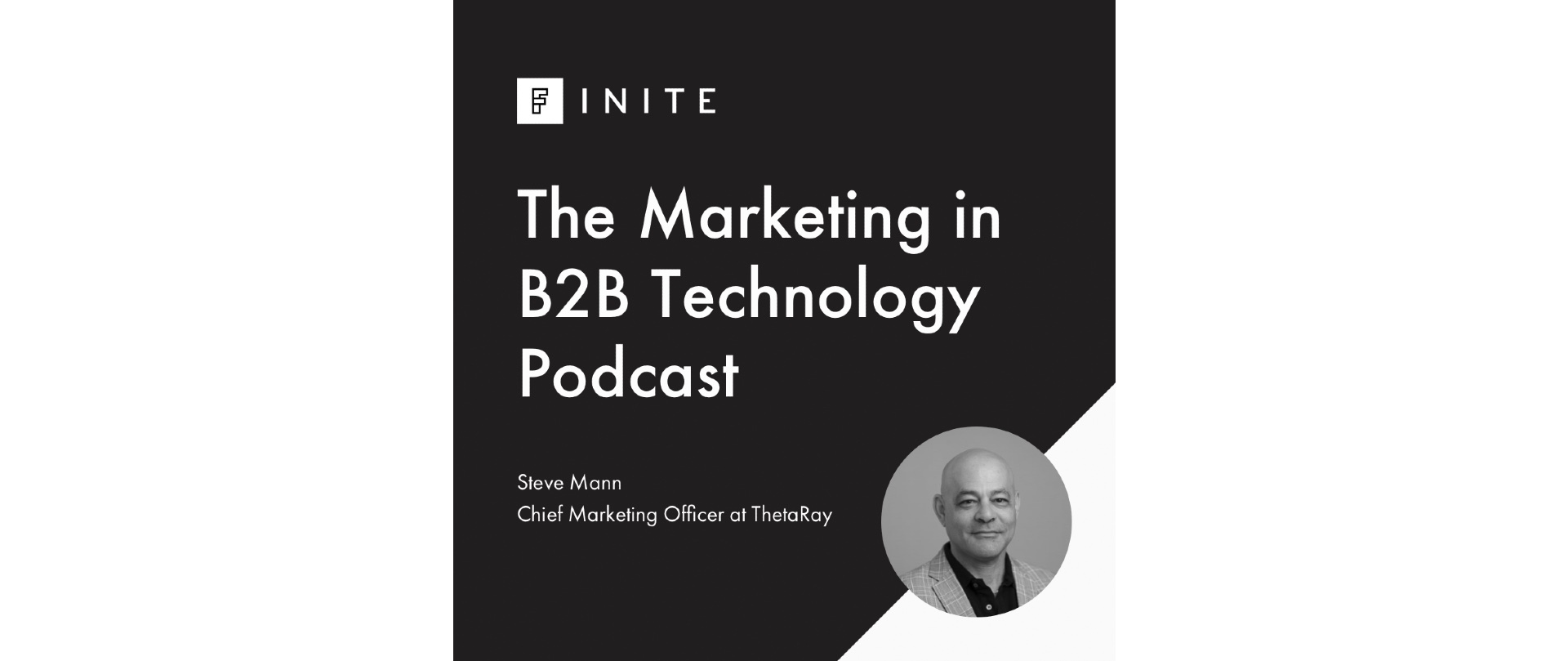
Since the start of the FINITE podcast in 2019, we’ve had inspiring B2B marketing practitioners across the technology industry discuss truly exciting topics and share their pearls of wisdom. From sales & marketing alignment and enablement, to ABM, personalisation, and the value of marketing theory.
For this episode of FINITE, we sat down with Steve Mann, CMO at ThetaRay and dived into the psychology of marketing. Given todays focus on technology and digital, the more emotional and psychological side of marketing can be overlooked, but certainly should not be. In this episode Alex and Steve discuss gamification for B2B marketing, building a marketing team, and marketing to the emotional part of us in the B2B space.
The psychology of marketing is the act of crafting marketing messages and strategies that talk both to the rational, logical, conscious part of our brains as well as the emotional, non-conscious, intuitive components of our brain.
Steve Mann, CMO, ThetaRay
Listen to the podcast below:
And once you’re done listening, find more of our B2B marketing podcasts here!
Full Transcript:
About Steve Mann and ThetaRay
Alex (01:40):
Hi Steve. Thanks for joining me. I’m looking forward to talking with you. Lots of interesting stuff around the psychology of marketing, I’m sure. But to begin with, why don’t you tell me a little bit about yourself, what you’ve been up to, your marketing career.
Steve (01:52):
Certainly, and I’ll tell you a little bit about myself personally because I think the two are intrinsically intertwined. So I’m the Chief Marketing Officer for ThetaRay. ThetaRay is an Israeli based AI, big data, analytics platform. Currently we focus on financial crime detection and the AI that we use is completely different. It’s called artificial intuition. And since I’m so interested in the psychology of marketing, we’ll talk about that as well. I’ve been the CMO of two other FinTech’s prior to this in the capital markets and AML space. And prior to that, I was CMO at LexisNexis which is a lot of fun really, marketing to attorneys which can be strange at times, but giving them the tools that they need to actually attorney. I was a senior marketing executive at SAP. I’ve been a software engineer, a VC, a product marketing manager, and I’m the father of triplets, 12 and a half year old girls. And so they’re in that puberty stage where you just kinda wanna lock them in their room for five years. But yeah, so it’s a busy, it’s a busy day for me.
Alex (03:10):
Cool. So tell us a bit about what your day to day looks like in the marketing world. Once you’ve taken care of the triplets. Marketing function, how big is it? Who’s involved?
Steve (03:19):
Okay. Well we have a small team right now. I’ve been with ThetaRay for six months, so this is a build year for me. My focus is on recruiting and retaining, you know, senior director, VP level individuals that have deep expertise in growth marketing and integrated marketing relative to media and communications. Traditionally the financial institutions that we market to are, it’s a confined market, right? It’s a bounded market and because it’s a bounded market, it gives us the opportunity to market high and market low. And by market low, I mean, you know, pretty much account based marketing, it’s a small enough market where actually account based marketing is essential. You can’t really talk to, there are just so many financial crime professionals in the world. There are so many financial institutions in the world. Sure. So ‘one day in the life’ thing is really building out with the sales force, those ABM strategies where we can truly move somebody from being a blocker to an influencer or giving a business decision maker, the tools to convince an economic decision maker no matter what the path needs to be. The majority of my day, although you know, everybody loves the strategy thing. You know, if you look at the actual definition of strategy, it also means logistics and tactics and really getting your hands dirty. So, and that’s something as a CMO I really enjoy. So I do a lot of writing every day, talk to my sales team every day, go out to visit customers, all the time because I can’t, we can’t, write we can’t position a message without really understanding what resonates with our customers. And I find that many, many marketeers, believe it or not, neglect that very critical element of talking to customers.
Alex (05:12):
Yeah. And I guess a big part of that is coming back from sales feeding back into marketing what they’re hearing, I imagine with them all, this is what sounds like a very enterprise account base kind of sales process. There’s a lot of conversation, a lot of feedback loops that keep coming back. So that sales and marketing alignment piece is pretty key.
Steve (05:28):
Yeah, we sell a very sophisticated product that’s really enterprise grade and we use something called the ‘Rule of 25’. We believe that at a minimum you have to be engaged with 25 different individuals in the buying centers that we focus on in order to actually accelerate or effectuate a deal.
Alex (05:49):
That’s high even for enterprise generally, I think. Right?
Steve (05:52):
I would agree. The one thing that I would say is in today’s enterprise sales, you are typically looking at at least three buying centers. And so that kind of equates to that 25 if you think about a buying center being a discreet department or a discrete set of influencers or users, and so you need to be able to sell whether or not it’s an, if they have multiple budgets, you have to pull those budgets together. They typically have multiple business needs that are at many times divergent. And so that’s why an enterprise sale, you know, if you’re lucky, takes nine months.
Alex (06:23):
Is that your average?
Steve (06:24):
I think ours is actually a little bit faster simply because we, I’d like to think are very good at what we do. But if you look at the average enterprise sales cycles, they will move anywhere from nine to 18 months. I’ve seen two year sales cycles that are not only painful for the provider, but also very painful for the prospect.
Defining the psychology of marketing
Alex (06:43):
I can imagine. Yeah. So let’s talk a bit about the psychology of marketing. I guess, should we start with a definition? What does it mean to you when you, when you talk about psychology and marketing? Yeah. What are you thinking?
Steve (06:53):
So the psychology of marketing is the act of crafting marketing messages and strategies that talk both to the rational, logical, conscious part of our brains as well as the emotional, non-conscious, intuitive components of our brain. Many, I believe that many marketeers think of marketing in a unidimensional way that they consider marketing to the rational components of the brain to be what they’re here to do. Whether it’s giving them the pricing of a particular product or talking about the speeds and feeds of a particular widget. It’s very product focused, as opposed to being individual focus. You know, even in B2B, you know, typically the same actions are the same techniques that you would use in a B2C setting are applicable in B2B. It’s just that you’re spending somebody else’s money.
Right. Okay. So from a practical example, what psychology of marketing is or what it does? One of my favorite people is a gentleman by the name of Antonio Rangel. Antonio is a behavioral economist and it’s really fascinating. He went to the UK, which where you’re from, maybe you are part of his study? All right. It depends on how much you drink. Do you care to go down that rabbit hole, right now? So on a supermarket shelf he took five French wines and five German wines and you match them on price and dryness and alternating days. He played other French music or German music. On the days that French music was played, 72% of the wine purchased was French. On the days that German music was played, 77% of the wine purchase was German. Now typically you wouldn’t think that the music playing around you would have any impact on your purchase decisions. But obviously it did. There was a nonconscious emotional element to the purchase decision that was brought on by the music.
Another example, I love banana Republic. They’re my favourite clothes. I feel like, you know, they get me. So when I walk into banana Republic and say I want to buy a pair of jeans, I’ll go into the fitting room and try them on because I don’t want to try them on in the middle of the store. And so I go into the fitting room and I try them on and I look at myself in the mirror and then I, you know, look the price and the price seems reasonable for what I want to buy. It’s the color that I want. But then I look at myself in the mirror, I say, ‘Damn Steve, you look good in this!’. There is that combination of rational, the price and the color versus the emotional. How I feel about myself when I actually try them on. So what I’m saying in a, in a specifically, in a B2B context, most marketers, they market to the price and colour. They don’t market to the damn. You look good.
B2C marketing strategies for B2B marketing
Alex (09:56):
Yeah. So in terms of application in a B2B space, because I think in B2B general as you pointed out, but even more in tech, software, and SAS, we get so wrapped up in ‘the product does this’ and ‘this is a feature’ and as we say product marketing. How do we then apply that in a way that I guess people are behind. But I think for a lot of tech companies when CMOs are reporting back into founders and CEOs and the rest of the C suite, we’re in a world that’s so driven by performance and data and numbers that sometimes being bolder about brand and telling stories and those kind of things and further down the list of priorities, almost, for a marketing function. And my belief is that the marketer with a spreadsheet is always going to beat the marketer with a big, bold idea. Are there any practical tips for kind of starting to apply some of this in a way that is tangible for your typical for B2B tech company?
Steve (10:46):
Well, let’s take all that in in two ways. I’m a bold idea type of guy. I always have. I’m very much at home on the creative aspect, creative side. Not that I’m a designer or anything, but let me think of big ideas and then let me work with my team to execute them. That being said, you’re right. Most CEOs, most executive teams, most boards, they’re looking at the numbers and so to be a CMO worth anything, you need to develop competencies in both. I may like one more than the other, but to be a valuable CMO, you absolutely need to do both.
Now, coming back, more directly to your question about, okay, so how do you actually use this stuff in a B2B setting? Well, first of all, we’ll talk about content and then we’ll talk about gamification, but before that we kind of have to lay the groundwork, right? You think about what happens internally in our brains, we have a neurochemical called dopamine. Dopamine makes us strive, we want, we desire. Whereas endorphins give us pleasure, you know. At the end of the day, we’re designed to be happy. If you think about our world, we’ve been building a world that is remarkably oriented to giving us pleasure. So, if I am able to create content that evokes emotion, right, or I develop content that is targeted at say somebody who does cognitive shifting, which is the act of being able to flexibly move from one idea to another. That content is going to be more compelling and it’s going to be absorbed at a much better rate and much more quickly. If I can: Are you logically and are you emotionally to that individual.
Gamification
Gamification directly utilizes that notion of striving behavior and that notion of pleasure. Let’s say I’m in an online community. In an online community, I’ve developed a series of missions and based on these missions I get points. Works in a game, it works in a B2B community. Every time I complete a mission such as writing a blog post, I get 20 points. The reason why this works though is because then I’m going to be given another mission, but it’s surprising to me. I don’t know what the next mission is, so I’m striving to get to that next mission. Number one, because I want to be the best. I want to build my reputation and it’s a surprise to me and it’s one of the surprises that drives me. That’s the dopamine side and the endorphin side. I get pleasure from completing these missions. My wife is a SEDUKU addict, right? You name it, you know, four by four, six by six, nine by nine. So you know, it doesn’t matter the type, but when she completes something, it’s this act of being surprised going on to the next one that she’s not quite sure what it’s going to be, that drives her from a striving perspective. From a pleasure perspective, she gets a real kick out of it. She’s an addict. And seriously, in the best sense of the word, you know, we’ve been talking a lot about dopamine and how it impacts behaviour. A lack of dopamine causes Parkinson’s disease. The treatment is L-DOPA, which is a precursor to creating dopamine in the brain. Individuals that are treated for Parkinson’s and they get L-DOPA. One of the unfortunate side effects is compulsive gambling. That is a striving behavior. That’s addiction. This is also addiction. We want to get our customers addicted to us, whether it’s on the brand side, the product side, or the loyalty side.
We want to get our customers addicted to us, whether it’s on the brand side, the product side, or the loyalty side.
Steve Mann, CMO, ThetaRay
Alex (14:22):
So to some extent, its almost like it resonates more with the product, once someone’s using the product itself, I can kind of visualize how you can gamify elements of a product. But if we work our way back up the kind of journey into just the pure kind of marketing and sales process, what ideas do you have for actually gamifying elements of that?
Utilising emotions for B2B marketing
Steve (14:40):
Okay, so in this instance it doesn’t always have to be gamification. Gamification is a, is a very solid example of it. But let’s think about our targets at ThataRay. At ThataRay we created something called artificial intuition, which is right up my alley because it’s direct impact on the brain and replicating human decision making. In fact, what we do is we replicate human decision making, but on the intuitive level. If you think about your intuition, let’s say Alex, you’re standing on a Hill and you see me walking towards you and you’re trying to decide, ‘Gee, is that Steve or not?’ You’re not going to measure the RGB colors of my eyes. You’re not going to measure the distance and centimeters between my nose and my ears. You’re going to look at the way I move. You’re going to be looking at the shape of my hair or lack thereof. You’re going to be looking at my overall gestalt. You’re not looking at data points. You’re looking at relationships. Sure. Our technology works the same way. It replicates artificial intuition.
My marketing is meant to do that as well by utilizing the emotions that drive my customers. Like fear, because they, these guys are compliance professionals. They’re financial crime professionals. If they don’t catch something, then it puts their banks at legal, regulatory or financial peril. There was a CEO of an Estonian branch of Danske bank who a few weeks ago was found deceased. And whether or it was suicide or a Russian oligarch,we don’t know, but it’s, there’s some really high stakes to not catching financial crime, to not catching money laundering, very much driven by fear.
So my job as a marketer and to market ThetaRay is to tell them how to, we can ameliorate that fear, how we can find the bad actor, how we can help them stop narco trafficking, or terrorist financing. These are all behaviors that not only just drive fear, but they drive anger and resentment and anxiety to the degree that I can help a buyer ameliorate those feelings. Feel safe, be safe, help secure the world, I’m more likely, to drive a purchase of ThetaWay. Because of that, this notion of secure in the world, it’s not logical, right? It doesn’t have a real logical element. It’s completely emotional.
Alex (17:03):
Interesting. How much of this is we talked just before we started about people that Simon Sinek and his approach to The Power of ‘Why’ and starting with ‘why’ and not ‘what’ or ‘how’. How much of that overlaps with this? Is this building the brand for ThetaRay is also a big part of the decision making process about who you are. It’s about your mission statement is about your beliefs. It’s about who you are as a business is as people. All things I think are often overlooked in B2B generally, as again, we’re too focused on the product. Is that part of the equation for you?
Steve (17:31):
Yes. In a word. It’s funny. I get calls for executive recruiters all the time and they say to me things like, ‘Hey Steve, are you a brand marketer or a product marketer or demand guy?’ My answer is, yes. You can’t do one without the other. You can’t drive demand without having a great positioning and messaging foundation. You can’t build a brand without getting out there with your demand efforts or your positioning. You can’t have great positioning if you can’t communicate it via your brand efforts. So if somebody says to me that ‘Steve, that’s only B2C’, I’m like, are you kidding me? This is completely it. It’s part and parcel of B2B marketing.
Alex (18:21):
Business to human, there’s just more humans involved in the decision making, right? And it, it’s a unifying process.
Building marketing teams
Steve (18:26):
It’s an interwoven process. If you try to tease one out from the other, it doesn’t work. That’s why my teams are always integrated. You know, I’ll take an agile marketing approach or I’ll put a product marketer with a demand guy. I’ll put a brander with a positioning and messaging guy and I’ll give them projects and tasks that say the brand guy will say: ‘Well, I don’t know anything about demand.’ Well number one, you’re going to learn. Number two, you’re going to take your experience and branding and meld that with the demand generation efforts to deliver a superior product.
Alex (19:01):
So as you start to build out your marketing team and this, this kind of building year, how do you think that will look for you in terms of generalist versus specialist? And I know you mentioned before we started, content was always going to be big investment. I think broadly in B2B is always going to be important. I’m always interested in the kind of Google’s T shape model of someone that’s got some deep specialisms but then some broad. Which kind of played into what you’ve just described of pairing different teams together. I guess, I almost want to cry sometimes when I see some job descriptions that just have everything under the sun listed on them from like Salesforce experts to web developer to designer. I think it’s hard. Theres more and more expected of a marketer these days, than ever. So looking ahead, how do you see the marketing team starting to grow with that in mind?
Steve (19:41):
Right, so layer one, my first hires are marketing generalists. Since at that point you don’t have a lot of resources. You need people who are facile in a lot of different areas. Level two, which I’m beginning to recruit for now are those folks with specific competencies. I need killer content marketers. It goes a level deeper in the sense that not only content marketer, but a content marketer that knows the financial crime space. So that’s a very specialized person, right? I need a digital marker because again, I’m a young company and part of my brand efforts is to establish a strong content slash digital footprint. Right? And then the third level is regionalization. Okay, I’ve got great generalists, I’ve got great content, I’ve got great digital aspects. Now I need specifics around supporting EMEA, APAC, North America, right? And underlying this are the typical broader marketing activities such as events, which I’m not always a big fan of, but there’s a a requirement to be seen.
Ethics behind the psychology of marketing
Alex (20:45):
Makes sense. Yeah. I guess coming back, the psychology aspect and you know, you talked in your first example about almost getting inside people’s minds with the music playing in the supermarket. In this day and age where, you know, we see Mark Zuckerberg being dragged in front of committees and people asking questions around data and ethics. And my belief is that a lot of these basic principles of marketing existed long before digital existed and they’re almost natural, to the point that it’s just a natural human thing to do. But are there ethical questions about getting, you know, really sitting down and thinking, okay, how are we going to get into a part of people’s minds that they don’t even know that we’re exploring?
Steve (21:22):
So it’s an interesting question. And the reason that it’s interesting is because I would posit that marketing, for lack of a better term, marketing is marketing. Whether you’re marketing to the cognitive and rational component in somebody or you’re marketing to the more emotional or non-conscious, you’re marketing to the whole person. And if you think about it, any marketing is meant to influence, right? Whether it’s just that marketing to the left side of the brain or marketing to the right side of the brain. It’s all meant to influence. It’s all meant to direct. So for somebody to argue that, wow, this non-conscious marketing is unethical, well if that’s the case then all marketing is unethical. So I fundamentally disagree with that notion.
Framework to influence the rational and the emotional in B2B marketing
Alex (22:07):
Yeah, that makes sense. Are there any other kind of frameworks or principles or things that you think are worth exploring or can be applied? I guess we’ve talked about fear being one, and theres things like scarcity, uncertainty. I think like social proof is one that I know for us on the agency side working with lots of tech companies are often like defining a new category or new to the marketplace. There’s a lot of credibility and question marks, particularly when we’re dealing with security. For you guys, are there things that you think you can formally apply very much or that people can go and read about that you think are particularly relevant for this?
Steve (22:40):
Before I answer that question, let’s define ‘framework’ because it’s an often used term.
Alex (22:45):
It is, and maybe it’s too often used. I guess things which give people a benchmark against which to measure, is this falling into the right category? Are we ticking the boxes of, I guess almost like a research driven or something that’s backed up by some degree of science and research?
Steve (23:01):
Well, there’s a lot of academic data, a lot of academic research on the ability, the effectiveness of marketing of influence based on using a mix of strategies that either tact that either approach and influence, rational, emotional or both. I would recommend reading Gerald’s Zaltman’s book ‘How Customers Think’. Because his book really delves into both the emotional as well as the logical elements and it has a more. It has a practical side as well, which is, ‘Okay, so how do I market to both of those elements?’ So I use Gerald’s book as almost a Bible. When I first started here with regards to frameworks, I would use the same frameworks that I would use in a ‘standard marketing’ approach, right. You would be doing AB testing. Right? You’re going to be quantifying your demand funnel, you’re going to be looking at the ratios, and pipeline linkage in that funnel and you’re going to use those, whether or not you’re using the type of strategies I prefer to employ, versus the ones that I think are more like a marketing cul-de-sac. It has a common set of analytics.
Alex (24:14):
Okay. Do you think looking ahead, we’ll see the rise of I guess like almost dedicated neuro-marketing budgets or neuromarketing technology. Like you know, there’s I guess still coming from an academic world, but you know, you can scan people’s brains now, right? And see how they respond to a website. There’s all kinds of things which are probably not accessible for most companies or it’s just so far down the list of priorities, that they’re not explored. But is that something you think you might explore or that we’ll see more of in marketing generally over the next five, 10 years? Cause I imagine that that kind of technology is going to become more accessible and lower cost. And I’m sure soon we can just buy, you know, of Amazon and plug it into our brains and see what people are thinking.
The future of marketing
Strong marketers will think not only in terms of their positioning and messaging, they’ll think in terms of emotional influence.
Steve Mann, CMO, ThetaRay
Steve (24:49):
Well you’re talking about augmented intelligence, which I think is quite a ways off. But to answer your question, I don’t think that there’ll be dedicated budgets for say neuro marketing or neuro digital marketing. What I do think will happen, is in the same way that digital marketing is now just marketing, neuro digital marketing or neuro marketing will just become marketing. Strong marketers will think not only in terms of their positioning and messaging, they’ll think in terms of emotional influence. They’ll think in terms of how do I ameliorate anxiety or fear or how do I generate lust or passion? Because if you think about passion, for instance, as a emotion that you’d want to address, the lighter side of passion is desire. I really want to do good. How can I do good? I want to complete this project. I want to be recognized for it. That’s passion. So it’s easy or easier to address passion when you think of it in this notion of: ‘How can I build or support the desire? How can I sponsor my customer to be successful? And, you could do that through branding, hopefully.
Alex (26:04):
I guess some of this is like if you think about the start of any marketing strategy you’re defining user personas and thinking about what drives people. What are their challenges and their pain points? And I guess to some extent it’s everybody starting with it, or at least considering it, but probably falls by the wayside quite easily. And it’s not something that people keep as a key vein through their marketing as much as it needs to.
Steve (26:25):
That’s a very good point. So when you’re doing persona definition, right, you are indeed identifying, you know, drivers, whether or not they are business, personal, logical or emotional. I absolutely agree with you 100%. I also agree with you that thinking through the influence path to particular persona, it’s not always, or many times it’s not complete. It doesn’t have that vein of personally addressing the personal issues that an individual has. At least what I’ve seen. People build out these persona definitions but then don’t necessarily use them or don’t to your point, don’t necessarily use them to their fullest extent and I think that’s where people fall short.
Alex (27:08):
I think. Yeah. Kind of almost measuring the success of a piece of content against one of these pain points and making people feel more comfortable. Or one of these fears or concerns they have is probably the way to approach it. But I was going to ask, about, if we think about the size of the decision making and then you talked about like 25 people potentially or they may be split into three different kind of buying centers. That’s potentially a lot of different people with lots of different drivers. Right? Some personal, some work-focused. Some people might want the next promotion, some people might want it something on their CV so they can move on to the next job. Prioritization must be hard right? To then think about or is the answer just kind of sorry it’s a lot of work, but you’ve got to go after all of them. Or obviously in that buying unit there’s going to be some people that have more weight than others in the decision making. I think prioritization generally for marketers is just a massive challenge these days with so much to do. How do you approach that? Is there any, any tips or advice?
Account based marketing
Speaker 3 (28:00):
Well this is a partnership between sales and marketing. That’s how you answer that question. And it’s related to account based marketing, right? Because in any account based marketing effort you’re going to be looking at, well who do I actually need to target in this, you know, one-to-one marketing campaign? Which blockers do I have to convert? Which economic decision makers do I have to push over the finish line? Which business decision maker or user seem to have power in a room or in any sort of evaluation dynamic? And so, you can’t do that unless you have a deep partnership between sales and marketing, number one. To build that complete account review account strategy. Number two, really sit down and identify which individuals are gonna move the needle and then develop the content, the strategies, the tactics that are actually going to help you move the needle. I do that all the time here at ThetaRay because as I mentioned earlier, that’s our market.
Sales and marketing partnership
Alex (28:59):
Sure. So you spend a lot of time talking with sales. Is it easy? Are they based in the same office?
Steve (29:04):
No, it’s never easy talking to sales. If you think about it, there’s a lot of education that needs to happen. Both on the sales and the marketing side. You know, I’ve been around for too long so I have an understanding of that. I’ve carried a bag, I’ve been a presales guy and I’ve been a marketeer. But if I have somebody coming purely from the marketing side of the house, they’ve been trained, this is what they know. The one thing that’s typically missing in that training is the partnership with sales. And vice versa with sales. If I’m carrying a bag and I have a quarterly perspective on my world, it’s difficult for me to take a step back and say, okay, looking at this particular deal, what does the partnership between sales and marketing look like? That’ll help me accelerate my deal. That will improve my close rates. I mean because most organizations are so used to, you know, broad brush, big marketing strategies that address, you know, thousands potentially of a segment. Right. Although I would like to keep my segment to you know, the 5,000-7,000 line. But if you’re throwing out to 25,000 yeah that’s a problem. But that’s the way sales guys think. The more the better. It’s not about quality, it’s more about quantity. The less the better, the less the better.
Alex (30:21):
Yeah. But that can be hard to get a sales team on board with that. Right. And as you say, it’s an educational piece. Do you have like service level agreements between marketing sales or you’re literally writing down and saying like these are expectations and number of leads.
Steve (30:32):
The SLA’s have to be jointly created, right? Number one. Number two, you have to do the same thing for a lead scoring model, you have to be revisiting both the SLA as well as the lead scoring model every 90 days. And as a CMO, it’s incumbent upon me to actually educate not just the sales force but the entire company as to what they can be doing in terms of marketing. So for example, I typically create a curriculum, marketing 101 or Steve’s version of marketing 101 is branding, right? And the goal of that branding, of that education is to teach the organization how a brand has true economic value and that brand is the act of creating an emotional connection, right? Like I want my customers to put a tattoo on their arms that says ThetaRay right? It’s that level of commitment, that level of loyalty. Then 102 is demand generation and what does that look like and how does that interact and intersect with branding? And then 103 is going to be on positioning and messaging the product marketing components.
Alex (31:33):
Awesome. Steven its been a pleasure talking. I feel like we could keep talking for many hours, but I’m gonna wrap up there. Thank you so much for your time and for joining me.
Steve (31:39):
My pleasure.
Thanks for listening. We are super busy at finite building, the best community possible for marketers working in the B2B technology sector to connect, share, and learn. Along with our podcast, we host a series of events here in London. So make sure you had to finite.community to subscribe and keep up to date with upcoming events.