- Some additional information in one line
- Feb 3 2025
Podcast: Is this the next evolution in B2B marketing? With Ari Capogeannis, Director of Revenue Marketing at NVIDIA
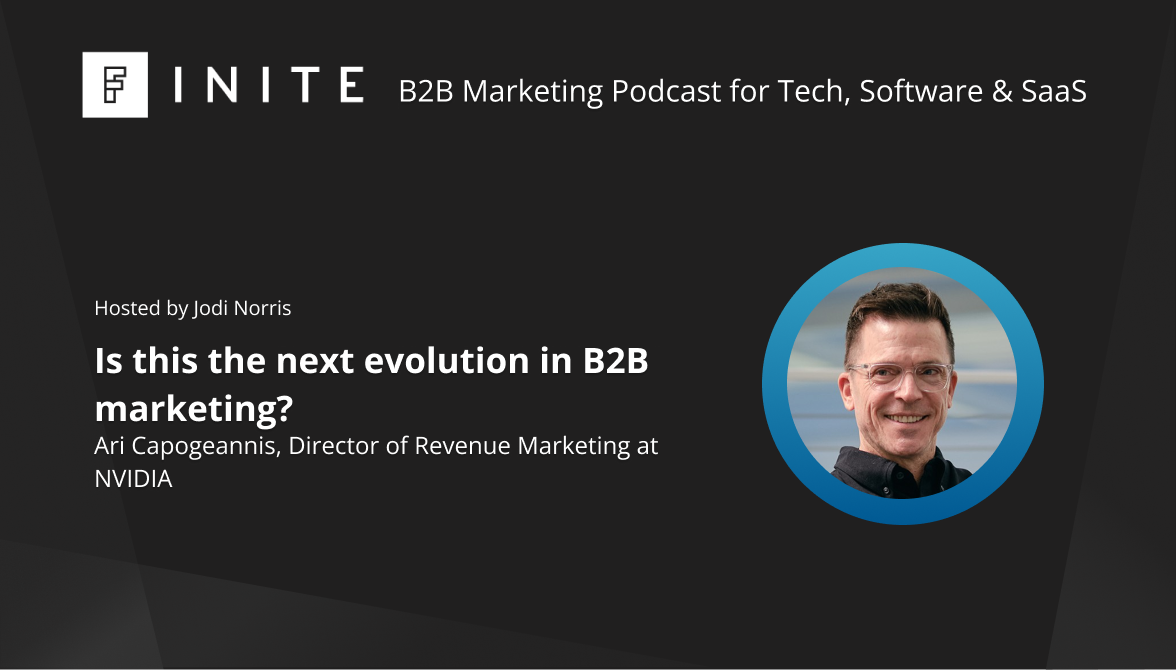
Get insight into the next evolution of marketing with Ari Capogeannis, Director of Revenue Marketing at NVIDIA.
Ari shares his sophisticated, yet simple, approach to marketing that revolutionises what marketing can offer to an organisation. You’ll learn how AI and data analytics are transforming marketing from a traditional practice into the data heart of businesses.
Gain cutting-edge insights on aligning sales and marketing and making impactful forecasts using data.
Whether you’ve got a team of 2 or 50, a budget of £10 or £1m, this episode promises to enlighten and inspire, offering practical takeaways for teams of all structures.
Listen below, on Apple Podcasts or Spotify
And once you’re done listening, find more of our B2B marketing podcasts here!
Find the full transcript here:
Hi, Ari. Welcome back to the Finite Podcast. Thank you. It’s good to see you. Yeah, it is good to see you too. It’s been a long while. I can’t believe it’s been four years since you were last on.
And yeah, it just reminds me, one, I feel like I’m getting really old, and two, where has the time gone?
So last time you spoke about revenue marketing, and you gave us a lot of insight into how you approached marketing from quite a sales led perspective.
And we’re not going to talk about that today because there’s been so much that’s happened since. And I’m sure you have a whole kind of new philosophy towards marketing, which I can’t wait to hear.
But first, I would love to hear about you, who you are, where you come from, your background in marketing and all of that.
I’m Ari Kapoyanis. I head up revenue marketing at NVIDIA. My background is primarily in data driven marketing. And whatever buzz term happened to be labeled on that in the past, whether it was demand gen, growth marketing, revenue marketing, and the like.
No matter what we’ve done with whatever technology at our disposal or lack of, I’ve always had a fascination with data.
And that’s my background. I live in San Jose, California. Born and raised and focused on revenue growth in a global economy. It has been a long four years since you joined us last, and you still had the same kind of revenue data mentality.
So I’m interested to see how that has evolved. I want to know what has changed since then, what has changed for you, either circumstantially in your marketing team and your marketing structure, anything like that, but also in your mindset.
Mindset wise, I think the biggest change four years encompasses that milestone where we had that iPhone moment of AI.
the big boom with open AI and AI at the disposal of individuals that typically wouldn’t have a budget for the super compute and developer army that you traditionally require to dip a toe in the water there.
So from a mindset perspective, my foundation is still the same. If you go back to no technology and one-to-one enterprise marketing, and how are we going to do ABM towards these two accounts?
Versus now with AI in the mix, being able to start thinking about, hey, instead of looking backwards at all the cool data we have, how are we predicting and getting prescriptive?
And what are the solutions that we have at our disposal now to do that? Yeah, awesome. So you’re kind of embedding AI in your analytics and modeling and things like that?
Yeah, there are aspects in marketing. There’s GenAI, which is phenomenal from a personal use case, like content writing and the like, where I really see the application of AI and its benefits for revenue marketing is big data.
And traditionally, I still love spreadsheets, just like people that at one point said, email’s dead, use a workspace collaboration platform.
We still have email. We still have Excel. I’ll probably die one day and Excel will still be something everybody’s using.
It’s great, slice and dice. But I can tell you at this point, looking at the amount of data and data creep that we have, as you get more and more granular, anybody doing that work knows what the row limit and the data limit is in a Google Sheet or a Microsoft Excel worksheet.
You can hit that really, really quickly. When we start looking at analyzing an account relationship, And the account relationship, backing up a little bit, is very important because as we serve from revenue marketing, all our varying stakeholders from marketing to sales, developer channel, on and on and on, every one of those individuals have their individual KPIs and that are specific to those individuals.
The one aligning point amongst all those groups is the account. They’re all looking at the account. And within the account, if you talk about buying groups, you’ve got a water cooler conversation happening amongst take your pick, however many people, 15 on up.
All those people are interacting in varying programs for our first-party data across all those different groups.
They’re also interacting on third-party sites, info sites, radio, TV, content that’s syndicated somewhere.
As you pull all that in to really get an idea of where this account is when it’s relationship with us, that’s a huge amount of data, billions of rows of data.
At that point, that’s where AI has made it even feasible to actually get more real time prescriptive on where we are with all these accounts that are in our mix.
That’s the biggest change, I would say, from where we were four years ago. Foundationally, I still have the same views. I don’t think anybody should forget the foundation when it comes to selling, go to market and marketing and B2B.
But the toolkit that we have when applied correctly is phenomenal at this point versus four years ago.
Interesting. Okay. Yeah, there are so many thoughts that I have there. So you’re using a water cooler conversation as a metaphor for first party data.
That’s interesting. Well, no, the water cooler conversation are the individuals in an account that are talking about whether they want to purchase from us or not.
You’ll have a group of people that represent your influencers internally in that account. You’ve got your one to a couple key decision makers, and then the executives for the sign-offs.
Whatever you’re defining as your personas in your buying group, you have in B2B, especially as you get into mid-market and enterprise, a large group of people that are either self-researching or researching via internal conversations on you as a company, their perception of you, the value they think you’re going to get from you, the need and whether they want to actually go with you as a solution.
In some organizations, that buying group, I mean, in most organizations, that buying group forms when there’s an identified need and problem and they’re having that water cooler conversation.
That’s one focus. Okay, we want to go after these accounts that are ready for that sales conversation. From a relationship timeline, if I look at all engagement for those people, before that stage occurs or the water cooler conversation is actually taking place, they’re doing something as much as say two, four years back.
Attending events, just learning about you. So when you take into effect that want to provide relevant experiences and conversations that resonate by individual within that account, the type of account, the industry, identifying that, maintaining all that, and then getting prescriptive on what to do next just for the one account is a massive amount of data.
I mean, hopefully, yeah, I feel like it’s, um, an achievement in itself to have that much data on not only one person, but an account as a whole and how those water cooler conversations interact and go.
The data is the easy part. The volume of data, people get offended, people managing, say, your CRMs and maps out there.
When we start talking about data dumpster diving, it’s true. As soon as you put a form on a website, you’re going to get a bunch of garbage.
It’s really easy to collect data And then from the third-party perspective, obviously there’s tons of vendors to pull engagement intent data, dark web, funnel metrics, and the like.
The question is, once you have all that data, okay, I got everything. Oh, man, what do I do with all this? What do I do? There’s no way. I don’t know what to pick out from this.
In the past, I’ve always preached avoiding what I call the spaghetti monster mess, especially when it comes to personalization.
because you start thinking I can personalize by account industry. I can personalize by company size. I can personalize by revenue range. I can personalize by the persona hitting the site when I’ve identified them.
And it gets on and on and on and on and on. And then if you take all the permutations of each of those, say covariates, if you want reach them, it’s a mess to manage until you end up with a solution They can manage that for you and just give you a few bullet points telling you how you’re doing and what to do next, which is where AI comes into play.
Okay, great. Yeah, you’re right. Data does come in from all corners, doesn’t it? All sides and corners. And it doesn’t tell you, I always say it doesn’t tell you what to do.
People are always like, read the data, look at the data, understand the data. But it’s like, well, to do that, you kind of need that tacit analytical knowledge.
in order to interpret that data. And I’m getting the sense that you have your own kind of framework for this from the analogies and the terminology and everything like that.
So I would love to unpack that a little bit more. Yeah, go ahead. No, I mean, please, I don’t know where to start, please. I would say the framework’s ever shifting.
The foundational things we probably touched on four years ago I probably touched on people-based marketing and a fire model where you’re looking at your total addressable market.
And which typically when you ask a leader, what’s our target list, if they haven’t done a lot of analysis, they’ll just give you their global 1000 list.
And then you go in there and you say, okay, how many of these people are truly a fit? And then you leverage your data to say, how many of these people actually show intent?
How many of these people have recency? And engagement and what is that engagement and you slice and dice it, and then you get from 1000 down to hopefully 20 to 50.
Um, and then, and then target from there traditionally in the past, there’s been some automation around it, but execution against that has been more manual.
Um, we’re still trying, I’m still trying to nail it where we get truly prescriptive, meaning. I can get all the great modeling, the great propensity modeling in place and I have the data output and it goes into our dashboards.
As soon as something’s in a dashboard, the dashboard is backwards looking. Your stakeholders who hopefully they have something consumable, they’ll say they’re data driven, but if you show them a dashboard that’s three pages of scrolling charts and whatnot, they’re not going to know what to take from it.
But even if they did, no matter what date filter I’m looking at and I’m looking backwards at that point in time.
I might get crafty and have some kind of forecast line, but we know with seasonality and the like, traditional forecasting has a huge variation in accuracy there.
So as these people huddle around this dashboard, a couple of weeks go by, rescheduling meetings, and they’re looking backwards and they’re looking backwards.
And the next thing you know, they’re halfway into their next period of execution. but saying I’m data-driven in our strategy. How is that? You’re already executing. You’re always looking backwards.
Prescriptive, true prescriptive with AI means getting to the point where in as real time as possible, I can have output saying what’s the most important thing I need to worry about today and execute on that.
The trick is properly defining the ecosystem for the model so it’s catching what really truly is important.
understanding that we’re hopefully not missing anything the way we’ve set this up, which is why we’ll always have to date a dumpster dive.
And then two um trust amongst our stakeholders. Stakeholders, the dashboards are almost like warm blankets, security blankets.
I don’t, you know, the usage metrics might be really low on the dashboard, but they feel good because there’s a dashboard.
If anybody wants metrics, I’ll just give them the link to the dashboard. Whereas when you give them two bullet points, this is the most important thing to worry about today.
Trust me. And based on our modeling, it’s got a projected effect of this over the next four years. That’s a huge hurdle to go from traditional reporting to trust in that model.
I’d love to know how it seems easy. Like you just chuck a bunch of data in an AMI model and it spits out some pattern recognition and some predictive analytics for you to tell your stakeholders.
But you’re right, it’s that feeding, the feeding of the AI model. Do you have a big part in that? people, the data scientists on my team that are producing all the wonderful work there would probably get really angry if I called it easy.
it was easy, I’d be the one doing it. It’s easier now with the search, this new industrial revolution that we’re in with AI.
But again, you’ve got people on one end that are very, very savvy at, say, managing AI models. You’ve got people on another end that are very, very savvy at B2B execution.
So marrying those two, getting interest from the people that are savvy on B2B execution to work with the data scientists and the data scientists to think beyond producing a product and figuring out how do I get adoption on this and how do I ensure it really, truly is accurate for the organization?
Because the pitfall there is, If we disappear and build what we think is the most amazing thing for the organization, and I don’t bring in sales, marketing, everybody else from the ground floor, even though that’ll make the process move that much slower, there’s no vested interest in those people.
And then when we deliver the model, the first thing they’re going to point out is what’s wrong. And as soon as they identify something wrong, they’re not going to use it, not going to trust it.
And we’ll continue with our old school tactics. Okay. So there’s a lot of diplomacy going on, I guess, for you. Okay. And great credit to your data engineers.
I’m sure they’re doing very well. Would you say that this kind of predictive modeling replaces data platforms? I wouldn’t say nothing replaces an intent data platform per se.
You’re bolstering that intent data. Traditionally in the past, before this AI moment, you had to choose a vendor and you were locked to that vendor.
And each vendor had a race going to be the one platform you’re gonna use. And the whole idea is if they could diversify their offering, they’re gonna displace competitors and sibling type product competitors in the market and just become the behemoth.
And you’re vendor locked to that platform. For most orgs now in this moment, especially if you’re doing your own first party data modeling, you really just want the data at that point.
The hurdle with the platforms has always been, how do I get sales and marketing and other people to actually work in those platforms?
Sales is spending every day working out of Salesforce. And now I’m going to tell them, hey, we got this really cool stuff for you.
You just have to log into this other platform in addition to you logging into Salesforce, which we have a hard time anyways getting you to do and exercise proper data hygiene.
It’s been a losing conversation for the majority orgs aligning around that technology for years, which is why the budgets are still split between marketing and sales when it really should just be one budget.
Now, The win really is, and it’s always sort of been this way. How do I make somebody better at what they do without them having to learn something new or change how they execute or be a marketer, trying to go to sales and dictate how sales should sell, which they’ll never listen to.
So all I want is the data at this point. And I think a lot of those platform providers are getting it. They’ve got secondary offerings now where we have data.
data delivery for you. You just want the data and pull it in. The pricing’s kind of all over the place, but in a perfect world, if I had an infinite amount of money, I would want everybody’s data.
I’m no longer vendor locked to one provider’s intent data because it’s a Venn diagram when it comes to indicators and data points available amongst all the vendors.
I want it all. And the more I have, it’s like a diversified stock portfolio. The more accurate I get, in being able to plug in one data point into Salesforce or wherever your sellers are working to say this account is this ranking, call it propensity to buy.
Okay, interesting. So the intent data, you still use intent data to show propensity to buy and you feed that into your sales CRMs.
Yeah, I would say with AI, it’s propensity to anything at this point. When we talk about that account relationship timeline from, say, four years before they even knew about you to the buying center being identified as forming and targeting that to lifetime value, monitoring churn, upsell.
the model should really be propensity to anything. Personally, I think at one point I shot myself in the foot referring to propensity to buy because when you talk about getting cross-org adoption in this really rich data, people will turn a blind eye that aren’t the direct sellers, the people that are doing the marketing or the early engagement.
Well, it’s propensity to buy, and we’re focused on awareness and engagement. No, no, no. The model identifies that as well for proper targeting.
So it’s feeding useful data to all of those groups. Yeah, I was going to actually ask for some examples of things that you use predictive modeling for.
would you say those are the main ones? Yeah, I would say that it’s anything you’re doing, you can do better with data. And then the application of that data at scale is where any of that modeling really comes into play.
There’s nothing perfect, though. You know, when it comes to your database, it’s always going to boil down to hygiene.
So the model, let’s say the model was perfect. It never will be. But if it’s based on your historical data in your database of leads, contacts, accounts, there’s a lot of garbage in there traditionally.
I think my favorite are students. Students can be precursors to somebody that potentially buys from you at some point in time.
So you work on them involving them in a community and yada, yada, yada. Stuff that traditionally in the past, marketing had no involvement in.
But with a model ingesting all this data, the involvement is cross-org at that point in time. The problem is if you have a student that went to some university that was, say, a net new name 10 years ago, they’re either a really, really terrible student or probably garbage in your database at that point.
And that is something where in addition to the model, it’s almost like you have to create a secondary model for data hygiene and cleanup.
Yeah, definitely. I can imagine. It sounds like there’s a lot of maintenance involved, both on the hygiene side, on the feeding side, on the analysis even on the stakeholder management side, which I guess you you deal with a lot.
I know that a lot of our listeners, they don’t have a big team. They, they’re just them and as many platforms as they can get budget for.
I was wondering if you were, if I was a SaaS marketer at a say a hundred person company, um, we were doing 10 million rev, I don’t know, more.
Um, what, how, what would be the advice that you would give to me to even kind of get on the road to this kind of, this way of thinking?
That’s my background. So when we spoke four years ago, that was shortly after we were, I was at Cumulus Networks and we were acquired at that point in time, a hundred something person company, you know, similar web range, more, but you know, in, in that So these concepts are nothing new.
The, the AI application, um, allows for more data, but at the same time, more data does allow for more noise and more complexity to figure out when it comes to the a hundred person hyper growth startup, um, with a limited strap budget.
It’s the same thing. How do I get into my database? How do I analyze my apply a fire model to my accounts that are the mix fit intent, recency engagement.
None of that is, is costly budget magic. Um, How do I pull in sales and marketing at the foundational level so they have a vested interest in actually looking at things by account?
How do I switch up my reporting to actually report awareness metrics like visits just by account and then talk to MQAs and accounts only versus the leads or random person records in the mix?
The foundation doesn’t change. And it’s all doable, which is probably why I still work out of Excel, because that’s exactly where my mindset still is.
Strap budget and small org agile pivoting constantly. Interesting. So, yeah, very kind of top line strategic focus on buying centers.
What I do find in that situation, that example, if you lock yourself into the platform and take the platform as gospel, the vendor platform, you’re missing something.
You’re missing some data, some issue with your system, some alignment across the organization. The big thing is, in addition to championing the MarTech that you purchase, which is a big miss for most, I think a lot of tech is purchased and then the flip is the switch is thrown.
It’s on. I’m assuming it’s doing something. Hopefully it is. That’s not championing the product. And that’s not pushing on adoption of the product. In addition to that, it’s a matter of being in the guts of the machine and constantly dumpster diving that data.
Most of the time, you don’t even know what you’re looking for. Those aha moments that have occurred for me are every one to two years.
The really big pivotal business driver aha moments. And they come about from just diving in and slicing and dicing versus being stuck in a vendor’s canned report dashboard.
Interesting. Okay. So it’s getting into the weeds, looking at it for yourself, thinking, coming back to it. You’ve intrigued me, actually. I really want to know one of these big aha moments.
Can you share any? Do any come to mind immediately? Yeah. Let me think about this one. Sure. What could I share? Yeah, exactly. Maybe from the previous company. Yeah, I have a good one.
There you go. A few companies ago. In early predictive intelligence, There was an early when intent was not even a buzzword yet, but it’s really what an organization was doing.
They’re not around now, so I’m not talking smack about an existing vendor. They came in and created this data driven intent model. And the idea was that sellers or SDRs should only be calling people that are this score or higher.
Really, let’s simplify it. This score or higher. Anybody below, we just won’t reach out to. And that’s how we’re going to manage the thousands of leads coming in.
I don’t even think we had thousands of leads, but that’s how we’re going to manage the volume. As we’re dumpster diving the data, you come across this organization and realize it’s a 500 person trucking company that has been engaging throughout our site, that has been requesting contact from sales.
but nobody’s reaching out to them because they’re located in Columbus, Ohio. And the model had a region facet to it that well, you don’t sell to Columbus, Ohio.
So we will decrement that score because of that. So they didn’t cross the threshold. Sellers weren’t reaching out to them and they’re sitting knocking at the door with a bag full of money, wanting to push forward the product and nobody’s getting back to them.
Huge, huge moment. And so, Once you realize that and you play that same lens, you see these other people that are in the mix there that the sellers just weren’t seeing.
And then boom, that’s revenue. That’s an aha moment. Doesn’t happen all the time. But while we’re doing best foot forward on the right technology and establishing a good foothold on modern B2B selling and everything associated with that, the foundational aspects of really embracing the data should never go away.
Interesting. So it helped you look at the data in a different way. That story reminds me of a question I thought of before. I’ve got so many questions. I wanted to ask, I know lead scoring has been around for a while.
I wanted to know how you distinguish between lead scoring and your approach. Yeah, that’s a good one. It’s been interesting, you know, going through waves of the lead gen era, demand gen, account centric, and then buying center.
Everything now is focused on targeting the buying center. Buying center is not a new buzzword. It’s just the right way to execute. Marketers somehow have constantly redefined who they are, whereas sellers have always been account based since the dawn of time.
But marketers get all the flashy new titles, revenue marketing. And as much as we say, hey, we got to be account based. And everything should be a count. Everybody still has a lead gen model in place, inbound lead flow to SDRs, lead based.
lead scoring, which in the past I’ve likened to, there used to be an old role playing game called Dungeons and Dragons.
And there’d be a dungeon master that would help people develop their characters. You would roll dice. And based on each of the dice roll, it would determine the point scoring for the facets of the characters.
And that would determine how strong your character was. That’s lead scoring. If you go to the website and you read an ebook, you get 50 points.
If you attend a webinar, you get this many points. If you’re a king of the ogres, continue with Dungeons and Dragons, you get an extra 50 points.
Boom, MQL. It’s important. Those are firmer graphics and demographics that are good data points to have. Unfortunately, they’re tied more often than not to a web form.
where you have lazy form filling or people just out and out lying. Yeah, I’m the CEO of Microsoft. The CEO is Microsoft every quarter. So I can get away from it. And and the the key thing is actually applying that propensity model, whether it’s a team of people working on a propensity model or just sound intent data at the account level, coupling that to lead scoring.
If I take my lead scoring model and I actually say, okay, out of these 3,000 MQLs, how many of these people actually fit my FHIR model?
Fit, intent, recency, engagement. And from that, I cobble down to this few. Now, most people, regardless of what size organization they have, have some sort of automated calling technology, automated cadences, sequences.
Not gonna name vendors. You know who they are. SDR is working. in those platforms. So you create an automated cadence for the other 90% or a series of them that are relevant to the identified account industries or supposed account industries based on the self-identification.
They all go into that. And then you have your sellers focus on the ones that are actually identified as the icing on top, the ones that are truly showing fit, intent, and whatnot.
And that’s not, the heavy, heavy budget ask that’s just proper marrying proper sanity checking of this antiquated scoring mechanism.
That is the bane of the, of the existence for marketing when it comes to aligning with sales and getting trust.
Yeah, definitely. I I’ve always thought lead scoring models were a little bit simplistic, like marrying that intent data with it means that this person just because they went to a year event doesn’t mean they want to buy from you.
Pairing it with that intent data proves it. And it kind of grinds my gears. When you see marketers, they win a big deal. A salesperson wins a big deal and their marketing goes, well, they went to an event and then they did this and then they did that.
And then the whole company goes like, woo. I just think it’s overly simplistic. It’s kind of why I’m not a big fan of multi-touch attribution or MTA, which can cram down everybody’s throats.
And in varying attempts in applications to date, a lot of that is for marketers to prove to the organization that they’re doing something.
We shouldn’t have to worry about doing that. We should be looking at the entire model and seeing, okay, what makes sense for our OpEx spend?
AI is helping with that identification, looking at correlation and causation analysis and projecting output over the next four years, is helpful.
But when it comes to execution, if you look at an anatomy of a deal slide that sales likes to put together, it usually starts with the opportunity creation.
There’s no acknowledgment whatsoever that the individuals from that buying group were involved in anything marketing related at any point in time.
What you’ll typically see is research behaviors start really ramping up as you get closer to that buying group engaging with sales.
And then you’ll find out that the first touch was somebody from years ago. So there’s two things at play. One, identifying those people years prior to the opportunity to wrap the warm blanket around them and create them, really build them up so that they’re advocates and champions for solution when the buying group conversation actually happens.
And two, identifying the surge amongst those people in activity across those varying things that typically we haven’t looked at in cohesion in the past.
The event versus the on-page engagement versus the webinar attended over here. Putting that all together is where you start really saying, okay, this lead came in, they were this, this, this, and they did this, so got this score.
And based on this account in overall engagement, I should push this person over. Yep, that double layer. I see what you mean. And you do raise a good point. I do think that getting buy-in for marketing in, I would be hesitant to say majority of organizations, but I will, is really tough.
Marketing has come a long way from just sending out letters in the mail to where we are now. And I think this conversation that we’ve had today is kind of a product of that and also proof of that.
I feel like on the Finite podcast, We have lots of conversations, but this feels like almost like a not marketing in a way because it’s just so complex and it’s so data driven and it’s going to that extreme with it, which I find really fascinating.
And it’s been so good to get that insight. Yeah, the delineation between marketing and sales, especially from a budget perspective, is something that before I pass on, I hope goes away at some point.
Traditionally in the past, if an org is hurting, marketing’s a nice to have. Marketing’s the first thing to go. I need people to sell the product. I need people to build the product.
With no acknowledgement that to sell the product, I need some sort of go to market to actually have somebody to sell to.
You know, we’re not for B2B. We’re not walking door to door or house by house selling with a bag full of steak knives that we’re selling to people that are home.
We’re the sellers are inside a building trying to reach out. And everybody knows at this point in time what a poor experience cold calls are to their cell phone.
Mine rings off the hook all the time. We, for a number of years now, have had this blurred line where the hampering of aligned execution, it really is the delineation of the budget.
For a number of years now, we’ve had the ability such that, let’s say somebody filled a form out, their Gmail address, So we can’t enrich them.
No technology to do anything about that. They come in, iSeller is tasked with making, let’s say 40 to 60 calls a day, really boiler room, SDR situation And they’re calling because they want to get paid.
They want them to hit their comp. They want to make it to President’s Club, what have you, whatever your org has. And so they call this person and it turns out yeah, they’re actually really, really interested in your widget.
And they’re from this company, which is in this industry. And they’re evaluating the competitive offering against your primary competitive here.
Once that seller hangs up, you’ve from an anonymous Gmail address individual to this bounty of information.
Traditionally in the past, the seller goes, okay, well, you know, I’m going to set a meeting up. I’ll try and pull people here. Hopefully they get back to me. We have the ability, we’ve had the ability for a long period of time, right in Salesforce in the lead record to create a dropdown and have the seller choose, let’s say preset cadences for this industry looking at this solution evaluating against this competitor, which if you click that it triggers an omni channel experience, banner ads, multi touch sequences going out to the relevant contact coverage that you have engaged from that account, email, what have you everything.
The problem, the only reason that doesn’t happen most of the time is whose budget is that coming out of?
Whose budget is a white glove ABM experience coming out of for a seller that’s trying to knock on a door somewhere while marketing’s spending all their OpEx on, let’s say, pre-demand gen and brand awareness.
It’s the budget delineation that’s really hurting us. an interesting perspective and it is incredibly logical thinking about how obviously financial businesses are And that’s all it really comes down to.
Um, which leads me, I mean, kind of, it inspired my final question. Unfortunately, we do have to wrap up now. It does fly. It’s been a great conversation, but, um, I just wanted to know from your perspective, how you’ve seen the change of marketing’s reputation within either your organization or marketing as a whole, um, with your approach?
How has that impacted how marketing is seen? I think marketing still has a ways to go in many ways as far as alignment. Alignment now, people are, you can read on LinkedIn, people find the alignment conversation cliche at this point, but I just don’t think most people have nailed it.
I think, and there’s the trust validation and proof of value. The best example is events, right? For a lot of people, is it worth doing these events?
Is it worth having my booth at these events? And most of the value looked at is meetings, meetings booked from the events, not in how much value did I get for awareness, interest, cultivation, and like, because you traditionally haven’t been able to measure that.
Now we’re at the point with the AI models in play that we can look at correlation and causation analysis and say, okay, finance gives out a paid media budget quarterly.
Let’s say in your org, it takes two years on average from a first touch to an opportunity generated.
Finance looks at your output from marketing quarterly. So everybody devolves into reporting by clicks and impressions. And it’s taken by finance, but it’s taken with a grain of gray impressions.
Here’s another 50K. You know, whereas now applying Super Compute, which is much more in the hands of people to do now in this new revolution that we’re in, we have the ability to say, okay, you gave me 50K and based on the historical analysis, the past four years of behavior across similar accounts and people and programs, we’re looking at a projected revenue of X in the next four years.
That is compelling. That is valued. That takes marketing towards actually applying LTV valuation to the activities occurring within these accounts.
Sales needs the data. More often than not, the market is delivering that data. We’ll hear back from sales when there’s something wrong, but not necessarily when something’s right.
So we’re in this realm where I think we have the right data. It’s just a matter of applying it in a consumable manner. We get really excited on something we worked on for a year and we want to show somebody the kitchen sink and the eyes roll back in their head and they go back to executing how they’ve been executing.
Again, how do I take all this goodness and not have them have to learn something new or change how they execute, just be better at what they’re doing.
For the people that are doing that, the value is seen, but that’s where I think moving forward, the orgs are going and that’s where it blurs.
for the people that are doing that, especially if they’re enabling the org cross functionally, that’s a focus that could sit anywhere.
The marketing moniker goes away. It could be sales. It could be a finance team. It’s going to be interesting to see where ownership of holistic enablement from data and AI application that data sits moving forward.
Yeah, exactly. Incredibly holistic. This is why I’m surprised almost that your title is even revenue marketing. It feels like it’s so much more than that. I’m a marketer. I’m a marketer.
We just want to keep reinventing ourselves. Exactly. I just have one more question. Sorry. I’m studying the philosophy of science at the moment, and a big question that we have around AI is trusting the data because AI is a black box.
You do have engineers making the models, but what the AI uses to learn is a bit of a mystery to us.
I wondered if there were any kind of feelings of doubt within your organization about the AI data, if you yourself have any, how you remove that, how you actually begin to trust it, or if it’s not even a conversation at all, I just.
Well, it’s constant revisiting. So, you know, the models are, if done right, are based on say four years of historic data or whatever data you have to feed into it.
And then you run the models on those past time periods because you have, let’s say if you did look at four years and it learned from that.
Now I’m going to look at what happened three years ago. And then I’ll see the output from those actions a year later and see how accurate the model was in predicting those actions from three years ago because I have all that data.
So that gets tweaked, tweaked, tweaked. Now there’s always going to be seasonality in effect. There’s always going to be industry things that come up, new federal regulations that impact business, things like that, that have to be accounted for.
So it’s not a one-stop, okay, we built it. We’re good. What do we do next? It’s a product. You essentially have a product team creating a product for your organization that has to have a customer success facet to it and constant product updates.
not a flip the switch, it’s good, we’re good, good to go. So you’re gonna have varying degrees of accuracy in that moving forward.
Now, if you have a seller who’s managing a general account patch that has five to 600 accounts in their territory, without that, how are they starting their day?
More often than not looking at their inbox. So if you had something that on one day was 85% accurate, on a bad day, 60% accurate, I’d still take 60% accuracy to start my day when trying to figure out out of five to 600 accounts where I should put a foot forward on next.
Interesting. So quite an iterative approach with a lot of learning. Interesting. But again, those people on the outside aligning, they’ll, they’ll find the first thing that’s wrong.
And that’s where marketing becomes, marketer becomes the politician in trying to swash concerns and, and, keep vested interest in that instead of them just turning and running.
Okay, so it’s highlighting those areas that it did work, where it was accurate from year-on-year historic data, I’m sure.
Yeah, that’s very possible. Okay, great. Well, I think that was a great question to end on. I feel like there’s a lot that we can go away and think about.
Thank you so much, Ari, for coming on the show. It was so great to hear from you. Thank you. We’ll talk again in four years. And then you put these all together, you’re going to see more and more gray hair in the From me as well.