- Some additional information in one line
- Mar 29 2019
Podcast: Talking Sales & Marketing Alignment with Nathan Bethell, Ricoh UK
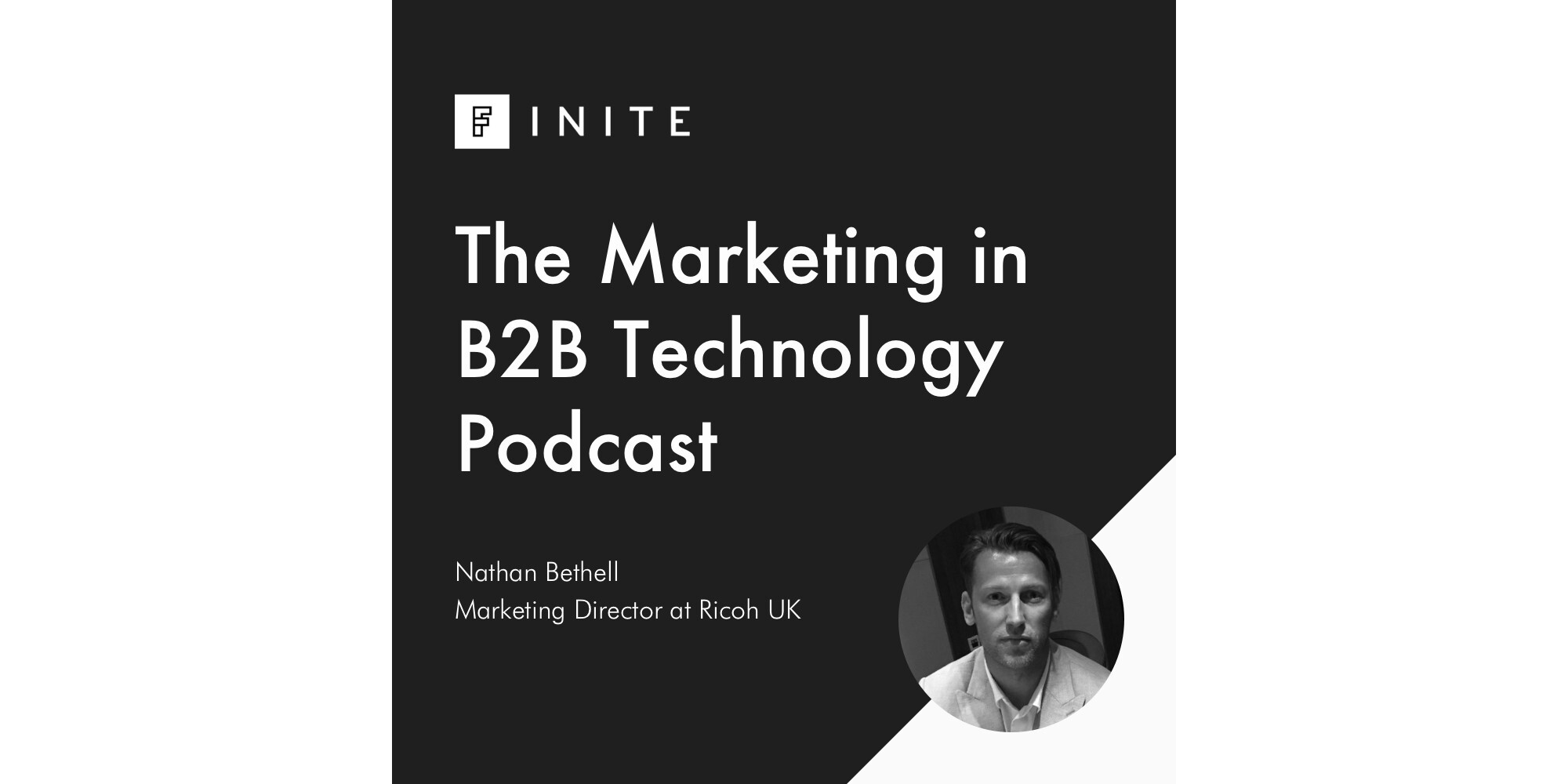
In this episode of the FINITE B2B marketing in technology podcast, we sit down with Nathan Bethell.
Nathan has an interesting background having begun his career in sales before moving over to marketing, and is well placed to offer his thoughts on getting sales and marketing functions working together with a refreshing and pragmatic outlook! Currently working in marketing for Ricoh UK, Nathan has a wealth of experience across B2B technology businesses.
Sales & marketing alignment is a hot topic and something that comes up at nearly every FINITE event we have hosted, so this felt like a very relevant conversation.
Our host Alex Price sits down with Nathan to hear about his work and tips for aligning sales and marketing teams.
This episode covers:
- About Nathan’s transition from sales to marketing
- What does ‘sales and marketing alignment’ mean?
- Maintaining a rich CRM to reduce sales and marketing tension
- Creating a culture of shared knowledge to enable sales and marketing collaboration
- Are marketers and salespeople fundamentally different?
- A marketers job is to drive sales long term
- Tips to bridge the gap between marketing and sales
- The value in a head of marketing and sales to oversee the two sides
- Ways to measure the alignment of sales and marketing
Listen to the full episode here:
And once you’re done listening, find more of our B2B marketing podcasts here!
Full Transcript
Alex (00:07):
Hello everybody. Welcome back to the FINITE podcast. Today I’m on my way to sit down with Nathan Bethell. Nathan first joined one of our FINITE events on a panel where we were talking about education in marketing and how marketers can learn and grow and develop. And as we were having that discussion with the panel that I was hosting, we had some really interesting conversations about sales and marketing alignment which just kept coming up as a theme and as a topic.
And interestingly, Nathan began his career on the sales side of things before then moving into marketing, so has a really refreshing and holistic view about how marketing and sales can work together. He then went on to work as a digital marketing manager and cross-marketing in businesses like Kenshoo and WhatUsersDo.
He has contributed to Google Squared and their own marketing activities in terms of how that’s launched and currently is delivering marketing strategy for Ricoh IT services across the UK. So another big enterprise UK based technology business.
So I’m really looking forward to sitting down with Nathan, hearing about his perspectives on how sales and marketing can work together, how those silos can be broken down, any tips that he’s got having come from a sales background as to how marketing and sales can get the most from each other. So enjoy.
FINITE (01:17):
The FINITE community and podcast are kindly supported by 93x, the digital agency working exclusively with ambitious fast growth B2B technology companies visit 93x.agency to find out about how they partner with marketing teams and B2B technology companies to drive digital growth.
Alex (01:39):
Nathan, hello, thanks for joining us.
Nathan (01:41):
Thanks for having me.
Alex (01:42):
I’m looking forward to chatting. So we’re going to be talking about the hot topic of sales and marketing alignment, which we’ve talked a bit about before. And we talked about when you were on our last panel event. Before we dive into all of the good stuff around sales and marketing specifically, why don’t you tell our listeners a bit about your background and the journey through the roles of sales and marketing, to where you are now and what you’re focusing on currently?
About Nathan’s transition from sales to marketing
Nathan (02:04):
Sure, sure. So, I’ve worked in B2B marketing almost 20 years now, long time. I started probably in the late 90s, early two thousands working in academic publishing, working for a company called Pearson Education, big, big, massive business. And I remember I started off as a marketing exec or marketing assistant. I can’t remember now.
And we used to do direct mail every week, actually more than once a week probably. And I remember the jobs we used to print these A4 flyers around individual books that we sent to lecturers and we used to actually stuff them in the envelopes individually if I remember right. And sometimes we’d do a cover letter with that as well if we knew the lecturer for personalising our content.
And then we would take the stamp, put it on, stick it out. And actually, we were asking the lecturer to reply, they’d fill in the form on the back of the thing and they would then post that back to us. And then we would get all the post back in and then we thought okay, we need to send this book to that person.
Alex (03:09):
How things have changed.
Nathan (03:16):
It’s changed for a long time actually. Because going digital was always a tricky thing, taking away their fundamental business model. But anyway, so that was good fun. And then from there I did that for a few years and then went into sales for actually their big competitor, McGraw-Hill and looked after London and the Southeast and went to see lecturers, knocking on doors, visiting bookshops and generally trying to look after the territory. That was good fun.
It definitely brings to life that decision making process face to face. And you were actually even back then, you’re feeding off the back of a lot of the campaigns the marketing team were doing. I mean, they would send those flyers out. You’d have the authors attending different conferences, speaking about their latest book, et cetera.
So yeah, it was really, really valuable lessons in terms of understanding that decision making process. It’s something which I probably still take today, even though that was probably only 2004, or whatever time it was. And then after that I went back into a more senior market role and then I’ve stayed largely with the marketing since that point and it definitely helps, definitely helps. You always pull upon that real life experience of understanding will this marketing activity ultimately affect the sales person’s chances of getting a sale.
Alex (04:45):
It’s fascinating that you’ve been literally knocking on the door off the back of other people’s marketing campaigns.
Nathan (04:53):
If somebody did my job, I would then get a list of where those direct mail pieces have been sent. And so I could knock on the door and say, hey Mr Lecturer, did you see the flyer that we sent about Kotler’s new principles of marketing book and then Mr. Lecturer would go, yeah I did see that, I was going to fill in the form. Oh well, I’ve got a copy here right now.
Do you want to take a look at it type of thing? And how does it compare to your current book? What’s really important to you? What do the students struggle with? And then you go through your sales cycle at that point. So yeah, that was valuable back then.
And then the kind of digital age started coming in. So we start to do email campaigns. And started to have websites with stuff on them. And so you could actually then start to do a lot of that yourself. So again, as a marketing person you said, okay I could do these email campaigns when I’m at home, reach all my lecturers. And so you would do, and a lot of time it might be one-to-one, but you just copy and paste that kind of stuff.
And then the guys in the marketing team would do it a little bit more sophisticated with whatever email client they’ve got at a time, and then maybe give us some reports on if people have opened and clicked and that kind of stuff. So that was really interesting stuff.
And you learn all the tools around B2B engagement and what tools can help you with it. I thought that was an interesting time in terms of being able to pick that up. So you’d end up, when you go back into marketing, back into a slightly smaller business. You’re then being asked to scale yourself up on, I remember taking a Dreamweaver course and learning how to code and to do those things and actually becoming quite semi skilled on most of the Adobe creative suite platforms.
So, you know InDesign and Photoshop and Illustrator so again, you still keep those with you. So it’s quite nice to actually be able to still use some of those skills and be able to use those tools to personalise content as much as you can, especially around some of the campaigns we do right now, we personalise them down to an individual.
And sometimes it is a case of being able to take an invitation or a campaign or your message and really do that to try and drive a response from one person, and if you’ve got the time and the effort to be able to do that, and you get good response, it depends what industry you’re in. Sometimes the metric of success is one, you get one customer buying an X amount that changes everything.
Alex (07:35):
Especially in that the enterprise space, which is where you are now?
Nathan (07:39):
Yeah, I think now you fast forward on and over the last few years, most of the target clients we’re going after are, we call them mid tier upwards. So yeah, absolutely. Yeah all at Ricoh. So, we’ve got a whole range of clients. I think Ricoh has probably 15, 20,000 clients in the UK alone. So a huge, huge client base.
But the clients that for my area, the one that I look after in terms of the IT services, that’s a client base that we’re trying to sell many different solutions to across many different partners, whether that be IBM or Microsoft or HP, Dell, Lenovo, Cisco. And if you think as an enterprise client, you’re buying all of those things, you pull that all together and provide a service around those.
So you’re trying to market lots of different solutions to the same people. So you’ve got to be quite sophisticated about how you do that and how you balance the message around that. And the metric of success is one, right? One client buying at that level for 10,000 users across the organisation is a huge deal.
Often takes a long time. You know, it’s a long process and you have to drip, drip, drip nurture these people along to be able to do it properly and effectively. And one of those activations can be a game changer for sales. You know, whether that’s a digital asset or whether that’s an in-person activation like an event. I mean the combination of those things are really, really valuable.
Alex (09:22):
Let’s talk about that a bit more. So when you were at our last FINITE event and on the panel, I think between just the discussion and the questions that came afterwards, there must’ve been like three or four occasions where we suddenly found ourselves back at sales and marketing working together. And we had people on the panel that had come from a more traditional sales roles. And we’re now in marketing, you’ve kind of done both.
There’s just so much out there in terms of the debate around what comes first, is it marketing and then sales? What happens when you’ve got your old school sales team that doesn’t really believe in marketing and it’s just their leads, their clients? Marketing’s a waste of time and more and more with technology and data and CRM and marketing automation kind of breaking down the walls and visibility between marketing and sales, that issue of alignment and how the two sides as such, which is maybe an unfair word in itself, but two separate sides work together is really key.
So you’ve come from a background where it sounds like really just started in marketing then gone into sales, then gone back into marketing, but had a very kind of holistic approach to both. And what you talked about is fascinating around insights into decision-making because I think when we look at B2B, generally, the thing that makes it different from B2C is that there are multiple decision makers involved in any purchasing decision, usually.
So understanding how people think are such critical parts of it. But I guess in a nutshell, what is sales and marketing alignment for you? What does it mean? Almost as a definition?
What does ‘sales and marketing alignment’ mean?
Nathan (10:48):
Yeah. It’s an interesting one. I guess let’s say it’s a journey, right? So you’ve got your target customer. Let’s just take Mr. CIO, for example at company X and you’ve got your account account director, account manager and his job is to try and build relationships with that person and those team of decision makers, to be able to look up what that organisation needs to continue on their path of success. So there’s lots of different things that you’re going to look to introduce or sell to that one customer.
And I think really that’s what sales and marketing can do really well to get by is that marketing can play that really crucial support role in driving that level of education and nurture across that group of individuals and being able to split up their content. So then you’re able to do it in a softer way that’s not asking for the sale. And I think a lot of the time the sales person is ultimately the person who has to ask for the business, right?
And so it becomes as a marketeer, you’re able to engage those people without having to do that. And I think that’s a real value add. I think you can step away and say, actually all my job is to do as a marketer here is to drive value to you. We’ve got series of content that we can deliver to you and you can consume whenever you choose to do that, whether that be online or whether that be actually in person at an event.
I think these are the things, these are the activities and the tactics that marketing can do to softly influence these people, to get them up to a point where when sales can then come in off the back of that and actually really refine. So what does that mean for you as an organisation?
So I think the two can play when it’s done together, when it’s done skilfully, they compliment each other, like you wouldn’t believe. And I think you see too often, on either side, you’ve got the sales guy who owns that customer and owns a conversation with the customer and nobody else is allowed to talk to that person or those individuals.
Alex (13:02):
So it’s ownership, it’s pride almost?
Nathan (13:06):
It’s invisible barriers, right? It’s that I don’t know what you’re going to do. And it’s the fear of me not knowing what you’re going to do and potentially impact my relationship with those people is what creates those barriers. And sometimes rightfully, for the sales person to be involved in marketing campaigns where they just don’t land, right?
The message is wrong, the target audience is wrong and the timing was wrong and all of the variable things that when you take a campaign, if you get any of those things wrong, when it lands with that individual, it can have a ripple effect on the relationship itself.
Alex (13:48):
Yeah. So let’s pause on that because that’s a really interesting point. So if we look at sales and marketing being aligned as something tactical whereby they operate nicely side by side, but then actually we explore it being something more cultural and there being almost a deeper connection between the two.
Then in the example, you’ve just given of a campaign, not landing, the message being wrong, the audience being wrong. And the sales guy sat there going where’s my marketing qualified lead? If culturally the two sides are aligned, how do you bounce back from that?
Is it the case that the sales guy is understanding when he understands the ins and outs of marketing. And he knows that not every campaign is going to land perfectly, or is there reduced tension because actually you’ve got two teams working nicely side by side?
Maintaining a rich CRM to reduce sales and marketing tension
Nathan (14:32):
Yeah. That’s an interesting one. I think web marketing teams probably don’t do themselves a favour, as they’re probably very late to tell the sales owner they’re going to do something. So we work in silo, I’ll create a campaign in my mind it’s great. It’s got a lovely piece of content. It’s going to take people down this journey and I’m out the back end of that. Some of those people are going to engage with this campaign and I’ll generate MQLs.
And at that point I might say Mr Salesman, I’m going to send this to your person. And then you’re asking that sales person to then be able to understand everything you’re going to do and then fit it into the thread of conversation he’s already having with that customer. And that’s what you might not always know.
And I think if you don’t have a super rich CRM with lots of different data points and capture off of conversation and thread of conversation, you can absolutely get stuff wrong. You can mess things up badly, because there may be a thread of conversation that’s already happened. And because it’s not in the CRM, you’re going to send something to somebody that could potentially conflict that so you’ve got to get that communication between your sales and marketing individuals and be able to really check that data that you’re going to be sending it to. And go through it with a fine tooth comb type of thing.
So, okay is this person going to respond to it? What was my expectation of the individual? And I think when you’re playing up in the enterprise level it’s worth doing. I don’t think marketing teams spend enough time asking that question of their data. You know, they’ve got their data list, they segment, they’re happy with that. It’s 1000 people, 2000 people, 10,000 people, you send it to, well actually interrogate a day or a bit more, do a job of that, it’s gonna serve you well.
I think in terms of you’ll get a better response rate, open rate. All of the metrics that you’ll judge yourself from, as a marketeer. And ultimately you’ll drive a better quality of lead. So I think that’s really important.
Alex (16:56):
So you’ve touched on, within that broadly there’s communication as an issue, there’s kind of transparency as an issue. These are things which I guess we see in businesses, almost as core values, they’re things on which the business can run at its core, they’re not just unique to sales and marketing working together. And then tools and technologies are really interesting.
And one I really want to talk about is most businesses are using a CRM of some kind now. Probably some kind of marketing automation in the B2B space as well. Are those tools helping to achieve sales and marketing alignment? Are they breaking down the barriers? Are they actually increasing transparency in theory, are they increasing levels of communication because if they are all set up properly, then you’ve got visibility of all the emails that have been sent, which pages on the website, the prospects being on or the client, everything should be there right? That’s the ideal, not always the reality.
Nathan (17:50):
It’s definitely the dream that when you land on a HubSpot or Salesforce website and you can what good looks should look like and you’ve got all of these variables, touch points in there and you’re tracking down to phone conversations amazingly. So you’ve got all of these variable things that you should look and be able to see. The contact records, see that thread of conversations, see all of the data that is important to that individual and their organisation.
Alex (18:16):
So it comes down to implementation? If they’re in there in the right way and working, then you should get to where you want to get to.
Nathan (18:24):
Those tools are great. They give you the template for what good looks like, and it’s up to your implementation of that. And, I think a lot of the time that means actually you’re changing the business. I think those tools can affect massive change in an organisation if you do it well, because it can pull the teams together.
And you’ve got a CRM system that’s rich with the people face to face putting in data that you’re not going to get elsewhere because it’s down from out of the back of a conversation. And then that gives marketing people the chance to be able to take those data points and be able to become a lot better with their campaigns.
Alex (19:08):
So it’s those feedback loops in terms of gaps in marketing, actually it’s not just a case of generate a lead and hand it off. It’s actually then I guess being proactive in saying, how did that lead go? Checking this CRM, seeing if someone’s left some notes, listening to the sales team as to why it was wrong, if it was wrong, what could have supported it a bit more? And so it becomes cyclical rather than just for fun.
Creating a culture of shared knowledge to enable sales and marketing collaboration
Nathan (19:28):
And that behaviour creates a culture of shared knowledge and that’s ultimately what you want to do. Is that you’ve got marketing people who’ve got the ability to spend maybe a bit more time building their knowledge around what’s important in the marketing industry. And they’ll take some of that, turn it into content, and then be able to offer that to you as a salesperson, to be able to decide whether or not you want to push that to your customer, because you know that customer and, you’re bound to a very good level of what’s going to land or what they’re looking for, what’s really important.
I think if that’s done well that can make a massive difference. One of the examples that I’m looking at right now is obviously Windows 10, it’s a big year for Windows 10, for Microsoft, from a perspective of we partner with those guys. And obviously they’re going to end support with windows seven. So for a lot of organisations, I think the stat they give is about 60% of organisations haven’t migrated yet.
Alex (20:24):
Okay. And that’s something you’d look to help your clients with?
Nathan (20:27):
Absolutely. So that would be effectively being able to help those clients with that transformation of taking them from seven to 10 and all of the impacts around that. It’s a big change for an organisation. And there is cost, the cost of change and the cost of doing nothing, the risk of doing nothing. And so they need to look for a partner who is able to do that properly.
So what I want to know is be able to make sure I can send the right content to those organisations that are currently still using Windows 7 and I’ll only get that if the individual account managers are able to take that knowledge, drop in into the CRM so I can actually send a sophisticated campaign of some form. So done well, it can be a tool that brings people together. Done poorly, it can be a barrier, it can absolutely be a barrier and it can throw up a lot of questions and frustrations and all those types of things and whose fault is this?
Alex (21:38):
Yeah, you spiral into the culture of blame.
Nathan (21:40):
And that’s not a great thing to be in.
Alex (21:43):
What’s your perspective on marketing and sales teams? Just almost by virtue of the type of people that are either marketing people or salespeople. And obviously you’ve kind of done both and there are people that do both, but then I guess if I was being maybe more skeptical, I could say that marketing people are kind of the gatherers where sound hunters or there’s a few different languages you could use.
Are marketers and salespeople fundamentally different?
Nathan (22:08):
You’ve got the colouring-in department. The marketing department is the colouring department or the brochure department.
Alex (22:14):
It’s attitudes like that that get you in trouble. But I mean, are they just two completely different things?
Nathan (22:20):
I think they are different people. I think what’s great about the best salespeople is they’re very single minded, single focus, and I think they understand exactly what they are needing to do to hit a number, which is fundamentally…
Alex (22:32):
If you’re that single-minded and that focused, are you thinking I don’t even need marketing? Like I’m so good at sales that I don’t need marketing.
Nathan (22:39):
I’ve come across a lot of salespeople who don’t need marketing, being honest. They don’t, they do it all themselves. They run effectively their accounts, like they’re their own business and they live and die by their relationships with those individuals within that. And so they build up the trust and the credibility and that supersedes anything else that marketing can do, but that’s only for some people.
I think for some people who don’t have that type of relationship with those customers, who need that marketing support to be able to gather the information and be able to nurture those people within their customer. I think there’s an appreciation of that.
I think the best salespeople are the ones who sell to marketing. What can you do for me to help drive leads? And I think the guys who do that realise, they actually see them, they’re switched on. They’re like, you know what? You guys can effectively be my own personal marketing team. And so if I do this, you’re going to be able to do that and do all of these things to generate leads, right across the organisation.
From some of the influencers who are just a little bit further down the chain, but they’re actually really important because you know what, if they’re going to their CIO or CMO saying I really like this, this is a really good tool. And you get a few people doing that. All of a sudden it makes your job as a salesperson so much easier to persuade that person.
You’ve got your whole team really wanting this, you’re going to want to support your team and their view. So I think they are different types of people. I haven’t, in the recent in the recent past, seen too many salespeople want to move into marketing. I don’t know if that’s good, bad or indifferent, but I’ve seen more marketing people want to go into sales.
Alex (24:34):
I guess if we take a step back and zoom out, then the whole point of any B2B marketing is ultimately to drive sales long term. But, if you’re a marketer, do you have the mindset?
A marketers job is to drive sales long term
Nathan (24:45):
I’ll go back and say it’s to build relationships. If you get a good relationship, the consequence of that is good sales. I think if you’re just looking for sales, without that relationship build, and marketing plays a big part in that, then you’re only on a clock until somebody else builds that relationship. And then they’ll take your sales.
So I think that’s really important is that together, you could build that relationship and then the consequence is sales because you’re not asking for that individual’s own money. And I think that’s the difference between B2C. You’re asking for them to buy off of a slightly different reason because yes, the number’s bigger, but it’s not that individual’s money.
And there are different drivers as to why that person is going to buy from an organisation. And the relationship build is trust. Credibility is absolutely right at the top. And I think you can do that as a combined sales and marketing team.
Alex (25:47):
I imagine a lot of people listening to this podcast are going to be marketers working in B2B technology space, some in enterprise space, some not so much. But what are your tips or recommendations if they any marketers listening feel like they’re struggling to get sales on board, they feel like there’s a barrier between marketing and sales, they’re not really working side by side.
Is it a case of them having to stand up, cross their arms, close their eyes and fall backwards and hope they get caught by sales and some good old fashioned team building? Do they need to go to the pub? Out for lunch? Is it just good old fashioned cultural team building stuff? Or is there more to it?
Tips to bridge the gap between marketing and sales
Nathan (26:28):
You know, in terms of tips, I would say generally salespeople the nature of them, especially in B2B is they’re generally very friendly, personable people. They have to be to build those relationships. It’s very hard to be a successful sales person in B2B without that.
So I think the kind of personalities that you’re able to then strike up a engagement with and I would recommend spending the time with one or two very good salespeople and just asking to shadow. People love to talk about their knowledge and their skill set and tips. And what can I pass on to you to help you do your job? I think so, there’s a lot of ego.
Again with salespeople play to their ego right? You’re brilliant at sales, tell me about your job, teach me about your role. And I might be able to offer you some value to help with your role. So I think there’s something there. And then also I think account-based marketing is so important in B2B, align yourself to one or two accounts and learn what you can do with those one or two accounts that can help shift the needle.
So if there’s an open early stage open opportunity, get involved in that. Say what can I give you that will help move them along and follow that opportunity down through it’s cycle, right? So don’t just do your bit here when it’s sat at 10%, and then when it gets to like 50% go I have done my job, actually follow it along.
And when they wrap-up of we’ve won a deal, you’re going to be part of that team that sales person reports back to the organisation says, thank you to these people for helping me on this because they offered value here, here, and here. And all of a sudden that recommendation or reinforcement from your salesperson to your help with that, will elevate your position in the mindset of the rest of the sales team. They did a good job with these guys, can you help me?
Alex (28:31):
Yeah. And beyond the softer stuff and building the relationships internally, have you had experience actually formalising it? Some organisations use a service level agreement, some kind of SLA between sales and marketing to say, this is what a marketing qualified lead actually is. This is how many we’re expecting marketing to generate. Do you think there’s an advantage to just setting a bit of a framework on a one pager that both sides can follow?
Nathan (28:54):
Yes, then you get a mutual appreciation of the value of each other. I think you, as a marketer, you can feel under appreciated. If you’ve create a campaign, you generated smart and qualified leads, they go across the CRM system and a week later, two weeks later, three weeks later, they’re still sat, unchecked, and nobody’s done anything with them. And so you bang your head a little bit, like, what more do you want me to do, guys?
I think there’s definitely value in getting some form of an agreement in place. You know, when these are passed across within 28, 48 hours, you’re going to do do something with these. You’re going to acknowledge that you’ve got these and make some form of engagement with that individual. And I think you need that at board level. You can ask the board. And I think every board member that I’ve spoken to over the last 10 years, absolutely.
If you’re going to go to the effort of doing some marketing and creating some campaigns, the minimum I want my salespeople to do is actually pick them up and do something with it. So get that board buy in. And I think that’s when you’ll find the sales people go, I better do something with these cause otherwise I’ll be on the hook here.
Alex (30:00):
That transitions nicely on to how much leadership roles actually play in making sure that that gap is bridged between sales and marketing. I guess I’m always a big believer that in any business, most things kind of start at the top and they trickle down. Most behaviours, most cultures are very much defined at the top and the origins of a business.
Do leadership have to be the ones that really oversee that coming together and unification of sides? And then I guess, what does the team structure look like? Is there one person that’s at the head of that? Is there a head of sales and marketing? Is there like an overarching structure that connects the sales and marketing team?
The value in a head of marketing and sales to oversee the two sides
Nathan (30:38):
That’s an interesting one. I think you’ll get some organisations say that actually. That’s there’s culture that goes from the ground up. But actually in reality, in the ones I’ve worked in and all the people I speak to it’s influenced hugely by the people at the top and the way that they want to run the business and create that kind of culture.
So I think you need a leader at the very top who sits above sales and marketing, who’s prepared to say the value of each part of the business and give credit where it’s due across the business and actually highlight the value of it and champion that regularly, not just reward the number, not just play the number.
And I think that if you’ve got that then that’s great. I’ve worked for sales and marketing directors in the past and what you end up doing is you’re working for a sales director for 95% of the time because the number is the number and it’s the most important.
Alex (31:39):
So if you are head of sales and marketing, you’re going back into your board meetings every month and really getting quizzed on how much business.
Nathan (31:47):
Never lead in with your marketing message. When you’re going into that board meeting it’s never I’m going to spend 30 minutes talking about Marekto first, then we’ll get into sales. It’s just the reality of life. So I would say I think you need dedicated people to do that, to do it credit, to do it justice.
And I can see why people say sales and marketing should be aligned fully aligned, you bring it all together. But actually, I don’t know. I think you need somebody who’s full-time devoted on that marketing role to be able to do it properly and raise the profile in the board room and be fully dedicated to it. So it doesn’t just become that and here’s the marketing piece as well.
Alex (32:27):
I’ve seen some organisations that do kind of sales operations, or they talk about smarketing, sales and marketing together. There was a McKinsey report that I read that was talking about having a sales operations team, which has the word sales and it not marketing. So maybe that implies something in terms of priority, but that was like the overarching team that connected marketing and sales together and the other stuff kind of came….
Nathan (32:54):
I think that happens, you know. There’s no formularity around that, certainly within Ricoh, there’s not naming convention, but there’s almost a SWAT team of here’s account director, here’s the pre-sales, here’s the clever people. And here’s the different people from across the organisation who can add value into that client.
So we’ll have a client who’s a fortune 500 business, you got to have more than one person looking after that organisation. Because there’s lots of different people across your team who can add value. So bring those sales operation teams, because you’re going to add value in different perspectives, different topics of conversation to bring the two organisations closer together to help build that trust and credibility say what can we do to help each other? And I think that’s a really good strategy. I think if you can get it done right, it makes a big difference
Alex (33:50):
As a final question, is there a way of measuring or validating that marketing and sales are aligned? Is it that clean cut? Is it ones and zeros? Or is it actually the reality is that it’s a never-ending process? It’s very people-based, people come and go, cultures shifts as businesses grow and change? And it’s something that just needs to be worked on consistently. Are there actually metrics that we can say marketing and sales are working for you?
Ways to measure the alignment of sales and marketing
Nathan (34:14):
I think there are metrics. It’s not easy to find, but I think you can retrospectively in B2B, you can retrospectively take a closed one deal and you can look at all the touch point. And you can sit down and go, let’s take care a wash up on this account, and let’s look at the last year of this account. And what did it look like from an engagement point of view and where all the various different marketing touch points?
That whether directly affected or indirectly affected this customer in their buying journey and their cycle. And then you give credit to it and you play that story out and you piece it together and you storyboard it. And say this is what it looked like in the real world. And it’s not just relying upon one salesperson getting one signature on the contract. That last click attribution went a long time ago.
In B2B we say the only value we’re applying is the guy who gets a signature on the contract, that’s the only value. And so it’s kind of that attribution model, if you can get to something that you all agree on and you give fair credit to the whole business. And it’s not an easy thing, I’ve got to be Frank. I’ve not seen it done very well.
Alex (35:29):
I guess attribution is always hard. And even more so in the B2B space. And as we talked about earlier, it sounds like this really comes down to demonstrate that you’ve got the two aligned, you need CRM and data and everything in place and working seamlessly. Otherwise it’s quite hard to do.
Nathan (35:42):
That commitment to your CRM tool and the build of the data within that, and it’s getting that done right. And I think it makes everybody’s job so much easier.
Alex (35:54):
Fascinating. Alright, I think we’re going to wrap it up there. It’s been awesome talking to you. Lots of interesting insights. I’m sure people from across the spectrum of sales and marketing will find it all really interesting. So thank you.
Nathan (36:07):
Thank you.
FINITE (36:10):
Thanks for listening. We’re super busy at FINITE building the best community possible for marketers working in the B2B technology sector to connect, share, and learn. Along with our podcast we host a series of events here in London, so make sure you head to finite.community to subscribe and keep up to date with upcoming events.