
- Nov 16 2026
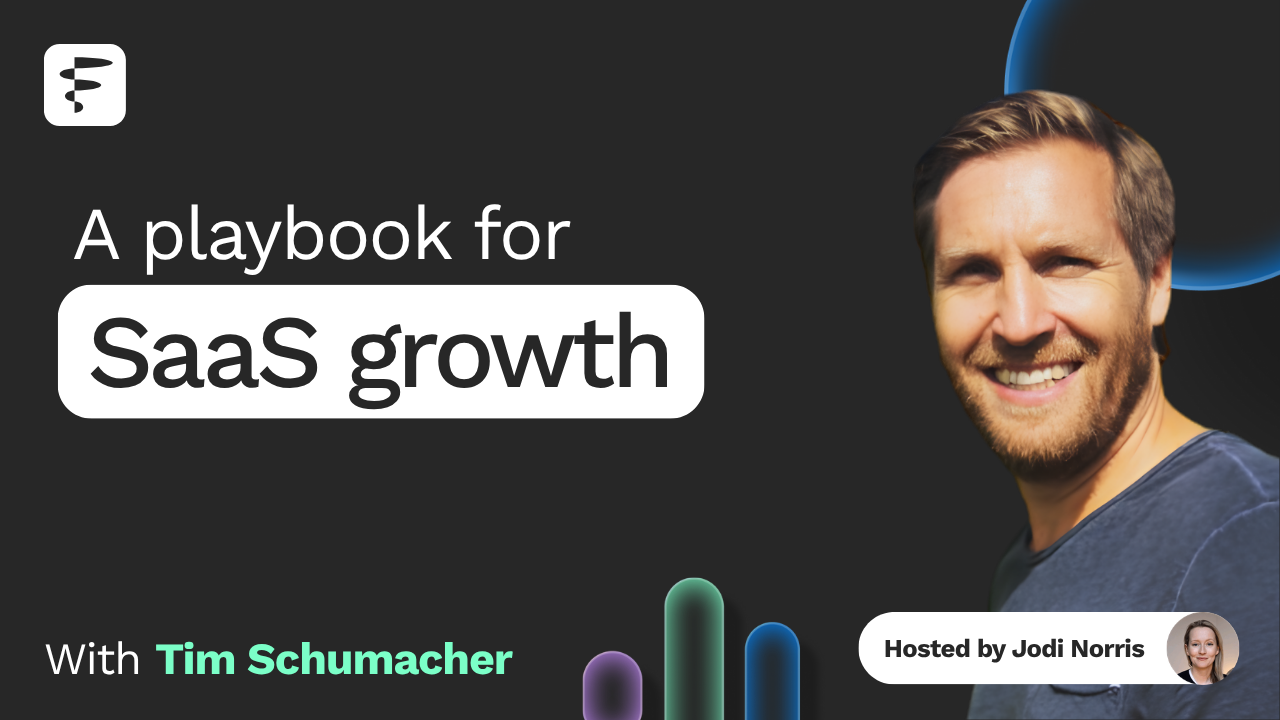
Most marketing leaders get one shot at a new channel. Tim Schumacher gets 25.
As co-founder and CEO of SaaS.group, Tim oversees more than 25 SaaS brands with a combined revenue of over 100 million. Every one of them doubles as a testing ground for the others. If a tactic works in one business, it can be rolled out across the group. If it doesn’t, the whole portfolio learns from it.
In this episode of the Finite Podcast, Jodi Norris sits down with Tim to unpack the playbook that took one brand, ScraperAPI, from a single-founder business to ten times its revenue in five years. The answers aren’t where most marketers are looking. Think buying a subreddit. Think building a Chrome extension. Then there’s the influencer campaign that pulled in almost a million views and didn’t produce a single paying subscription.
Tim has seen online advertising from an angle few marketers ever will. Before SaaS.group, he co-founded the company behind AdBlock and Adblock Plus, which are now the two most popular Chrome extensions in the world.
Inside you’ll find…
The Finite by Clarity Podcast is sponsored by Clarity, a full-service digital marketing and communications agency. Through ideas, influence and impact, Clarity empowers visionary technology companies to change the world for the better.
Jodi (00:01)
Hi Tim, thank you for joining me on the Finite podcast today. It’s great to have you here.
Tim Schumacher (00:05)
Hey Jodi, thanks for having me.
Jodi (00:10)
So nice to have you here from Paris. But you’re usually based in Germany, aren’t you?
Tim Schumacher (00:15)
That’s correct.
Jodi (00:16)
I’d love for you to tell us more about that, what you do, your current role, and your background in marketing.
Tim Schumacher (00:24)
Yes, so I’m the co-founder and CEO of SaaS.group. At SaaS.group we buy SaaS companies, but essentially I have a long career in online marketing. The first company I started was Sedo.com. We’re the biggest domain marketplace, and for a while we were also the largest Google syndication partner in all of Europe, putting online advertising onto parked domain names. It was the biggest network in the world for that.
Then later, and that’s probably the most interesting marketing story I have to share, though it’s not the topic today, I co-founded the company behind AdBlock and Adblock Plus, the leading ad blocking company in the world, with hundreds of millions of users. A lot of you probably know the little red stop sign saying ABP, or the hand in your browser. That’s a really interesting story from the other side of online advertising. But it is an online advertising company, because we have a programme called Acceptable Ads. Obviously we weren’t loved by all online advertisers, and there’s a really cool story there, but that would probably make a separate podcast.
SaaS.group is my topic today. There, we also have a very strong online marketing background. We have a lot of brands, a lot of online marketing brands. My co-founder, the CTO, founded OMR, the Online Marketing Rockstars, the largest online marketing conference in Germany, with about 70,000 attendees every year and a big online presence as well. So, happy to talk about SaaS.group today.
Jodi (02:06)
Definitely. I’m really excited to hear more about that. It’s an interesting background. We usually have more in-house CMOs and marketing leaders on the show, but you’ve got a really unique perspective spanning a whole portfolio of companies, and all of the learnings from that and the playbook you use to scale them. So I’m really looking forward to hearing about that. And it’s really interesting about AdBlock. I don’t know whether our listeners will appreciate you or not, because I guess we’re in two minds. As consumers we hate ads, and as marketers we love them.
Tim Schumacher (02:47)
Yeah, that’s the funny thing. We see so many marketers who actually have AdBlock installed and then have to deactivate it when they look at things. Maybe one sentence on AdBlock. Our idea was always not to stop all ads, but to stop annoying ads. The ads that capture your whole screen, pre-roll videos, those sorts of things, are the stuff consumers hate. Useful ads, affiliate ads, little text ads, they don’t harm people. So the idea was always how to create a balance between the two.
Jodi (03:23)
Absolutely. So marketers should love AdBlock as well. We should all be targeting correctly and giving people what they actually want to see.
Tim Schumacher (03:27)
Absolutely, yes.
Jodi (03:31)
Okay, cool. Well, let’s get into the topic. As you said, you have a portfolio of companies. Do you want to talk us through how many companies, what kinds of companies, what SaaS.group actually does, and who it serves?
Tim Schumacher (03:45)
Yeah, sure. SaaS.group has more than 25 independent brands, mostly B2B, with a combined revenue of over 100 million. We buy small SaaS companies, and a lot of them are actually in online marketing. Some provide social media monitoring, like Juicer or Ayrshare. Some provide SEO services, like Prerender or Keyword.com, and many others. So we actually have a strong presence in tools that a lot of online marketers use. We also have some developer productivity tools, but online marketing is one of our strengths.
We have almost 400 people working for us remotely in over 50 countries. About 80 people, so roughly 20%, work in online marketing itself, either in one of the brands or in our central marketing team. So we have strong marketing expertise.
What’s interesting is that we see a lot of effects across different brands. Because we have those 25 brands, we can see what is working and what is not working. We can run a lot of experiments in one brand and then roll them out across the group. So from an online marketing perspective, it’s a really interesting company. We are a product-led growth company. We’re not strong in enterprise sales. Marketing is really our way to grow our software products, and I would say marketing is one of our core disciplines. Happy to share what we’re doing there. And AI, of course, is reshaping everything, so these are quite interesting times.
Jodi (05:37)
It sounds really interesting. You’ve got such a broad span of companies in your remit across different sectors. And it’s interesting that one core playbook, or maybe slight variations of it, can drive consistent and predictable growth across all of those categories. Is that what you’ve found? Does the strategy for each company vary much between categories, or do you feel your playbook works across all of them? Not plug and play, but close.
Tim Schumacher (06:11)
I would say 80% is the same across all brands. They’re all SaaS brands, so software marketing of course follows a certain pattern. But in some cases the more quantitative marketing, pay-per-click and SEO, is more important. In others, influencer marketing plays a bigger role.
For example, we own Picdrop, Picdrop.com, which is photographer software and digital asset management software. Because photography is so visual, influencers play a real role there. In other brands, say our SEO brands, influencer marketing is virtually non-existent. But I would say 80% of it is the same. You need to be good in certain disciplines. You need to be good in SEO and, of course, AEO. You need to be good in pay-per-click marketing. You need to be good in social. A partner programme is always one of the things we do that works really well. And then there are a few things that depend on the brand.
Jodi (07:21)
That’s a really good overview, and really interesting that 80% stays the same across all of those different categories, with 20% variation. So let’s talk about your best story. Let’s show off SaaS.group a little bit. What’s the best success story you’ve had, where you’ve taken a company from a small startup to a proper scale-up?
Tim Schumacher (07:51)
We have quite a few, but let me take one example. We often buy businesses that are run by literally a single founder. Very often it’s one person in front of their computer, coding, doing all the marketing, doing everything.
One of the businesses we bought back in 2020, so six years ago, was ScraperAPI. It’s scraping software, also used by a lot of marketers who need company data. It’s scraping packaged neatly into a very nice API. It was one person running it with one or two freelancers, and the code carried a lot of tech debt. Growth had stalled, because you get far with one person, but in pre-AI times you only got so far. But he had 2 million in revenue.
So we brought in new leadership, grew the team to about 10 people, removed a lot of the tech debt, fixed reliability, and those sorts of things. Then we invested a lot in customer success, in changing pricing, and in a lot of marketing disciplines. We always invest heavily in SEO. It’s very long term. Now, of course, AEO is the new game, but a lot of things are very similar. You look for credible sources outside, you look for proper links citing you, and you look for a fresh stream of relevant content coming out every week or so. We made a lot of investments there.
We also moved the affiliate programme in-house. For that we have our own platform, Rewardful.com. Rewardful is affiliate marketing software, and it’s actually a company we bought. We run our own programme on it, and it’s also open to others. So we have a really streamlined affiliate programme in-house. Affiliate is actually an underutilised channel, because it really helps with building links and spreading the word. You can plug everything into partner programmes, and a lot of influencers use things that have a partner programme.
And last but not least, we did add-on acquisitions. We bought a company called Traject Data in 2025 and added it to create a combined web data platform. Long story short, the company is now about 20 million, so roughly 10x within five years. It was multiple factors, not just marketing, but marketing of course played a big role.
Jodi (10:29)
Do you remember any key learnings you took from that specific instance, or from any of your biggest growth stories? How have those affected your playbook and how you see marketing and product marketing more generally?
Tim Schumacher (10:49)
The cool thing is that we can really test a lot of things in one brand. I’ll give you an example. We did an influencer test in one of our niche B2B brands, and then we developed a little internal tool that shows us, first for that one brand but later for any brand, within about 30 seconds, whether to accept, negotiate, or pass on an influencer deal. That was a really cool way to bring down the cost per thousand views, and now we’re adopting it across many channels.
Jodi (11:28)
From your perspective, seeing all of these different growth stories and learnings, how do you see product marketing changing right now? I know you mentioned AI. How is it all shifting? How are you bringing new channels, tactics, and strategies into your emerging businesses and changing their growth strategies?
Tim Schumacher (11:57)
AI, and especially AI Overviews, but also native AI engines like ChatGPT, Claude, and others gaining in popularity, meant we needed to change some of the marketing mix. For example, Reddit started to work really well and became really important.
Again, take Rewardful, the affiliate marketing software. We invested heavily in Reddit. We got about 150,000 views and over 300 upvotes in a quarter. You don’t always know what works. There was one helpful comment we made that drew thousands of views, and there are other things that just sit there and do nothing. But in aggregate, it really helped our presence.
Then, in one case, we bought a subreddit. We bought the SaaS marketing subreddit and the startup SaaS founder community. You can actually buy Reddit communities. Of course, you don’t just bluntly use them for your marketing. You use them smartly and integrate them into your marketing, but this way you suddenly have reach. So that’s one example of how, in AI times, you really need to think a little differently.
Jodi (13:34)
That’s really interesting. I didn’t know you could buy subreddits. Reddit is quite famously anti-promotion. Even though everyone’s anonymous, they have such a keen nose for any kind of inauthenticity or any promotion at all.
I remember when I was on Reddit, there was a big trend back in the day. You’d scroll and see an ad, and every single ad would address the audience as Redditors. “Redditors, have you heard of this software?” Because there was such immense pride in being a Redditor at that point. And I don’t assume that pride has drifted, even if Reddit is getting a little more B2B-centric.
Tim Schumacher (14:20)
Yeah, absolutely.
Jodi (14:21)
So what do you think are the key tricks for not crossing those boundaries, and owning that subreddit with authenticity and genuine trust-building for the audience?
Tim Schumacher (14:36)
You have to be authentic, and you can’t advertise. Owning a subreddit doesn’t mean you should spam it full of marketing, because then it’s dead immediately. You have to really put effort into being helpful, being authentic, helping the community, and moderating the community, just like you said. But of course you can steer certain topics a little better if you own it and moderate it than if you don’t. That’s the whole purpose of it.
If I can share another marketing trick, piggybacking on other platforms is really nice. Things like the Chrome Web Store or GitHub are underutilised marketing channels. I’ll give another example. We have a company called DeployHQ. It’s a deployment tool, a developer tool. They built a tool called PR Radar. In this case PR stands for pull requests, not public relations. They built PR Radar to manage their own pull requests, and it runs without a server, so for developers it’s a cool thing. Not sure our marketers can appreciate it, but it was a really nifty little tool they used themselves.
Then they made a Chrome extension out of it, and in very little time it earned a Featured badge from Chrome and had thousands of active users. That of course builds credibility over time. It provides a valuable service, and it provides backlinks, credibility, and real referral traffic to the actual brand. Those integrations into other platforms, whether it’s skills for Claude, the Chrome Web Store, or source code and other things on GitHub, are a powerful marketing tool that we like to use a lot. The key is always to be helpful first and profit in the long run. Don’t spam people. Build a web of useful services around your own brand.
Jodi (16:58)
That definitely makes sense. I’ve not heard of that before, a Chrome extension. Do Chrome extensions have to be free, or can they be paid for as well?
Tim Schumacher (17:06)
You can have a paid service in the back, but they don’t have a payment gateway like an iOS app. Adblock Plus, for example, has an Adblock Premium solution that does additional things. It blocks cookie banners and very elaborate YouTube video ads, those sorts of things, and you can pay for that. But that’s a separate payment gateway that runs via our own system. So Chrome itself doesn’t have a payment gateway, but you can make it a paid app.
Jodi (17:40)
So it’s more like light options. I guess that makes sense coming from an AdBlock history. AdBlock’s probably the most famous Chrome extension ever.
Tim Schumacher (17:47)
It is the most popular Chrome extension in the world, indeed. We own both AdBlock and Adblock Plus, and they’re the number one and number two Chrome extensions in the world.
Jodi (17:57)
So it makes sense that you’re bringing that into your portfolio. It’s a really creative idea. I like that it’s not just about visibility but accessibility too, making it seem like just another everyday tool above your bookmarks bar.
Tim Schumacher (18:16)
Right.
Jodi (18:17)
I like the way you’ve described those additional platforms. And I’d love to know, in your opinion, what isn’t working? What’s something you see marketers doing or trying a lot at the moment that just hasn’t worked for your brands, where you’ve pivoted or worked around it?
Tim Schumacher (18:41)
Sure. Marketing is a lot about experimenting, and a lot of stuff doesn’t work, and that’s normal. What works, you scale. The other stuff, you retire. I’ll give two examples.
AI makes it very simple to build a lot of things, so we’ve toyed with building things like a CRM matchmaker. The idea was to generate leads for our own CRM, but those matchmakers weren’t used. It really didn’t work, so we retired it.
Also, and any marketer can relate to this, reach very often doesn’t turn into revenue. Another example is Picdrop.com, our photographer software. We spent over 20,000 on influencer promotions in the US, and they brought almost a million views and sign-ups, but literally no subscriptions. It just showed that reach doesn’t automatically convert. We all know this. And of course it’s always hard to distinguish. Did you buy brand recognition for the long run, or did you just not reach the right people? So we scrapped that and moved to a more granular way of finding the right influencers, the ones who actually target professional photographers. But it’s not always easy to distinguish.
Jodi (20:13)
That’s a really good point. With influencer marketing it is hard to understand the end revenue at first, because you don’t know what the target audience is. I guess that’s when you look at your existing customer base and see who’s working. But it is test and learn, it is trial and error. And that’s what’s so interesting about the number you gave at the start, that 80/20 split, with 20% variation across your marketing strategies. I guess that’s the room for experimentation, but you’re still experimenting with the same kinds of tools, technologies, approaches, and channels in the first place.
So let’s talk about AI. How are you using it? How is it not only speeding up your workstreams but making your marketing across your companies more effective?
Tim Schumacher (21:11)
A lot, literally. We encourage massive AI use within our marketing teams to make things more efficient. Some brands are at the forefront. I mentioned Ayrshare before, the social media tool. They have some amazing AI-first marketers who run everything through AI and have a ton of agents working for them. I’ll give two specific examples.
We run AI focus groups before launches. We turn real sales call transcripts into buyer personas, and then use Claude skills to run simulated workshops with them on taglines and launch emails before they go out. Of course it doesn’t replace talking to customers, but it’s a scalable way of doing something that used to cost weeks and tens of thousands, and it’s actually pretty good.
And of course every marketer can work with AI ghostwriters, training Claude on your best posts and guides, on what you should and shouldn’t say, and then producing content. It still needs to be genuine, but you can supercharge yourself, like 10x. We encourage every single function, whether that’s content generation, social media, or anything else, to use AI and keep the human in the loop. I think we all recognise AI slop when we see it on LinkedIn or elsewhere, so the human in the loop is super important. But if you’re the right human in the loop and you know how to really use Claude and other tools, you can supercharge yourself, just like developers supercharge themselves when they code.
Jodi (23:14)
We talk a lot about efficiency on the podcast, getting a lot of stuff out quicker, and I don’t think anyone can deny that at this point. But I’m starting to wonder about actual effectiveness beyond scale. Yes, you can get more out, and that will increase pipeline. If you put more out, more will come in, I guess, because although reach doesn’t always promise conversions, there’s a correlation between more reach and more conversions. But I’d love to know your opinion on the actual outputs and the quality, and whether it’s making marketing resonate more with the audience. Whether it’s going to be more standout or more effective, rather than just more of it. Have you noticed that difference?
Tim Schumacher (24:14)
Absolutely. The problem is that because it’s so much easier for everyone, there’s just a lot more. If I think about something like email, I used to get one or two cold outreach emails a day. Now I get 20, because everybody has 20x’d themselves. And of course those messages haven’t become more effective than they were before. Because everybody can do it, it raises the bar, and you have to be louder.
That was again why we started AdBlock in the first place. Online marketing, classic banner advertising, got so noisy that you needed to turn the level down again, and that’s exactly what AdBlock does. I think the same is happening here. We kind of need an AI block these days.
But again, I think AI can be used really, really well. Some of my best LinkedIn posts have literally been written by AI, but I used the right tool and the right prompts at the beginning to get them to that place, and otherwise I simply wouldn’t have posted. That really helped. So, the human in the loop. I think we see it with everything. The human in the loop is just so important. AI working together with a human is 10x more powerful than either AI or humans working alone.
Jodi (25:41)
Absolutely. I guess it’s about distinguishing what needs to be a wow, what needs to have impact, and what you can get away with just scaling up. Sales emails to a list of 10,000 don’t need to be that bespoke. But if you’ve got an ABM list, a target list of ten accounts, then you’ll want to use AI as a collaborator. That’s the distinction.
Tim Schumacher (26:05)
Absolutely. And there are things where AI clearly can help. Take the management of pay-per-click accounts in Google, for example. That’s a purely quantitative thing, where AI can really reduce your costs, and so reduce your customer acquisition costs, while keeping the output the same. That’s quantitative modelling, and sure, there are tools out there for that, but that’s one area where AI really helps and no human sees it.
Everywhere humans actually see it, you still need that sparkle, that extra tweak. That’s why many people say, and I agree with them, that in times of AI, real marketing becomes more important again. Billboards, events, physical things people can touch and feel. So some of the time we’re freeing up with AI, we’re reinvesting into calls and meeting people, because that stuff no one can fake. In times of AI, it actually becomes more important.
Jodi (27:15)
Which is interesting, because you’d describe yourselves as a more product-led company. I guess that’s an interesting topic as well, the convergence of product marketing and human-centric marketing and how those collide, because product marketing has traditionally been seen as more demand gen driven and more numerical.
Okay, we’ve only got time for one more question, unfortunately. It’s been a great chat. I want to look ahead and see where you think the market is going. As we’ve said multiple times, you’ve got a huge portfolio of companies that are experimenting, testing, learning, and using new channels, GitHub, Reddit, everything. So I think you might have a really interesting answer to this. Where do you see the biggest opportunities for SaaS and product marketing in the next few years?
Tim Schumacher (28:22)
A couple of things. Number one, the buyer persona for software is shifting from humans to, often, AI agents. Few people talk about this yet, and company valuations don’t reflect it yet. But if you think about certain software, it’s not consumed by humans anymore. The data and the insights are still needed, but by agents.
I’ll give a specific example, again from our Ayrshare brand. That’s Ayrshare with a Y, so A-Y-R share. Ayrshare is a social media tool, and it’s booming at the moment, because what it does is help AI agents access social media data through APIs. Otherwise that data is hidden behind the very complicated individual APIs of the various social networks. So it’s a big wrapper around all those networks that deals with a lot of those complexities.
What we’re seeing is that a lot of the consumers of this data are actually AI agents. If you code an AI tool in Claude or Lovable or something like that, it needs this data, and the agent says, well, let me access Ayrshare for that. It sounds very abstract, but it’s very similar to before, when the CMO would say, “I want this data and I want to look at it, so I need a dashboard.” Now it’s the agent wanting that data. AI agents become the ultimate customers.
It sounds abstract, but it has a lot of implications. It creates demand for structured web data and for additional services, but it also lowers demand for anything that’s visual or UX-based. We’re seeing that too. Some of our brands are under pressure because they’re very UX-focused, and people need that less. So very often it’s the unglamorous software that sits deep in the customer workflow that’s more interesting than the stuff people can see.
I think that’s one of the really interesting takeaways, and it goes beyond the marketing opportunity for SaaS. It’s really about product and strategic positioning. That’s probably our most interesting takeaway from seeing over 25 brands and what they do.
Jodi (31:12)
Really interesting, and something our listeners should definitely be thinking about. I know we’re all updating our content, writing different content briefs, and figuring out how to speak to robots. So I guess it’s embedded in the product as well. Thank you so much, Tim, for chatting with me today. It’s been a pleasure, and I hope you had a good time as well.
Tim Schumacher (31:35)
I did. Thank you very much for having me on the podcast.

