Find the full transcript here:
Jodi Norris (00:01)
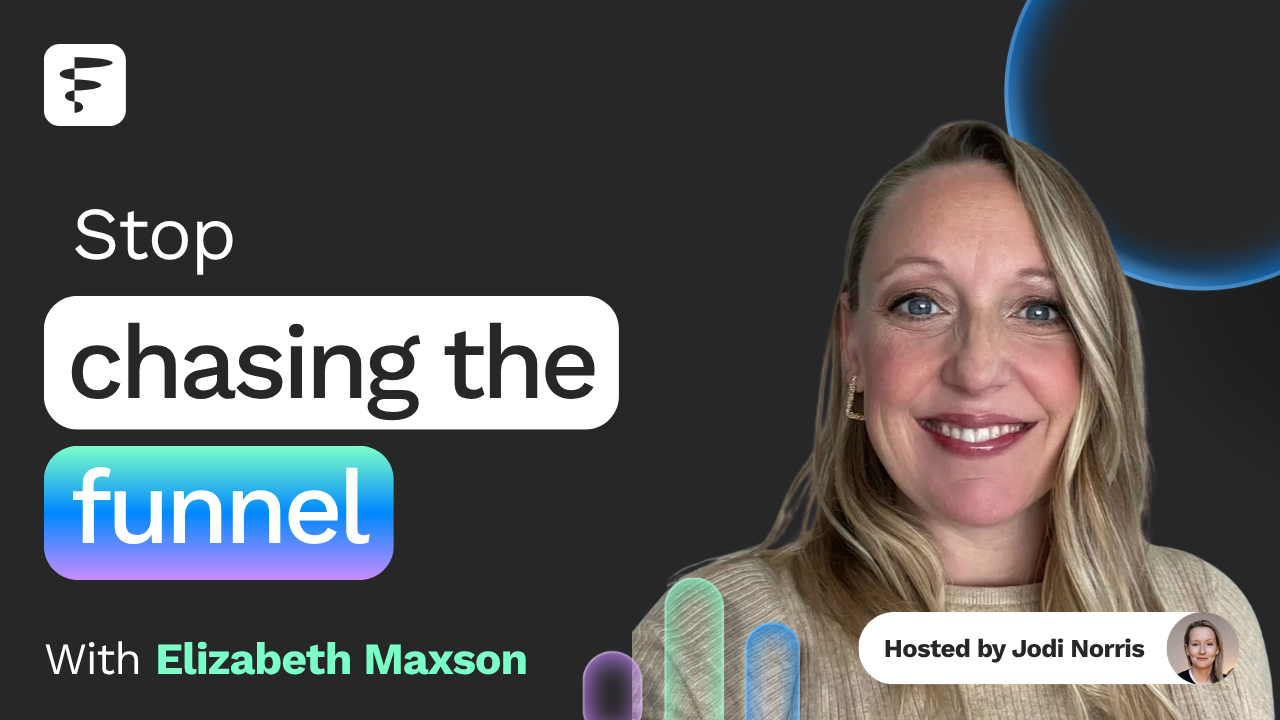
Hi Elizabeth. Thank you for joining me on the Finite Podcast today.
Elizabeth Maxson (00:05)
Thanks for having me. I'm so excited to be here.
Jodi Norris (00:08)
It's great to have you here. We're discussing changing B2B buyer expectations and buyer journeys more generally, diving into digital experience, zero-click, and everything in your remit. Before we do that, we always ask our guests to introduce themselves — explain your career so far, how you got into marketing, and how you got to Contentful as CMO today.
Elizabeth Maxson (00:39)
Great, yeah. I have a pretty unique background, to be honest — maybe not the most natural path to CMO. I started out in the events industry, on the agency side, supporting major conferences all over the world in technology and automotive. I was soon introduced to Salesforce, who were a customer of that agency for many years, and that's where I went in-house. I spent over a decade at Salesforce in a variety of roles, from events to corporate messaging and content, to supporting mergers and acquisitions, and then leading some great marketing teams. I led marketing for our strategic technology partnerships — launching Google, Apple and AWS, to name a few — and I was also Head of Marketing for Quip, a previous Salesforce acquisition. I then transitioned to Tableau, where I became CMO for about a year and a half, and that brought me to Contentful. I'll actually be celebrating my two years here this autumn, and it's been a really amazing time, especially in the world of content — so much is changing, both in how content gets deployed and how it's read by agents and humans. It's opened up a lot of opportunities for marketers. It's a hard time to be a CMO, but also a really exciting time to navigate all this change together.
Jodi Norris (02:12)
Exactly — that's what I'm always going on about. I have CMOs coming on saying, Jodi, it's the wild west out there, so we just have to learn from each other and peer into each other's strategies, and how we're arming ourselves against all of these changes. So, speaking of this — what's happening with content at the moment from your perspective? How is it changing, and how are you adapting, particularly in the digital experience space?
Elizabeth Maxson (02:45)
We've been thinking a lot about how content is evolving, and we're calling it a great content collapse. If you start with CMOs, you're constantly being asked to do more with less — that's nothing new, marketers are always being asked to do 10% more with 20% less budget or people. But now there's a new filter of doing that with AI, so there's pressure there. The second part of this is all the content being created with AI that is AI slop — it's all starting to look the same, it's not breaking through the noise, and consumers aren't even attracted to it. They're not falling for it, and it's actually hurting trust in brands. The third part is that it's affecting your funnel — what is the funnel these days? Top of funnel is collapsing, your content strategy is collapsing, your budget and people are collapsing. So we think this is a bit of a crisis moment. It's a time for marketers to take a step back and decide where they can be more strategic with content — how they can view LLMs as a new persona, not just a new channel, and be more thoughtful about creating better content. And I don't mean quantity, I mean quality. I often see people using AI just to produce more, more, more — which is true, you can produce at lightning speed, but that doesn't mean it's the right thing to do. I'm always advising marketers that more content does not equal better content. Better content equals better content. Keeping that top of mind really helps teams develop their strategy.
Jodi Norris (04:41)
Absolutely — I think it's interesting how you mentioned the funnel is collapsing. What does that actually look like? Do you mean the top of funnel is full of AI slop, the middle of funnel isn't on your website anymore but on social media or through influencers, and the bottom of funnel is one-on-ones with AI agents instead of sales teams? How does that actually come to life for you?
Elizabeth Maxson (05:14)
It comes in a couple of different forms — that's a perfect example of one way it could collapse, but it could collapse in a lot of different ways. If you take a step back, we've all been trained to think about the funnel as a three-step process, but it's no longer a funnel. We think of it instead as a buffet. Consumers and buyers are now able to consume content wherever they want to consume it, so it's about making sure you really are meeting your buyers where they are — and where you're meeting them may be on a different part of the journey than you'd expect. So it's about reevaluating your channels and how you're investing, from paid to the content you're creating. You still need the same awareness and the same type of content to support different stages, but the realisation is that they're not coming in that order anymore — they might come in a completely different order. Another place we see this in the digital landscape is how much it's affecting website traffic — most companies are seeing a massive drop in traffic, because people are getting their information from answer engines first, and through GEO in Google searches. It's been amazing to see how much that's changed. A standard Google search a couple of years ago was six words — now it's thirty-seven words or more. I'm a mum of four, so as an example: four years ago it would have been 'great mum shoes' — now it's 'I'm a mum of four kids under eight who lives in Northern California, who likes to hike in the morning but transitions to the playground in the afternoon, what shoes would you suggest?' That specificity is getting so granular that we now expect personalisation in the content that comes back. So it's about thinking about your website differently — if buyers are getting all their information from LLMs, what are they getting from you by the time they reach your website? In some cases they're more highly qualified, so how should you be shifting further down the funnel on your website, because you're getting that top-of-funnel information elsewhere?
Jodi Norris (07:57)
Absolutely. That was going to be my next question — what is the website now? It went through this huge evolution from being a shop window to a marketing engine. Is it going back to that shop window mentality, or does it still have a big place in discoverability, and in getting into those LLMs in the first place?
Elizabeth Maxson (08:26)
One hundred percent, it still has a place. What's interesting is when I speak to customers, they often ask — do I need two websites? They're thinking about how to have a website that meets human needs, and a website that also supports agents. What we're really learning is how agents are crawling content, and how you can create content to do both. That runs from the infrastructure of how your website is set up, to the type of content you're creating. Take a blog, for example — adding a table of contents is content you maybe never added before, but it's helpful for a human, and great for an agent crawling it. A lot of this is so new, and it goes back to what I said about learning from each other. Honestly, the best part of my job right now is networking with other CMOs, because no one has the perfect answer. We're all learning new tips and tricks, testing what makes sense for us, and seeing if we get the right results. It's important to keep learning as we all figure this out together.
Jodi Norris (09:44)
Definitely — that's something we're a big proponent of at Finite. I can't tell you how many CMOs I've had on recently who say, I was at a dinner with the CMO of Salesforce, and really bringing together that knowledge to piece together solutions. But in your answer, I noticed a real challenge — we want to create second websites, we want hyper-personalisation down to the level of thirty-word AI questions, but we're also battling AI slop, and people noticing inauthentic content, whether that's on social or on a website with an information-dump blog that doesn't say anything different to your competitor. How are you balancing production at that level of personalisation with the battle against AI slop, and not just creating content for the sake of content?
Elizabeth Maxson (10:54)
It starts with a proper personalisation strategy. A lot of CMOs I speak with don't know where to begin with personalisation — they overcomplicate it, thinking about every product, every service, every persona, and it becomes this huge matrix they feel they have to solve. What's great about our team is we run on Contentful, on Contentful Personalisation, so I get to test this in different ways, and one thing we've found is that keeping it simple works. We treat our audiences in big buckets, with very simple personalisation that has a real impact. For example, on our website we use cookies to know if you've visited before or if you're a first-time visitor, and we serve different content depending on that. Similarly, if you're a marketer versus a technical person like a developer, you see quite different websites. The result, especially on the marketer side, has been a 195% increase in click-through rate from personalising content for marketers versus speaking to everyone. Another example is the eyebrow header at the top of our website — we host an event called Contentful at the Cinema, where we buy out AMC theatres worldwide and host movie premiere events before they're out in the market. We've done this with Formula 1, Wicked, The Devil Wears Prada — it's fun, light, and engaging, and has a great response rate. A big reason is that we localise our invitations — so if I'm hosting an event in London, the top of the site says 'Hey London, come join Contentful at the Cinema.' We've seen a 51% increase in registrations just from localising by the city we're promoting to. These are simple tweaks — this isn't a website overhaul or generating more content, it's being tighter in how you think, tighter in who you're targeting, and being human about it. Everyone gets so stuck in B2B versus B2C, and at Contentful we believe in B2H — business to human. We try to talk to people as humans when they come to our site, acknowledging what that means, without over-personalising in a way that feels uncomfortable from a data perspective.
Jodi Norris (13:49)
That sounds really cool, honestly — that level of personalisation for website visitors is really captivating, and I've seen it on B2B websites myself and I'm always impressed. But from a practical standpoint, does that exist as one website per segment, and how does Google or AI crawl that? Does it count towards discoverability — would you have more luck showing up for marketing-specific phrase matches? How does that work technically?
Elizabeth Maxson (14:33)
For us, it starts with strategy. Prior to me joining Contentful, we were a PLG motion, and as we shifted to SLG we also shifted from a technical audience to marketing — having our end users be marketing buyers. There are still technical aspects, and we never want to leave developers behind, but our product is really built for marketers to deploy content in a structured way without relying on engineering to get there. A big part of that is keeping it simple. In terms of what this means for LLMs, we actually launched our own AI visibility product called Palmada. That gives us key insights by segment, by persona, by region — I can run reports to understand whether our strategy is showing up the way we intend, where we're investing our dollars and awareness, and how prompts and content are supporting awareness versus bottom of funnel. We've used our own platform to do that, and now we're supporting customers doing the same. These are new metrics — metrics we've never reported on before — and they're going to become a new standard for CMOs, even reporting to their board, on how their brand is showing up, their AI visibility, their reputation. But primarily, it's understanding what's in your own control — the content you create, the content you can influence through partners or earned media, and then your competitors, which you can't control at all, but it would be great to understand how their content is shaping your perception in LLMs. We've built a solution to help with that, which has been exciting for our team.
Jodi Norris (16:43)
Okay, great. I'm wondering how you, as a CMO, are also managing external channels — reputation, executive profiling, social, these new emerging channels that influence buyer behaviour. We talked about the disruption of the funnel at the start — how are you taking control of these, balancing AI slop with quality content, and how does personalisation come into those channels too?
Elizabeth Maxson (17:29)
There's a lot to unpack there. Let's start with understanding data and performance. Last year we launched a report with The Atlantic, based on marketers, and one of the questions was about stack-ranking what's most important to them. Marketers in North America ranked campaigns highest, whereas marketers in Europe ranked governance highest — no surprise there, but wildly different topics. That was eye-opening, because at the time we were marketing to marketers globally with the same content. It gave us the opportunity to realise we weren't doing the right targeting or personalisation if we weren't meeting the topics that matter most to marketers in different regions. That was a pivotal moment heading into this year — the same goes for segments. Enterprise buyers are more sophisticated, and that buyer journey and sales cycle is much longer than for mid-market or commercial, where buyers get their information in different places. One place we hadn't been investing in for mid-market, for example, is G2 — understanding how we show up in reviews there, and whether we have an actual strategy. Every CMO should be data-driven, looking at what's performing and what isn't. Something surprising for us is that ads on Spotify perform really well in France, so we're investing more there — but that doesn't mean we do that globally. It's about looking at what's working and deciding where to lean in, what's best for the business, to support sellers in getting the right leads and the right conversion rate. It can't be a blanket strategy. The more you leverage the data at your fingertips, granular by channel, region and segment, the more you can get to a kind of personalisation by thinking in bigger buckets.
Jodi Norris (19:55)
I love that answer — it's foundational, isn't it, and something we've always been doing, but it feels like we're able to do it at a larger scale now, and really hone in on specific markets and segments. It also sounds like you're enabling your team to experiment a lot — trying new channels like Spotify and G2. Has your leadership style adapted to this kind of experimental strategy?
Elizabeth Maxson (20:30)
Honestly, my leadership style has always been experimental. I often think of it as a scale of ambiguity, and I'm right at the far end of that scale — if my CEO said 'turn the sky pink,' I'd just say yes. That means I hire people who are different from me to help balance that out — someone who asks, what colour pink, when do you need this by, how much money do we have, how long does it need to be pink. Within my leadership style, it's been important to look at who we're hiring — there's a technical element now, doing great prompt optimisation, using AI to bring in and analyse data at a different rate, alongside producing content and being strategic. We call that a full-stack marketer. But one thing that's often not talked about enough is soft skills. I'm trying to find people who are super curious — the ones who ask all the questions, who want to experiment, who push boundaries, who are okay to fail fast but learn from it and try something different. That's not new to my leadership because of AI — it's always been something I've empowered my team to do. I just think it has a shinier spotlight on it now, given the world we're in.
Jodi Norris (22:11)
Definitely — that's awesome, it sounds like you're a great CMO, and that's what we need to be doing in general, but particularly with increased competition and new channels. Are there any channels that haven't worked for you, or any fast failures that stand out — things you thought would work but didn't quite?
Elizabeth Maxson (22:42)
It's not necessarily the channel itself, but I do think it's interesting reevaluating quantity. About a year and a half ago, we hired someone on our content team who focuses on our webinar strategy. She analysed the webinars we'd done to date, our frequency, the topics, and how they were working, and came in with a proposal to do less — to be more focused and strategic about the topics. We moved to one webinar a month, and saw a much higher rate of registration, participation and conversion by doing less. It's the same with our social strategy — there was a moment where the team wanted to completely rethink that channel, being more thoughtful about the content we create, understanding the data on what's working, and again we're getting higher engagement by doing less. Less is more has really worked for me — that may not be true for every marketing team, but it's been great to see my team narrow in on these channels, learn from the data, and not be afraid to pivot in the moment. Another example — going back to the Atlantic report, we hosted a webinar on it, and halfway through the promotion things weren't performing well. The content and web teams said, let's try a completely new web page, A/B test it and see what happens. I said sure, let's try that — and as soon as we flipped the page, we saw an instant spike in registrations. We didn't even wait for the webinar to underperform, we saw the data slowing and changed course immediately. That constant inspection, that constant desire to make things better, is what I really admire in my team, and I've seen it come through in so many channels. So it's not about doing a channel more or less, or choosing one channel over another — it's about looking at each channel, the data and performance, understanding what quality content performs best, and rallying around that.
Jodi Norris (25:22)
That is so interesting, Elizabeth, because honestly, all the conversations I have are about scale — doing more, more, more, ninety AI agents, millions of pieces of content. Even LinkedIn is saying you have to post once a day or no one will see you. We're in an environment where it feels like things have been ramped up tenfold, and when we think about that quality versus quantity question I mentioned at the start, that's a great part of the answer — quantity, no, not at all, or maybe even selective quantity. Choosing what you decide to scale is more important than scaling everything at once.
Elizabeth Maxson (26:10)
I think the LinkedIn example is really interesting. AI has had a lot of tells, and those tells have evolved. It started with the em dash — every time someone used an em dash — then it was the formatting, these bold statements and structure. But now it's certain phrases that are constantly repeated, and once you start to see them enough… There are leaders I've admired over the years whose content I love, and now I'm starting to see them use AI, which I don't think is wrong — I use AI all the time, to generate ideas, to produce a first draft before I add my own voice. But if you go straight from creation to publishing without your own judgement, your own experiences, your own you filtered onto it, I've started to lose trust in those leaders. It shows a lack of care — a sense of just doing something fast, maybe to keep up frequency, and I don't think that's the right thing to do. I miss people being human, just being themselves, and I wonder at what point that becomes its own collapse and starts to change. I've started using em dashes again — I can't help it, I love them, but that doesn't mean my post was written by AI.
Jodi Norris (27:38)
No, but there are so many subtle tells, and the more you use AI to write your own content, the more you notice them — like when there's a statement, and then it says 'that is why…' — I see that everywhere.
Elizabeth Maxson (27:56)
Yes, exactly, or 'leaders who are going to win will do blah blah blah' — these certain phrases. Once you start to see it, honestly, I'll catch it in my own drafting and think, that doesn't sound right, I would never say that. It's your own experience that makes it easier to recognise, and that's where the slop comes in — you scroll past it, you're not breaking through the noise anymore. That's really the problem — how do you find the balance of breaking through the noise, being an active participant, moving fast, trying to scale, but keeping it high quality. Honestly, I think maybe people need to slow down a bit.
Jodi Norris (28:44)
Agreed, especially on LinkedIn — I think it's become its own beast at this point, with all those clearly AI-written comments, as if agents are just talking to other agents, agents writing the posts and—
Elizabeth Maxson (28:58)
Yes, which they probably are.
Jodi Norris (29:01)
That's the thing. I think it's particularly bad on LinkedIn because the business model feels almost prepared for its own downfall — it's a platform where everyone wants to get something out of it for themselves, as opposed to just contributing, or even observing. It's, I'm on LinkedIn because I want something from it, and if everyone wants something from it, it feels like it's going to collapse. I don't know, I've been thinking about that lately.
Elizabeth Maxson (29:35)
That's an interesting perspective, I totally get that. For me, not every post, but I do tend to talk a lot about my personal life and tie it back to business problems, because that's me — I'm a mum of four, I'm working a lot, I'm travelling all over the place, and it's easy to get daily inspiration outside of work for work. A lot of the thought leadership I share tries to bring that human element back.
Jodi Norris (30:11)
Great tip — sincerity is definitely the way forward, along with those anecdotes and humanised experiences, especially as a mum of four. Well done. That's a great note to end on. Thank you so much, Elizabeth, it's been an absolute pleasure to have you on the Finite Podcast today, and I hope you've enjoyed it.
Elizabeth Maxson (30:28)
Thank you so much, Jodi. I really have.