- Some additional information in one line
- Apr 20 2020
Podcast: Positioning for B2B tech companies in uncertain times with April Dunford
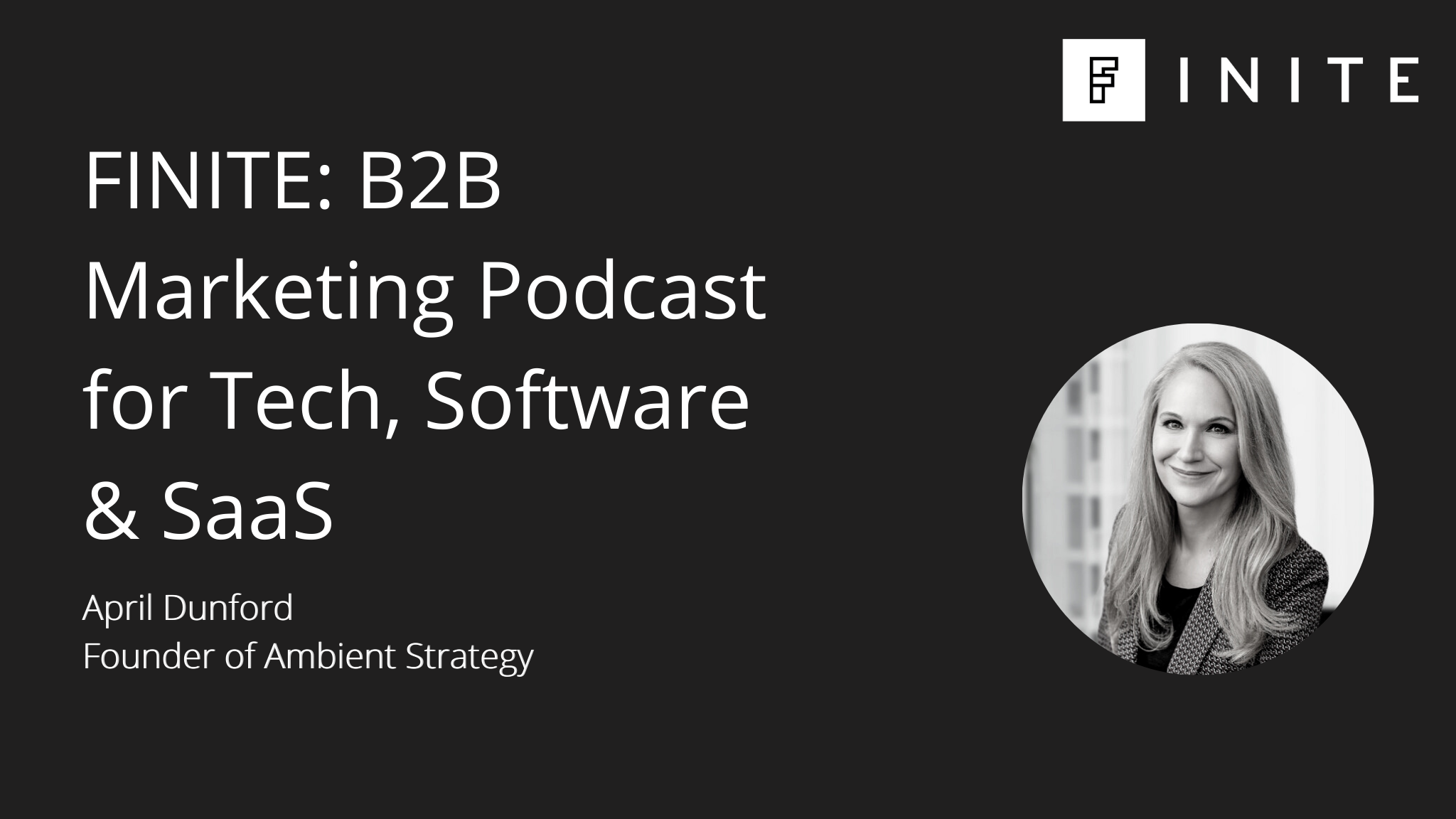
April Dunford is a positioning consultant, entrepreneur, speaker, board member, angel investor and advisor. Her expertise built on 25 years as an executive in 7 successful startups & 3 global tech giants. April is currently working with B2B technology businesses to help them position innovative products in a way that customers intuitively understand.
For this episode of FINITE, Alex and April discuss a very current topic – how can B2B tech companies position themselves and adjust their messaging in uncertain times?
Listen to the full episode below:
And once you’re done listening, find more of our B2B marketing podcasts here!
Full transcript
Alex (00:07):
Hello everybody and welcome back to another episode of the FINITE podcast. Today I’m going to be recording an episode with April Dunford. April is a speaker, an author, a consultant, and has a long career working as VP of marketing in all kinds of different B2B technology businesses and now specializes in positioning and messaging. And I first came across April’s profile on Twitter when, one of her tweets, which we’ll be talking a bit more about in this episode, was doing the rounds around how B2B tech companies have to adapt their messaging in uncertain times in downturns. So I reached out to April and I’m super excited to be recording such a relevant and topical episode with her in such an uncertain time. So I really hope that you find this episode useful and insightful. I know there’s going to be loads of actionable and useful takeaways, so I hope you enjoy.
Alex (01:20):
Hi April. Thanks for joining me.
April (01:22):
Hey, it’s great to be here. Thanks for having me.
Alex (01:24):
No worries. I’m looking forward to talking with you. I think we’re hopefully going to be covering an episode which is super topical and relevant to the uncertain times we will find ourselves in. But as we always do, let’s start with a bit of background and introduction would be great to hear a little bit about how you got into the world of B2B marketing. You’re obviously very specialist in the B2B tech world and the positioning side of things now, but would be great to about where you started and the type of businesses you worked in.
April (01:49):
Yeah, so I didn’t intend to be a B2B marketer when I started out and I have a degree in systems design engineering and I was always interested in tech, but my first job out of university, I got a job with a startup which was so long ago, gosh, it was the late nineties and back then we didn’t even call them startups. It was just a small tech business. So I got a job in product management and I mainly, I landed that job because I knew somebody at the company at the time and that was a pretty cool job. And the company got acquired and a little bit after that my boss left the company and I was kind of in the right place at the right time and they put me in charge of this team that I had no business running like it was, I think there were 30-40 people on my team and we had been acquired.
April (02:40):
So we were now part of this big global organization. And now I’m like the head of marketing for this big team and I could barely spell marketing at this point. I had studied it, I didn’t know what I was doing at all, but I was lucky in a couple of ways. One, I had really great folks on my team, so I learned a lot from them. And then two, I kind of had this attitude like how hard can it be? Just figure it out. And it turned out as this really hard, but I read a lot of books. I took a lot of courses. I built a kind of personal advisory board of smart marketing people that I could go to and ask questions. And after a couple of years of doing that, I decided, you know what, B2B marketing for tech, this is my jam. And so I spent the next 25 years doing that.
April (03:25):
My specialization was I would come into a startup at about what you would call now, like series A, but basically kind of the company had some traction and they were going and they needed to hire their first senior marketing hire. I would come in, build the team, get the lead to revenue engine working. And in my case, you know, we do that for a cupboard and then I get stuck at the big company for a couple of years doing your, your earn-out or whatever. And then I would pop out and I’d go do the next one. And I did that six or seven times across 25 years. So yeah, that was a lot. And then in the last few years I decided, Hey, you know what, I’ve done that a lot. Maybe I’ll do something else. So I transitioned into consulting and like you mentioned very specifically I focus on positioning work and the vast majority of the companies I work with are B2B tech startups that look a lot like the companies I worked for back when I was in house.
Alex (04:32):
Nice. And I guess like I’m always interested in the education side of how people get into marketing. You said the systems engineering you studied, so I guess a pretty technical course and I guess marketing is becoming more and more a technical discipline and in a lot of ways as well. But, but actually you’re more on the positioning and the brand side. So away from the marketing technology side of things. Do you feel like that was an interesting route into marketing anyway in terms of formal education or not really relevant to, to what you do now?
April (05:01):
Well, you know, I will give you this like in the early days of my career, a lot of the work that I did involve me working a lot with the product team and the development team. And what helped in terms of having a technical degree was, it was a bit like wearing the T-shirt that says I’m not a dummy. Like it was a pin like that. Like people would like in Canada, which is where I’m from, if you have an engineering degree, they give you this pinky ring and it’s like a thing in Canadian with the engineers. And so people would see the ring and go, Oh you’re an engineer assaulting kind of thing to say to people. But it was useful for me in that the development team and the product team knew they could get kind of techie with me and it wasn’t gonna freak me out or scare me or anything.
April (05:53):
Not that it would a non-technical person either. But that was just kind of the attitude of those folks. So I was happy that I had the technical degree at the beginning. The second place where I thought it was really helpful is even from an early stage in my career, I was very, very focused on being able to model the pipeline with numbers because it just didn’t make any sense to my little engineering brain that we would run a program and not be able to measure whether or not it worked. And so a lot of the traditional marketing that was happening when I started was more brand oriented versus demand generation. And, and that didn’t sit with me very well at all. I was always very oriented towards measurable demand generation because the branding stuff, well though I understood that it was important to a certain extent.
April (06:47):
I had a really hard time measuring it, particularly when I was at a smaller company when I was at places like IBM, they did amazing job of measuring on impact on brand with stuff, but we didn’t have the resources to do that. And the ways you measured it back then anyways were quite expensive. So I did a lot of focus on demand generation, you know, and those were kind of early days for people to be doing demand generation and that was very good for my career because I quickly became like the numbers oriented demand generation, VP marketing that if you needed that you would come and talk to me. So that bit I thought was really good too. But like I said, the marketing piece of it, there was a lot to learn there. And I would say I probably spent the first maybe seven, eight years of my career filling in that gap.
April (07:41):
It was a lot like I did postgrad courses, I did a bunch of things at the university in Toronto, which is where I had been based most of my career. And then, you know, but a lot of times I was working with American teams and the Americans were kind of like, you know what? You really should take some courses at Northwestern university if you’re serious about marketing, that’s where you need to go. So I’m like, okay, I’m going to go take some courses at Northwestern. At one point I was working for a big company and they had a big education budget. I was like, all right, I’m going to go get proper marketing education here. And then at one point I got rid of them at some point, but at one point I literally had a bookshelf of 900 marketing books. Like I read absolutely everything. So it took me a long time to get up to speed and feel like, you know, I could sit in a room with senior marketers and not be a fraud. I could have had no problem working with the tech folks on the development side. But the senior marketing people were more scary to me that they occasionally they’d look at me and they’d be like, do you really know what you’re doing? Like when you say segmentation, what do you mean? And I’d always be like, ‘Oh, I hope I know this’.
Alex (08:55):
It’s interesting that, I have no idea about the ring for engineers. That’s really interesting.
April (09:00):
Weird thing. It’s a Canadian thing. You can spot us. Apparently there are particular States in the United States that do it too. I’ve heard Michigan, if you’re an engineer for Michigan state, they got a little ring.
Alex (09:14):
And is it like engraved or with a particular metal, or?
April (09:17):
Okay so this whole thing like, so apparently the ring, the original rings were made from the metal of a bridge that fell down and it’s supposed to remind you of the importance of your work and how you know you shouldn’t build a bridge that falls down basically is what it is. And then it says, I’m not allowed to say this because now that the engineers will, we’ll probably have to kill me, but I have coronavirus so they’re probably too scared. So the deal is, and then you do this weird cult-like secret ceremony where they give you the ring as well, which is super weird. And the ceremony was written by Rudyard Kipling. It’s like you’re not allowed to talk about it. It’s like the whole damn is ridiculous.
Alex (10:05):
That’s amazing. Well that’s no good. Any deeper. Otherwise we might get in trouble with the engineers.
April (10:09):
find a Canadian engineer and give them a couple of pints at the, at the pub and get them talking. That’s what you need.
April (10:16):
I should do that. Let’s dig into what we’re going to talk about, which was I guess positioning in these very uncertain times. And I guess for everyone listening, I reached out to you to record this episode after I saw one of your tweets kind of doing the rounds on the internet and I think it had obviously had some reach and it had reached me somehow through someone. And you were talking about, I guess the importance of how different B2B businesses position themselves and growth focused messaging in different times. But I guess before we really dig into that, tell us a bit about your, I guess almost like the, the approach or methodology or how you look at positioning generally.
April (10:55):
Yeah, so the big thing I’ve been focused on as a consultant is positioning. And part of the reason I picked that as a focus area is because I don’t think positioning is done well. It is often misunderstood. And in my own course of trying to learn marketing on my own and taking a lot of courses and reading a lot of books, I was super surprised that we have this concept of positioning, which is really foundational to a lot of stuff we do particularly in B2B. And yet there didn’t seem to be an accepted methodology for actually doing it. And I found that really surprising when I was going through my own stuff, particularly because I was landing at startups that often had quite weak positioning and I was expected to be running demand generation programs. But I’m asking really basic questions about the positioning, like who exactly is our competition and how exactly do we beat that competition and where, you know, how do we define our value and who is a best fit customer for that value?
April (12:06):
And Oh by the way, what market are we actually positioning ourselves in to win? And I often got mushy answers to those questions. And, what I did learn from my marketing education was that’s positioning. Like putting all that stuff together is, kind of the foundation of everything we do in marketing and sales, but there’s no way to do it. So I was kind of making it up as I went along. I’m having coffee meetings with every smart marketer I can find and I’m saying, Hey, how do you do positioning? And it’s not like we weren’t doing it, we’re all doing it. It’s just we weren’t all doing it in a standard way. So a lot of us senior people anyways, we’re kind of making it up. Or we had our own sort of way of doing positioning that worked for our particular company.
April (12:54):
But then the next time we picked up and moved to a new company, we’re like, Oh gee, that doesn’t work exactly this way here. So now I gotta do something different. So I became really obsessed about halfway through my inhouse marketing career, I need to do this in a repeatable way. This is more probably my little engineering brain thinking about this. I need to do it in and there needs to be a methodology that I can pick up and take with me. Every company I go to work at. So over time I built that. And then I started teaching a course at a local university about positioning. And I was trying to teach people my methodology, which it turns out knowing your methodology is one thing, but then trying to teach it to somebody else is a whole different thing. So after a couple of years, I got good at that.
April (13:39):
And then I started teaching a class at a local startup accelerator, and then I started doing more accelerators and eventually I wrote a book to capture it. But that basically I can give to anybody and say, you want to know how to do positioning? I don’t know if it works for everybody, but if you’re a B2B tech company, this is how I do it. And so it’s captured in the book. And so the way the methodology works is it starts by breaking positioning down into five component pieces, which if you’ve ever encountered the positioning statement, the positioning statement is a way of capturing positioning. And it’s a kind of fill in the blank exercise. And in the positioning statement, the components of positioning are essentially the blanks. So I’ve got competitive alternatives. Your unique features or capabilities of your offering, the value that those features or capabilities deliver for customers, which customers are we talking about?
April (14:40):
So what’s my segmentation of which customers I’m trying to target. And then the last is the market category, which you can think of in a way if you know the context in which we position our product that makes it relevant for our people. And so my methodology breaks it down into those five pieces and then we work through the pieces in a very specific order, in order to get positioning that is differentiated. And this came out of some of my research and learning, spending a lot of time with the folks that do jobs to be done stuff. And I had a bit of an epiphany that we actually needed to start with competitive alternatives. But competitive alternatives might not be what we actually think of as competitors. So often the competitive alternative is do nothing, or the competitive alternative is hire an intern. So we need to really understand who our competition is.
April (15:37):
Then we can say, okay, what have we got that they don’t have? What makes us different capability wise, then we can say, okay, what’s the value in that? Then I can say, well, which customers care a lot about that. And then market category is what’s my context that makes this value obvious to these people? That’s the methodology in a nutshell this is this super fast version of it. If you want to geek out on it, you can buy the book and like, you know, spend all day thinking about it. But that’s essentially the way I look at positioning and my approach to it.
Alex (16:10):
Awesome. And yeah, I think you’re so right that positioning is one of those things that you just don’t have. No, there hasn’t been until you’ve come in on like a framework to apply it. And it’s one of those words, but I think a lot of marketers probably see or hear r and it’s, it’s a bit like the word strategy generally. It’s like, gosh, no kidding. Yeah. It’s just what is that actually?
April (16:28):
Like what does that mean and how do I build one?
Alex (16:33):
Um, so it’s great that the engineering has brought, uh, a sense of kind of law and order to something that otherwise it’s kind of, yeah, can feel like a pretty overwhelming and a big mountain.
April (16:42):
I hope so. Like this is my hope. I want to make a little contribution to this thing. The idea was I’m going to write a book that I wish I had when I had that first senior job and I was like, okay, I think we have a positioning problem. How do we actually do it? And then crickets.
Alex (17:00):
So the, um, the tweet I saw of yours was kind of touching on a few areas around, I guess messaging in, I guess you referenced the downturn, but I think in uncertain times also kind of applies, but right. Tell us a little bit about kind of what you were saying there and the outlook.
April (17:16):
Well, so I got thinking about, so I’m, you know, I’m kinda old so I’ve been through a few bad downturns. I mean we had a bad one in 2008 2009 before that we had the, the 99 2000 dot com bubble pop. And I lived through that one too. And I think I learned a few things from that, although I have to preference this by saying like I don’t think we’ve ever seen anything like what’s happening right now. And so who knows if this one is going to be different. I certainly think it has the potential to be different longer term or in terms of how we come out of it. But right now it feels very much like 2008 to me or even 1999 to me in B2B tech, 1999/2000 was a bad year. And so I wanted to share a little bit of what I saw through that and how it relates to positioning cause that’s kinda my jam.
April (18:15):
So here’s what happens is when we have a big external thing like this happen, what happens from our customer point of view is often their priorities go through a massive shift. And so something that was a high priority previously, suddenly a low priority and things all get turned upside down. And so one of the things that you see when the big external force is an economic downturn, you’ll see certain customers, not everybody, but certain customers will shift their priorities in a way that your very strong value proposition two weeks ago suddenly doesn’t work anymore. And one of the biggest things I’ve seen through the previous downturns is in B2B. And I had a boss that used to talk about this all the time that in B2B if we abstract out our value propositions to the most abstract, they could be. All our value propositions either helps you make money or helps you save money.
April (19:21):
These are, this is all we got. That’s kind of, and so if you think about it and the rule of thumb in general when we talk about those two it helps you make money is a stronger value proposition then Oh we’re going to help you save some money or we’re going to help you reduce costs. But in a downturn, what happens again for some businesses is they switch from being in growth mode to being in survival mode. And so I’ve seen it with a lot of the companies I’m working with right now and their customer base is suddenly not focused on growing like crazy this year because they don’t have the ability to grow like crazy this year anymore. Things are slow and in some cases closed. And so instead they’re very much focused on how do we ride this thing out? Like we just need to sustain and survive and come out the other end and then we’ll worry about growth again.
April (20:23):
So if your customer’s priorities have shifted like that, all of a sudden this, Hey, we are going to help you grow faster. Value proposition is irrelevant because they’re not focused on that anymore, even though they were a month ago. And this idea of, Hey, we’re going to help you sustain by helping you get costs under control. We’re going to help you save money. We’re going to help you do more with less. All of a sudden that value proposition seems incredibly relevant. And so you might ask yourself like theoretically from a positioning standpoint, how does that fit in? I had this thought anyways, how does that fit in my methodology and how would I actually figure that out? And how it’s changed is, again, the starting point is this idea of a competitive alternative, which is what would I do to solve the problem that your product solves if you didn’t exist?
April (21:15):
Well, suddenly the problem has changed and therefore the competitive landscape has changed. And a lot of times, you know, I’m no longer competing with other things that are helping me grow. Now I’m competing with, gee, maybe I could do nothing here. Or maybe I could just, you know, I’ve got reduced staff and I’ve got some staff that are really getting redeployed from doing one thing to doing something else. Maybe I could just throw some people and not buy software for this at all. And you know, or maybe I could just do this in Excel. I know it’s not perfect, but I don’t have money to buy stuff right now. So then the competitive landscape changes. Therefore your value and the priorities for customers change. Therefore your value proposition in some cases needs to shift. So the way you figure this out is you need to actually be really close to your customers right now because you need to understand how their priorities are shifting so that you can respond to that and make sure that what you’re talking about out in the market is still relevant for those new priorities.
Alex (22:24):
And so I guess that leads onto the question of like what is the practical next step? Because you’re talking about when we talk about positioning, we’re talking about something that’s pretty fundamental to the whole brand of the business a lot of the time. And it’s not something that can just be, you can’t just kind of shift the tracks to the other side overnight. And then so I guess at one end you’ve got a whole repositioning and at the other end you’ve just got, you know, some temporary adaptations to messaging and your communications kind of shift in tone slightly to adapt to a new environment that, I mean you talked about staying close to customers and really understanding their attitudes. I guess. How’d you go about doing that on a practical basis?
April (23:03):
Yeah, so I, so if it was me and I was sitting in the VP’s chair right now, there’s a handful of things that I would very specifically be doing right now. So one is I would be doing as many customer interviews as possible and in particular I would be looking to my best fit ‘good customers’ and I would be looking to have, and I would be hesitant to even do this in a survey because I’m not sure you’d be smart enough to ask the questions that you need to ask because we just don’t know. And I would be actually getting those folks on the phone and saying, what’s going? How’s everything going? What’s shifted in your budgets right now? Have your priorities shifted? Where do you see yourself and what’s your timeframe on this? Is it six months, is it a year and how does our stuff fit in that?
April (23:58):
Do you see it fitting in that how does our stuff change in terms of, you know, how you’re using our solution and where it fits in this new priority. So I would be having a ton of those and then I would be sitting with my team trying to decide like if the feedback I got from my customers is, you know, yeah, we’re shifting some priorities a little bit. We’re still more or less on the same track. We’re just being a little cautious. Uh, we think this is maybe a short term, four to six month thing and then we expect to be kind of, okay, if I was here and that for my customers, then I might almost treat this potential new positioning as a campaign. Like something short term that I’m not going to forklift everything on my website. I’m not going to retrain my sales reps to tell a totally different story.
April (24:52):
I would treat it more like we’ve got a good story to tell for customers in this particular situation and let’s run this like a campaign for customers, we think may meet that criteria or that set of qualifications. Now if instead I started talking to my customers and you know I had a call yesterday with a company that I’m working with and they’re in the middle of doing this and what they’re hearing from their customers is we got a brand new 12 month plan. We don’t expect this to change in 12 months because of the industry we’re in and it may be 24 months and we have absolutely shifted all the resources and everything else and we’re not even doing another checkpoint on it for six months. These are our new set of priorities and it’s going to go for a year. If I was hearing that from my best customers, then I would actually consider a complete forklift of my value proposition and my messaging because you know what?
April (25:54):
Positioning is not a static thing. It does change over time and it doesn’t mean you can’t change it back a year from now, but if it’s going to be a year, then I need all hands on deck with this. I need to, I need to build new sales materials, I need to get my sales people trained to deliver this new message and this new reality so that we’re relevant to a new set of customers. That’s one thing. The second thing is if I was hearing that from my existing customer base again and this was like an all hands on deck kind of emergency, I would absolutely be looking at whether or not I’ve got a serious risk of churn in my existing customer base and if thats so then I would be redirecting a significant amount of my budget from growth related things to retention related things. And so what I’ve done in previous downturns, if I think about the 1999/2001 in the team that I was working on, we completely stopped doing growth marketing essentially at least growth into Greenfield accounts and we switched almost everything into retention and existing accounts and in certain segments.
April (27:17):
I was running expansion inside the account campaigns because we had a really good value proposition for Hey, if you expand in here, here’s how we’re going to save you extra money. And so we saw that as our best chance for a little bit of growth over the next over the year we were looking out at, and we did a complete shift on the messaging and a complete shift on the sales materials. That complete shift on our campaigns. A clear like the underlying positioning changed that we were, we are no longer competing with who we used to compete. Therefore our differentiated capabilities are totally different. Therefore our value proposition is different and therefore the target customers, which in our case was, we’re not getting anybody new, we just got to focus on the ones we’ve got already is different. And so we changed the messaging and then downstream from that, that changed everything from messaging on the homepage campaigns.
April (28:12):
We were running, materials we were doing for the salesforce. Everybody got retrained. It was like a massive effort over the course of a quarter and we turned the thing. And then we ran that for 18 months before. And even at the end of the 18 months, we lightened up on it a bit, but we were still like, like the 99, 2000 wasn’t over in a year. That was like, it felt like you turn it to I think maybe three years. We were getting over that one. And it, it changed our, I would say our value proposition stuff was impacted forever after that.
Alex (28:54):
That makes sense. And I think that’s a nice way of looking at it in terms of, I guess a) talking to customers, which I guess you could argue all marketers should be doing pretty regularly anyway, but now it’s more the time than ever, be thinking about.
April (29:06):
Well, I would say the kinds of questions you’re asking are different, right? Because sometimes you’re in there talking to customers and you know, a lot of the customer interviews that I’d be doing would be with you know, a brand new customer that I’ve just acquired and I’m trying to get a feel for, you know, did we pull you off another platform to get you on ours? And when you were in the purchase process, who else did you look at? And you know, I’m trying to get at who is my real competition here and why did you pick us? Whereas when I’m in the middle of this ‘oops, I think something has really changed here’, I actually need to check in with a bunch of customers that have been my kind of bedrock, good fit customers and, I’m having a bigger question about their overall business priorities and whether or not I fit into that in the same way as I used to. So the conversations I’m having are really different. It’s a bit more like, ‘Hey, are we, are we still a high priority solution for you or are we somewhere else?’ And if you were thinking about us, you know, how did you think about us before and is the way you think about us changed because of your shift in internal priorities and that’s what I’m trying to get a beat on.
Alex (30:24):
Yup. I think that the idea that yeah, you know how long it’s going to take for people to, if they rewritten it a 12 month plan and I think you can almost think about it now in some of the, some of the industries that have been most acutely affected by coronavirus in terms of, you know, recruitment is at a standstill but probably only semi-temporarily, right? I think people are still going to need some new jobs and that should, even if it’s a few weeks, once people have passed the shock, can we adapt to new ways of working? They should be coming back online. But if you’re the, if you’re a B2B tech company selling into, I don’t know, hospitality or, or travel, then I think you’re right in that, you know, a year if not more, could be the bigger things.
April (31:01):
Yeah, hospitality and travel are like the extreme versions. But what we’ve got is a lot of like there’s nuances in there too. Like I have a company that I work with that sells to big consumer packaged goods brands and some segments of CPG are on fire. They’re doing amazing. Like if you sell cleaning products and you know it’s a great time to be you. And there’s a lot of things like you know grocery is doing really well cause we’re all at home and we’re eating like we’re stress eating like pigs apparently. And people are showing that they’re doing different things. Like they’re trying new brands sometimes because their old brand is sold out and they, you know, they’re so in the food side is different. But other things in CPG like interestingly makeup is terrible because no one’s going out and we can all put that filter on our Zoom.
April (31:54):
So we look fantastic even without makeup. And so you know, makeup is way down and that’s a thing that’s more about experiential. Like, you know, you want to, you want to be in the store and try things out and stuff. And so you know, so that’s not doing so well. So you know there are things in the gray area between, you know, there are some things we know are doing really well, like if you’re going to remote communication technology, yay for you but and if you’re in travel not so good but in the middle there’s a lot of nuance in the middle that, you know for me it’s interesting like a lot of the companies that I work with, they’ve got a segment of their customer base that is going great. Like, like their big problem is theyre too busy and they don’t know how to handle the growth and they’ve got another segment of their customer base that is literally fighting for their lives, trying to stay alive.
April (32:48):
And then they got folks in the middle that are kind of a bit of both and some of them are just holding their breath to see what happens. Like you really got to check in with your customers and figure it out. The other thing I’ll mention is, and we had talked about this before, but one of my favorite things to have in B2B is a customer advisory board. Like I’m really big on customer advisory boards and I run virtual advisory boards, even pre Corona time and you know now would be an amazing time if you have the cycles and you can figure it out to form a customer advisory board, particularly if your customers tend to center, like if there’s a lot of commonality across your customer base because I think the customers are interested in being part of an advisory board as well so they can talk to each other.
April (33:43):
And so you could actually provide kind of interesting value by gathering people together and then it would also give you a chance to have these kind of more open conversations with a group of people and say, do you see this? Do you see that? What do you see changing? What’s the temperature of this in your organization? Is it the same across all organizations and is it different? And so I would be thinking about is there a way for me to do a customer advisory board? How would I do that virtually? What would the commitment be to look like that? What are some best practices around that? And I think that would help me again do more of this checking in on customers in a real systematic way.
Alex (34:25):
You talked a little bit about the shift of focus potentially from acquisition to retention and reducing churn and I guess how designed, I don’t know whether the pricing strategy kind of forms part of your positioning work, but it’s obviously a pretty important part for most B2B tech companies. I guess there’s always been a landscape of, of within any kind of specialist product of those cheaper guys and more expensive guys and some people have done quite well off the back of, you know, we are the cheap guys. But as you said, if you’re now up against a spreadsheet rather than the more expensive solution, it’s more about saving money than making money. How does that kind of landscape shift specifically around cost I guess?
April (35:04):
Well, pricing is really interesting. So you know, I have, for example, I had a conversation last week with a company and they said, you know, I think we’re, our positioning is okay because we always positioned ourselves as the low cost solution in this market and that made me feel really uncomfortable because what I worry about with that positioning at least that if that was your positioning before the downturn, then my worry is that the kinds of customers you have that have chosen you are willing to settle for the low cost solution and not a higher cost solution because the thing that you do just isn’t a priority, which means you’re at great risk of churn. So even though you were the low cost solution, if I’m trying to trim some stuff off my op bags, I’m going to look at this and say, what is this thing?
April (35:59):
I know we only spend 15 bucks a month on it, but that’s 15 bucks in my jeans right now. So I would be very careful if that has been your positioning previously. I’d be really, really worried about churn right now. And again, I’d be checking in now in terms of what we’ve got happening right now. You know, I’ve seen, it’s interesting to watch how certain companies are reacting. So some companies, particularly those that are selling into small businesses are doing some relief things where they’re saying, look, you know, we’re going to give you, you know, a break on your rates for the next three, four months and three months free or whatever. And you know, and I think if your customer base is hurting, if you have a risk of churn, because people are doing extreme panicky price cutting, I think buying yourself a few months for everyone to settle into the new normal is a very smart thing to do.
April (37:00):
But again, it’s very different for every company. I would not knee-jerk drop the price because I think, Oh, that’s a thing I could do to reduce the term because it doesn’t necessarily, right. It doesn’t necessarily, that’s why you really need to check in and have these conversations with your customers and find out what are they doing. Because it could be that they, you know, they look at your thing as kind of a sunk cost and all we’re here anyway and you know we can’t churn you and we’re just looking to use you in different ways of things like that. Like I would figure that out first before I reflexzively tried to do a price drop, but if I checked in and found out, you know what I, I’ve got a good swath of customers that are at risk of turning me off even though they love me because they just don’t have the budget to do it right now or there’s panic.
April (37:56):
Then I would look at some of these things. I also think that again, it’s very segment-specific but in certain cases for certain industries, if the industry is hurting right now, but you know it’s going to come back, the minute stores are open and we’re out of our house and we’re out doing stuff. It may be an interesting experiment to try take all the friction out of bringing in a new customer by making it free for three months or for free for four months or something. And then we’re going to turn you on later. If you know you may want to experiment with some of that stuff, at least have that conversation with your team to see is it worth running an experiment around that. Cause I’ve seen some of that that I think is very, very smart because six months from now or four months from now you’re going to turn this revenue on and it’s going to be amazing.
April (38:52):
But if you’re trying to get cash out of these people right now, forget it. So you know, again, it really depends on your customer base and what they’re doing. But I would be trying to figure out other things I can do short term tactically that involves pricing and packaging that can help me weather this bumpy patch and potentially set me up nicely for whenever the heck we’re out of this thing. Because again, the end of this thing is going to look like no other recession or downturn we’ve ever had. And so we’re all going to have to, it’ll be fascinating to watch how this thing wraps up.
April (39:33):
Good advice that I think you’ve got a number of different things on your website in terms of some kind of templates and downloads and things that people can can make use of and of course your book. But yeah, tell us a bit about some of those resources and why people would go. Yeah, so the whole deal with the work that I do and the book and everything else is you know, is born out of my frustration of trying to figure out how to do positioning and being like, it’s all very nice. We don’t, we talk about positioning a lot, but no one knows how to do it. Like in particular when I was learning about positioning, everyone reads this book by these guys Ries and Trout called ‘Positioning the battle for your mind’ and this is an amazing piece of content marketing from the eighties basically it gets you all excited about positioning, but then you get to the end and it’s like, but how do I do it?
April (40:21):
And the answer to that question is call us. So my stuff’s not like that. I’m trying to actually teach you how to get it done. So the book is the deep dive in the methodology. There’s a handful, if you, if you read the book and then you’re interested in the templates, there’s a bunch of templates you can go on my website and download them. So the templates include some templates around the methodology as a way to capture a positioning in a canvas. It also includes a couple other things that are more things you do after a shift in positioning. So I work a lot with small startups and at bigger companies we always built a messaging document. Most small startups never do that. So I have a template for a messaging document cause I’m a big believer that everybody needs a messaging document. So I have a template for that.
April (41:14):
And then I also have a template for something I call a sales narrative, which is a bit of, once I have my new positioning figured out, here’s a template for how I would build a sales story around that. And again, a lot of smaller companies don’t have a lot of discipline and how they build a sales narrative. This is kind of my template for doing that based on how we build sales narratives across all the bigger companies that I worked at. That tended to have a bit more rigor in the way they built those things. So those templates are up on the website. I think I make you give you my email address but don’t worry, I never ever send newsletters out. Maybe I will like twice a year or something I hit my email list and say, Hey, remember me? But anyways you can give me me your email address, go on there and download the templates and then if in the middle of that you have any questions or you want to just, you know, bounce some stuff off me. I’m april@aprildunford.com and you can drop me an email too.
Alex (42:13):
Awesome. That’s very kind. I’ll make sure that we link to your website and the book and your email address if you’re happy for that to be shared as well when we publish the podcast. But I feel like we could keep talking for hours and hours, but in the interest of a concise podcast for our listeners, we’ll wrap up there, but I’m hugely grateful for your time and for talking through something that’s, yeah, such a current topic and one that people need so much guidance on. So I think this is going to be some really valuable food for thought for everybody, that listens, but a big thank you for joining me.
April (42:40):
Hey, well thanks for having me. It was fun.
FINITE (42:44):
Thanks for listening. We’re super busy at FINITE building, the best community possible for marketers working in the B2B technology sector to connect, share, and learn. Along with our podcast, we host a series of events here in London, so make sure you head to finite.community to subscribe and keep up to date with upcoming events.