- Some additional information in one line
- Nov 2 2020
Podcast: The importance of trust in B2B marketing with Nick Harley, VP of Growth at Raygun
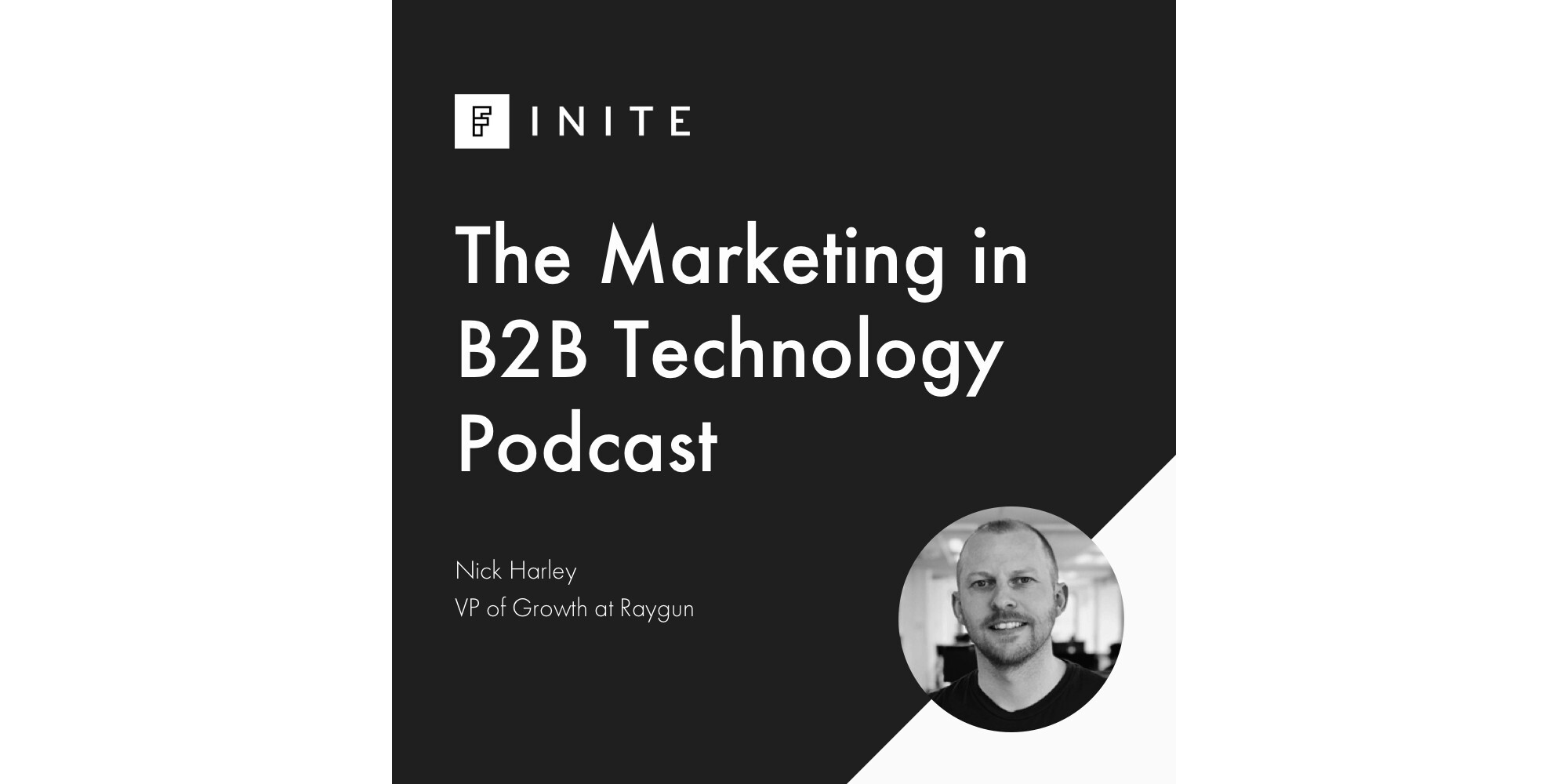
FINITE founder Alex sits down with Nick to talk about the importance of trust in B2B marketing, particularly when marketing to technical stakeholders such as CTOs or developers.
Nick Harley is VP of Growth at Raygun, an application performance monitoring solution enabling development teams to build high performance software.
This episode covers:
- Nick’s background in marketing and the marketing function at Raygun
- About the B2B tech scene in New Zealand
- How to build trust with technical personas
- Empowering junior/mid level developers as a word of mouth marketing strategy
- Using a free trial to build trust at the beginning of the buyer journey
- Delivering value, instead of ads, to build trust
- How not to market to developers who are pro self serve and ad blockers
- Educating about the problem and your solution through word of mouth
- Optimising documentation for SEO
- Segmenting developer personas according to language
- Using online community platforms to trigger word of mouth
- Autopilot as a marketing automation tool
- Challenges and trends in the industry
Listen to the full episode here:
And once you’re done listening, find more of our B2B marketing podcasts here!
Full Transcript
Alex (00:07):
Hello everyone, and welcome back to the FINITE Podcast. On today’s episode, I’m sitting down with Nick Harley. Nick is the VP of Growth at Raygun, an application and performance monitoring software.
And we’re talking about trust and how key trust is in B2B marketing, particularly when, as in Nick’s case, he is marketing to developers as a key persona. So this should be an interesting one, I hope you enjoy.
FINITE (00:31):
The FINITE community and podcast are kindly supported by 93x, the digital agency working exclusively with ambitious fast growth B2B technology companies. Visit 93x.agency to find out about how they partner with marketing teams and B2B technology companies to drive digital growth.
Alex (00:54):
Hey Nick, thanks for joining me today.
Nick (00:56):
Good to be here.
Alex (00:58):
I’m looking forward to talking. I think this is a topic that’s, the more I thought about it, it’s going to resonate with pretty much everyone when it comes to trust in B2B marketing. I think it’s pretty relevant in today’s age. As we always do, should we start with a quick background and intro to yourself? Tell us a little bit about your background and experience to date.
Nick’s background in marketing and the marketing function at Raygun
Nick (01:16):
Yeah, sure. So I currently work at a company called Raygun, provide application monitoring software for software teams. I’ve been involved in start ups 12 or 13 years now and, I have built various companies of my own. I’ve helped other people get their ideas off the ground or with varying levels of success. Some of them stand out as wins and some have been complete failures.
So I’ve pretty much rode a rollercoaster over that time of going to zero in the bank account and then back up and then back to zero and then back up again throughout that time. So quite entrepreneurial, quite involved with the startup community here in New Zealand.
And the very first startup I built around 12, 13 years ago was very much at the start of what we would know now as the cloud and SaaS, software as a service as we know it now. And so maybe if I’d have been a bit smarter back then, I could’ve maybe made a better go of the software I was building. But it was very, very early in that kind of space. And so I kind of learned a lot growing as an individual and with experience over that time.
And when I got the opportunity to join Raygun around 7 years ago now, it was certainly, they’d launched a product and they just needed somebody to help them grow that business. I saw it as a very good opportunity to get in early, grow a Wellington based SaaS company and market that to the world.
And so I’ve pretty much had most of my career in the digital marketing space. I was director of marketing for a long time. And then late last year I became VP of growth, which is kind of a fancy title, similar to like a chief revenue officer. I have around 10 or so people reporting up to me across business development, customer success and marketing, but definitely my background has been more around the marketing side of things.
Alex (03:15):
Cool. And within the team, what are the different roles, specifically within the marketing team, how generalist, how specialist is the marketing set up at Raygun?
Nick (03:24):
We’re very generalist and when we try to hire people, we look for people who have just got that passion and get stuck in and kind of learn. So it’s actually quite a good mix, but we have three people mainly in the marketing team: Freya, who does our content side of things, Andre, who’s more our events, webinars, podcasts, and media type skill set. And then Jamie who’s joined us as a product marketer and runs a lot of our PPC.
And we use a couple of external agencies as well in that mix, but we’re very much generalists and we like everybody to get a bit of experience across all the disciplines of marketing.
The B2B tech scene in New Zealand
Alex (04:01):
Nice, very cool. And I must ask you whilst we’re talking because I think this is the first episode I’ve done with a company based in New Zealand. So do you want to tell us a little bit about the New Zealand start up scene as such and like, I’m trying to get a sense of the scale. I guess in most of the cities in the world, there’s like little hubs where lots of companies are side by side. I mean kind of literally geographically, do you have something similar in Wellington?
Nick (04:24):
Yeah, very much so. I mean it’s surprising just how much is going on in New Zealand. A lot of people don’t realise that we’re around 5 million in population, but certainly tech has been a very fast growing industry for us. And especially in Wellington, there’s a lot of tech, startups and tech community meet ups and stuff you can go to.
So it’s actually a thriving little community down there and a very good test bed as well for companies like Facebook that tend to test a lot of their technology down in New Zealand. And then if it’s successful here, we tend to see it extended across the rest of the world. So they use it as quite a bit of a test bed, which is somewhat good in that.
But yeah, I moved there from the UK and I wasn’t that involved with startups in my time in the UK, but certainly coming to Wellington, you kind of feel like there’s a real community spirit around startups and everybody’s willing to have coffees and help out and knowledge share together. So it’s very, very tight knit as well.
Alex (05:25):
Nice, well let’s dive into the topic. So we’re talking all things trust, I guess this topic came up, we had a bit of back and forth right about what we’re going to talk about on this episode. And obviously Raygun is targeted at developers and they’re kind of your main persona as such, as with every B2B purchase, I’m sure there’s other people involved, which we can dig into a bit more.
But actually the more I thought about this, I realised that there’s going to be very technical personas involved in pretty much every B2B tech purchase decision. And I think we think a lot about trust as marketers and all the things that we can do to demonstrate trust and validate social proof and all the things that we can dig into. But to set the scene, why don’t you tell us a little bit more about the specific audience that you’re marketing and selling to, and your target personas?
Approaching trust building with technical personas
Nick (06:10):
A lot of our core users are developers. That’s who gets the most value out of the tools we sell. But as we’ve kind of scaled the company, we’ve gotten to bigger deal sizes as you sell you then start to get procurement people in. CROs, product managers, CIOs, and CTOs, and the level is shifted from purely developer only play to speaking to more technical decision makers.
For anybody who already markets to developers, they’ll probably be nodding in agreement when I say they’re a very tough audience to market to, and I often tell our team that the best way to market to developers and technical people is not to market to them, which sounds a bit a bit odd. But they really don’t like general typical marketing.
Like you have to get them on a more educational value driven, give them something that helps them learn in their career or their job, like give them some value in order to build that trust. I think anybody who is traditionally going out there and saying the best way would be to throw a lot of money in Facebook ads and do that type of marketing won’t have much success targeting more technical people.
I think they’re very community driven and word of mouth driven as well. And they all run things like ad blockers, script blockers. They don’t like traditional ways of marketing and they will tell you that as well. So I think the way we approach it is we have our kind of core base of users and we have to deliver good value with our products.
But then when we’re talking to more senior people, the conversation shifts more from what are we providing as a developer tool into things like what’s the impact on revenue of the business? How does it help them be more efficient? Does it save them money? How does it make them money and things like that. So it it’s a bit of a split at the moment, but traditionally speaking, historically, we did have a very developer heavy focus in the early days.
Alex (08:05):
Even in those more enterprise sales environments where procurement, legal, CTOs, et cetera involved, is it still a developer at a slightly more kind of mid junior level, that’s initially kind of reaching out to you or inquiring or demonstrating? Then once they’ve validated there’s a use at Raygun, or they like it, they then go back to the rest of the business and say, we want to buy this. And they have to kind of build the business case, et cetera.
Targeting junior/mid level developers for word of mouth marketing
Nick (08:28):
It’s a real mix right now because it’s kind of bottom up and top down at the same time. So we can get people who are quite senior in the organisation and they want to consolidate it over their entire team. And that’s one conversation. And then we could have a developer who’s trying to sell it up within the organisation.
We often feel that we have to empower that developer and the lower level people to actually take the right information up to their manager and up to the most senior people. Whereas when you’re talking to them, the more senior people, they’re very much cost driven. What’s the benefit to the business? And they’re a lot closer to the outcomes that they’re trying to make for the team.
Alex (09:08):
And so developers are probably not thinking in terms of business case and how to demonstrate business value. So when you talk about empowering them, how do you go about doing it?
Nick (09:21):
Yeah, well essentially they might want the tool, but they’re struggling to actually give the reasoning why, so a lot of times they’ll have to provide a demo or an ROI analysis or some kind of level of reasoning because developers traditionally have been sat at their computer’s coding way. And then when they come to buy this tool, they struggle to articulate the why to their manager, what’s the impact on the actual business.
So we try and arm them with the right collateral or join them on a demo to kind of be their champion, make them the hero of the deal. Like, you know, this person’s going to bring in this tool and it’s going to fundamentally change the way that they develop software or the way that they ship software to their customers.
So they’re our advocate at that point, we need to empower them and give them the right resources to allow them to frame it in a business case way. So if the deal’s looking like it could all hang off that we try and make that certain person our best friend almost and help them succeed in what they’re trying to do.
Alex (10:27):
Cool. And just so everyone listening has a sense of the journey. Is it most common that a developer would have a free trial as such before then building that case or what does it typically look like?
Using a free trial to build trust at the beginning of the buyer journey
Nick (10:37):
Yeah, we provide a 14 day free trial. We’ve never gone down the freemium route and we’ve never really needed to, but once the trial has been done, that’s the evaluation period, but often once the trial’s finished that’s kind of the beginning of the journey because they have to then go and take that information and then share it with the wider team. And then you have to sell them on why the tool is going to be good for them and why this solution is going to be good for them.
So it depends on the company size a lot of the time because people who take free trials and then self serve are one side of the conversation, but then there’s also the other people who want you to provide a demo to them and to their team and do the work to kind of sell them on why they should use your software. So it’s kind of a split in the funnel right now in that we have a free trial, but then we also have the contact sales and let’s talk about your particular problems and we can adapt demos to fit certain use cases, things like that.
Alex (11:36):
Cool. And are we saying that trust is basically just more important for this audience? We’ve talked about how they’re kind of more naturally skeptical and some of the things that they do and how they don’t like being sold to, and I think your point about them letting you know if they’re not happy with your marketing, it’s one that I’ve seen before.
Like if you target some developer focused Facebook ads or LinkedIn ads or something, they’re going to leave comments and be pretty vocal about not liking your apps. I guess you can almost damage the brand as much as you can build one, if you get your marketing wrong with this community, but yeah. Do you think trust is just even more key here?
Delivering value instead of ads to build trust
Nick (12:12):
Well, I think trust goes both ways, right? They want to trust your company that you can do something for them, and then you want to trust them that they’re going to be a good customer and then they’re going to stay for a long time. So if you’re just throwing them ads and then expecting them to buy, that’s just never gonna really work. You have to build them a bit of a relationship over time.
Like I said earlier, if you’re delivering some kind of value to them, that’s going to help them, like it could be a technical blog post that helps them solve a problem they currently have, or it could be resources that they find useful. You’re building that relationship with your brand over time. Then when it does come time that they need a product and you can offer it, they will choose you over other tools because you’ve already built a kind of relationship with them. And you’ve built that trust over time. But you’re just not going to get that unless you actually have some kind of educational component that helps them with senior technical people.
Alex (13:10):
Makes sense. And how much of a challenge is there around that? Because I guess application monitoring is something that’s pretty widely accepted in most developer environments, but are they already using a different product before they explore Raygun? Or is it something that most developers or businesses aren’t using anything at that point when they engage with you?
Nick (13:27):
It can vary because we have three core products in our suite of products. One being a crash reporting tool. For that one, you would say that a lot of people are using traditional logging and they can move over to a dedicated product that can help them get a handle on their errors and crashes that happen in their applications. Then we’ve got a monitoring tool, which is front end performance.
A lot of people come to us for that product and they don’t have something existing. And so that’s more of a greenfield type approach. Then with our APM, which is our service side monitoring there’s players like New Relic, Datadog, AppDynamics, Dynatrace, like we’re in that kind of space.
So traditionally for that product, then people are coming to us from a competitive tool. And a lot of it is around cost savings and simplification and consolidation of tools at that point, because they can be very expensive. But yeah, it can vary across the different tools and what we’re selling for each kind of audience for us.
Alex (14:27):
And so what are some of the quirks that you have to think about when you’re marketing to this persona? You mentioned at the start that they often use ad blockers, but what are some other things that they often do and what’s the impact for you on marketing?
How not to market to developers
Nick (14:39):
Yeah, it can really depend on what type of person you’re selling to in the sales funnel. So typically developers come in and they don’t really want to spend much money. They just want to learn the ins and outs of the product themselves, they don’t really want to be bothered by sales team and they just want to self-serve on their own, find their own answers.
So that can be a bit of a challenge when you’re trying to do on boarding emails and things like that, because people will sign up for your product then immediately unsubscribe. So then they’re never going to have any of the onboarding help. And you’re just going to have to hope that they can onboard themselves at that point. And then, like you say, a lot of people are using ad blockers, script blockers. Anytime a tracking tool, they don’t want that they’re going to run some kind of blocker to make sure they don’t get in that.
So you can find that when you’re driving traffic to your website and a lot of your target audience are then blocking your pixels or LinkedIn ads, Google ads, Facebook ads, then you almost start to build these audiences where you’re targeting the people you don’t actually want to use your product because it’s all the audience that aren’t using those are starting to build up in the audiences and then you’re targeting the people who don’t use an ad blocker.
And so you can start to find that your audience start to become saturated with the people that you don’t actually want to target, which is always a bit tricky. And so I think the good way to counteract some of these things are to focus on stuff you can actually influence and sell.
Things like Google ads are very good for us because people type a specific query into the Google ads. And then we know that we can meet that as a solution and also SEO and content allows us to actually market to them in their language, to the right people, talk to the people who are our target persona and get them visiting the site, and then just use our PPC ads as a bit of a backup.
So I think you’ll find that your PPC ads, if you’re continuing to try and brute force people through your funnel, using PPC and this type of audience, then it’ll become less and less effective over time, is what we’ve seen.
Alex (16:46):
Cool. I think everything you’ve said so far, it lends itself really naturally to a very inbound marketing led approach, where you’re adding a lot of value, producing another content. I mean, we’ve talked a bit about this already, but I gather that a big part of this is just producing useful, relevant guides content that helps them do their job better and builds trust with them.
Would you say that you’ve got a relatively, I guess, a kind of educational buyer journey as in are developers, do they know what they’re looking for as such? Are they at the earlier stage of not even knowing what the solution is to their problem? They just know they’ve got a problem if that makes sense.
Educating about the problem and solution through word of mouth
Nick (17:24):
Yeah. I think you got it spot on. A lot of them need educating on the problem first, before you educate them on that you can solve it. I think a lot of developers like to sit within their own company with their own group of friends and then they all kind of recommend what they’re all doing. It’s very kind of word of mouth driven.
And so we can be banging on somebody’s door saying you need to use our solution for these reasons. And they just will not want to sign up or want to know about it. Or they might hear your name and they’ll be like yeah, I’ve heard of Raygun before, but they don’t actually take a step to actually try it. But then their friend might mention it and instantly it’s like they’ve signed up, they’re already trying because the word of mouth and the power of the referral is so much better than any other channel that you can market to them with.
So I think developers also, and more technical people, they’re quite stuck in their ways and the way that they’ve done things. And sometimes it can take somebody on the team just to come up with a better solution and then sell it within their team for them to actually realise there is a better way of doing it, which is what we see with our error and crash reporting product, where traditionally teams are looking at these log files a lot.
But our tool kind of takes a lot of that pain away and allows them to have a much smoother diagnostic experience with resolving those errors. But if you try and just tell them one’s better than the other, then they won’t want to change. You have to educate them into their problem and tell them why it could be better.
Alex (18:55):
One area that I’m always really interested in with any kind of technical product is documentation. I just always feel like there’s such a huge opportunity to use developer documentation as a marketing channel almost as marketing content. Cause I think I’ve been there myself on some more technical purchases. Like I want to know how it works before anything else. Like, can I work with this? How can I integrate, how does it fit into other things?
And then you quite often end up in kind of quite heavy technical documentation, which is basically supporting that it’s not necessarily been written with that in mind. It’s been written for existing customers that are already on board, but actually, I don’t think people realise how much it’s often driving the earliest stages of the research and the purchase decision. So is this something that resonates with you and do you have this kind of similar view when it comes to documentation of this kind?
Optimising documentation for SEO
Nick (19:45):
Absolutely. I think a lot of technical people almost go there as their default. They’ll go there first, you know, rather than looking at your product page, they’ll go to the documentation. And as a marketer, this actually plays to your advantage because if you’re any company where the developers own the documentation and are responsible for updating it, there’s a lot of SEO wins you can usually get in there.
So you might go and find that the H1 tags for SEO are present on the pages and simply making a quick change to the template can get you thousands of visitors just by doing quick marketing lens and marketing focused action items. There’s actually a really good talk by Danielle Morell on the heavy bit site for you, if you Google that. And she was the marketer to Twilio in the early days, and there’s a really good talk on the importance of documentation and marketing to developers there. And I think optimising your documentation for SEO can also grab some wins that you might not currently be looking at as a marketer trying to market to technical audiences.
Alex (20:53):
You mentioned just before we were talking about referral, word of mouth. And I think it’s pretty clear that there’s a strong sense of community amongst developers, not just online communities, where people might hang out away from work, but even within work and different languages and frameworks and every single one of them have their own talks and discussions and meet ups and all of these things. How has that influenced your approach to marketing?
Segmenting developer personas according to language
Nick (21:21):
I would say greatly, it’s hard to catch up to be honest with the movements and all the programming languages and everything. So we’ve done specific sponsorship of meet up groups and events that target specific languages. Cause they’ll have their favourites or our products might work with one language better than the other. So it might make more sense to target like a JavaScript meet up group over another language.
So we used to, in the early days, we used to go to very language focused events and conferences and do small booths there. They had quite a good success rate for us on driving leads. I think we can always do better, but I think we’ve traditionally gone after our main languages and targeted specific pain points for those languages quite well. And it’s always going to be a different type of developer that maybe wants to look at Ruby on Rails type tools and they’ll get started in a different way to others that might be on JavaScript or PHP.
So I think you have to segment out your audience based on languages. And if you do have products that are used in different ways for different languages, then just try and get quite personalised with this particular person as a front end person, they care about JavaScript. So let’s hit them with jobs, with focused advertising and we just try and get as close to the persona as we can for each language. But you’ve got to have a good story across all languages and frameworks really, but that’s really hard to keep up with.
Alex (22:58):
Yeah, I can imagine there’s a lot of developer focused websites, kind of more niche, specific websites communities where developers might be. And I’m conscious that I don’t want to stereotype with things like Reddit, but sites like Reddit, StackOverflow, Quora, there’s sites where you can leave questions and answers and you know, they’re very technical and developer heavy. Are there like marketing opportunities through these sites? I know some of them offer like paid channels of different kinds, but yeah, are they sites that you’ve explored as channels for marketing and growth?
Using online community platforms to trigger word of mouth
Nick (23:28):
We’ve definitely explored them. What we’ve seen personally is the likes of Reddit and StackOverflow, they are very developer specific. And so every time we’ve advertised on them, the quality of our trial signups has decreased. If you’re targeting junior-mid developers, I think these channels could be really, really good, but I think we’ve had the most success out of just driving traffic off those with like helpful articles and top 10 type listicle type articles, which drives traffic to the website relatively cheap. And they kind of appreciate that. And they’ll share that type of good content.
Like we did a really good one on JavaScript debugging, which got heaps and heaps of traffic. Because once you put your ads on these channels, they tend to down vote, put comments on them, they just don’t want to see them. That’s kind of giving you negative associations with your brand.
Give them some value, drive the traffic, and then once they’re on your site and you have this traffic, then the ones that aren’t script blocking and ad blocking and the ones you can get in your audiences, you can then start to retarget them on Google Ads, LinkedIn Ads, build audiences with that traffic.
It’s been a bit of a journey of experimentation over the years, but we’ve certainly found some channels can give us very good quality and others can drive lesser quality. And it’s just going to be dependent on whoever’s listening and the software they’re selling, who you really want to target.
Alex (24:59):
Makes sense. We talked a lot about community and I don’t want to keep going back around to it, but I guess community and word of mouth are two separate things on the kind of referral side of things. Do you actively work on word of mouth referral?
I know that if a developer likes a product, they’re going to recommend it to their peers, they’re going to talk about it at meetups, those kinds of things. Is it something that you actively try and encourage in any way or have any kind of programs around or maybe something that you are looking at doing in the future?
Nick (25:24):
Yeah, we’ve looked at referral programs in the past and naturally working on more of a partnership type model because we do have a lot of kind of advocates and people who will go around and be brand ambassadors for us. But what I’ve found in my investigations into how we actually build this out, is a lot of these developers, they don’t want to be paid with any type of money. Like they kind of get motivated by that.
So what do you actually do to create incentives for people to go on and talk about you and do talks and things like that? So what we’ve found is that those people who are passionate fans, you know, they do talks and stuff. We just support them in what they want to do. So some of them might have consultancy businesses or products that they want to promote, and we can partner with them on this kind of give and take.
But we haven’t really gone down the road of doing kind of paid referral schemes and things like that. Because from our basic research is that people getting 50 bucks for inviting their friends, won’t really help drive those referrals from our audience because they just don’t really want to be seen as pushing an advertisement almost to their friends.
So I think if your product is good enough, then you’ll get that word of mouth anyway. And that’s what to focus on. Make sure your customers are having great experiences and then they will all go and talk about your product anyway.
Alex (26:46):
Yeah. Good advice. And yeah, I think you risk fundamentally undermining all of the trust if you then start offering people basically money to promote your product. It’s an interesting one because obviously influencer marketing within the B2C world is so huge and so many brands to get massive results from it.
Yet within B2B, it almost feels like a bit of a kind of dirty word or like, I think it really does undermine trust in it in a way that in B2C we seem to just look through, like, we see something on Instagram and we know it’s sponsored, but people just don’t seem to care. Whereas if someone was paid to do a LinkedIn promotion for something, or you’re giving money to promote a product, there’s something about it that feels a bit different, right?
Nick (27:25):
It’s a bit of a weird one, but certainly you’re seeing the same patterns we’ve seen.
Alex (27:30):
Yeah, cool. I’m going to ask you a few final questions. One of them, which I like asking people is around MarTech tools, technology, is there a favourite tool or technology that you’re using at the moment?
Autopilot as a marketing automation tool
Nick (27:43):
Yeah. I mean we use a lot of tools. One that springs to mind is Autopilot, and we use that for marketing automation. And I guess what I like about Autopilot is a lot of marketing automation isn’t really effective in that. I think a lot of people put these nurture programs in, and then they expect them to have like a three to five email journey and that somebody will read the first one and then they’ll get convinced.
And then they’ll read the second one and then the third, and you build up this messaging over time. But what usually happens is people don’t open the first one. They might look at the second one, then not know what it’s on about then they don’t open the third or fourth. It doesn’t work as the kind of journeys that people often map out in these tools.
So what I like about Autopilot is it does a lot of the heavy lifting for us in kind of moving leads around, thinking them over to Salesforce, building journeys and tasks and opportunities and linking people to campaigns. And that’s all you really need out of a marketing automation tool, like do the heavy lifting of the actual automation part. I don’t need it to be a social media scheduling tool and all the other bells and whistles. Just give me the stuff that I don’t want to do manually.
So that’s a tool we’ve been using for three or four years. And I think it’s a really cool tool and a very good journey builder, visual journey builder. I guess we also like a lot of the data analytics tools and digging into a lot of our SEO data and things that can give you competitive analysis. Moz and Ahrefs have been very good for finding good keywords to target and ways that we can compete against competitive type keywords and searches. So they’d probably be my two.
Alex (29:28):
And biggest challenge right now?
Challenges and trends in the industry
Nick (29:30):
Well, it’s hard not to say COVID, but apart from that, I think we’re a fairly small team of about 50 people. So not that small, but we’re not kind of swimming in VC capital. And so I think we have gone more down the bootstrap route, and that has meant that we’ve just had to be fast, smarter with our money, far smarter with our time, far smarter with our resources, which has actually been really good.
I would much prefer it that way, but I think at the moment, there’s just an awful lot that we want to do. And then we have to allocate our resources to the things that actually move the needle. And that’s always a challenge for any team, is what to focus on right now this week that’s going to move the needle and not get too distracted by things that just fundamentally won’t.
Alex (30:17):
What are you most excited about looking forward? Obviously COVID hopefully is a six month problem or not much less. Obviously the effects could be felt longer, although I’m not sure I’m even going to let you complain about COVID being sat in New Zealand where everything’s pretty much as normal, and it feels a bit unfair on the rest of us. But I know that you’re working globally and the impacts are everywhere, but on a more positive note, what’s coming up, that’s interesting, or exciting you in the world of B2B marketing?
Nick (30:40):
I think every now and again, a new tactic comes on, but everybody tends to jump on and the old ones stop working as everyone does them. So I’m kind of excited to see kind of what’s next. And I think brand authenticity is quite important right now.
People are starting to choose products and services, not just based on features and functionality, but actually do they believe in the brand and is the brand actually something that resonates with them. So that’s going to be pretty big. And I think there’s never been a better time to kind of get out there, build something.
You know, you and I are talking opposite sides of the world over the internet here. I think technology has got to this point where you can build a business or you can do anything from anywhere. And so I don’t think there’s been a better time to build a business or get something started or sell your product globally from wherever you are. And I think that’s a pretty exciting prospect because we can work remotely. We can sell remotely, we can take on the world and do it all from wherever you are.
Alex (31:44):
Yeah, very cool. Well, Nick it has been a pleasure talking. I think there’s a lot there for anyone that’s even remotely thinking about trust and how it is in their marketing. It’s got me thinking a lot about using them too. I felt like I needed to dig into the New Zealand startup scene a bit more and see if there’s anyone else we can get on the podcast.
Maybe I’ll ask you after this for a few other marketers you might know, based in Wellington on the B2B tech side, that might be interested. But I’m super grateful for you giving up your time and joining me well early for me late in the day for you, but it’s been great talking.
Nick (32:15):
Yeah, really great talking. Thanks.
FINITE (32:18):
Thanks for listening. We’re super busy at FINITE building the best community possible for marketers working in the B2B technology sector to connect, share, and learn. Along with our podcast we host a series of online events, so make sure you head to finite.community to subscribe and keep up to date with upcoming events.