- Some additional information in one line
- Dec 14 2020
Podcast: Innovation in B2B marketing with Carlota Feliu, EMEA Marketing Leader at HP 3D Printing
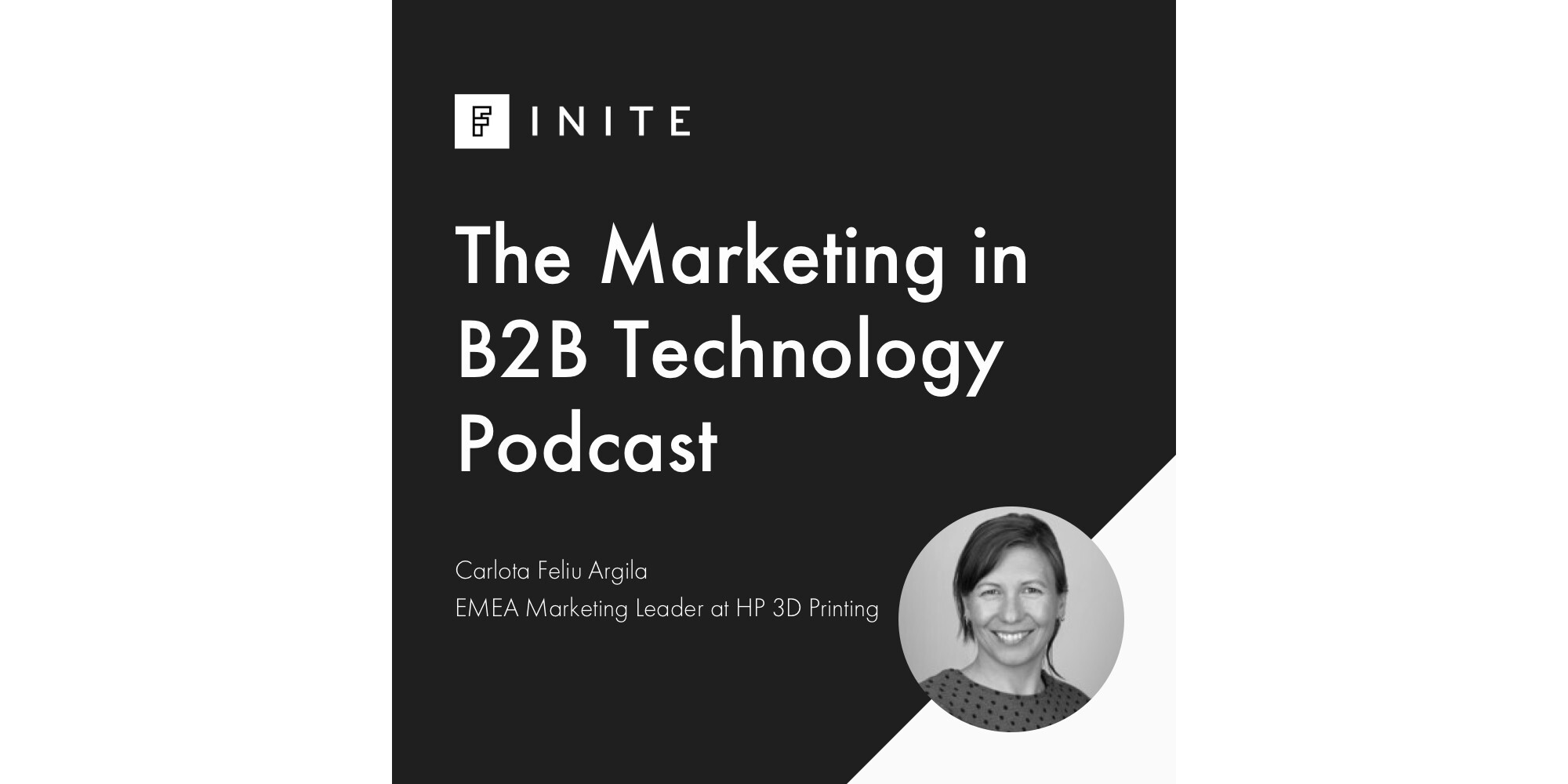
Carlota Feliu is an experienced B2B tech marketer, having worked at a number of innovative high end technology solutions businesses. Carlota is currently EMEA Marketing Leader for HP 3D Printing, a business unit within HP.
Carlota joined the FINITE podcast to talk all about innovation within B2B marketing, and some of the challenges and opportunities that exist as a marketer within highly innovative technology businesses.
This episode covers:
- Carlota’s background in B2B marketing and her current role at HP
- How Carlota uses innovation in her role at HP
- How company culture can encourage innovation
- How marketing operations can facilitate innovation
- COVID’s impact on innovation
- If creativity or data drives innovation
- The most important lesson about innovation in marketing
- Innovating with older legacy systems
- A starting point for creating a culture of innovation
Listen to the full episode here:
& once you’re done listening, check out our other episodes here!
Full Transcript
Alex (00:10):
Hello everyone, and welcome back to the FINITE podcast. The episode today is with Carlota Feliu. Carlota is the EMEA marketing leader for a division within HP, looking after their 3D printing side of the business. Carlota has got a long track record of working in all kinds of interesting B2B technology businesses.
And today we’re talking all about marketing innovation, how to be innovative as a marketing team, having a culture of innovation and how important it is to get innovation and strategy ahead of technology, how people and process are just as an important part, if not more of an important part than technology itself. So I hope you enjoy.
FINITE (00:51):
The FINITE community and podcast are kindly supported by 93x, the digital agency working exclusively with ambitious fast growth B2B technology companies. Visit 93x.agency to find out about how they partner with marketing teams and B2B technology companies to drive digital growth.
Alex (01:13):
Hi Carlota, thanks for joining me today.
Carlota (01:14):
Hello, thank you very much for having me here.
Alex (01:16):
I’m looking forward to talking all about the world of innovation and marketing. I think this is going to be an interesting topic, but to begin with, like we always do, I’ll let you tell our listeners a little bit about your background and your experience. Because I know you’ve got a lot of experience in all kinds of interesting B2B technology businesses, so over to you.
Carlota’s background in B2B marketing and her current role at HP
Carlota (01:38):
I’m an EMEA marketing leader for HP 3D printing. So one of the most innovative business units inside HP, which already a very innovative company. I joined HP eight months ago. And prior to these experience I’ve been working, as you said, mostly in B2B companies and mostly selling high tech and very innovative products.
I was there for five years, working in companies selling super high end solutions based on photonics technology for the quality control on production lines for pharma, food chemicals, et cetera, and leading the marketing department for that company.
And then from there I moved to a startup working in the data space and working mostly on developing solutions based on a core technology that this company had developed for capturing what is called dark data. This is the data that is usually not easy to capture with traditional technologies and the data that is behind all of this and hides a lot of potential in terms of insights and information. And we were selling solutions to gather all this data for companies on the logistics, on the manufacturing, on the retail landscape, et cetera.
Alex (02:54):
Interesting, cool. And so the current role, now tell us a little bit about what that consists of and where you spend your time, but also it’s always interesting for people to hear about your team and the structure of the team around you.
Carlota (03:06):
Sure. So my position is media marketing leader. What I’m doing is I’m leading the marketing EMEA and currently I’m leading, not just in EMEA, but also Americas and APJ, which means that I am leading our eight sub markets. And I’m like a bridge now, I’m in a middle management position.
And my role basically is to make sure that the teams in the market are close to the field and close to the customers and close to the partners, that they have everything they need to make the job. That they have the right guidelines, right tools, the right strategy. And then coordinating this with another thing that we have inside HP marketing for 3D printing, the central thing, which is the thing that enables all the markets to apply and enter all the activations.
And also from the central team we deliver content, the social strategy, also the operations analytics, et cetera. And then the marketers are the ones who activate this and I’m in the middle.
Alex (04:09):
It’s interesting to hear how such a big organisation is structured so globally and regionally in that kind of way. So yeah, an interesting structure.
Carlota (04:18):
The truth is that we are small compared to other business units inside HP and now because 3D printing, it started four years ago, it’s pretty new for HP. So we are globally covering the business, but we are small compared to a startup inside the big corporation and we are operating in sometimes very similar to a startup, but with the facilities that make us be a part of a large corporation.
Alex (04:46):
Cool, and so hopefully the best of both worlds. I think that leads us nicely into the topic around marketing innovation and how innovation is within technology companies, they’re naturally innovative as businesses. But then some might argue that for a company the size of HP, maybe at a certain size, some of that innovation starts to get a little bit lost.
A business this size, some of that magic can be lost, but tell us a little bit about how innovation relates to your role currently. And then we can dive into the cultural side as well.
How Carlota uses innovation in her role at HP
Carlota (05:20):
Exactly. So I would say that I live in both worlds, so I had less experience in startups and now I have experience in large corporations and I’ve been surprised in HP, how they have innovation embedded in the culture and how they are making sure that they are still keeping their teams trying to think outside of the box.
And even though, especially in our division now in 3D printing, we are working in an innovative business, so we are screwed if we are not innovative especially in marketing. So in that sense we are lucky. And also what makes a lot on the innovation side is that people. We are working in teams and we are people.
And looking inside HP 3D printing, we have a team who joined a very innovative business so it’s people that it’s up to take risks. And that’s helping a lot, mostly in my role as I’ve mentioned before. So being that bridge means that most of the times we’re going into innovation, I’m that bridge too.
So we have the operations and analytics team where most of the innovation is coming, when we are talking about innovation in terms of marketing technology and that sort of thing. But then the marketers are the one who needs to use these innovations to bring it to the reality and to really apply them to the day-to-day. And so my position in that sense needs to make sure that from one side, whatever is coming from the operations and analytics team feeds what the marketers are needing for their reality.
And so I need to make sure that the marketing operations teams understand what we are doing from the marketers and vice versa. Helping to embrace everything that comes from the team, all the transitions that have been made, all the change management that is needed.
Luckily we have a very innovative team and people with very open mindsets in that sense, but we need to transform the way that we are doing things when we are embracing new technology. And that requires not just the technology, but also the science, the process behind how we are going to use it, how we are going to first test it, how is it going to be the first MVP of the usage that we are doing of this new tool that is bringing us new capabilities?
Alex (07:55):
Yeah. And I think it’s widely understood, I think lots of people listening will be able to relate to the fact that the culture of a company can probably be the biggest blocker of innovation in a lot of cases. I think for yourselves, you mentioned previously that innovation is literally one of your core values as a business. So tell us a bit about the culture and how easy it is you feel to be innovative from a marketing perspective within HP.
How company culture can encourage innovation
Carlota (08:19):
Yeah. So luckily HP as I tell you is a very innovative company. So we have digital transformation programs. We have even a C level person take on leading the digital transformation inside the company, which already can tell you a lot. So we have a transformation officer inside HP.
So the company is taking all the innovations, but it’s usually in all areas and especially in marketing. Our lead motivation at HP is to keep inventing. So that exemplifies how it’s at the core of the company, that innovation, and obviously that helps us in marketing to take risks, to be innovative, to try to go always one step ahead. And obviously there are different reasons. And I always say that besides R&D is innovation, but then the second thing is marketing.
I mean, if marketing is not the ones pushing and pulling for the innovation, then the company is not going to move forward in the future because the first is marketing and then sales operations, and all the others will follow up on this innovative path.
Alex (09:42):
Yeah, you made reference to marketing operations. I’m interested in how big a role of marketing ops and being innovative in marketing these days relies on a good amount of data and insights. So how important is marketing operations?
Because we did a webinar recently on marketing operations as a subject. And I think it’s a growing trend. I interviewed a CMO a while ago who said that the first role he would hire for, if he was building a marketing team again, would be a marketing operations role. How does that support what you do?
Marketing operations can facilitate innovation
Carlota (10:12):
Yeah, totally. So now marketing operations is a must have in every marketing team. So even though one of the first roles or one of the first things that you need when you’re building a marketing team from the scratch, it’s all the operations side and building all these orchestrations that will facilitate you to scale, to grow. Because if you try to build these when you are already growing, then you are going to be late.
I mean, we live in a world where data has become more like a commodity. So we need to be using this data. We need to use it properly to understand our customers because all the other companies, our competitors are going to be using it. I’m going to be understanding the customer. And if we are not doing that, we are going to be behind them. So yeah, it has become a must for every marketing team, operations.
Alex (11:18):
I think what’s interesting is that as we talk about innovation, the first thing that pops into people’s mind is they think about technology and data. And I think you’re alluding to the fact that the people and the process is probably more important than the technology and itself.
We see this all the time where you can spend thousands on a MarTech tool, but unless you have the people in the process to get the most out of it, you’re just wasting your money. So how much is it about people and process for you in terms of training? And I know we’ll maybe talk a bit more about that kind of change management piece, but it’d be good to hear how you take the team with you and others in the business as well.
Carlota (11:58):
Yeah. It’s so important. And it’s important because if not, you take the risk that the systems are the ones leading your innovation and it shouldn’t be that way. So the people, the team should be the ones building the strategy and using the innovative systems to support your strategy. And I’ve seen the things that are happening vice versa.
You have the systems and then you are expecting the system to tell you what to do next. And you are expecting the system giving you the answers. No, the first thing that you need is to be innovative at the core and you need to have the people, the team, the strategy that is going to lead you towards this innovation.
And then you need to see what are the questions that you want to answer? Then you can go and see, okay, where do you find this? This answer was from the technology stack that you have. And also understanding that the innovation and marketing goes farther than the system and the technology.
It’s the creativity is thinking outside of the box for when you are looking to solve certain problems. So one thing is marketing innovations and the other thing is marketing innovation as a whole. That includes all these other things.
Alex (13:17):
We talked a bit already about culture, but do you think you need a culture which allows people to feel safe to fail? And I mean, the test and fail mentality, the fail fast mentality is a big startup thing. I guess before we had this conversation, if you’d said to me people were failing fast within a business as big as HP, I would have maybe been skeptical and said it’s not possible in a company the size of HP. But it sounds as though that was definitely part of how things worked for you?
Carlota (13:44):
I don’t know how the ideas inside HP are working, but from my experience in 3D printing, yeah. Because at the end we operate very similar to a start up, but being part of a large corporation. So yeah, definitely as soon as you can fail, you can improve and keep being better.
Alex (14:04):
I think we wouldn’t be able to record this without at least talking about COVID 19 for a little bit. I think I’ve actually probably made a few episodes recently where we haven’t talked about it. So we’ve had a bit of a break, but I think everybody in the world has seen COVID impact things negatively in lots of ways.
But I think those of us working in technology, I’ve seen how much it’s sped up innovation in certain areas. And my general observation is that lots of things that would have taken five years have happened in five months instead. From your perspective, how has COVID impacted innovation overall?
COVID’s impact on innovation
Carlota (14:40):
So in the end, COVID accelerated many transformations and especially all this digital transformation. And they need to keep being better at understanding our customers. But now it’s even more challenging because our customer has changed.
The reality is that our customers have changed completely, the people that we are targeting and the people that we are selling to, they are not set up at the same place. They are probably now in their homes, they have other priorities, other things.
So we need to be able to understand who they are now, how they are behaving now. And all of these things require you to have a proper intelligence of your customer, and to have intelligence of your customer you need data and you need systems and you need to go there and find answers to understand this better.
So yeah, it does accelerate not just inside HP, I’m seeing it in many companies having many innovative processes not just in marketing, but also in how companies are going to be working in the future. So it’s also accelerating all these future work types of things.
It’s also how we are collaborating as teams, marketing and many other departments, because it puts us all in this position where we are working as in remote companies. And we were not used to work as a remote company. So at the end, all these things are pushing us out of our comfort zone. And that’s what’s clicking the innovation for many of us.
Alex (16:16):
I was going to talk a little bit about the creative side of innovation. I guess we talk a lot in marketing at the moment about the use of data. And often it’s positioned as data versus creativity and it’s like it’s one or the other, you can’t do both, which I don’t think is correct. But I guess I’m interested in your view on how to drive innovation. Is that as much about being creative and thinking freely as it is about having to underpin everything by data?
Does creativity or data drive innovation?
Carlota (16:46):
I think that it’s both things. So at the end data is the enabler. So it’s a currency that you need to have to be able to do or to know better your customer and your market. But expecting the data to give you the answers is not enough. You need to be creative also in identifying which are the new answers, the new questions that you need to look at the answers for. That’s where we need to push the limits now.
Many companies will have the same type of technology stack as we are having, with similar information about the customer. So at the end, if we want to compete, that’s not enough because that’s not innovative enough. And so we are already almost all at the same point at that level.
So what will make the difference is that we find new questions, and I discovered that once I was working at this data company, because one of the things that they do is help companies to go this one step farther. So I do look for more. Not just be comfortable with the data that I have right now, which is the data that all the other companies are using.
But trying to first define what are the things, what are the gaps that they have on their customer intelligence or on their operational intelligence because there are still lots of gaps. And from there, see where they can find this data that they don’t have right now that will help them to solve these gaps and how they can use this data. Because it’s not just what’s the data, but how to use this data.
And one of the things that I discovered is that even though we have a lot of data and we live in this big data world, most of the time it’s not the big data is the small data that everyone is using. But if you call that and try to use it, it will help you to find different answers for different questions.
Alex (18:46):
That’s a really good point. I hadn’t thought about it that way, but you’re right in that we all use the same tools, the same technology. It’s not about the tools, it’s about how you use them and what you can get from them and asking the right questions and things. So, I think that’s a great takeaway.
I was going to ask about, I guess it relates to the change management side of things to some extent, but I think a lot of marketers often have an internal battle. Maybe that’s the wrong word, but they have to take others that are not in marketing on the journey with them when it comes to building business cases and talking about budgets and talking to finance teams and maybe even legal and procurement teams and others.
Is that part of the challenge for you in terms of consulting with other parts of the business and trying to explain why certain things are happening from a marketing perspective and is that difficult?
Carlota (19:35):
It is. But I think that at the end, this is the role for marketing at the company. So we need to be the ones leading the innovation. We are the ones in a position where we will need to be coaching, evangelizing, convincing people from sales, from operations, but that’s the nature. And that has always been like that.
Even though before we had all these new technologies, marketing needs to be the one with the crazy ideas. If not, who will be? We can not expect them to, we need to be the ones. And we need to be the ones that we are pushing the limits there. And that we are trying to go one step farther because we will have others who will slow us down and say this is not possible, but we need to be the ones thinking that there are other things possible out there.
Alex (20:36):
What do you think the biggest or the most important lesson is that you’ve learned about innovation in marketing so far?
The most important lesson about innovation in marketing
Carlota (20:43):
So it’s always tied to two very basic marketing concepts. What is the why? It’s easy with all these crazy tools and technologies and the best offer of things that are out there, and that we are receiving hundreds of emails every day selling us different types of software solutions. And it’s easy to get lost. But in the end, you need to tie everything to your reason why, you need to understand what’s the superior objective and outcome that you are hoping to achieve with all of this knowledge and not to the what and the how.
Alex (21:32):
It makes sense. I imagine that you’re dealing with lots of older technology and legacy systems, and you must have different websites. And I assume it must take some time to move certain things forward that are maybe a bit out of your control. How do you approach that kind of thing? Because I think for me, that already feels like a minefield to navigate.
Working with older legacy systems
Carlota (21:50):
Yeah. For example, one of the things that, even though 3D printing is a startup inside HP, we are part of HP and there are legacy systems, and this is something that I haven’t done before, because I’ve worked previously in startups where we didn’t have legacy systems. And I was selling solutions to break with the legacy system for other organisations. So now I am on the other side.
And at the end, this is a transformational process that needs to be called top to bottom and bottom to top. So everyone in the company needs to be involved in this because it’s not an easy process, but we should continue with this path if we want to have the agility and we will want to be adapted to world where we are living now.
Alex (22:42):
I mentioned talking to finance and putting together business cases and budgeting and that kind of thing. I did an interview with a CMO recently who talked about having a certain percentage of her budget. I can’t remember what it was, but some marketing budget is just put towards experimentation and testing. I’m always interested in the financial side and maybe it’s a British thing, but we don’t like to talk about money.
I’m not sure how it is in Spain, but it’s always a bit of the elephant in the room, the thing that people don’t really want to talk about. Do you feel like that’s something that you do? How do you structure potentially taking a gamble on something that you’re not really sure if it’s going to work and not necessarily seeing a return on investment from that?
Carlota (23:24):
So like every other technology company when someone is launching our product first, that is a test. Maybe we buy a lot in one country or for just one specific program. And then from there we look at secret results to make the decision if we want to scale it or not. But yeah, that’s the way to go in and try to find the right scope and the right place to pilot these, that we’ll make sure that the results show that it’s something that is scalable. And then you can strike the right conclusions from where you are piloting.
Alex (24:06):
Yeah. As we head towards wrapping up, I was just going to circle back to the COVID point, because I think a lot of marketers I’ve been speaking to obviously the data landscape, and you mentioned people are working from home and the vision that you have of your customers has changed and you have access to different types of data.
I know, for example, that before COVID intent data was rising, seeing what people were searching for using firmographics like IP addresses. But my view of that is that a lot of that has gone out the window and no one’s using corporate IP addresses anymore. Are there things like that that you’ve experienced? More tangible changes that you’ve seen that you’ve had to adapt to?
Carlota (24:45):
Yeah. So besides all of the things that apply to most everyone in marketing, I would say that one of the challenges or the things that we are facing right now, which is a consequence from COVID is our fatigue. And this is very challenging for us because at the end, we are not able to do field marketing because there are no events.
So all our activations are on the digital side, but we are starting to see what we already started to see a few months ago. That is digital fatigue. And again, this is an opportunity to start thinking outside of the box and seeing more types of activations. And some of them can be going back to the basics by doing some direct marketing, but that’s also complex, because people are working from home. So yeah, it’s putting us in a complex situation, but it’s an opportunity. And that’s what we are going through right now, especially in our marketing team.
So planning the next year and the next activations, considering how we are going to overcome this digital fatigue and how we are gonna make sure that whatever we put outside it’s relevant enough. It has, let’s say a creative focus because if you pretend to launch a regular webinar, it’s not going to be successful anymore, you need to be very creative in what you are doing in terms of digital activation.
Alex (26:19):
Yeah. I think we can relate to that. I think everybody will agree. It’s a tough one to get right. I guess to wrap up this part, before I ask you a few final, quick questions, have you got one tip or one thing that you would recommend to people that really feel like they want to push towards more of a culture of innovation within marketing? One thing that you would recommend people do as a starting point?
A starting point for creating a culture of innovation
Carlota (26:44):
In general to be curious, to read a lot and to learn from other teams, especially from engineering teams, from tech teams. And that’s an opportunity that I had during my professional career, because I’ve worked very close to engineers and engineers, not just from software, but also from many different specialisations, mechanical engineers, industrial engineers. And because I’ve been very close to them, that helped me a lot because they have a way of understanding the processes and the innovations, which is very interesting.
And it’s a little bit different from the marketing side of things, which is more, let’s say chaotic. And having known both worlds, I think that it’s a good balance and it helps you to be the cow that can lead you to innovation in the right way. If you have the opportunity to sit with your engineers, with your technical people, from your company, from your team and learn from them, learn how they are innovating, that’s very helpful.
Alex (27:51):
I think that’s a great tip. I think as marketers, we can always look beyond the marketing world for ideas and inspiration. So a good tip. I was going to ask you a few final quick fire questions. One of them was going to be, do you have a favourite kind of MarTech tool or technology that you work with day-to-day at the moment?
Carlota (28:09):
So I will leave you with one that I’ve discovered now and I’m working with now. So during my time in the smaller companies and startups, I’ve used a lot of HubSpot and I’m in love with HubSpot. I should confess, in terms of completeness and facility and especially for small companies and medium companies, I think that it’s great.
So I will highlight HubSpot and two other ones: Databox, especially for those people that need to understand insight and getting insights from data, but we are not techy enough to go and use a big data platform’s success. And right now we are discovering how to have a better use of PathFactory. And we are finding PathFactory to be very interesting in our programs, content hub, even in our virtual events. So we are exploring PathFactory as a good tool to serve content in a different way.
Alex (29:20):
Interesting. It’s been a while since I looked at PathFactory, but I need to check it out again. So it’s good to hear you’re experimenting. What would you say is your biggest challenge right now?
Carlota (29:30):
I would say it’s digital fatigue. There is fatigue because all of our activations right now are digital and we are in a complex world right now. To catch the attention from the people outside, you need to do something relevant, do something creative. You need to hit them with the right message at the right moment. And with a message that is different from all the tons of messages that we are receiving right now. So yeah, I will say this one, definitely.
Alex (30:01):
And finally finishing on an optimistic note, what are you most excited about in B2B marketing looking forwards?
Carlota (30:08):
I would say that to me, one of the things that I love the most from the B2B marketing side, and I know that we’ve been talking a lot about the technology side, but it’s the people side. So the psychology behind it, because even though we are in B2B and the other day I was reading some comments from Dave Gerhardt saying this.
Even though we are in B2B and especially in large enterprises and in serious businesses such as the HP, at the end, we are addressing the people, we are talking to people, and these people are also expecting that you surprise them, that you delight them.
So that’s the most interesting insight for me for B2B marketing, to understand who these people are, who is the buyer group behind each company, how you can navigate inside each buyer group, the different personalities that you can find the different type of roles, how all these things interact in a buying decision process, which is a very complex topic. But also these types of things that fall more on the psychology side of the marketing for me in B2B are very interesting.
Alex (31:24):
Yeah. I think it’s great that the whole B2B marketing world is, thanks to people like Dave Gerhardt and others, it’s talked about more frequently now. And I think we’re all as B2B marketers, more conscious of the human side which is important.
Carlota (31:34):
It’s something that the people in B2C have very clear, but sometimes in B2B, we tend to forget it because we think that we are targeting names, companies, logos, but that’s not the truth. I mean, at the end of the day we are targeting people.
Alex (31:50):
Yeah, absolutely. Well, there’s some great insights there and I think some good inspiration for anyone that’s serious about innovation within marketing within the business generally. So I’m grateful for you giving up your time to talk today. So yeah, big thank you.
Carlota (32:05):
Thank you very much, Alex. I really enjoyed it.
FINITE (32:09):
Thanks for listening. We’re super busy at FINITE building the best community possible for marketers working in the B2B technology sector to connect, share and learn. Along with our podcast, we host a series of online events. So make sure you head to finite.community to subscribe and keep up to date with upcoming events.