- Some additional information in one line
- Jul 27 2020
Podcast: Demand Generation for B2B Tech Growth with Clemens Deimann
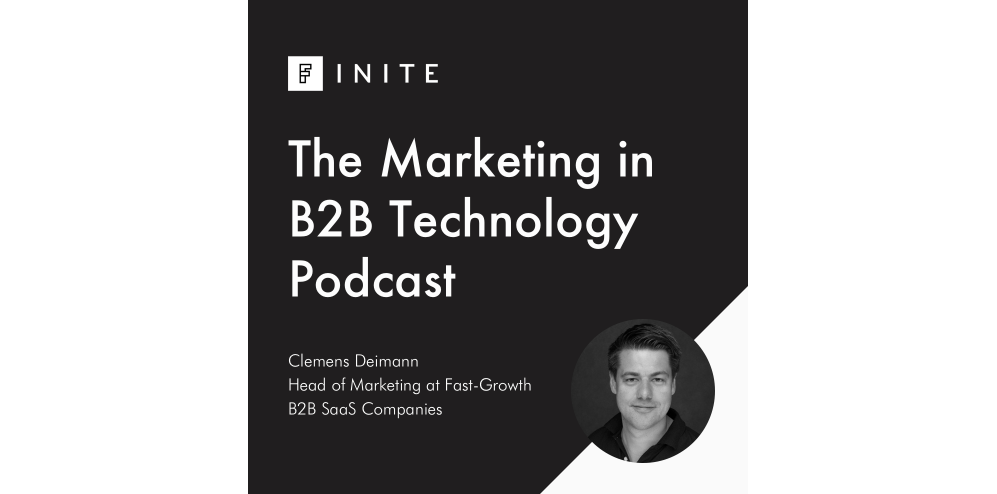
In this podcast episode, FINITE host Alex Price talked all things Demand Generation in the world of B2B Tech with Clemens Deimann who has led B2B tech & SaaS demand generation and marketing initiatives across scale ups such as Lynda.com, LinkedIn and has consulted for a number of hyper growth tech companies.
This episode covers:
- Clemen’s career progression from being a hypnotherapist to his current marketing role
- What is demand generation?
- How the EMEA is trailing behind the US in the technology sector
- How to transition organisations from sales-led growth to marketing growth
- An increasing focus on marketing from senior management
- Content syndicates as an initial approach to B2B marketing strategy
- A shift in the world of webinars due to COVID-19
- Clemen’s approach to building top of the funnel
- How to use nurture campaigns generate qualified leads
- The benefits of direct mail in a modern context
- Building and refining a successful attribution model
- How emotions play into B2B marketing?
Disclaimer: The views and opinions presented in this podcast belong solely to the interviewee and do not reflect an official statement or opinion of the author’s employer, past employers, or any other organisation or committee this interviewee may have been, currently is or will be affiliated with.
Listen to the full episode below:
And once you’re done listening, find more of our B2B marketing podcasts here!
Full Transcript
Alex (00:07):
Hello everybody. And welcome back to another FINITE podcast episode. Today we’re talking all things demand generation in B2B marketing, and I’m lucky to be joined by Clemens Deimann. Clemens has led demand generation across a number of B2B technology scale-ups including Lynda, the learning platform, which was acquired by LinkedIn. Then becoming a consultant and working with a number of other fast growth B2B tech companies. Clemens is now leading a marketing team at Google. I should add that Clemens is here completely from a personal perspective. That everything he shares in this episode is his own perspective and not related to his current role at Google. With that said, I hope you enjoy the episode.
FINITE (00:49):
The finite community and podcast, are kindly supported by 93x, the digital agency working exclusively with ambitious fast growth B2B technology companies. Visit 93x.agency to find out about how they partner with marketing team and B2B technology companies to drive digital growth.
Alex (01:10):
Hi Clemens. Thanks for joining me on the FINITE podcast episode today.
Clemens (01:13):
Hi Alex. Thanks for having me.
Alex (01:14):
I’m looking forward to talking. We’ve got a lot to talk about with demand gen as our topic and I think one that we’re going to be talking a lot about. You’re joining a FINITE webinar that we’re doing next week as well. So we’re recording this just in advance of the FINITE webinar, but yeah, looking forward to hearing all about your experience in the demand gen space. I guess, as we always do, it’s always nice to start with a bit of an introduction here about your route into marketing overall, where you’ve worked, what you’re up to at the moment?
About Clemens
Clemens (01:39):
Cool. My name is Clemens Deimann. I am originally from Germany as you can probably hear with my accent after living in London for eight years. Originally when I came to London, I was actually working as a secondary school teacher, and then I got very deep into personal development coaching, that kind of stuff. And I qualified as a hypnotherapist, made a transition then to actually practicing and building my own practice as a hypnotherapist. And during that time where I built on lots of marketing and sales channels for that, because yeah, being a great therapist, you can be the greatest therapist, but if your marketing and sales channels are not good, then you won’t be successful. So that was a focus of mine while I was practicing.
And over the course of that and running my practice, I became very fascinated with strategies of marketing and sales, and I’m very fascinated with the whole business aspect of what I was doing. I then got an offer from a scale-up or like a very successful startup that was in the hyper growth stage. That was a learning platform called lynda.com, with a Y, that was six, seven years ago. And I started working for them in a very ambiguous role which was lead generation. Nobody between marketing and sales, nobody really knew what it should be doing, whether it should be a BDR role or whether it should be a more marketing focused role on email marketing and building out other channels.
I then pivoted more towards the marketing side of things and built out demand generation channels. So, generating leads at scale. I can speak a bit more around that. And then Lynda was acquired by LinkedIn. So I then was working for LinkedIn for a while. I was part of the integration process of integrating the learning platform, lynda.com and to what became LinkedIn learning. And which was a very interesting journey. And after that, I built my own consult or set myself up as a consultant and was running my own consultancy. I consulted for a few California based scale-ups hyper growth companies. And then Google came on as a client. And then I made the transition to full time employee at Google in the beginning of this year, heading up a team at Google right now in marketing. One thing to note here is I’m not speaking on behalf of Google. I’m purely sharing my journey and opinion as a marketer. And that’ll be my focus here.
Alex (04:25):
Cool. I mean, I said just before we started recording that, I think the last episode I did was with someone that was a nuclear physicist before they ended up as the CMO of a company, I think I’ve had mechanical engineers. I haven’t had one person on the podcast who studied marketing at university or formally, and you’ve just gone and trumped it with hypnotherapy to leading a marketing team at Google. So yeah, it’s always really fascinating. I guess it’s worth asking though is there.. I know hypnotherapy is kind of not the same as I guess, psychology, but kind of overlaps with a deep understanding of the way people think, which I guess is kind of the foundations of all marketing to some extent. Isn’t it really understanding how people think and what they’re looking for and meeting those needs.
Has that, obviously you said that you started all the marketing knowledge to kind of build your practice, but are there things from the hypnotherapy side of your knowledge and your training now that you actually apply to some extent? I’m not suggesting you hypnotise people in your marketing, but yeah, what’s the kind of crossover?
Hypnotherapy and marketing
Clemens (05:19):
Yeah. I think it is mostly facilitating an educational journey. So B2B marketing is highly educational in nature. So as a former teacher and as a hypnotherapist, of course, you try to get people from one state to another, right? Like a one in one state of not knowing, through a learning process to another state. Right? So that can be a pure learning, or you can describe that as a pure learning process, but it’s also often an emotional journey, like change. For example, especially with disruptive B2B technologies, that also create a lot of fear and anxiety and uncertainty with that amount of change.
And so I would say it is an emotional process and an educational process and then B2B marketing, what I find quite fascinating there, especially with like the SaaS solutions is that I think it’s about educating the prospects or ideal buyers and customers to make them actually often aware of a problem that they don’t even know they have. Right. So it’s a, or something that could become a problem in the future or like how they can actually grow much faster, become much more efficient and improve as a company through technology.
Alex (06:32):
Which is kind of hypnotherapy to some extent. Right? It’s kind of uncovering people’s…
Clemens (06:37):
That is certainly it, yes. I’m fascinated by exponential growth, like in the personal realm as well as in the business realm. So how to grow fast in a way that is at the same time sustainable.
Alex (06:50):
So fascinating. I feel like we should do another episode at some point on hypnotherapy in itself, but we’ve got lots to talk about today around demand gen. So I guess the first thing I wanted to talk through is just getting some definitions straight because I think demand gen means different things to different people at different companies at different sizes and stages in the journey. I guess if you look at what’s demand gen versus lead gen and there’s differences, but ultimately everything kind of ends up generating leads potentially. From your perspective, when we talk about demand generation, what are we referring to?
What is demand generation?
Clemens (07:22):
Yeah, that’s a great fundamental question that is often left out. And that was actually exactly the ambiguity that I had in my first role, that demand generation, I believe, as a term wasn’t really coined or popular back then. So it was still like about six, seven years ago. So the idea was that I would do lead generation and what that meant to, I was reporting to a sales director at the time. And the idea there was from our expectation from the sales team was kind of, I’m exaggerating a little bit, but like, “hey, here’s a telephone book. Here’s a telephone. Start calling people, and see if they’re interested.” And for me, this was kind of inefficient, I mean, the way after I had done it as a hypnotherapist already was giving lots of talks, creating seminars, and started an education journey where people then became naturally interested in what else I had to offer in terms of one on one coaching. So I wanted to reach more people at the same time, instead of like, because the challenge with lead generation is that if you approach it from a sales one on one conversation, that it’s a very slow process and very hard work and hard work is fine.
It’s just that as soon as you stop talking to somebody, your funnel is empty, essentially, there’s nobody else coming in who’s interested. So it is really about finding a way to find this one to many communication, and this is especially relevant. So I think what demand generation mostly connects to and the way it has been popularised, as I know it in B2B, is that, especially US-based companies, because they have perfected that model really. There’s also European companies like that, but they have their headquarters in California or wherever, and at some point when they figure out the product market fit, meaning that they know who their ideal customers are and they have the right product for them.
And then it is all about becoming the market leader very fast, which happens normally in a time span of five years or so, and being the market leader means like being the global market leader. So if that involves setting up an office in London or in India, or in Sydney or Singapore for APAC, and then from there are scaling into those markets globally. And because the product is very unknown and there’s very little time to kind of establish that market leadership, what is required is really lead generation at scale. It’s not possible to do that through one on one conversations, but it is really identifying the right audience to speak to, and then finding channels to reach and educate that audience.
Alex (10:07):
I think that’s a pretty good summary, I guess, diving into it in a bit more detail, we will talk a bit about that transition, which you’ve just mentioned from that kind of pre product market fit stage into, I guess, that real deep transition and to understanding the customer persona and having messaging that works with that persona. I guess it sounds like when you started at Lynda, it was like a little bit of everything and the role wasn’t particularly well defined and was that because they were still kind of at that pre product market fit stage to some extent,? Or was it just that they were growing quickly?
Clemens (10:39):
I think at the time, really in Europe, there’s always a bit of a lag, I would say going on anyways. So the people that work there often didn’t have that software background or B2B software background. So they were somewhat more old school sales oriented. I think the way I was able to make that transition to the pure demand gen function was by spending a lot of time in the US with my counterparts over there and yeah, learning from them on how to best do it, and replicating certain models and balancing those models or adjusting those models to the EMEA markets. And yeah, through this translation exercise actually build out the demand generation channels in the EMEA.
EMEA trailing behind the US in tech
Alex (11:25):
Why do you think EMEA is a little bit of a lag behind the US generally? Is this because, are you referring to companies which are US based, therefore that’s kind of the origin of their operation and therefore any expansion is behind? Or is EMEA just as a market, a little bit behind in some…?
Clemens (11:39):
Yeah, I think a great example for that is San Francisco. If you go to San Francisco nowadays, it is different to London, right? So in London, it’s still the cliche of the banker who is suited and has this very business office attire. In San Francisco, everybody works in tech. It’s very hard to actually see people in a suit. Everybody wears hoodies, walks their dogs, has their e-scooter or whatever. So it is… yeah, definitely the Bay area. But I think in general, in the U.S, being in tech is such a normal thing. In the Bay area, everything is so the way that London is known for finance, that’s the way that the Bay area is known for software. So I think it’s just something that has organically grown over time. And London is starting to change in that direction, but yeah, like I said, it’s still known for finance.
Alex (12:40):
In terms of that transition from sales-led to marketing growth, and I think I talked to people all the time who had been on the journey and we had a founder on the podcast episode recently, who I think a lot of founders have started doing growth themselves when they’ve just been a few people and still kind of finding product market fit. And they might bring in someone on the commercial side, on the business side, then they reach a limitation as you’ve kind of described that one two one doesn’t really scale. And we need more to come in at the top. What’s been your experience of that transition so far and your experience with companies that you’ve consulted for, or places that you’ve worked?
Transition from sales-led to marketing growth
Clemens (13:13):
It requires faith and patience. Right? So I was lucky at Lynda because of course, building out those channels requires some time. And during that time that you’re building out those channels, leads are not being generated. So I was lucky in the sense that I was able to sell my manager at the time and the leadership into that vision of building out these scalable channels. And the way I started that was actually by doing research around the content syndicates and to figure out which content syndicates have to have the right target audience. And I think that is a great starting point for any company that is looking into demand generation and to webinars with them or advertorials. And I think that was really then the realization when the first webinar happened, where I’ve found like speakers internally and externally brought them together in the discussion. Like had platform that we sponsored, and then when the leads came in from that of senior decision makers from enterprise companies or large scale businesses, that’s when really, the whole sales team was on board with that approach. It took a few months but yeah.
Marketing as an increased priority of senior management
Alex (14:35):
And it’s worth touching on that a bit more, I think, because I think this is the challenge that all of our listeners probably come across, is building those business cases and getting people in. Well, I guess I believe quite passionately that a lot of this stuff kind of starts at the top. And if you’ve got a leadership team who just don’t really get marketing or think it’s advertising, like why don’t you just put a billboard up on the side of the motorway, then I think there’s nothing worse than being the marketer in the company that doesn’t understand or value marketing.
I guess there’s an element of luck on that basis about you, you ended up in a place where you were able to have those conversations and it comes down to relationships too. And it’s about people and it’s about trust. And there’s much more to it than just, I guess, just the numbers and just building the business case. Being a hypnotherapist probably helps as well. But yeah, would you say that’s a fair summary?
Clemens (15:24):
Yeah, absolutely. I think I see the evolution of the B2B marketer. Yeah. I think it’s mostly a B2B phenomenon in three stages really. Of how the marketer started, if you look at mad men in the fifties, sixties, that was pure brand awareness. What you mentioned as well is all about how you can make people feel and connect to a product that works much more. Or that’s much more relevant in consumer marketing. I would say in B2B it’s, it’s much more informational in nature. Right?
I think that the second wave of marketing then came in with the internet, mostly with Google Ad Words. I think that’s when the marketing person became a spreadsheet person. And that also applied very strongly to B2B in this case. It’s all about tracking numbers, measuring. And then there’s a lot of challenges with that in the B2B space, because it’s not like one single user that makes a decision, but it’s a more complex sales process that happens.
And then I would say the third stage that nobody really talks about, is kind of what you mentioned, is that in the B2B context, it doesn’t really work in my experience to be the introverted, number cruncher as a marketer only. It requires a lot of internal sales and championing of vision strategy, to get, especially when you’re in a hyper growth environment. And you’re looking to build out that thought leadership and the channels around that, that actually directly result in return on investment, on any marketing dollar spent.
Content syndicates
Alex (17:05):
Let’s talk a little bit about what you mentioned around the content syndicates. And I guess working with kind of quite niche publications to reach the right people, I guess it’s an approach that’s very much founded on truly understanding who your target customer is, but yeah. I’ll let you let you explain the approach
Clemens (17:20):
Yeah. Like once you take that decision, that’s the way you want to go and, I can elaborate a bit more of why I think that’s a great way to go. Is that the way you would go about it is you would first go off Google or go to a search engine and type in the niche of the audience you’re looking for. Right. So if your product is to a marketing audience or to an HR audience, or like at lynda.com, it was an HR audience and learning and development audience.
So I would go on Google or a search engine and say, okay, platform, publications, HR publication, anything that would come to my mind too, of how the go to place would call itself. That is relevant for HR because I’m not an HR person, but I would ask HR people like, hey, if you want industry information for yourself, then yeah, what’s your go to place? How do you get news? And then very quickly it comes down to a few syndicates that are really dominant in that space, and they normally have a website, they have email channels, they have social media channels. So they have blogs, they have different ways of reaching their audience.
And then once you call them, or at some point you call them essentially. So that also tells you how at bonds they are. So if you call them and say, “Hey, I want to have a sponsored webinar or an advertorial, what are your offers?” And they can’t give you an offer then you know, that actually they’re not that mature yet, but if they are more on the mature side, then they would, they would say like, yeah, these are our webinar cost pricing, whatever and this is for advertorials. And once you know that, then you would also ask for a breakdown of their audience. What’s your percentage of enterprise company of mid sized businesses.What is your seniority or titles, right? Like how many are CXOs? How many are decision makers, directors and so on. So this is all information you would get. And then you would ask how many attendees or registrants are normally participating in a webinar. Of course, part of the agreement is if whatever the cost is that you would get for the webinar you’re doing, you would get these leads in return.
By then you get very close to figuring out what your cost per lead will be and what your lead list will look like. And normally it’s a pretty good value that you’re getting. So it’s around, I mean, it depends on the industry, but I would say around 100 to $200 max. Which is a pretty good cost, I think, depending on what you’re used to, but that’s much more expensive channels. And especially if you want to grow a list or an audience fast. And then I think what I really, really love about content syndication is that the editors, they know their audience very well. So especially if you’re, if you’re new in a geography, right? Like for example, with lynda.com, there wasn’t much experience with selling the product and marketing the product, especially in Europe.
So the great thing about the editors of content syndicates is that they would teach you how to sell your product, right. Like, and not, I mean, you wouldn’t go into a hard pitch in the webinar, but they know their audience very well. They know the pain point of their audience very well, so they know how to adjust the message you had originally in mind. So they are really great for you to find that product market fit or to really fine tune that and nail it. So that’s why I love content syndicates so much as a starting point, because they tell you how to do your job. Which is education for free. I mean, of course you pay them, but that knowledge you can then use for your own in house marketing channel.
Alex (21:16):
Yeah. I think that’s a really good tip because I think a lot of companies you see, I guess, getting the positioning and the descriptions of the type of stuff they do through webinars, not quite right. And, and sometimes it’s a bit too hard sale and I guess there’s, I think a more mature as you described that publication would probably have some editorial guidelines around what they would promote anyway. But I think it’s easy to just assume that they’re just journalists, like how much do they know about what we actually do, whereas as you point out like they’re immersed in this world all day, every day on quite a granular level. So listening to them is probably pretty valuable. I reckon that’s a step that a lot of people don’t put enough thought into. So that’s a good tip.
Any tips for kind of, I guess, have you just done webinars or I know that often a media pack will be flooded, like email blasts and webinars and sponsored content and other things like, is it worth going and negotiating for the whole shebang and trying to get the rates down under the big package? Is it worth starting small and trialling one webinar?
Clemens (22:12):
I mean, it depends on… My budget was very small to start with. So what I did is I split test it. I had two syndicates I was trying this with to see which one would work better. So I only went for one webinar and a couple of advertorials. Advertorials work in the way that it’s essentially like an educational article that talks about it in general, a bit like the webinar, you would have a general pain point that you describe, like educating decision makers about a problem that they might not even know they have. So especially with SaaS software that has to do with the cost and scalability, and then present the solution you have to offer as one way of solving that challenge. If that makes sense, I can give examples to that if that’s too abstract.
The point here is that I think the great thing about webinars is you have really 45 minutes of time to build a relationship and to build trust and to establish yourself as an expert, or like whoever is speaking on your company’s behalf and to really take people, or the decision makers, through that journey of understanding the problem, understanding ways forward and possible solutions. And then yeah, seeing one solution as a live example.
A shift in the world of webinars
Alex (23:31):
I have to ask with everything that’s going on at the moment, whether you’ve seen a shift in the value of a webinar in a basic sense? I mean, obviously we’re still running them ourselves and we’ve transitioned our physical events into webinars, but I guess there’s some school of thought which is like, webinar overload. Too many webinars, engagement numbers are dropping? At the same time, I guess from our angle we’ve seen, this is quite nice for people to be able to engage with content in a more kind of on demand way, even if they can’t make the webinar live, you’re potentially reaching more people afterwards. But any thoughts?
Clemens (24:00):
I mean, right now there’s definitely a massive shift towards digital communication and experiences. And which we’ll speak more about in our webinar on this in which I will speak more around COVID, and webinars in the context, or like demand generation in the context of COVID. In general, I would say that, yeah, it’s in this time of COVID I think there’s really two things that people are looking for. A, it’s community, right? Everybody wants to feel that they still belong or have a network in place, and cultivate their network. I think that’s one thing, and this is why I think it’s an excellent time for FINITE to be doing those webinars.
I think the other aspect here is relevance, right? So I think with every B2B company or everybody now doing webinars, because other channels, physical events, those are no longer happening, there is kind of an overwhelm in webinars, I would say as well. And so relevance is very important too. I think one thing that makes sense in this time is to, instead of making your events, which is physical events about geographies to really break down your audience and hyper-focus on different segments of your audience and speak directly to them with their problems in their language. I think the targeting or becoming more niche and targeted will increase your relevance and thus attract higher…
Alex (25:36):
Even on the FINITE website, added some tick boxes for kind of key topics within B2B marketing, whether it’s ABM or personalisation or whatever it is that people might have interest in. So yeah, good to hear that we’re hopefully heading in the right direction. What was it just out of interest? What’s your results?
Clemens (25:53):
I haven’t actually run the data. We’ve probably had it out there for like the last month and we’ve had a lot of applications. I’ll let you know, I’ll do an export and let you know. I think that ABM pops up pretty regularly, I get emails through HubSpot. ABM is often there. I think it’s just such a hot topic within B2B and it’s such a trend that it’s kind of on everybody’s lips, but I’m sure there’s some others in there too, but yeah I’ll let you know. We’ve talked about that approach to partnering with the syndicates and running all kinds of different types of contents through them, I guess what happens from there, you know, you do a webinar, it’s a great success. You have 50/100 of the perfect persona on the webinar and what’s the next steps in working your way down the funnel.
Alex (26:32):
Yeah. That’s a great point. So I think initially the sales team was super excited with the first webinars I did, and then I kept on scaling that and then they became really big actually. Which was kind of disappointing, but also like a great success that my webinars, there had to be some filter implemented that those were like leads generate from webinars were not qualified for sales followup, or definitely not all the way qualified for sales follow up, which basically meant that the generated lead volume exceeded sales capacity. Which was in that sense, a great, great achievement. And I think once you hit that point, or maybe even before you want to think more about building your mid funnel and bottom funnel, or depending on what you call webinars, that could be mid funnel, I think like anything or top funnel, depending on your definition.
Building at the top of the funnel
Clemens (27:22):
That wasn’t more for other companies when I ran my consultancy on AdWords. And then of course contact sales and really like increasing the conversion rates of contact sales through landing page optimisation. That’s a big one, right? Like, so I improved the landing page conversion in my consultancy by 30 to 50% just by optimising the landing page experience. Which of course is quite important because these are people that really want to talk to you and if you make it difficult for them, then it’s an opportunity lost. So I think that becomes very much about going into the weeds, around making those tweaks that really create the optimum success, retargeting campaigns, all this stuff. So I think, yeah, that would be the example of the bottom funnel.
I think something a bit more mid funnel would be… And that’s kind of like questions about the philosophy of the company or the leadership again, how aggressive do you want to go against competitors, right? Do you want to bid against competitors as a keyword? So this is something that actually a lot of people don’t know is that, I haven’t looked at actually how it looks like right now, but that most people don’t know how to distinguish ads from organic rankings in search engines. Meaning that if you bid against a competitor and the competitor doesn’t do AdWords themselves, you will be the first choice in front of that. Even if somebody looks exactly for your competitor. Right? So these are, these are tactics that can be applied in a more mid and bottom funnel way when it comes to search engines, for instance, that I’ve seen as quite successful.
Alex (29:02):
And when you talk about that issue of, I guess being above quota in terms of the amount of leads generated and sales just not having the time to get through all of them, I guess, was there anything you did that to, obviously there needs to be some lead scoring and different things that you can do to try and I guess be a bit more granular about who is a good fit rather than just dumping a hundred leads on sales and some are good and some are bad. Like what, was there a step that you built in between before they got sent across to someone else?
Nurture campaigns to generate qualified leads
Clemens (29:26):
I think that’s when it really comes into building out nurture campaigns. So you would have a marketing platform such as, I mean, most companies I worked for have used Salesforce and Marketo. Those can vary sometimes from a CRM and marketing automation platform and you would build out nurture campaigns in Marketo to wait. One thing that you can do is actually repurpose content from your webinars into your emails and create somewhat of a user journey. So then have other gated content available. They are like case studies or just, I mean, or you can just track it by clicks on emails and then build that into the scoring model. So even if someone doesn’t qualify immediately for sales follow up after a webinar, by reengaging through email content, that’s how the qualification then happens. How the sales follow up then is relevant.
Alex (30:23):
We’ve talked a little bit about other tactics and channels in terms of different stages of the funnel. I know that obviously AdWords and paid stuff, there’s partnership kind of marketing too. I guess the direct mail one was when we chatted about quickly before we started recording, which is quite interesting, particularly at the moment with people being harder to reach at their home addresses, but I guess direct mail is being on a bit of a resurgence and can be quite effective. And I hear lots of people saying really good things about it. I think obviously with all things it has to be executed well, but what are your perspectives on it and have you seen it being used successfully?
Direct mail in a modern context
Clemens (30:53):
Definitely, I mean, okay. So I think there’s kind of two questions in there, like how to leverage that direct mail during COVID and what’s the power of direct mail, right? I think the power of direct mail is like physical events. It’s real, it’s not a digital thing, right? People look for something real, like they value something real. And if you do it well, like I think one example that was really successful in terms of the impact it had from a return on investment perspective, but also from just like an internal feedback perspective is that I found a SaaS solution that allowed me to give out credits to salespeople or to have salespeople as users of a direct mail solution.
And I would set up a program with that direct mail platform and they could actually send out lunches, coffees and other stuff to their prospects. So all they would have to do is in Salesforce, I think actually they could, I don’t know if it was some plugin, whatever, like basically what they could do is execute a direct mail sense, like choosing a prospect in their database and choose them to send them a lunch or a coffee. And the way I set that up with the sales team was almost, because I think that’s also the next step to give this as a marketing tool to salespeople. So they would become like franchise holders, they would have their own budgets of how much they could spend and what I said to them, you’re responsible for your budget, but spend it wisely.
You need to create, you need to show positive pipeline impact here in order to be getting more budget or so, so we can scale this as a channel. So what they used it for mostly was when they set up sales demos to make it like a lunch and learn session to send over lunches, coffees, stuff like that. And the incredible impact of that is their cancellation rate went almost down to zero. Because you know, like if you organise an event, right? Where people feel like suddenly they are getting something from you. So, you have a relationship already and they feel kind of obliged to then attend.
And I think that’s something that even to cancel the second part of the question right now, of course, there’s the question that we talked about before the podcast, how to get someone’s personal address? So of course it needs to be voluntary. You can ask that information on a form perhaps. I don’t know if you need to work with your internal legal team to figure out legalities around that. That’s like something that needs to be discussed. But assuming that that is okay, if people don’t entirely give you their address, then of course that’s something very powerful, especially in a time right now when everything is digital to actually give them something real and physical as a sign, or like as a gesture of wanting to connect. And I think that, especially in the time we’re in right now can be very powerful.
Alex (34:01):
Yeah. I think I’ve seen it used really interestingly, but I think I’ve also felt like I’ve been on the receiving end of it really poorly when someone I’ve never heard of before just tries to offer me a free coffee or something. And it feels like you’re kind of just being very transparently bribed into doing something you’re not really interested in. And so it’s at what stage I think in the funnel, does it appear and at what point, there has to be a level of awareness of you as a business to feel like it’s valuable.
Clemens (34:27):
That is why as well, it’s good to have salespeople have that as a tool. Right. So rather than kind of going into your database, downloading your database and sending everybody something, it can be calibrated on a case by case basis. I mean, there’s of course events, I think like you mentioned, it needs to be well thought through, right? Because especially right now, if you come across salesy in a time like this, right. Then, then that destroys relationships more than it builds relationships.
Alex (34:55):
So you’ve talked a bit about sales and marketing alignment already. I guess something that comes off the back of that is how everything’s measured. And I guess this is, as you mentioned on the pipeline side too, in terms of the sales team having to show positive impact to the pipeline. But as we talked about, every marketer is kind of driven by spreadsheets whether we like it or not these days, and I guess attribution in B2B has always been a challenge and probably always will be a challenge to some extent. So how do you view the kind of measurement and attribution piece overall?
Marketing attribution
Clemens (35:24):
This is something that actually creates so many more… It seems straightforward when you just are new to it, but the more you get in the weeds with it, the more complex it gets. And I think that’s really down to the fact that CRMs are not really built for marketing attribution, they’re more like sales tools. So a CRM like Salesforce. Yeah. There is no marketing attribution that automatically is calculated in the out of the box experience. So yeah, you either need to kind of program your own or you have a software that’s like, for example, with Marketo there’s Bizible now, right?
Like, so there’s a couple of attributions, and I’m not saying that they are the best ones, I’m just saying that that’s something that’s often used in conjunction with Marketo and they have some kind of out of the box attribution models, like w attribution. So like the lead generating activity, then I think the last touch before the opportunity for marketing and then the last touch before the opportunity converts into a sale. Right? So essentially like it’s like a last touch model before these events occur. And then there’s 33% attribution given to these three events or like to these marketing activities that drove those events. So that would be a simple example of an out of the box attribution model.
It, of course, then gets also more into buyer’s persona and how you want to weight these because like the other dimension you have in B2B marketing is that apart from the multi-touch model, you also have the fact that there’s different stakeholders involved in the sale. So you have in an account maybe 10 people you’re talking to, or that are part of the decision making process. Some might not be part of the decision making process but are touched by marketing nonetheless. So that’s kind of like where essentially weighting the different types of roles or like types of seniority or decision makers and identifying those, that becomes important and, and waiting that, and the attribution model is crucial. And that’s something that knowledge is gained over time and by looking at the current existing database structure and with the decision makers are in that. So yeah. So those are considerations that need to feed an attribution model. And are now part of the attribution model,
Alex (37:43):
Would you say it’s better to just have something, even if it’s simple, rather than have nothing? It feels like you could just keep going forever, right? Like where do you, and at some point, but equally, if you start making changes, then your historical data is less valuable and yeah, are you better just to get something in place and kind of run with it at least for a period?
Clemens (38:01):
Exactly. And so starting somewhere, and in the beginning, when you really start with kind of building out your channels and there’s nothing in place, I would say the success metric is making the sales team happy. And once you deliver the leads, you know, going from zero leads generated on an outbound perspective to a couple of hundred leads that’s infinite growth already. So I think then at that point, you just want to get going, right? But once you’re going and leads are coming in consistently, because you have built out some of those channels, then it’s, I agree. It makes sense to take any model to use as a baseline for discussion and measuring success. And then mostly in conjunction with the sales team and the BI team of analysing customer data and customer behaviour. That’s when you are able to refine the attribution model.
Emotions in B2B marketing
Alex (38:55):
I thought we should wrap up, I guess, slightly, because of you’re talking about your background in therapy, which I don’t want to keep going back to you, but at the same time you talked about, I guess having consumer marketing’s things are a bit more emotional than B2B things, a bit more informational. At the same time, you recognise the need for taking people on a bit of a journey. I guess there’s a lot of merits of B2B being more emotional or there’s more people in the decision making unit, but you can still get to them emotionally.
Do you think we’re at this kind of tipping point in marketing and it’s a debate that comes up often of like performance versus brand and is there a risk that everything just becomes about data and therefore quite shortsighted and short term and you forget about the brand and the awareness and the reputation of a business in three years time, because you’re only interested in the next three months of your paid campaign. How do you balance those two things out and what role does emotion play in B2B moving forward?
Clemens (39:52):
I mean, at the end of the day, we’re all humans and we want to connect with other humans. So building relationships is of course crucial. And yeah, I mean, I’ve been on the consumer side, of the B2B side, of course. And I think it’s expertise paired with having a good relationship that is the winning formula. I mean I think the difference to consumer marketing is that in consumer marketing, it’s possible to make a purely emotion based decision. I believe in B2B marketing, that’s harder because normally there needs to be internal alignment in the decision making process, there needs to be a case built internally to justify the spend for a new solution. And that’s why I would say you are an educator and also like a consultant to not only sell something or make them feel good about it.
It’s really about becoming an expert, understanding the challenges in that business and how your solution can solve those challenges and help them improve their business. And by showing that you’re knowledgeable, which is kind of like a marketing/ sales cross-functional effort, that’s when you build trust and the relationship, because otherwise, even if you have the relationship, you won’t be able to sell because the internal case isn’t strong enough.
Alex (41:12):
Yeah. Cool. Well, pleasure talking to you, there’s so much that I think if anybody, that wherever they are on the demand gen journey, I think there’s some really interesting things to take away there. So I’m grateful for your time. I’m looking forward to talking even more about demand gen with you next week. That webinar will be done by the time this podcast is published, but yeah, lots of demand gen listening for everybody within FINITE. So, yeah. Big thank you for joining me.
Clemens (41:33):
Thank you, Alex.
FINITE (41:36):
Thanks for listening. We’re super busy at FINITE building the best community possible for marketers working in the B2B technology sector to connect, share, and learn. Along with our podcast we host a series of online webinars, so make sure you head to finite.community to subscribe and keep up to date with upcoming events.