- Some additional information in one line
- Oct 13 2025
Old School PR is the Key to B2B Marketing in 2025 with Will Gardiner, VP of Marketing at Vertice
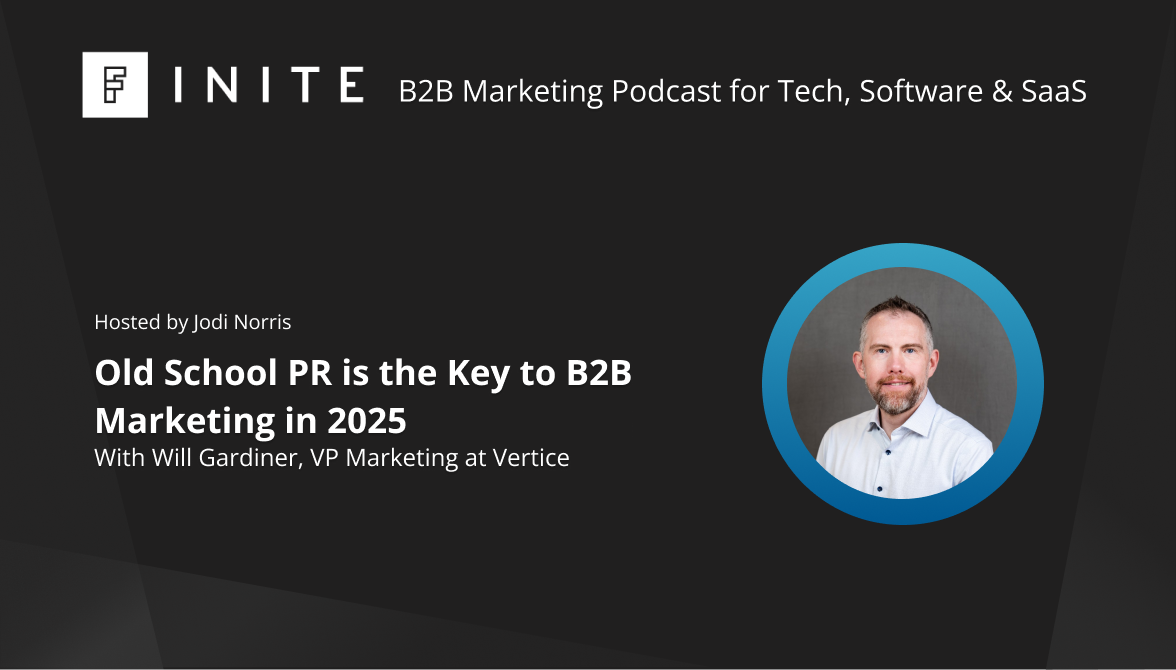
Will Gardiner, our guest today, has a theory: The tactics used in successful marketing today are based on the strong fundamentals of old school PR!
He’s got the experience to prove it. Will Gardiner is VP of Marketing at Vertice, the UK’s fastest growing scale-up in 2025. They’re growing fast, and it’s not just because of a good product or positioning.
Will’s approach to marketing prioritises high-quality, resonant thought leadership across all digital channels. He employs creativity, data, and emerging channels such as influencer marketing to achieve immense marketing impact.
You’ll learn from a marketer cracking the code for growth in 2025, with tactical tips for your own strategy.
Listen below, on Apple Podcasts or Spotify
Or watch on YouTube
And once you’re done listening, find more of our B2B marketing podcasts here!
The FINITE Podcast is sponsored by Clarity, a full-service digital marketing and communications agency. Through ideas, influence and impact, Clarity empowers visionary technology companies to change the world for the better.
Find the full transcript here:
Thank you for joining me on the finite podcast today. Not at all. It’s an absolute pleasure to have you here. I’m really excited about our topic today. I think it’s going to be a really fun one.
We’re looking at how old school PR is really the bedrock of a modern marketing strategy in 2025. Now, usually I’ll let you tell the audience about your background in marketing, but we’re going to be talking about that throughout the episode.
So I thought, let’s talk about your current role. Let’s impress the audience with your current role. Let’s say we’ve had loads of enterprise leaders on the finite podcast lately.
And I thought, let’s get a scale up. Let’s find out how startups and scale ups are really hustling in 2025 to achieve hyper growth.
And I searched, fastest growing scale ups in the UK and your name popped up. So why don’t you tell the audience a little bit about your current role at Vertice?
Super. Thank you. So yeah, I’ve been at Vertice now for about a year and a half, a little bit more. I joined back in about April of last year as the VP of marketing.
And yeah, it’s definitely a scale up. We’re moving really, really fast. It’s really exciting. We sell software. spend optimization software to procurement and finance leaders.
And we seem to really hit a bit of a niche. So our speed of growth has been phenomenal. You’re quite right. We were picked up by the FT and sifted as the fastest growing startup in the UK back in around about March, April of this year.
And it seems to be well-deserved. And the gap between us and a lot of the rest of the people on the list was pretty substantial so it’s going really well um like i say we’ve hit a niche we had product market fit really early on which goes a bit of an acceleration um and there’s just huge appetite for for what we’re doing so it’s uh it’s been quite a ride this last one and a half years.
Awesome. I think you’re being super humble there. Product market fit is essential, but all of that marketing strategy on the top really, really boosts that.
So well done and congratulations. Um, Cool. So let’s, you came to me with this topic idea. I thought it was so exciting and wanted to run with it immediately.
You said old school tactics are really making a comeback. Can you tell us about your experience in PR and how you define old school PR?
Yeah, sure. So I kind of cut my career history in half really, because my first 10 years or so were in PR agencies, always B2B tech PR agencies, but PR agencies nonetheless.
And with one particular agency, my first one, I started off at the bottom of the ladder and went all the way up to a board director.
And then from that agency, we actually launched a spinoff, which was one of the first HubSpot resellers in the country, which shows you my age.
Unfortunately, HubSpot is now a massive business. But that’s since grown and really taken off. We founded it as B2B Marketing Lab, but we changed the name to Hubble Digital.
And that’s now the largest HubSpot reseller on the planet, and it’s going great guns. I then joined another PR agency, CC Group, and set up the enterprise tech division there.
And it was around about 10 years in total in these two places, three if you count Hubble. And I obviously acquired these fantastic new skills, of, um, of selling PR contracts and executing PR campaigns and thought leadership and things like that.
Um, and then I had a bit of a career change, um, triggered actually by, um, pitching for a new piece of business.
Um, and the CEO then calling me and saying, actually, can we hire you? And it came at a sort of the right time in my time of thinking career and whatnot.
And, um, I, that was my first step in house. I went straight in as chief marketing officer. It was a hell of a jump going from sort of account director and division leader in a PR agency to, you know, going straight in as chief marketing officer.
But he sort of gave me my break, if you like. And that was a company called Caligo. And I kind of thought that PR was going to become just another strand of my activity.
And, you know, all of these other pieces would sort of slot in alongside. And maybe over time, PR would take a backseat, maybe a front seat, whatever it would be.
What I’ve actually noticed, and particularly in these last couple of years actually, is that those PR skills have been absolutely crucial.
It may not be necessary that we’re really executing PR campaigns per se, but the skills that I acquired in that first 10 years, I would argue, have never been more relevant than they are right now.
And they’re just popping up all the time. And I’m talking to my team about them all the time, to the point that they make wry smiles now, because I’ve been saying it so often, like back in my old PR days.
This is what we used to do. And it’s now become almost a sort of a running joke. And do you think your experience has really been a key point of difference in your career as a marketer?
And it’s really helped you get to where you are now as having this old school PR lens? Really helped. Really, really helped. So PR by its very nature is… and I’m going to upset a lot of marketers on this, by the way, because I’m going to talk about things like top of the funnel, middle of the funnel and bottom of the funnel, because I’m a firm believer in it still.
And there’s plenty of marketers out there who think, oh, the funnel is dead and so on, but maybe a topic for another podcast, but it’s not dead in my opinion.
So going back to it, PR is inherently top of the funnel. Of course it is, um, in the majority. And a lot of that brings with it things like thought leadership and, uh, and big thought leadership campaigns and coming up with ideas that resonate with the market and that position you as strong, intellectual, observant and of high interest and fast moving and all these other fantastic adjectives that especially scale ups want to be perceived as.
And this may be a point of difference between what we experience in scale ups versus the enterprises that you’ve been talking to previously.
And a lot of those adjectives may not necessarily always resonate with those enterprises, but with us, it’s really important.
We’ve got to pick up speed quickly. And building those thought leadership topics that are instantly resonating is a fundamental for startups like us.
But it is also a fundamental for a PR agency and particularly an agency because you only win those competitive pitches by having really the strongest ideas.
And that’s really what you end up buying as a marketing leader when you’re talking to these agencies.
So you have to be able to put these ideas together. They have to be differentiated. Ideally, you’d want them to be backed up by data. In an ideal world, they’d be actually proprietary data.
That’s what you really want to tap into. They’ve got to be creative. They’ve got to be… You’ve got to know the difference between what’s trite and overplayed and what’s genuinely fresh and new, and what is going to make journalists raise their eyebrows and see it and go, yeah, that’s of interest.
And also, therefore, they’re readers. And journalists are the best barometers of what’s actually going to make it in the audience because they receive 300 pictures a day.
And that’s not necessarily an exaggeration. They receive all of these pitches. They know what they’ve seen over and over again, and they know what’s new and different, and then they’ll put that out, and then the audience taps it up.
So that skill of putting those thought leadership pieces together, we were doing that to win contracts, bluntly, in the past.
Now I’m doing that to survive, really, or arguably flourish in this demand gen world and attract attention quickly and immediately and continuously with each campaign.
We can’t sort of take a quarter off with a dud campaign. We’ve got to always make sure that sort of leadership works. So it really seems like you’re honing in on this element of pure creativity here, as well as resonance with the market, which you feel with journalists on.
This might provide a bit of a basis for your answer to the next question, but I want to ask, because you said that old school PR tactics have really become more significant in the past two to three years.
Why do you think that is? Why now? So the ways in which all of this thought leadership now manifests and has a material impact on a business has now really spread.
So back in my old days, when I was working in PR agencies, it was more a case of, would do thought leadership in order to get pr coverage, in order to have strong, um, content marketing campaigns that would go out through email and all, you know, God knows whatever other channels.
Um, and we would basically add people to the database as a result of all of this. Um, and then be able to lead nurture and so on. And it’s kind of like a very short list.
Now, the importance of thought leadership actually resonates in quite a few different areas. So. If you take the example of LinkedIn and paid LinkedIn activity, yes, thought leadership has always been a strong tactic that works in LinkedIn and your ads perform well, and maybe you do a lead gen form and things like that in order to get people to download content or what have you.
That’s great. But now thought leadership ads have really come to the fore. I say that as if it’s a wholly new tactic. It’s obviously been around for months and months, but it’s now really starting to pick up a load of momentum and people are really starting to realize that the cost per lead in a thought leadership ad is often a hell of a lot smaller than with a standard ad.
We’re certainly seeing that. Finding leads of around about a third of the cost is certainly not unusual. And actually, they tend to go through the pipeline a little bit faster as well and actually convert a little bit better.
And obviously, these thought leadership ads are predicated, hence the name, on thought leadership. And that thought leadership needs to be strong. And it needs to be pithy. You can’t write an 800 word article and slap it in a LinkedIn post.
Some of these posts are quite long, but they’re not that long. So be able to consolidate it all and be able to capture it in those first two lines that appear in a thought leadership ad often, or capture it in a single image or something like that.
Big idea, but then boil it down to its nuances and really down to only about maybe 10 or 15 words. That’s really powerful and commercially powerful more and more so now.
So that’s one way in which thought leadership is now creating these campaigns that I used to do back in the day are now becoming financially impactful.
But also people have always talked about the impact on SEO of having PR coverage and all these inbound links back to your website and so on from wonderful media titles, whether that’s your broadsheets or your trade media or whatever.
People have always talked about that. But now with zero click search, you could argue that it’s even more important because the LLMs rely on it so much more.
They prioritize external sites. They prioritize things like Wikipedia, which I know that was something we used to really hone in on before.
And then obviously it really dropped in terms of a PR agency deliverable because it just became something that was too obvious and the editors would pick it up and say, no, and what have you.
But now it’s back again. you know, having spoken to a load of contacts in PR agencies very, very recently that they’re starting to see these deliverables being thrown back into the contracts that don’t want to sort out your Wikipedia presence and we’ll manage it for you and so on because the LLMs rely on it so much.
Disproportionately, you can argue, but nonetheless, it’s still an important piece. Reddit and other forums, G2 and so on, these are all, you know, PR, they come under the PR umbrella and they are now starting to be so important for LLMs.
And yes, the percentage of most inbound traffic into most websites is quite small for LLMs, but it’s growing and growing and growing.
And it’s becoming this almost headache for quite a lot of marketers where they know it’s kind of important now, but they’ve got to set their stall up now for the future, for when it becomes even more important.
And if they don’t do the groundwork now, then they’re going to get caught behind. talking to a lot of my peers, both in my size of business and also much larger, the story’s the same.
It’s absolutely universal for every marketing leader of, I know this is a problem and I need to carve out time for it for me and my team, but I don’t know how.
And I think those who’ve got a PR background can get a bit of a headstart on it. Absolutely. You’re so right. LLMs are trawling. And the only way that you can stand out with them is by doing something unique.
LLMs are founded on averages and finding the overall general ideas. But if you can penetrate that with something interesting that resonates with an audience, I think that’s ever more important.
It sounds like you’re using the broad idea of thought leadership and applying it in all of these new kind of, I don’t like to say digital marketing because marketing is basically digital marketing, but like these digital channels and working out how you can really, um, spread the maximize the impact of that thought leadership.
Would you say that’s correct? Yeah, absolutely. And I’m certainly not saying that the only marketers who are ever going to make it in today’s world are those who’ve got a PR background.
That’s far too simplistic. Of course it is. But those who have an understanding of PR and whether you, it’s quite easy to use the words PR, thought leadership, maybe content marketing, and it’s going to wind some people up and maybe demand gen as well.
Like you can use a lot of those often quite interchangeably in certain scenarios, but those who really and also understand the ways in which to get these pieces out into more places, I think are going to stand a far better chance.
And those who can be quite flexible with the way in which they can express these thought leadership ideas.
If you’ve got a team where the content marketing guys are only really capable of creating white papers, but they create them beautifully and really well and very intellectually, that’s really all they can do.
They can send out the email marketing for it and drive people to it. That’s going to give you some benefit, of course it is. But unless you can turn that into thought leadership ads, unless you can turn that into a PR pitch and get some coverage, unless you can talk to influencers, which is another thing we need to talk about here, unless you can get that across all of these other various channels.
And people have been talking about atomizing content for heaven knows how long. But my argument would be that it’s never been more important than it is right now.
I reserved the right to come back in 12 months’ time and say, oh, now it’s even more important. And now it’s even more important because it seems to be an ongoing conversation, sure.
But I’ve definitely noticed that it’s been these last 18 months or so that when talking to my team and when talking to external people, it is much more often that I’m now talking about PR skills than I was, say, two, three years ago.
So… Let’s talk a bit more tactically, I guess. I want to know where do these ideas come from? You’ve mentioned the content team creating these intelligent white papers.
Is that where you find your source of thought leadership or is it more based on the creativity of your PR team or the market insights and awareness of your paid ads team?
Where do these ideas come from and for you to spread? Really importantly, they don’t come from any of those sources because that would be relying on basically the echo chamber of the company itself.
The ideas that we get are from talking to external. So when I first joined the business, one of the first things I wanted to do, and this isn’t rocket science, this isn’t new, this isn’t something that only I’ve thought of, but the first thing I wanted to do was talk to customers.
Yes, it helped me get some quick wins on the board and get some case studies and things like that that we needed with certain industries.
That was great. But I actually did it for the more long-term objective of starting to understand what our audience wants and needs and so on and so forth.
Because I personally hadn’t actually targeted procurement decision makers before in my career. Despite working for heaven knows how many clients in the past in PR agency days and obviously several roles in-house as well, I’ve never actually really targeted procurement that strongly.
So I needed to understand them really quickly, because we’re also going through a bit of a change in flipping from finance to procurement, or at least trying to get a balance between the two.
We needed to understand very, very quickly. So I was talking to a lot of procurement decision makers, a lot of finance decision makers, not just a normal interview for a case study, but talking to them about the wider departmental objectives and similar, just to get to understand them a bit better.
So that piece, plus also talking to those in and around the industry, so things like media contacts, influencers again, consultants, advisors, and so on, analysts, talking to as many of these as possible and asking them often the same, but importantly, different questions as well, just to sort of get a bit of a feel.
And that’s not just a one-off thing. That’s something that just has to continue constantly. Only yesterday I had lunch with another marketer at another procure tech business, not a direct competitor, obviously, and things like that, but someone else who’s living the life and talking to procurement decision makers, just to sort of get a feel for what they were succeeding with and also failing with and sharing some war stories.
It’s absolutely continuous. And it’s actually quite remarkable how many activities that we as marketers do. in our normal day-to-day life that if you just take it that extra little step further, you can start getting some really important industry knowledge.
So a lot of marketers, for example, will be talking to media titles, but often maybe the advertorial guys because you’re setting up a sponsorship or something like that.
Take that extra step and get an introduction to the media contacts, the actual editorial guys. Have a quick 15 minutes with them. They’ll spare the time because then You know, you can start to understand what it is that out of the 300 pitches they’re getting every day, which are the 10 they actually pursue and why.
So that’s where we sort of consolidate all of our ideas from, and then work out which ones we can actually tie to our commercial proposition, which ones we know from experience will work, won’t work, and then take it from there.
Awesome. So it’s really about having the entire marketing function, including leadership being super customer centric and in the minds of their of their consumers and the audience and feeding that into the strategy and leading with that lens.
That makes sense. Cool. So you did mention influencers. We haven’t talked about influencers in a good while on the show, but I remember looking at loads of 2025 forecasting reports and every single one of them said, influencer marketing in B2B is here and we need to grasp it.
I would love to talk to you about how you’re doing that, how PR, your old school PR tactics feed into that and why influences are so important at Vertise.
So we work with a lot of them. We’re not unique in procure tech or even in our direct market in working with influencers.
But we’ve done, I would argue quite a good job at getting a really good, solid relationship with a select few that we can prove have been commercially impactful to the business.
And I would argue that one of the reasons we were able to do that is because we take and I’m sorry, I’m going to bang the drum again, but take a slightly sort of PR agency approach to it because the similarities are remarkable.
An influencer has got their community. And if the influencer has been around for even only a short amount of time, they know what resonates with their community well and what doesn’t.
They know what channel works well and what doesn’t for whatever individual purpose. A lot of these influencers work across LinkedIn with a very strong email newsletter database.
They also do webinars, guest appearances, all sorts of things like that. And they know what topics will work in which channel best, what topics won’t work in any of the channels.
If you take that and then transpose it over to media, it’s exactly the same. If you talk to journalists about what their audience want to hear, it’s exactly the same sort of conversation.
So when we engage with influencers and we’re talking to them about maybe working with them, it’s exactly the same conversation that I used to be having with journalists when I was in PR agencies.
How do I get a story into your publications that your audience is going to click on an awful lot. That’s going to help your click numbers. It’s going to mean you’ve got a stronger argument for your advertisers in the future.
And that means I’m going to get more attention. It’s an entirely mutual partnership. We’ve both got our own goals, but we’ve got to come up with a story and an approach that’s going to serve both of us.
It’s exactly the same with an influencer. They’ve got to make sure that what they’re sending out is whatever they’re sending out on our behalf, essentially, is going to gel with what the audience is learned to come to expect from that particular influencer over and over again.
It is exactly the same. Um, and we now work with a few with whom we know we can work well. Um, and we’ve worked out which channels are good, what sort of angles are good, whether we should be talking about incredibly high top of funnel, even beyond the top of funnel sort of topics, or whether we should actually be, you know, trying to work with them to get people in the middle and the bottom of funnel and through to requesting demos and all that sort of thing and through which channels and how frequently and so on.
So we’ve made some really good impact with them in the market. Our brand has increased dramatically through working with them and through other tactics as well, but a large portion of it through influencers.
And we can see pipeline coming from it too. And I do truly believe it’s because we go at it as if they are journalists. Great, so it’s really about trusting your media partners to understand their audience and know what will resonate with them.
That makes sense. And not just flinging them some ad copy and saying, you must say this. I see that all the time. It can be quite jarring when an influencer you really enjoy is just reading off a script, knowing that, yeah, it’s not right.
I am fascinated by B2B influencers in particular though, Do you have any examples you can share with us of an influencer you’ve worked with and how you’ve worked with them?
Yes, there’s one in particular who’s been really good and was actually one of the first ones we worked with, a fellow called Tom Mills, and he’s a procurement influencer.
He’s actually quite a new sort of influencer. He’s been going for some time in terms of creating content, but he’s fairly recently sort of made the switch to go full-time.
And he’s also extremely data-driven. which really helps with me because I’m a bit of a data geek as well. And then when we were talking to him, he didn’t just come along like a lot of influencers do.
He didn’t just come along and say, well, I’ve got a database of this size, I’ve got an email that goes out that frequently, and it gets this sort of open rate, full stop.
Would you like to now pay to get some space in there? Instead, he came to us and said, look, I know that if I send out content like this through LinkedIn, I get X degree of engagement.
But if I send content that looks like this, then I get two X. And if I send that piece that only got one X in LinkedIn, but I chuck that out through my email, then actually I get a three X engagement with it.
People really like it. So he knew really, really in granular detail what needed to go where. And to use the phrase I used before, he knew what his audience had come to expect and then could talk to us about it.
And then we could say, well, that’s great. And here are the ideas we’ve got in the hopper for our content and the messages we want to push.
And then we could gel and then make sure that what we were going to push was going to go in the right places.
Because exactly as you said, if we push the wrong sort of content through the wrong channel, it kills both of us.
We look ridiculous because it looks like a silly ad and he probably loses a handful of followers in the process silently or otherwise he loses them.
So we needed to make sure that it was all going to work. And he’s also just a lovely guy to work with, which really does help. He’s very, very collaborative. And yeah, he also does a lot of different things digitally and otherwise.
And we’ve really enjoyed working with him. But it’s because we’ve taken this very pragmatic approach of really putting the audience first, not our buying audience necessarily, but his audience, put them first, and then making sure that whatever we’re doing is actually tying back to us as well.
Great. Thank you so much for that, Will. That’s super helpful in understanding how you work with influencers. And a key point of that is clearly data. You just mentioned you were a data geek.
I think that’s super interesting juxtaposed with old school PR. I feel like old school PR is not known, but people see it as not being so data driven.
and very hard to track and attribute. So how are you working around that? How are you attributing your thought leadership and really making sure that your wider business sees the impact of all of these PR-y kind of tactics?
So really it’s just a case of, so we use HubSpot. Of course we do. I’ve worked with them so closely many, many years ago. I couldn’t really introduce other platforms.
But We tag all of our interactions. We have a very detailed process of tagging to make sure that the same content themes maybe carry across lots of different tags.
We can see what sort of topics resonate well and what don’t. We put the channel in there as well. We might put the influencer in there and all that sort of thing.
It’s not rocket science. A lot of people will be doing very, very similar, but it really works for us. And the way in which we analyze it, because then we can see that people who have engaged in this thought leadership ad on LinkedIn, it was on such and such a topic.
We maybe used influencer content within it. We maybe used a report within it or whatever. We’ve got all of that in there. And then as they then progress through the funnel, we can then attribute it all the way back and say, well, actually the first way in which we know of them engaging with us, I fully appreciate there may be many, many other invisible ways they engage with us beforehand.
But the way in which we know they engaged first was this, with these sorts of topics, and then stitch it all together and say, right, this topic, this piece of thought leadership, that’s all predicated on maybe a white paper or webinar or something like that, that we’ve then atomized in all these various other ways.
If you pile it all together, that theme, that campaign has delivered X. And then drilling into it to say, well, actually with that particular campaign, then it worked really well for LinkedIn or worked really well for a particular influencer or for a particular media partnership or whatever.
And then taking those learnings when we do the next campaign and the next campaign. It’s not rocket science, but it’s enough for us to be able to say, certainly at our level of business, that we know what works.
We know what topics work and what channels work. And we’re starting, we’re only a young company, but we’re starting to learn the combinations that work best and the order in which some of these need to come as well.
And then replicate as frequently as possible. And we must be doing something right because we’re growing at the pace we’re talking about at the beginning.
So it seems to be working. But I talk to a lot of my peers about attribution because of course we do. We’re marketers, of course we talk about attribution.
And I hear and see some incredibly sophisticated attribution models. And I’m often incredibly impressed by it all. And then I look at our own model and think, oh, maybe it’s a little bit sort of simplistic perhaps, but it works.
And we seem to be making the right decision over and over again. So it may be just the nuance of our business, maybe the nuance of our sector, maybe the nuance of our size of business.
I don’t know, but it works sufficiently well for us to be able to say, let’s try that again because you knew it worked last time.
There’s probably someone listening right now who’s going, Yes, but if you do it my way with this much more sophisticated attribution model, maybe it could perform another 10% better.
They may be entirely right. Entirely right. But right now, for what we’re doing at the moment, it’s working well. Absolutely. You’ve really got to take into account your stage of growth and your MarTech stack and how sophisticated you want to be.
And if it’s working, why fix it? There’s a whole load more science and wonder behind it all that my marketing ops guy works on as well, but fundamentally is and the way in which those tags actually appear, of course, there’s a lot more sort of detailed science behind it, but we’ve only got so much time on one podcast to go through it all um but uh but all of that then translates.
Absolutely. But there is a listen to that and that, like, you do want the headlines of data. You do want those key insights. What’s the point of getting too granular?
You’re talking to the C-suite. You’re talking to shareholders about impact. You’re not trying to woo them with your maths. But yeah, I appreciate that you pointed out that there is a lot of method to the simplicity.
So yeah, absolutely. Well, we’re actually going over time here, but I’m loving this conversation. I have one more question to wrap it up. And that is, we’ve talked a lot about the, similarities between PR and modern marketing and why those two should really go hand in hand and how you can use the skills from old school PR to inform a successful, might I add, marketing strategy.
So I want to know, are there any differences? What are the key differences between PR and modern marketing? There aren’t that many differences. differences really. And maybe it’s because of my own personal experience.
I can only sort of be the marketer i am based on my own personal history and my own personal history is 10 years in PR.
So I’m naturally going to sort of lean on that quite a lot. And yes, I’ve built a whole lot of other skills alongside it as well, but naturally there’s a, there’s a foundation there.
Um, but in terms of like full-on differences um of course there are certain channels that PR just doesn’t really dabble with or influence that much.
And there’s certain sort of metrics and measurements and tactics that of course it’s divorced from.
I think it’s, but it’s not so much about that. I think it’s really about the mindset. So your mindset as a PR person is of a certain sort. It is deliberately collaborative.
It is deliberately creative. And when I say collaborative, by the way, I mean, collaborative with, external stakeholders rather than sort of being a good you know member of the team internally.
It’s about collaborating with journalists and collaborating with analysts to make sure that both needs are met simultaneously.
But yes, you have to be creative and yes, you’ve got to stand out quickly and i i do think that being in an agency world rather than an in-house pr world so early in my career and for so long so early in my career meant that there wasn’t any room for error.
We were pitching for business on a constant basis and we had to win. That’s the whole point. And not just because I’m competitive, but because we needed to increase revenues and so on, and then sort of win new clients and do new things.
So you inherently therefore have to be more discerning with the ideas that you’re putting together and more self-critical of the ideas you’re putting together and therefore put forward in the pitch.
And that I think has put me in pretty decent stead in my later career. And to reiterate from before, I’m not saying that the only marketers who will ever succeed are those with a PR background, but for me, it’s certainly worked.
And the number of times that the PR skills are popping up now, I’ve not really have seen it like this in all my years in in-house.
Cool. So when we really whittled down, old school PR to those fundamental skills. That’s what you’re tying to success in modern marketing. I love that. A great take. And that’s a wrap for the episode.
Thank you so much, Will, for coming on. It’s been an absolute pleasure to talk to you. Likewise. Really enjoyed it.