- Oct 27 2025
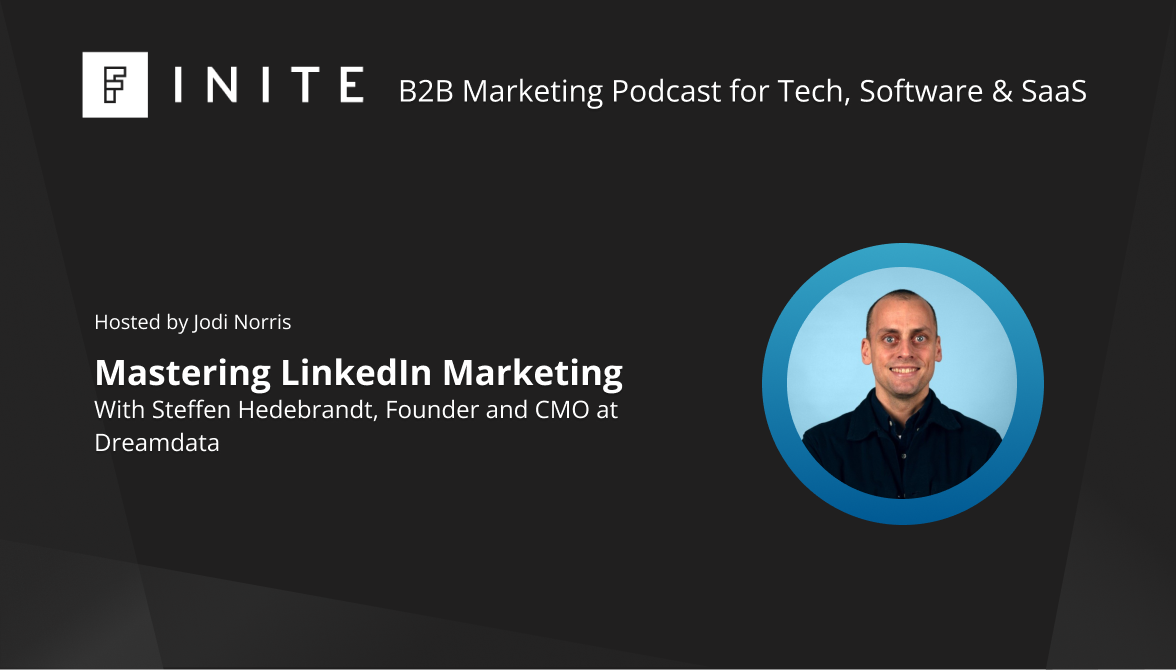
Steffen Hedebrandt, Co-Founder and CMO at Dreamdata, joins FINITE to share a contrarian growth playbook for B2B scale-ups.
We get into why “unserious” content (think memes and screenshots) drives serious pipeline, how to engineer organic LinkedIn that converts. Steffen breaks down connecting brand awareness to revenue with real signal, not vanity metrics – plus the experiments, frameworks, and attribution hygiene his team lives by.
Finally, Steffen shares his enlightening take on what it takes to win as AI overviews and LLMs reshape search.
If you’re done with cookie-cutter demand gen, this conversation gives you the edges: creative that compounds, measurement that actually matters, and an AI-native approach to search that most marketers are sleeping on.

And once you’re done listening, find more of our B2B marketing podcasts here!
The FINITE Podcast is sponsored by Clarity, a full-service digital marketing and communications agency. Through ideas, influence and impact, Clarity empowers visionary technology companies to change the world for the better.
Find the full transcript here:
Hey, Steffen, thank you for joining me on the finite podcast. Hi, Jodi. Thank you so much for the invite. I’m really happy to be speaking here with you. I’m happy to have you here as well.
We’re going to be discussing quite an exciting approach to B2B growth today and one that you took with your team at Dream Data, which is the company you founded and are CMO for.
So I won’t give too much away. But before we get started, could you tell our audience a little bit about yourself and your experience to date?
Yeah, happy to. So I’m probably like 15 years into the life of B2B marketing now. I’ve only ever worked in B2B marketing roles from like really small scrappy projects to larger companies.
And now today I dream that we’re around 60 people with two offices in the New York and Copenhagen. And my role is basically today kind of leading the marketing team.
That means that kind of going from people that we want to have buying our products, not knowing about us to knowing about us and appreciating what we do.
So classic kind of B2B marketing responsibility. Absolutely. And what does your team look like at the moment? We’re six people heavily on the content side and product marketing side, which kind of also some of the things we’ll get into later.
There’s good reasons for that as kind of, we are trying to reach B2B marketers and to do so we have to appear on the channels where they spend a lot of time, which I’m sure we’ll dive into in a minute.
Yes, absolutely. Cool. So really in that scaling phase, and I think this is why this episode is going to be so interesting, because it’s a really unique approach that you’re taking to scale.
So let’s dive into that. What are the main kind of strategies and tactics that you have used at DreamJada to really achieve scale?
Yeah, I think we run on kind of like, if you’re think about it like a classic funnel. I typically think about the bottom of the funnel being right people and at the right time, which is for us B2B marketers working in companies with low hundreds of employees to a couple of thousand employees.
And we’re trying to appear everywhere where they are actively expressing on the Internet that they’re actually looking for a product that does something of what Dream Data solves, which is kind of understanding B2B customer journeys, finding out what to do more and less often, automating how to run ads, et cetera.
So there’s this always on layer that I just want to cover because I think everybody should start there.
If they know the right people and the right behavior, keep something always on, which is probably your search ads, your review platforms.
Maybe there’s some technology marketplaces where you want to be appearing. So I just wanted to get that out of the way before I say it. Then above the right people at the right time is just the right people.
And this bucket is where we spend most of our time. I think when you look towards LinkedIn, they actively try to promote this 95-5 framework where they say 5% are somewhat in some state of searching for a solution.
But the large chunk, the 95% chunk, they’re not actively looking for a solution because they’re busy.
Other projects, they can’t afford your solution right now. Maybe they just got a kid or something like that. But those people represent basically the majority part of the people that you want to get on the radar of.
Because when they do have budget, when they do change jobs, when the timing is right, then you need to be on the day one list of those people.
And the way that we have approached this, I dream that it has been to kind of go very heavily into the LinkedIn network, both from an organic perspective where we try to try to get our employees to post a lot and to connect a lot with B2B marketers.
But we also run extensively ads on the platform towards the companies we define as our ideal customer.
So it’s like a joint effort between a lot of organic posting and connecting with the right types of people and then kind of having that air cover of actually thought leader ads.
So that’s maybe a good story to tell as well. We don’t really run as such like the traditional polished. Here’s our brand. This is what we do. We very extensively used employee posts that has already organically been validated as working really well to our target group.
And then we run these thought leader ads that LinkedIn has introduced where you can kind of sponsor the posts of your employees.
And then we put them in front of this cold audience of accounts that we want to be reaching. So that’s a very quick fly into how we raise awareness about our company.
Awesome. That’s such a good way of really breaking down the funnel and showing what the funnel actually is and why it’s so important.
I could, I think I’m going to host a debate on the finite podcast soon about whether or not the fine, the marketing funnel is dead because I hear so many different things from so many different people.
Do you have any thoughts on that? Yeah. It’s like, yeah. So I, I, it’s, I know I used the word funnel myself, but to some degree of, I think there is some funnel, but it’s not something that I think too much about.
Uh, I just think about maybe it’s more like there’s two chunks of people. There’s the ones that are actively solving something right now where they need extra ad pressure.
They maybe need more product-specific marketing. And then there’s all the others that maybe sometimes they want to know about a feature.
Sometimes they want to read an interview with a thought leader that you interviewed. Sometimes they want to see a funny meme that you’ve put out.
So I think for the 95%, it’s just about staying top of mind all the time. I don’t really think about a funnel as such, as long as we keep the quality of our content output super high, then hopefully these people will remember us in a good place in their brain where they kind of appreciate our brand.
So in our day-to-day lives, the funnel is not really something we think too much about besides kind of like in this always on face, we need to do a few things a bit more specific.
Yeah. Okay. That makes sense. Definitely. So that kind of awareness. Sorry to interrupt you, but I do get why you wish there was such thing as a funnel, because then it would be very easy.
You could say first A happens, then B, then C, then E. And then in reality, it’s very hard to like just get every duck in a very rational row.
I know what you mean. I feel like the funnel often implies that you can capture people and really like push them.
People say, push people down the funnel as if like pushing events on them and white papers and, and lead scoring them, making sure their score goes up and up and up is like, like making them do something, but people are, always going to do what they’re going to do they’re only ever going to buy from you when they’re ready to buy from you.
You’re right. So that five percent is the only people that you can really kind of influence in any way or convince in any way with sales.
And that other 95 percent is you’re right. Just awareness and making sure that your brand is there when they go looking for you you’re second on google and they recognize you.
And so it feels like an obvious decision at that point. Is that kind of how you would see it as well? It is, um, I just lost the third. There was something I wanted to say.
What I had in mind was kind of the, I think also like more and more of the customer journey is moving outside the realm of the salesperson’s control, which I think there’s vast amounts of resources that you can check out and how much of the customer journey takes place outside of the sales room now.
And that just means that us as marketers, we just, We have to appear everywhere. We have to answer all the questions of the stakeholders, but we have zero control of that kind of rational progression towards somebody buying, as you would have like ten years ago where the salesperson would kind of have each of the stages under control.
I think like when we look at our own benchmarks, I dream that 70% of the buying journey or the customer journey takes place outside the sales pipeline.
So it’s an immense amount of time that Where we’re not in control, the only thing we can control is that we consistently have an output that makes us stay top of mind with these accounts.
That’s a really fascinating stat and thank you for sharing that. So insightful. Can I ask how big is your sales team? How much resource do you put towards sales at Dreamdata?
I think we have around 10 sales people split between a European and American office. So we run basically also, we run an inbound model. So the marketing team is responsible from people not knowing about us until they hit our website and books a demo.
And then from there on, when there’s somebody who’s actively raised their hands, then we let the salesperson kind of drive the deal forward.
Great. So it’s really about inbound sales and focusing on that 5% from that point. Yeah. And then… It’s also very much the way we think about it is it’s not so much about getting people to click through on our website every day.
It’s more about can we make sure that we deliver the right message to the right people? And if we are to do that on LinkedIn, it doesn’t matter for us whether we push them to our website or not, because we hope that they at least will come to our website the day when they actually go into the 5% bucket of being in market.
So on the day to day side, we’re not kind of doing very click focused ads to push people to our website.
As long as we make sure we deliver the right message to the right person, then at some point when they’re ready, they will hopefully come to us.
Awesome. I totally agree with this approach. It’s almost an emerging and new approach to B2B marketing over the past five years.
And I feel like marketing still in these maybe a bit older organizations is still very much ROI driven.
You need to be attributing, of course, which I’m sure you do, but really making sure that every single ad, every single post is almost working towards this ROI and revenue.
And LinkedIn almost on the other side of that is… seen as kind of vanity metrics and what do impressions and visibility really mean to the C-suite?
And I think it’s interesting that LinkedIn published the study about the 95 to five rule to really show, prove their, um, their product success and how it works for marketers.
What would you say to marketers who are still being tied to hard ROI and harder attribution from LinkedIn?
I’d say they should come to us at Dream Data because it’s actually something we solve nowadays, which we didn’t do in the past, but we are an official partner of LinkedIn.
And that means we get access to an API that tells us you served this ad to this company on this day without having people, forcing people to actually click.
So we can still kind of do the, the ROI calculations now, even without people clicking, we still kind of can map the impressions, the engagement that happens on the platform into the customer journey of accounts now.
So that really has elevated the visibility quite a lot. When we ran the before and after numbers, it’s a 7.7x difference in how much revenue you can attribute to LinkedIn.
So it’s a new, there’s an API that LinkedIn has that is called their company intelligence API that some select partners get access to.
And we’re utilizing that to then join, which I think is fair questions. I think like the CFO, et cetera, they’re not doing it out of just bad faith to marketing, but they’re asking the questions.
I could be spending this dollar on a new engineer or a new salesperson. but you want me to give it to you in marketing, then do try then to explain me kind of the logic of why are we doing these things?
So there’s a bit of yes and no. Yes, you should try to kind of talk that language of revenue and ROI 100%. But then there’s also a lot of things like all ideas still needs to come out of your gut feeling and like the creativity of the team should be empowered to kind of just try stuff out before we kind of enforce the heavy measurement regime on top of things.
Cool. And does that work for your, because I know you do a lot of employee advocacy almost and really empowering your team to do their own organic posts on LinkedIn.
Does that work for those posts as well? No. The way we, I think we’ve been kind of through a journey with kind of a big appreciating the employee posts more and more.
When we started out, we were a very small company and a colleague of mine, Laura, did one post and a very large influencer suddenly commented on her post and then her post blew up completely viral.
And we could see, because we were a quite small bank then, that we had never had as many visitors on our website, never had we had as many kind of demo bookings on a day as that day that that kind of organic comment happened and there was no links to our website or anything like that.
So we got like that really firsthand experience that just because you don’t have a link that has a UCM that points to your website, these posts can still be very valuable if they’re seen by the right types of people.
So the way it’s kind of, we look at our organic program today is more, uh, is kind of our, our post, uh, resonating with our target buyers?
Are they commenting on the posts? And our employees, are they growing their following? And that part is kind of fairly, you can say, unmeasurable towards revenue.
It is very measurable when you look at the more leading indicators of, you know, LinkedIn has become very good at showing how many impressions, how many likes, et cetera, a post have.
Where the game kind of changes is when we start running thought leader ads with the employee posts, because then you get the ad measurement metrics as well, where how much did you spend, how much revenue did you influence and so forth.
But for teams that just start out, you should just start appreciating that your employees post and create awareness about you.
You’ll see how many impressions you get. And once you start seeing that ideal customers, ICPs are engaging with those posts, that’s when you should give them your team a thumbs up and encourage them to continue posting.
Absolutely. So I know that your audience are B2B marketers. Do you think that, I mean, do you think LinkedIn is particularly effective for B2B marketers or do you think it’s equally as important for B2B all around?
Because I know marketers are always on LinkedIn. It is one of their channels as well. Yeah. You almost feel like it’s kind of feeding into itself.
Yeah, I think you’re right, Jodi. I’m not claiming this tactic works for any B2B company in the world. If you’re selling to construction workers, no, they’re probably not spending the day on LinkedIn because they’re busy doing actual work.
But I think that goes for any company. Oftentimes I reflect back on the book called Tribes by Seth Godin. talks about being able to identify a tribe, say surfers, then surfers, they go to specific surf spots, they reach specific surf media, they follow certain influencers, there’s specific tournaments.
And if you’re just present where these surfers are, then you don’t have to boil the ocean with your budget, but you can just be present at those few places.
And for us, our surf spot is LinkedIn, as you say, Geordie Piemel. B2B marketers spend a lot of their day on LinkedIn. So I think that’s why particularly it’s a great channel for us, but it might not necessarily be for companies like industries where people are not so much.
Absolutely. I think you really honed in on the fundamental there is just be where your audience are. But I think you did share some research with me before this episode.
And it said that LinkedIn now accounts for 39% of total B2B ad spend. And this is an increase from 31% at the start of 2024, which isn’t that long ago.
Why do you think that is? I think B2B marketers are, I think it also goes a little bit hand in hand with LinkedIn’s ad platform development as well.
People are more and more realizing that the traditional networks like Google and Facebook have absolutely zero targeting options for B2B marketers.
You can only focus on demographics and stuff like that, that are not very efficient in B2B where we oftentimes need to be very specific with whom we’re trying to communicate to.
And kind of of these generally available platforms, LinkedIn just offers a superior targeting mechanism.
You can like literally upload lists of the specific companies you want to be targeting, the specific roles you want to be targeting.
So once you start paying for ads, you know, my ads are hitting exactly the accounts that I’ve asked LinkedIn to be hitting.
Whereas if you post on the Meta network, you don’t know if it’s like an 18 year old boy or like a, 64 year old grandma or something like that, that gets targeted by your ad.
So I think the main reason is this kind of the B2B targeting options on LinkedIn that is just far superior to any other ad network that makes people slide towards spending more and more of their budgets on LinkedIn.
Absolutely. And almost honing back to the earlier in the episode is probably to do with the success of their 95 to five research.
And you’re right. B to B marketers are realizing that it’s more than just awareness and engagement and impressions.
It’s about really capturing those B to B audiences in particular. Do you think? Yeah. I think also gradually there’s always been this notion that B to B takes a long time, but For example, we put out also in the same report, yes, you’re referring to Jodi, that like the average B2B journey is 211 days.
And that means like it’s way too late now if you want to sell something before Christmas, where kind of, I think for a long period, B2Bs hoped that they could have the same kind of e-commerce funnels where like advertise for a running shoe, then somebody clicks the ad, they go to the website and then buy the shoe.
But I think people are starting to realize nowadays that in B2B, we need to be more patient. Things are going to take a long time. And the first thing we can control is making sure that the ads hit the right people.
But from there, it’s going to be 200 something days before the customer signs a contract with you. So I think there’s this whole maturement of kind of understanding how B2B actually works or like, I have a more fact-based approach to how B2B works nowadays.
Absolutely. That’s a great start. 211 days. It’s quite a long time. It’s also a bit terrible. But I think it’s something that you should be communicating to the rest of your company as a B2B marketer.
Because if the sales team has a very high target here in Q4, it’s too late for you to start supporting that in Q4.
You should have started in Q3 or even better in Q2. So the marketing year wheel needs to kind of be one or two quarters ahead of the sales wheel because sales doesn’t come out of nowhere in B2B.
You need to plant some seeds. They need to prosper and things just take a long time. Absolutely. That’s a great take. And something that I think we should all be thinking about, especially as we head into Q4, well, we’re in Q4 now, gosh, where did that go?
But I’d love to turn the conversation to AI now. I’m surprised we haven’t talked about it so far. I think that’s a record on the Finite podcast in the past six months to a year, maybe two.
So I’d love to know your take on AI and specifically how you think LinkedIn is changing in the AI era, how marketers are adapting to AI on LinkedIn and maybe a little bit about AI slop or the huge waves, swerves of content on LinkedIn now?
I think I’m one of the people in the bucket that also thinks a lot about AI. If we put it into a few different pockets, we can start with the content component of AI.
I think the introduction of these generative AI platforms ChatGPT, Gemini, whatever you call them, that can just spit out millions of words of text in minutes.
That has really moved the bar for content that any mediocre content means crap content now because anybody can do mediocre now.
So that means the bar of the quality of the content you need to put out needs to be sky high nowadays if you want to stand out.
There’s also ways to do it. So the written language that comes out needs to be very high. It could also be very human, so still containing a lot of mistakes.
Like real world examples, I think nowadays go a long way. When I post stuff where I take ugly screenshots, they typically do quite well on LinkedIn because people can see, hey, here’s somebody who’s actually doing real work and has not polished everything off to be ready to go on LinkedIn.
I really hope that there will be a tendency to elevate content that is clearly produced by humans. But I think as a whole, us B2B marketers, we need to think about that.
Anything that is mediocre now today is not cutting the bar for where it needs to be if it is to stand out on a social media like LinkedIn.
The other thing I want to say is kind of also out of my personal interest in kind of how to grow companies through marketing is that I think fundamentally these LLMs, ChatGPT, et cetera, are changing the way people do research.
It used to be, there’s something I need to find information about. Let me go to Google and type it in. But what I can see everyone from myself and my fiance, even my parents saying, They say, I need information.
I start with the generative AI overview. And only if I want to go really deep, I go to Google afterwards. And that means for us in B2B marketing that, yes, SEO is great.
But if we don’t appear in the answers that our buyers will find in ChatGPT, then we don’t even make the list.
So we need to pay a lot of attention to How is our brand appearing in this new bucket? And if I think back on my marketing career, there’s been a few moments that there’s been introduction of social media, introduction of mobile phones, and then in the very early days, Google and the Internet.
But I think the LMS will be as big a change to how people find products as those really like seismic shifts.
And the good news is that There’s a period now within the next one to three years where there’s a blue ocean where not all everyone understands how to do this.
So us marketers who really wants to grow our brands, we have an opportunity to go there first and exploit the blue ocean.
But in three years, everybody will know how to do this. And then it will be just like Google and social media, et cetera, today where it’s a red ocean and the tactics are all exploited already.
Absolutely. It’s a really interesting take. I did have a guest come on the show a couple of weeks ago who kind of defended B2B companies specifically from this focus on AI overviews and LLMs by saying that B2B deals, you’re right, they’re not like e-com deals.
They’re not D2C. They’re huge, high value. They require big buying committees sometimes. I guess it depends on the product that you’re selling in B2B, but I can’t help but hope that these quite rigid and rigorous processes are still happening in B2B.
Do you have any thoughts on that? I think you’re wrong if your take is that this is not going to be fundamentally changing how all bioresearch takes place.
I think it’s people, well, they will get hit by kind of like an iceberg effect that no, ChatGPT is not throwing off a lot of clicks to your website.
The way you’re going to see success in ChatGPT Express is that people come directly to your website or they come through organic search on Google because they’re already done with their research once they leave the environment of ChatGPT.
I’m a very strong believer that this is a crucial battle to win for any B2B company. Awesome. And just quickly to wrap up the episode, I think that’s a really strong and almost optimistic take.
What are you doing at the moment to secure Dream Data’s place on AI Search? Good question, Julie. So we’re doing a handful of things at the moment. Once we have re-engaged a PR agency because the way ChatGPT ranks stuff is not the same as Google.
Google likes links. ChatGPT likes mentions next to topics. And how do you achieve that? You do a PR and push out a lot of messaging about what your company does and having your brand associated with it.
There’s some kind of what you would call on-page stuff you need to do when you write. You need to write in a more question and answered. kind of fashion, you need to write more specifically.
So what takes place in Google is very broad definitions of questions on chats. It’s a very specific question people are posing. And in order to be cited when people ask these questions, you also need to write very specifically.
And then a third thing that we can see is that of the top ten of our pages that have received most traffic from GPTs, All of those websites contains benchmarks.
So very specific Google ads, cost per click went up by this in this certain period. So it seems that the GBTs really appreciate proprietary, unique data that it cannot find anywhere else.
So if you as a company sit on this kind of information, make sure you publish this as well, so you allow your GPTs to promote what it is that you do and you have available in your business.
Fantastic insight. And it’s great that you and Dream Data and other B2B companies are really doing your own analysis of what’s actually working to get an AI search.
So really inspiring. Thank you so much for that. And we’re going to wrap up the episode here. So thank you so much overall, Steffen. It was a brilliant conversation. I’m sure our listeners are going to get loads from it.
Thank you, Jodi. And yeah, feel free for people to reach out with more questions to me on LinkedIn. I’ll be happy to connect.