- Some additional information in one line
- Sep 29 2025
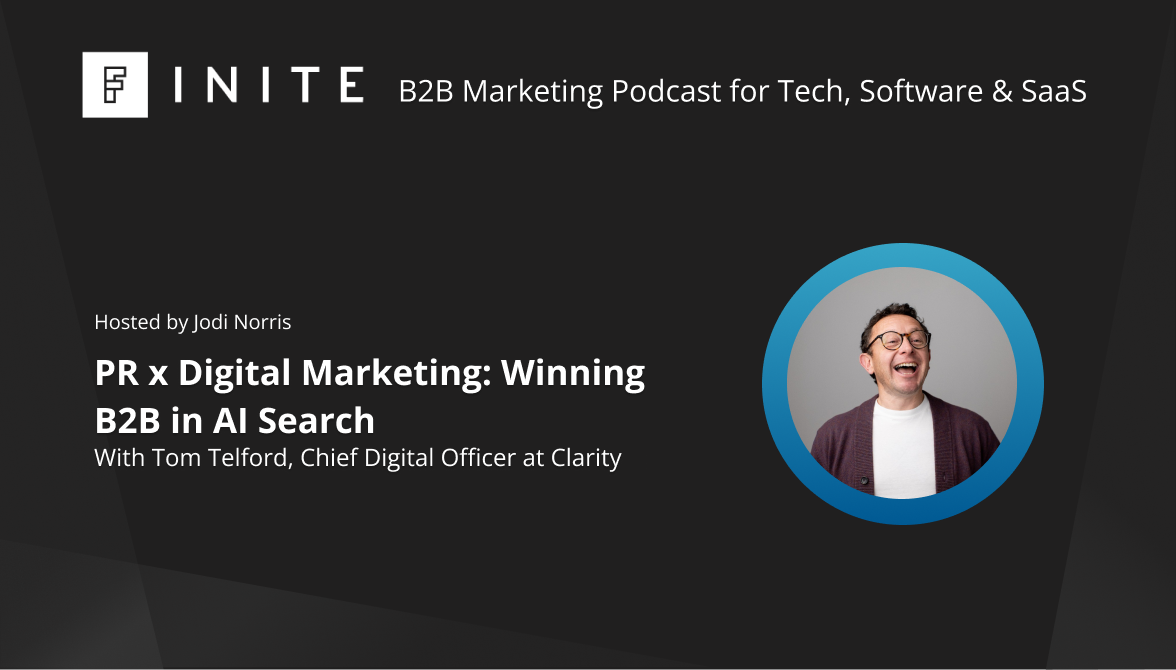
PR x Digital Marketing: Winning B2B in AI Search with Tom Telford, CDO at Clarity
In light of AI search, is SEO dead? Not so fast.
Clarity’s Chief Digital Officer, Tom Telford, joins FINITE to bust myths and bridge the gap between comms and marketing.
Drawing on lessons from the dot‑com era to today’s AI reality, Tom shows where CMOs and CCOs must lock arms, and where their functions should stay distinct.
Expect practical ways to align on metrics and budgets, and make PR, SEO, content, social and paid amplify each other.
What you’ll learn:
- Why AI search hasn’t killed SEO—and how to pair SEO fundamentals with PR to win in AI overviews and classic SERPs.
- How to align CMO and CCO around one “red thread,” shared metrics, and budgets so PR, SEO, content, and paid amplify each other.
- Which authority signals (analysts, reviews, trade media, Wikipedia/Reddit) LLMs trust—and how to build them systematically.
Listen below, on Apple Podcasts or Spotify
Or watch on YouTube
And once you’re done listening, find more of our B2B marketing podcasts here!
The FINITE Podcast is sponsored by Clarity, a full-service digital marketing and communications agency. Through ideas, influence and impact, Clarity empowers visionary technology companies to change the world for the better.
Find the full transcript here:
Hi, Tom. Hello. Welcome to the Finite Podcast. Thanks for having me. It’s an absolute pleasure to have you here in our London location.
Everyone watching on YouTube can see us on the video right now, which is exciting. Yeah. And I’m excited to hear about our topic today. I think it’s one that’s increasingly important with AI and as we talk about integrated functions and making sure everyone is aligned on data and strategy.
And their understanding of the funnel, which we’ll talk about as well. The funnel, yeah. That good old thing. Still alive. But before we dive into that, why don’t you tell us who you are, how you came into marketing?
Thanks. Yeah, so Clarity’s Chief Digital Officer. So it’s a bit of a big title, really. You know, we’re an integrated Marcom’s business. So my responsibility is to ensure that we are using the right channels and technologies for both our communications, our marketing, and our public affairs businesses around the world, creating a sort of unified experience for clients.
How did I get into it? I fell into dot-coms, basically, back in 2003, 2002, just after the bubbler burst. And I was working at Deloitte, and I left to go to Deloitte to go and work in this finance dot-com, just at the start for two FTSE 100 directors.
And at the time, it was almost like, We’ve tried the internet. It didn’t work. It was terrible. Not that I was any sort of savant, but I thought it seemed like a really logical industry.
It was also in Cornwall, which was sort of helpful so I could get to go sailing and all those sort of things.
And then I happened to just join as Google, pre-Google AdWords, and just happened to be in a business that went from sort of 50,000 customers when I joined to a million in the five years that we were there.
And I was responsible for operations and marketing at one point. And it was fantastic. You know, pre-Google Analytics, pre-Google AdWords, you know, it’s manual bidding on your PPC things.
And just right place, right time. I’ve been in marketing ever since. And I went from that to agencies and to client side. And then Will and I set our agency up in 2009.
We ran it for 10, 11 years and then sold it to Clarity a few years ago now, four years ago. And that was that. So over the years, I’ve had a mixture of roles, but very fortunate to have seen all of the technologies layer in.
Yeah, absolutely. decent search engines, we’ve had social media, the explosion of sort of better programmatic and other ads, and of course now AI.
So there’s been a number of eras over it, so I’m pretty fortunate. So I sort of fell into marketing, but I think everyone did into the digital bit at that point.
Yeah, that’s a really interesting take, and it’s so fascinating that you were there throughout that entire journey of the rise of digital, and now you’re almost seeing this completely new transformation as well and entering this new era.
Do you feel like a lot of your understanding of AI and the kind of revolution of marketing that’s happening around it is informed by your experience with the dot-com burst?
Yeah, definitely. I don’t think I realised probably until I was 10 years in how fortunate I was to be part of this thing that happened.
We didn’t realise it in the moment. It was all very logical. It was a good idea. It was a way of reaching mass markets. things that are a lot much easier, different infrastructure.
But I look back on it now, I’m 20 odd years in to this career and you see like SEO is dead. SEO isn’t because of geo and it isn’t. And what’s interesting is that if you boil down geo or LLM optimization, whatever you choose to call it, AI, SEO, the same principles applied that SEO did actually when SEO was seen as a dark art in 2006 or something.
So I think Yeah, I do think actually having ridden it out, you’ve seen lots of explosions. I think like voice search went off on one. That was everyone’s like, this is the next best thing.
And it petered out. AI isn’t going to do that. But you’ve seen these iterations of like shiny new objects and actual fundamental seismic shifts like social AI or search in general at the start.
So, yeah, I do. I think it’s a real privilege to look into it. And I think it does help shape how we now use these channels. A lot of guys on the team called me a digital boom.
I’m 45, actually quite old for someone who’s been in the digital industry and started out in it, probably the first year that actually had careers in it purely.
So yeah, I think that is a benefit. It’s interesting, but it’s about managing the hype, I would say, because there’s always something, especially in agencies, there’s always something shiny coming along, isn’t there?
But I think one of my jobs is to find and to help lead what is a good thing that is appropriate or commercially useful for our clients or ourselves and what is the next fad.
But I think a lot of stuff happening at the moment is another seismic shift. Yeah. And let’s talk about your current role just a little bit more for a second.
Do you want to tell us exactly what you do and specifically how it relates to our topic today, the CCO versus the CMO and those silos that exist between them?
How does it give you a unique perspective on that? I think the CDO is a funny job. it means different things to different people, but it’s ultimately, it’s channel agnostic.
I do come from a marketing background, but you know, clarity is two thirds three quarters of my revenue is traditionally comms or traditional comms clients, so I do get to sit across both industries and I think like, it is about using, omni-channel and integrated and expressions like that are bandied by everyone, us included, and I think it That also means different things to different people.
And often when you’re trying to blur too many channels together, it doesn’t work, actually. But some of these channels have got multiple purposes, like using SEO for a crisis or using comms to make SEO better and get more authority with links or more LLM entries nowadays.
So it’s really about integrated is a bit of a philosophical topic. But actually, as a CDO, my role is to look at all of the channels and all the skills and experts that we’ve got and work out how we can use them differently to craft services or products or find solutions for clients that have got specific problems for a big range of industries we work in.
So CDO for us, it’s not really about digital transformation, it’s more about fine-tuning these different channels to achieve really solid outputs for our clients that are relevant and efficient as well.
We’re trying to make the most of what we’ve got to get the biggest outcome, the biggest ROI, whatever that metric is.
I like that. It’s respecting the kind of deep technological and sector specialisms that come with each function.
But also it’s like that, how you can never create something from nothing. You just create things by meshing two things together. You’re looking for opportunities to create new opportunities for clients by looking at how the services work together.
Yeah, definitely. And I don’t have to always integrate. It’s not always the answer for everything. It’s not like everything mash-mash up into my multidisciplinary team to be any good.
I think you need a red thread for something. So if you want to pull your marketing and your communications together, the CCO and the CMO, it’s about having joint objectives.
And often we work with CCOs and CMOs and both do each other’s jobs in different places. So I think there’s a bit of an internal bent in the company.
But the reality is if we’re all, you know, we can be running channels in parallel, and that’s okay.
To get the multiplier effect, you do all need to be pulling in the same direction. And the way the industry has changed recently, that has accelerated the requirements for that, AI search especially, and GEO has meant that comms and marketing do have to do the same thing.
For us, that’s brilliant. We’ve been proposing that for a long time, and actually we see, when a comms campaign is going really well, domain authority and traditional old-school domain SEO metrics work pretty well.
But you don’t often tie it together. These guys go for coverage. These guys go for rank. They don’t talk together. If you can make them talk together, you can start to influence.
But usually different stakeholders, different budget pots, different outcomes. But now we knew it worked. It was hard to implement organizational change in our clients to do that.
The things like geo happening now, we have to do. Actually, to rank in ChatGPT or into, I don’t know, Google’s AI overviews, you need…
a really solid comms plan, you need really solid content, and you need really good SEO. And they all have to do the same thing. That’s cool, actually. So from my perspective, the industry is sort of being forced to change by technology.
But actually, the savvy CMO or the savvy CCO was doing that already. But there is as much of that as I would have anticipated, I think, when I come into the role like this.
Definitely, AI is really an opportunity to really integrate those and work together on a similar goal.
But I do think marketing and comms have always had a similar goal, really. We’re talking to mostly marketers on the Finite podcast. So I want to hear your perspective on why the CMO and the CCO should be working hand in hand.
Is it because they have the same goal, which is to drive revenue ultimately from different kind of perspectives?
Or yeah, what are your thoughts on that? sense that cco’s top of funnel just bothered about reputation and brand and the cmo’s sort of mid bottom of funnel and trying to drive leads.
And I think there’s an element of truth to that. And you know, the funnel changes and the funnel is rapidly changing at the moment, but the tradition, you know, traditionally they had different budget pots and different kpis at ones about coverage, um, brand sentiment, areas like that, which are quite hard to relate to roi or money or a thing.
And over in marketing terms, whilst marketeers are brand orientated, they’re more focused on the outputs and outcomes and the sqls deliver leads or sales or lifetime value or something like that i think and if your careers, your respective careers are relatively pointed in different directions to do with KPIs, you’re going to work your teams in those directions.
And often in in the plants that we work with the two separate budget pots as well. So actually you need a further up boss to stitch it together.
And we don’t see as much of that as i think We should. I think we will see that change now. And I think, you know, a few of us in the team have been working on this sort of narrative for quite a long time, actually.
And it’s easy to talk about, hard to deliver. And I feel like we’re kind of getting there. And what joins things together? Well, it is the red thread. The campaign message should run through the funnel.
Metrics should be aligned. And efforts should be rewarded. The comms campaign goes really well. There is a massive benefit for SEO. The SEO team should be influencing where the comms effort is going.
and the content. Ignore geo for a minute. I mean, it’s more relevant than ever because of that. But those sort of interrelationships, they’re quite different stablemates and often in different buildings, different people, different teams.
So they don’t interact as much as they should. But the mutual benefits are huge, actually, because then you do get the combined impetus and the combined momentum behind a campaign when it happens.
Absolutely. So looking for those opportunities to really leverage each other’s specialisms to drive impact.
And I wonder, just a bit more tangibly, how many, because you lead a digital team, a team of digital marketers, how often, one, those report to a CCO, which would be interesting, and two, how much those clients actually work with their comms teams or even the comms team within your agency?
How often do you actually see this happening live? Not as much as you should and as you’d imagine, and not as much as I think is perhaps externally portrayed in the world and in the industry.
I think I have a lot more marketing clients, so I see it from more of a marketing lens in the teams that I help manage.
I would say that a lot of CMOs are prevalent across both disciplines that have a very senior comms person.
And it does seem that understanding seems to fall in one or the other camps, still quite frequently, or comms is a, or PR as a channel within a CMO’s remit, as opposed to true communications, which is quite different, actually, and about controlling the brand message and the influence of how a brand is perceived and how it’s communicated, what its task is, what’s the POV and the underlying goal and sentiment that the board wants to get across to shareholders and whatever.
That’s quite different to driving value and driving leads. So we do see a lot of CMOs picking up those roles, but PR, I think, can be often incredibly commoditized into, oh, you just put some press releases out and it’ll be all right.
Get a New York Times, everyone will love you. Actually, it’s a really difficult art form. And I think it’s often quite hard to meet the pressures of PR, which is a lot of pressure, a lot of placement on the sort of sentiment and the words that we’re using to get something out.
So marketing does have that, but it’s much more about optimizing those words to drive an outcome or more of an outcome.
So they’re quite different. Marketing is almost like a science in many ways, and comms and PR is more of an art. So actually mixing those two can be quite difficult.
So we do see it more and more, though, I would say. And I think we do see a lot of CMOs taking up communications roles, is what we’ve seen in our client base.
And so we can only see through the lens that we see the world in. Yeah, it’s interesting. I don’t think we have netted out in a way where it sort of is still seamless.
I think internally we do well because we’re 100% 20 people or something. So it’s easier to control the narrative. And what we do is marketing and comms. So we’re quite merpically focused on those things.
So it’s a bit easier for us to talk about it because we, a lot of us sit in the same room or on the same phone calls or on the same clients.
So you can, you can influence change because we’re motivated to do that more. Absolutely. Do you do a lot of integrated projects then across? communications and digital marketing.
Could you give us an example of one and any failures or successes from that? Yeah, we do. I mean, sometimes you might say it’s integrated, but actually it’s ostensibly multi-channel.
Okay. We’re pulling, we’re pulling together more channels together to achieve an outcome. When we do it really successfully and really well, usually it’s the creative at the heart.
So the creative ideation is channel agnostic. The planning is channel agnostic. It’s not led by someone from a pr in our world, a pr a pa or a um marketing background that’s led by someone’s channel agnostic, and then we find the right channels to influence the change that we’re trying to achieve.
So as opposed to bolting multiple things and firing the same thing into various corners of the world or various stages of the funnel, wherever that metric is that you choose to use.
So yeah, when we are successful in it, we will find that the, you know, let’s think some of the different channels, like the social, we’re running social from an organic and a community perspective.
with the exec profiling running in it and also the paid social around it, or with the campaign message that we’re pushing into the media.
We’re buying the programmatic around the media. We’re buying programmatic in various different ways, as well as including digital out of home, connected TV.
We can do other things if we’re hitting the target. But at the same time, the content, which is coming out of that same creative message, is optimized.
It’s pushing into the generative engine optimization sort of work streams that the SEO is making sure that outside of the AI overview, outside of the sort of chatbots, et cetera, that we are ranking for that.
PPC is catching the bottom. You know, that’s a really good level of integration. They’re not managing, they’re all trying to work for each other.
SEO is looking out for PR, PR is driving relevancy through social, stitching them together. The paid search is catching where we aren’t ranking necessarily so well.
And we’re adapting in real time, the channels that we’re using and the amount of energy we’re putting into different channels where the budgets are going so that we can sort of keep going.
Or the future view on future CRM or ABM campaigns and data capture and actually trying to, especially in the B2B, which we’re predominantly B2B tech, longer customer life cycles in a lot of our areas.
So how we’re not only just doing the campaign that has a beginning, a middle and an end for us in the period we’re employed, but what about the bit afterwards and how do we help our clients with that?
the one, two, three, four year nurtures that they might be having to influence a deeper revenue shift for them.
Cool. I think throughout this conversation so far, we’ve heard amazingly lots of really inspiring opportunities to meld marketing and comms.
But we’ve also heard some really useful areas where marketing and comms should remain distinct. And that is through their deep specialisms and importantly, the ultimately different and distinct kind of secondary goals of this reputation versus growth, all aligning under this umbrella of ultimately making a great company that looks good to investors and grows as well and develops and advances.
So pulling this all together, I think it would be quite useful for us to turn to AI search as an example, a bit of a case study of the specific ways that comms and marketing are needed in this new environment.
Maybe let’s start with just a bit of an overview of what is AI search and why is it important right now?
Well, I think the predominant piece is, you know, look, You usually put something into Google. You’ll get a series of results. You form an opinion on the results that you put in.
It’s reactive to the key phrase you’re putting in. And the intention of the key phrase, to a certain degree, what AI is doing is takes a whole human loop out, effectively, within search, ingests all of the results, effectively, all of that’s in its LLM, and then gives you the informed answer over the top.
There’s lots of nuance to that, obviously. But from that perspective, the research cycle is reduced tremendously, as you could argue.
If you’re thinking in a traditional funnel sense as marketeers, it’s shortening the funnel, the length of time to a sale.
It’s combining, it’s probably concatenating the top two halves. I quite like, traditionally, the red funnel, replication, engagement, demand.
That whole understanding the brand and engaging with it sort of compiled into one moment. So harnessing, that’s really important for the way the brand is perceived.
The LMs, they forget once it’s in the model, it’s in there for forever. So the speed is interesting. I think at the moment there’s a sort of sense that SEO is dead.
It doesn’t exist. It’s all about LLM optimization, good PR, you’ll be fine. But the reality is for now, you’ve got AI overview at the top and then the traditional results at the bottom.
A B2B buyer, some of our clients sell things that cost millions and millions and millions of pounds or dollars or euros.
They’re not just going to go into the overview and be like, nice one. I’ll just buy that and then carry on and go off to lunch. So You need both. One is actually helping inform and speeding the process up.
And the other one is validating what’s going on. That’s really important from the way we’re doing our optimization and the way we look at both channels.
Ultimately, it’s about what prompts. The prompts is the traditional keyword. The content still remains the same. And then the external authority is almost the same.
So SEO used to be keywords on-site, off-site. It was a traditional loop, and it had been for ages. It’s actually fundamentally very similar. So you’ve got what are the prompts, what are the content areas or the clusters of topics that we should be communicating about?
Are we talking about it on a website? What is the content? Is the content relevant? And then how do we get externally? And the LLMs have access to a lot of publications.
They’ve brought their way into a lot of them. So it’s what are the target publications that these prompts are being referred to?
How do we get into those? How do you look wider? Reviews have become really important again all of a sudden. analyst relations and PR has become a big thing again.
And actually things like Wikipedia and Reddit, other areas, there’s lots of media formats that perhaps traditionally, a traditional communications campaign wouldn’t hit.
And from an SEO perspective, harder for a pure SEO team to get into those places. They’re quite specific ways of getting into them. So the optimization matrix is larger.
So from my perspective, it’s speeding things up. It means that the The social teams, the content teams, the technical SEO teams, and then, of course, the comms teams have to all do the same thing.
They have to fundamentally be benched in the same way, and you will get in there. There will grow. We’ve already seen Google often just showing you the AI mode, and that’s that, not the traditional results.
So we’ll see a shift. I think commercialization of that will be an interesting challenge for them. So that’s something we’re watching abated breath, and that will come around.
The way we pay ads across the world will change. the way we gain access to results and data. One of the things that’s really interesting at the moment, we talk about it a lot, it’s quite hard to measure how much money we’ve made for a client from it, by being in there.
I was having that chat just a couple of hours ago with one of our clients, you know, we’re doing all the right things, we are showing up.
The topic that they happen to do, we’re well covered now. We still have a lot of array of prompts. How do we measure the impact of that? You know, if we’re charging time or money or whatever, whatever that sort of value exchange is between us and the client and their customer.
Hard to measure at the moment. We know it’s the right thing to do. Can we say that we spent 10 units of money here, we’ve made 100 units of money over there by conquering GA?
It’s as difficult as you could in paid or to a certain degree in traditional SEO. So interesting times. But ultimately, yeah, it’s doing the same thing at the same time.
But it is directing. There’s an element of directing the orchestra more than you’ve ever needed to do. And that’s going to be the CMO’s challenge. And it’s getting everyone to just focus on very similar…
objectives together. I, I have so many questions off the back of that. We need a whole episode of this in itself. I guess we only have time for one more question.
So I want to talk about kind of the biggest question I have around AI search is it’s notoriously a black box and yes, it’s difficult to measure the impact on revenue, But it’s also difficult to measure how much you’re showing up in AI in what channels are working.
You’ve already mentioned Reddit, other socials, blogs, analyst relations even, oddly. So starting from the scratch and getting an AI search strategy is ultimately difficult because you’ve got all these options and how much do you give weight to and which ones are you focusing on if you don’t have The capacity, if you’ve only got a small growth team.
What’s your take on that? And is there any kind of first step or any sure things at this point that we know of in terms of raising visibility on AI search?
I think you could argue if you had a traditional SEO strategy in place. SEO is a framework. It’s not a channel. There’s lots of ways of achieving organic traffic if you’re going to do it.
If you had strategies that were working for you traditionally in old SEO money, you mirror those into the new one.
And that’s, you’re kind of halfway there. I think there’s, you know, just because we are asking people to put longer prompts in, the fun, keep traditional key phrases, which is a really concentrated way of saying a thing.
I want, I don’t know, indemnity insurance. That used to be the key phrase, but now it can be, what are the three best indemnity insurance providers in the UK?
Ultimately, some of the key phrases in the clusters, we know what they are, we know what our client specialisms are, and where our SEPs are.
So it is overwhelming, and the arms race will get more overwhelming as more people do it. But at the moment, if you haven’t cut through your traditional tactics, you could argue that just doing those, but more cognizance towards AI, understand, and actually knowing full well that not only were you meant to do that for SEO, and you may or may not have done it already for whatever internal reasons, But now there’s two battlegrounds for the same logic.
So there’s twice as much emphasis on you, talking about smaller teams, to start impacting change or outsource or focus your team’s efforts because this is going to take over and you’ve got an opportunity to get in there.
I think you would go a long way ahead. And then we start looking at the Reddits and the evidence has it it goes a bit crazy.
But as more and more people produce more and more content and they’re trying to game it more and more, obviously it is cleverer than traditional art, But you are going to have to diversify your content type and your marketing and communication strategies and integrate them better to stay ahead, to look more meaningfully, more meaningful, more sort of relevant to the AI overviews.
They’re going to get smarter and more bombarded. So then there’s going to be a bit of a kind of a channel volume, not volume, but like quality and diversity in content arms race.
Again, we probably saw research traditionally after the Pangas and the Penguins and all that back in the day.
we’re going to end up in the same place. So, right now, adapting the strategy is okay but over time, I think it’s, if you’re not changing behaviors now, you’re going to struggle in three, six, or nine months time to start to actually gain commercial benefit.
We will find out better results from it. will probably be, I wouldn’t be surprised, a bit like with um search console and other areas where google started to show brands how it was ranking them in traditional search.
I would imagine we’ll see a lot of that from in an AI perspective and also the monetization of it and other areas.
So the time is now to be mindful of it but not beat yourself up too much about understanding ROI but over the six or 12 month window, we are going to have quite a different view, I think.
Interesting, fascinating. I can’t wait to see. But for now, it sounds like if you’ve got a strong SEO strategy, you’re halfway there, you already know your audience, target sectors, you know your niche, you’ve got strong positioning, hone in on that and think about the channels second.
Start experimenting now. Don’t wait. Start experimenting. I like that. Okay, cool. Well, that’s great advice to finish on, Tom. It’s been an absolute pleasure to talk to you.
Yeah, thank you. Thanks for having me on. Appreciate it.