- Some additional information in one line
- Dec 1 2020
Podcast: The importance of search in the B2B customer experience with John Watton, CMO at Yext
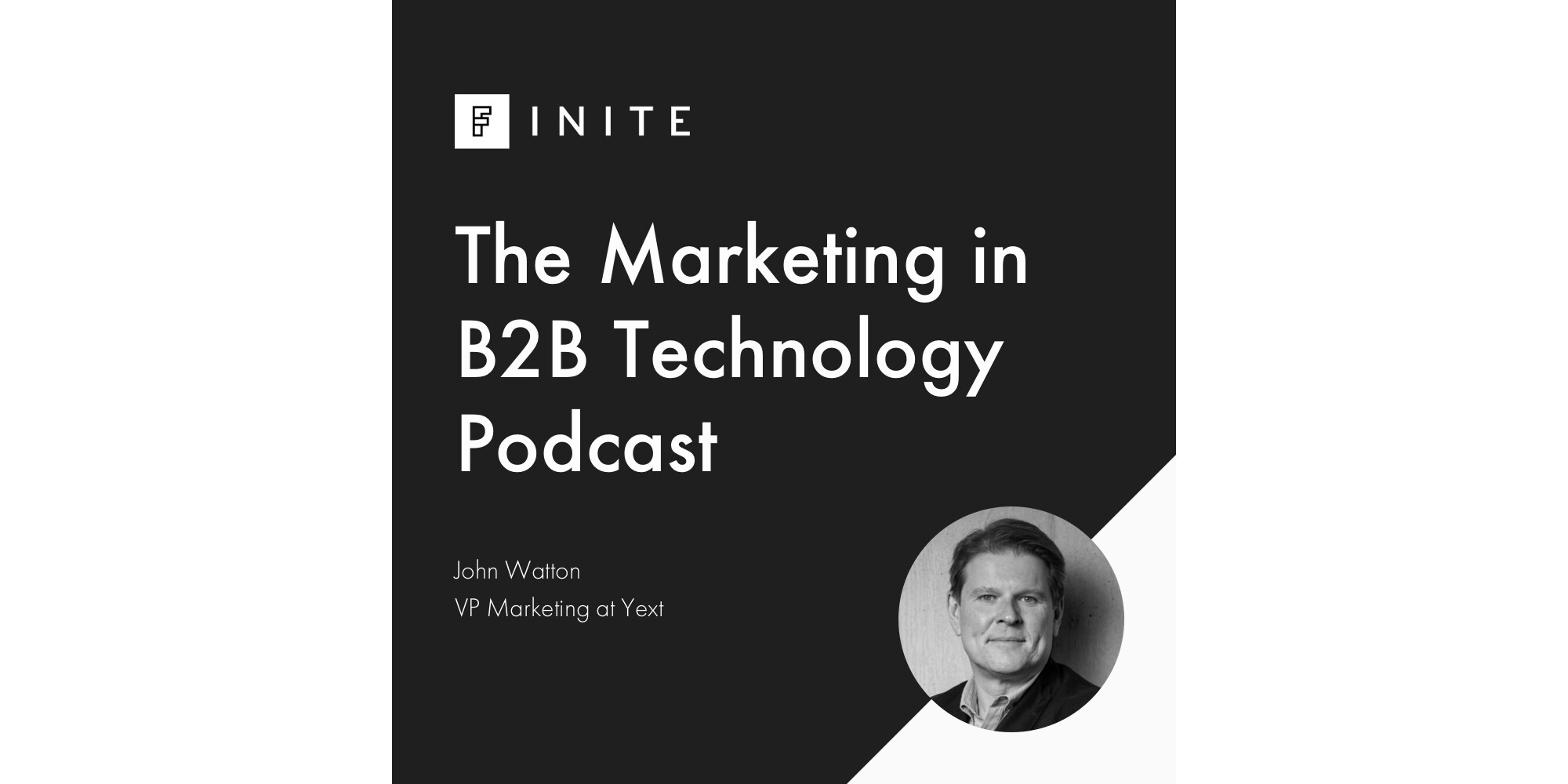
John Watton is an experienced B2B tech marketer, and currently CMO at Yext, a technology company that transforms the way brands offer search to their customers.
Search is an ever more important part of great customer experiences, enabling customers to find what they want quickly and easily, and so FINITE podcast host Alex sat down with John to explore how search can play it’s part in supporting modern B2B marketing.
This episode covers:
- John’s background in B2B tech from Microsoft to Oracle and more
- The marketing function of Yext as a global brand
- About the landscape of search and Yext as a search product
- Defining a new category in the market to differentiate yourself
- Balancing digital and offline marketing
- Using search at different stages of the buyer journey
- Using natural language processing in search
- Search as a lucrative marketing tool
Listen to the full episode here:
And once you’re done listening, find more of our B2B marketing podcasts here!
Full Transcript
Alex (00:07):
Hello everybody and welcome back to the FINITE podcast. My episode today is with John Watton. John is the chief marketing officer at Yext, and we’re going to be talking all about search, the importance of search in B2B customer experience. John has a pretty impressive track record, with senior marketing roles across the B2B technology space, and is now leading marketing at a very interesting business in the search space. So I hope you enjoy.
FINITE (00:32):
The FINITE community and podcast, are kindly supported by 93x, the digital agency working exclusively with ambitious fast growth B2B technology companies. Visit 93x.agency to find out about how they partner with marketing teams and B2B technology companies to drive digital growth.
Alex (00:54):
Hi John, thanks for joining me today.
John (00:56):
Thanks for having me, it’s good to be here.
Alex (00:58):
I’m looking forward to talking. The area of search in B2B is one that I think is on everyone’s radar it’s in a growing area. But I think before we dive into that as a topic, as we always do, I’ll let you introduce yourself and tell us a bit about your extensive B2B tech background and experience and a little bit about what you’re doing at the moment.
John’s background in B2B tech through Microsoft, Oracle and more
John (01:17):
Great, no problem. So yeah, I mean I’ve always been in B2B tech. Unfortunately or fortunately that’s been a long time now, so actually originally in sort of salesy more technical sales roles. And then for the last 20 plus years in marketing and, I’ve worked in the range of what would be called software businesses? I don’t know if we call a software business a software business anymore, I lose track. But yeah on the software side, rather than physical devices and a range of companies.
So I’ve worked in the tech giants, I’ve worked in Oracle, Microsoft, SAP, also Adobe latterly. I’ve worked in some startup situations and I’m currently a VP of marketing in Europe for Yext and we’re a search experience focused business. And I guess we can talk a bit more about that. But yeah, big and small, doing either global roles or regional roles and always in B2B marketing.
Alex (02:24):
You’ve got a pretty good roster there with SAP, Oracle, Adobe, Microsoft, not much else left of the big four. Tell us a bit about the current role and kind of day to day and what the marketing team and structure and stuff looks like at Yext.
The marketing function at Yext as a global brand
John (02:38):
Yeah, sure. Of course. So I guess in the scheme of all of what I said, Yext are a fairly small business, but we’re about 1300 employees globally and we’re actually listed on the New York stock exchange. So we’re publicly traded. So our sort of market cap is about 2 billion.
So yeah, we’re a midsize company. For a lot of people that’s quite a big company, for the Microsofts of the world we’re just a rounding error on some of their product lines. And really we’re a high growth business outside of all that. We’re growing at a fair click, over the last few years and, the role as marketer is really to be at the heart of that.
And the challenge is two-fold, it’s telling your story in a way that’s compelling and engages the right people to get into a conversation and build a commercial relationship with you. And it’s about doing that in a way that can scale. So high growth, building that in the region and being fairly small, I guess on the software scale.
You can’t really separate Europe and global, you’re very much part of a global team. So a lot of what I’m doing is working as part of the marketing leadership team sitting globally, and helping with the overall marketing strategy in terms of what we’re trying to do. How we’re organised locally, it’s very simple.
I have three teams, one that covers Northern Europe based in London, one that covers Southern Europe based in Paris. And one of that’s based in Berlin covering central Europe. And if you’ve ever been in companies like ours, the regional marketing teams and companies of this size, we wear all hats.
So we cover the gamut of marketing strategies and tactics. So we do everything from the awareness, PR, brand, advertising down to more of the high touch account-based marketing stuff and everything in between.
Alex (04:51):
Cool, interesting. Let’s dive into the topic and search in itself. So I think it’s a pretty fascinating area. As someone that works in and around web development projects and also SEO and other things, I think search comes up in lots of different areas, but when we talk about search, what are we talking about? And maybe also just tell a bit about the Yext product landscape and how that fits into it.
About the landscape of search and Yext as a search product
John (05:16):
Well, first of all we’re a company fully footed in tackling some issues around search, and the product portfolio we have sits under the banner of the search experience cloud. And I guess if I give our viewpoint on some of the issues and challenges with search, it will kind of map nicely to what we have to offer.
So I don’t suggest talking about the products, but the sort of issues that we’ve come to solve. And we’re a brand that is fairly modest. So our challenge is, as I said, getting people to know that brand. Some people know us, but not enough people know us. And those people who know us probably know where we’ve come from.
I guess we started in helping location-based businesses get themselves found in location based search. So we have a strong pedigree in restaurants, retail, operations, you know, stores, those sorts of things where the challenge of search was really the kind of near me type challenge. I need a whatever near me, restaurants, where’s my nearest this, where’s my nearest that, and that’s kind of a core part of our business. But it really set the tone for how search is changing.
First of all search, as you probably know being involved in it, has kind of evolved. It used to be a discovery thing. I’m looking for a list of things. Of course, when it started out, it was purely about trying to help you get to all of the websites that address a certain domain.
Fast forward to today and it’s about delivering an answer. So when you go into Google, you’re not looking… when you ask a simple question, right? Not a B2B question, but when you ask a simple question, like what’s the capital of France? You don’t expect a list of tourist sites and Parisian sites, and then to go out and find it’s Paris. You get the answer Paris now in a Google snippet.
So search first of all, has moved to being very much around delivering answers. And so the challenge for brands, whether they’re consumer or B2B brands is delivering that answer to the consumer at the point of request. And to get to that answer, consumer questions are getting more complex. So over 50% of queries now contain four or more words. So people are, they’re not asking for capital France or shoe shops. They’re asking for where can I buy a size six brown brogue of this make near me?
We’re asking quite complex questions. So the nature of search has changed from being very simple, to being very complex, and then from discovery lists to being answers. And then I think just the definition of search, we’re all visualising, because the way I’m describing it, is a desktop Google search, right? So in our minds, when I’m saying all these things, we’re typing into the Google search bar.
The way in which people search now varies. For example, back in the Google world, I probably more often than not, search in Google maps now, because if I’m looking for a business, I want to see everything, I want to see where it’s based. So, you know, it might be a partner to Yext or another technology company. I won’t look at it, I won’t do a Google search click on the website, I’ll go into Google maps, and then I see where they are, where the website is, all their information, and everything else around. So you’ve got the maps.
People are obviously finding answers to their questions in review sites. And the more and more it’s not just in typed text, it’s in search assistance. So people are asking Siri, Alexa, Google assistant, they’re asking all of these devices questions. So coming back to brands and B2B brands, when your prospect, customer, consumer is looking for you, they are looking in so many more places than just in the Google search bar.
So search for us is everything across that. Just the nature of it’s changing and of course as you get more into voice assistance and these complex context-based queries, you need to be able to pass natural language. So the best search capabilities now are natural language powered. So it’s a very complex, very challenging subject.
And fundamentally what we do at Yext is provide a platform that allows brands to answer questions wherever they may be asked and deliver those answers, not just a bunch of blue links. And I think specifically over the last six months with COVID, is more and more consumers are turning to brand’s websites.
So this kind of activity more and more is being carried out on a brand’s website and consumers are expecting a similar search experience on the website just as they get in Google search. And it just hasn’t been addressed by many brands and that’s another area we help with.
So we have capabilities to help people in search, in map based products, in location based searches, in voice assistance, but also on their own websites as well. So it’s really fascinating. What we do know is that no matter what the stage of the buying cycle or the customer journey, consumers and individuals are turning to search as a way to help fuel their journey.
Alex (11:04):
Yeah. We should talk a bit more about that. I was going to ask you one question before we do though, which was how much in terms of your own marketing for Yext, how much are you trying to effectively define a new category to some extent? Versus it sounds like you’ve got a relatively educational buyer journey where people probably are aware of a problem that they’ve got, but they don’t really even know there’s a solution out there.
I guess in the grand scheme of things, you’re not a Microsoft, but you’re not a small business either. So, it’s interesting because I think a lot of people listening, a lot of B2B tech companies are sometimes at a bit of a crossroad of do we define ourselves into a category that people are already in? They know that there’s a box for it and people are familiar with or defining a new category is not easy by any means. So where do you think Yext sits?
Defining a new category in the market
John (11:51):
It’s a great question because that’s exactly where we are. And like a lot of B2B tech companies, our instant sort of knee jerk reaction is to create a new category and get excited about it. But you know, no one knows.
Alex (12:05):
It would be pretty hard to do.
John (12:06):
Yeah. It’s really hard to do. So I think firstly, what we do is we come back to two things. One, you’re quite right, very often a customer has a challenge, but they don’t know we’re the answer. So of course, what we would do there is understand those use cases and map those use cases and talk to those customers around those use cases and how we solve the problem.
We try not to jump straight to the technology, although it’s often hard as technology companies not to talk about tech. But talking about those issues. And I think as a marketer, what we try to do is illustrate that through other examples. So, you know, it’s purely about companies like yours have solved this exact problem that you’re now facing. So we wouldn’t jump in and say, what about this new social experience category. But we would sort of bring them into our world.
I think it’s also true that customers like to see that there is some kind of vision and some kind of path forward, that there’s a bigger thing. But they probably want to solve a specific problem right now. So we have a portfolio of products, but there’s probably just one thing that we do that they really want help with, but they like to see that there is kind of a route forward, and there is a path that fits in their strategy. So that’s the first thing.
The other thing, to be honest in a lot of these sorts of topics like we’re talking about, people don’t realise they have a problem, right? They don’t really have the issue. Site search is a great one, right? So a lot of people don’t think they have a site search problem.
And in a world where consumers have fleeting loyalty, are pretty impatient, the expectations are pretty high. If they come to your site and can’t get the information they want, they leave pretty quickly. Now I’ve heard some people say, well that’s why we have amazing site navigation. Okay, that’s fine. But that is ultimately trying to build out a finite number of paths through your website.
And there are more and more wider and almost infinite questions consumers ask, and especially the last six months, right? If you optimize your site for a certain set of customer journeys, which is totally valid, then you’re going to be thrown a curve ball when people come to your site and say, what are your COVID 19 policies? What’s your company attitude to this, this, and this. And if you can’t move quickly, then they’ll just go somewhere else.
So what we find is that when it comes to search on site, a lot of organisations don’t see it as an issue and we have to raise to them some of the issues and challenges they had. Broadly it’s two things: missed revenue opportunity and increased support costs.
So I don’t know if any brands that you deal with in your personal life, you’ve had to try and connect with over the last six months, but obviously their call centres are working at limited capacity. And so it’s difficult to get through, you’re waiting and you can’t get the answer you want, and it’s not on the site. And ultimately if you go on to a support call, it’s quite costly for that brand to support that call. So there’s a lot of incurred cost as well, as well as customer satisfaction and lost revenue opportunity as well.
Alex (15:26):
It makes sense. The importance of search, I think is so often downplayed on the B2B side. I think even in the B2B tech space, we regularly come across a lot of people that believe that, I guess even from a research discovery perspective, we do business over handshakes offline, or our pipeline is generated through events and conferences. And I know from other work that we come across so many businesses that are sat on a search goldmine and they don’t even realise it’s there.
John (15:56):
Yeah. Back to your point, I mean, you made a great point about category creation. I mean, search gives you amazing insight to actually what people are looking for right now, you know, in your category. And I’ve only ever worked in B2B and we’ve used it exclusively to say, we want to create this category because we want to create a differentiated position in the market. That’s totally fine.
We’re trying to stand out and have a different story to tell, something that’s very differentiated. But to bring people into our world, there are just basic things that people want and they’re searching for right now. So, if we can capture that interest, bring them into our world in a language that relates the issues they have and then take them on a journey, then that’s gold dust.
Alex (16:42):
Yeah. I think we see that so often as there’s so much opportunity for organic search possibilities, that don’t properly align with what the business does. They might be slightly tangential or slightly off topic, but once you get people there, then it’s about how do you educate them that actually you’ve got to a solution which is maybe slightly different, or isn’t quite exactly what they’re looking for, but actually can add value more in a different way.
I think that the most recent research I saw from Google was that, and I don’t know how they worked this out, but 70 something percent of B2B research begins with a non-branded Google search or something. And I think personally, I think that number is going to keep increasing, particularly with younger generations who, when they’re looking for information or tasked with research, the most natural thing to do now is just sit down in front of a computer and ask a question. So I think as time goes on, it will be interesting to see all the data of search increasing over time.
Balancing digital and offline marketing
John (17:34):
And that’s been my experience working in B2B marketing over the last 20 years, it’s been this gradual march towards digitisation and nothing is off the table. I’m not saying anything that has been done is, cause there’s always this kind of email is dead, direct mail is dead, probably fax, I think fax is dead. I think we’re fair to say that fax is dead unless you and I want to sort of start up a revolution in fax marketing.
But you know, we use direct mail. We just did one actually the other week. We sent out a hundred direct mail items to a select group of individuals who actually won some awards. And we got a handful of responses, which on something that’s fairly low effort, 2%, 3% response is pretty good. With a direct communication saying, yeah let’s talk, which is more than you get through sending a hundred emails.
So nothing is off the table, but it’s more about that mix. So obviously the last six months we’ve shifted the dial over to almost exclusively digital and looking at virtual events and things like that. But you know, the dial will come back then we’ll have a mix again.
So I’m not saying the handshakes and the face-to-face is never going to come back, but it’s going to be in a different mix. And I think these moments that we’ve had have just really sort of put the focus back on B2B, because ultimately what we’re trying to do is find engaging ways to connect with our audiences in the places where they are. And more and more they are in digital places, they don’t necessarily go to find their information.
I mean, I remember when CIOs would go to a trade fair to find out about the latest technology. Now, some still do for different reasons, but you know, most are going to be now finding out through other sources probably digitally. And so, it’s about that mix. And I think for marketers as well, it’s about ROI.
And the exciting thing I think that we have had in the last five to 10 years is the data that’s underpinning all of this to allow us to make those decisions. Whereas I’ve got to be honest, probably what 10 plus years ago, it was a little gut feel. We kind of felt this was the right thing to do. We got some good feedback, some good anecdotal feedback. Let’s continue doing that. And now we have the data to drive those decisions.
Alex (20:01):
Yeah. So in B2B, I think particularly towards the enterprise end of the scale, journeys can often be pretty lengthy and considered and complex. You talked about maybe falling into the trap of defining very clear customer journeys through your website based on three main personas, and what happens if you get served a curveball. At the same time I guess that journey, HubSpot will probably have you believe that it’s step by step and it’s awareness and then consideration, decision, it’s all nice and linear and nice and simple.
But the reality is that that decision-making unit is full of maybe, I don’t know, 10 people who are all coming to the site, looking for something different at different stages in the journey. And sometimes you move backwards before you move forwards, and it’s not that simple. So how can search play a role in those kinds of journeys.
Using search at different stages of the buyer journey
John (20:44):
Consider this, on your homepage of your website, put a search bar that can answer any question that anyone wants to ask about your business.
Alex (20:53):
That’s really interesting. Cause I looked at your site and if anyone wants to check it out, they can go to Yext.com. And it’s fair to say search is a pretty central part of the website, more important than the menu, which is tucked in a hamburger and obviously aligns with everything you’ve been saying. I’m assuming it works for you and you practice what you preach, but do you learn from that? How effective is it?
John (21:15):
So rather than letting people have a, almost like little game of trying to work out where they need to get their information, working out your kind of encoding, your kind of hierarchy of content, just let them ask whatever they want. So there’s just answering any question, allowing that to be done in the context based way.
So listen, it’s no criticism of any particular brand, but it just hasn’t been a frontier that people have considered and most site search absolutely sucks. It’s like going back to the nineties and I bet most people when they go to a brand website outside of e-commerce, which people have optimised for transaction, but informational, you’re back into some kind of embedded Google capability where you get a bunch of blue links and you go, okay, what do I do now?
And what our engine does, and of course we’ve put it on our site, it’s NLP and AI powered. So it’s context-based so it understands the context of things like best and cheapest, fastest, and the context of that next to the word. So we’ve got quite a complex natural language processing engine behind the scenes.
So the goal, as I said, of giving an answer, not just a bunch of blue links and say, you figure it out, you click on it. So continuing what people are seeing in Google, providing a Google-like experience can say that on the website. The other thing you get is an insight as to what questions people are asking. So that is just really amazing if you tweak that and we have customers who have changed their merchandising because they’re understanding what products people are asking for.
People are asking for the fastest, cheapest, whatever, and they’re giving them products out of stock, which obviously is bad business. So you have products that are in stock. And the biggest signal of intent that you can get is someone asking your business a question. It’s like the strongest, you know, we’ve been trying to do that through behaviour.
We’ve been trying to do that through interpreting people’s personas, matching IP addresses. Of course, all of those things become more challenging with GDPR. But if they’re asking you a specific question, you get to see the intent of that individual with the context of it. So yes, it’s been very successful for us. And of course, it’s very successful for our customers as well.
Alex (23:41):
Are you using that data to kind of redefine your own, I guess it feeds back into your own kind of content marketing and you know, what content to produce based off the back of what people are looking for?
John (23:50):
I love it because what I love is, we’re getting that data and insight and then we’re using it to power creativity. As the language we use. And I don’t know, as a marketer, it’s like, we shouldn’t care how we want to talk, we should care how our customers want to talk to us and then use their language in response.
So if their language is very, in our opinion a few years behind, that’s always the gap, right? I mean, tech companies are always like five years ahead of the customers on those sort of curves. Super smart, intelligent product based people who have built something totally amazing. But can’t explain it in terms that the consumer, the late majority.
Alex (24:34):
Yeah, well it’s the oldest trick in the salesman’s book, right? Isn’t it to kind of mirror the customer’s language. And you’re doing that from a marketing perspective in terms of really optimising around what they’re really looking for. And particularly when, I guess every B2B business is just producing so much more content and content really is the fuel in the engine of most B2B marketing these days across all the channels.
Using natural language processing in search
John (24:55):
Yeah. I mean I’ve seen B2B tech customers who produce a shed load of content. So lots of white papers and guides and all that sort of thing. It’s been very popular in B2B tech marketing, which is fine, thought leadership content. Putting that repository underneath this search bar and just letting people go crazy, finding what they need and getting the right answer rather than digging around in some kind of a long list of publications. So, and again, that gives them strong attendance as to what content is being consumed or is of interest.
I think the other kind of frontier that I would comment on is, as I mentioned earlier, consumers are turning more and more to brands, going directly to brands to get their answers. And what this does is give brands the opportunity to take back or take ownership of their facts, their information, be the source of their official answers.
I think one of the failings that we’re seeing of search engines is that they’re optimised for ads, not for answers, right? So they’re totally optimized to maximize ad revenue for the advertisers on those platforms, versus brands connecting with their customers.
So, the idea, if I do a search I’m not picking on them but for the fastest Dell laptop for business, Dell’s results don’t come top. You get a whole bunch of other people and this is not a subjective thing to say currently which is the fastest one that you do? And it’s not cheapest, it’s not best, it’s not value for money. It’s just fastest. And Dell actually have to bid to get to the top with their paid ad.
To own their brand keyword and I don’t know where they appear on the organic search, but this is typical, right? Because these engines optimise ads, not answers and consumers want answers, but what they’re getting served is things are optimised to maximise revenue for them. So if brands can satisfy those answers on their sites, then that’s a strong way for them to have the opportunity to own their accurate and official information.
Alex (27:15):
I noticed on your own search, which I loved the look of the results page and the product. You’ve got a ‘ask a question box’ that appears at the bottom, which made me think like how much is search a marketing tool in itself? I don’t know what kind of results you get through that and whether you actually generate marketing qualified leads through that box.
But if someone looks for something, doesn’t find it, there’s a really nice clean way of them actually just asking you a question directly. Do you think search is, almost like maybe lead generation tool is a bit extreme, but a marketing tool in itself of some form?
Search can be a lucrative marketing tool
John (27:45):
Yeah, absolutely. And we’ve had that conversation with B2B tech customers. That’s absolutely what they want to do. They want to put that into the marketing automation scoring engine as well. So they want to be able to score those questions and put it into their nurtures or whatever they may have.
So it becomes a tool that, again with that intent, you can use that intent to ultimately deliver them more value, get them quicker to the answer they want, but yeah, hopefully kind of progress that relationship as well. And it all works because what makes the Google search so smart and what makes our stuff so smart on the onsite thing is the thing we have in common, which is it’s based on a knowledge graph approach, organising data.
That’s what Google did about eight years ago, they introduced the knowledge graph, which is just super good at relating attributes and entities together to deliver back that answer. And we do the same on the site. And that’s really the thing that makes the difference is having this knowledge graph behind the scene that you can easily edit and update, as questions are coming in.
It’s not about indexing content and pre tagging at all, it’s just about setting up relationships and then letting the questions define the answers. And then you can modify the knowledge graph as you kind of move on.
Alex (29:14):
Interesting. So pretty much every business now has a pretty extensive footprint across, you know, you touched on some of them at the start, but I know with our own things, like the number of review sites you have to keep track of and customer service channels and profiles and listings, and all of these things. How big a part of that is search and the kind of Yext offering in terms of keeping track?
John (29:34):
Yeah. That’s exactly what Yext are able to do is we provide a platform that allows you to manage all of your content that is first of all, updated in various listings in map based products, in review sites, manage all those reviews in one place.
So you get effectively a kind of a workstation that allows you to manage all that one place. And a big part of our history is founded on that challenge for brands who were updating all of these different channels and doing it individually and doing that for hundreds of entities.
So if you’re a retailer or a restaurant or whatever, it was just a complete nightmare. So that’s a key part of what we do and search is part of that. So we’re helping manage that across, as I mentioned, appearing in the organic search, in listings based tools and reviews tools, in location-based tools and AI systems and then on your website, you can do it all in one place.
So that’s the basic concept that we are continuing a consistency of information across all those channels. And that’s the challenge for a lot of brands right now is the situation changes with the COVID every week, every day, every hour. And you may have different policies, procedures, opening hours, you may have offices opening and closing, those policies changing. It’s impossible to manage all that manually. So that’s what we help brands to do.
Alex (31:12):
Interesting. It’s such a fascinating area, search. I feel like we could dive into for ages. I’d probably start geeking out talking to some of your engineers and others.
John (31:20):
I think you need to talk to the engineer. Yeah.
Alex (31:24):
I was going to ask you a few final questions, in terms of your own marketing, I’m sure you’ve got enough to be doing it at a top level without being inside tools and tech yourself, but aside from obviously Yext itself, are there any MarTech tools, technology, innovations that you’ve had your eye on or find exciting?
John (31:42):
Yeah, well my favourite tool actually is Marketo. For two reasons, we use it at Yext, which is fantastic, but I was actually on the Beta program way back when I was their first non US customer. So I had a small part in their journey and I was delighted to be part of that. So I’ve been staying very close to the company and delighted that we’re using it at Yext.
Alex (32:08):
When you were at Adobe, that was pre Marketo?
John (32:13):
Yeah, exactly. So yeah, I was on the Marketo Beta program, whatever it was 10 years ago, maybe? When they were 30 or 40 people. So that’s the tool I have fondness for. And I’m just blown away by how sophisticated we can get to help manage our marketing using these tools. I mean, we’re a smallish team. We can punch far above our weight.
As I say, my journey has been over a few decades now. And in the past you have to have huge budgets and huge teams to do the sorts of things you can do today with tools like Marketo. So I just love what that continues to do for us and helps us build relevant conversations with customers and prospects and not irrelevant interruptions.
Alex (32:59):
What would you say your biggest challenge is right now as VP marketing?
John (33:04):
Yeah, I think it’s building a category, being a small business, building a category. We have to sort of tread the right path. But what I love is that we’re getting almost real-time data and insight to allow us to sort of course correct. So we don’t throw things out and wait a month, we’re seeing almost on a daily basis. So the challenge really is building that category and scaling the company quickly.
Alex (33:29):
And looking ahead, I mean, it’s obviously been a bit of a weird year so far for pretty much everyone in and around marketing, but is there anything exciting on the horizon within the world of B2B marketing that you’re looking at?
John (33:40):
Yeah. I’ve always said, when it comes to tech, most of the tech that we need is out there. It’s about kind of leveraging it. I think it’s an amazing time to be in B2B marketing. And what I love about it is it’s always a learning environment. So there’s always something new and it’s not a stale profession, you know, no one’s written the playbook in terms of what we’re doing.
So what I love is that we have the opportunity to write that wherever we are. So I guess I’m excited by the future of B2B marketing, who knows what it is going to be, but you know, all I know is that what we’re doing today is not what we were doing three years ago. And it won’t be what we’ll be doing in three years time. And I think that’s why it’s such an exciting profession to be in. So I’m hopeful for the future just for that, but what it will be, who knows?
Alex (34:32):
Let’s see. Well it’s been a pleasure talking. I think I’m going to go away and keep thinking about search because I just think it’s such a fascinating area and hopefully other B2B marketers will be encouraged to do the same, but I’m really grateful for you giving up your time and sharing some insights. So thanks again.
John (34:46):
Thanks Alex.
FINITE (34:48):
Thanks for listening. We’re super busy at FINITE building the best community possible for marketers working in the B2B technology sector to connect, share, and learn. Along with our podcast we host a series of online events, so make sure you head to finite.community to subscribe and keep up to date with upcoming events.