- Some additional information in one line
- Sep 15 2025
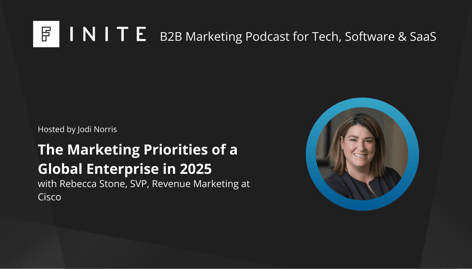
Scaling a Brand Through Cross-Functional Alignment with Mika Yamamoto, Chief Customer and Marketing Officer at Freshworks
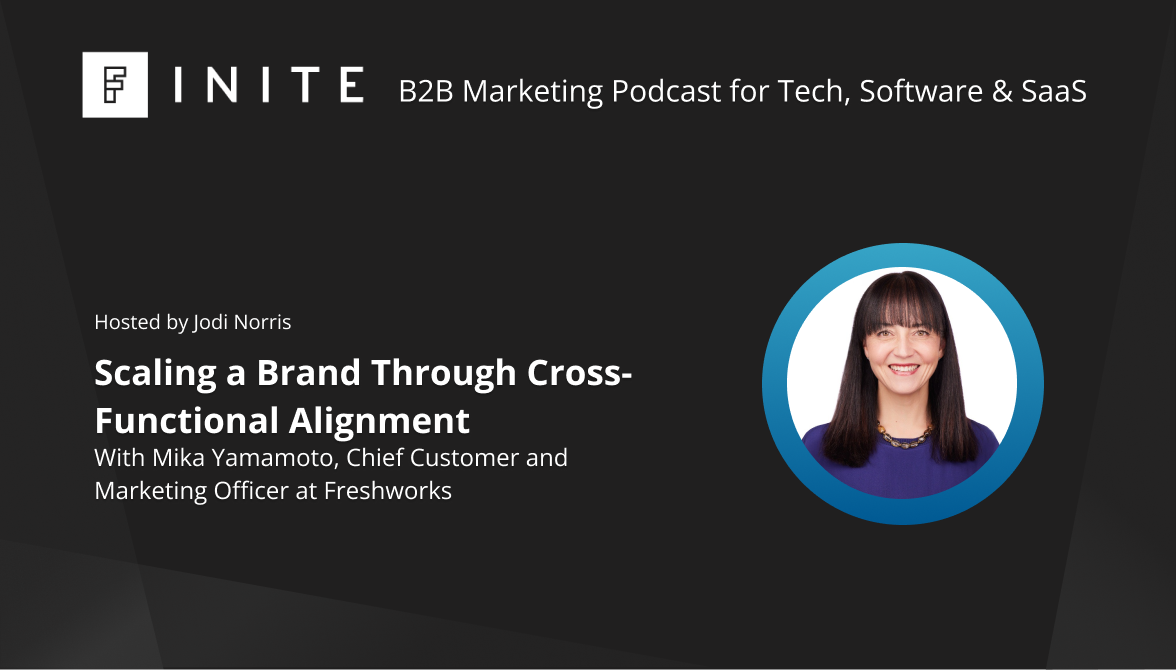
For years, B2B leaders have preached the importance of breaking down organisational silos, yet true cross-functional alignment remains elusive for many. How do you move beyond theoretical collaboration to create a genuinely seamless customer experience where product, marketing, sales, and support all speak the same language?
In this episode, we’re joined by Mika Yamamoto, Chief Customer and Marketing Officer at Freshworks, who oversees a diverse organization of 1,200 employees. Drawing on her extensive experience at tech giants like Microsoft, Amazon, and Adobe, Mika shares the blueprint behind Freshworks’ transformative “uncomplicate” movement.
Discover how Freshworks uses this simple North Star to reduce friction across the entire customer journey.
What you’ll learn:
- Why cross-functionality is essential to capitalize on innovations like AI search.
- Tactics for building a shared “source code” for brand messaging across technical and commercial teams.
- How to overcome the challenge of unlearning siloed behaviors and fostering a culture of mutual success.
- Proof points for measuring the impact of alignment on customer satisfaction and employee engagement.
Listen below, on Apple Podcasts or Spotify
Or watch on YouTube
And once you’re done listening, find more of our B2B marketing podcasts here!
The FINITE Podcast is sponsored by Clarity, a full-service digital marketing and communications agency. Through ideas, influence and impact, Clarity empowers visionary technology companies to change the world for the better.
Find the full transcript here:
I’m Mika. Thank you for joining me on the Finite podcast. Thank you, Jodi. Thanks for having me. It’s a pleasure. so excited to talk about our topic today and really hear your unique spin on it, I think.
But equally, I’m really excited to talk to you in general. You’ve got such an impressive background in B2B marketing and enterprise tech companies, specifically spanning leadership roles.
So before we dive into the discussion, I’d love to hear more about you. I’d love if you could share a little bit about your career background and how you became CMR at Freshworks.
No problem. I have spent my career, I mean, there wasn’t a, you know, when I started my career, I started in consulting because I thought I wasn’t sure what I wanted to do.
And I thought it would expose me to a lot of different of industries and types of roles to figure things out.
And so it wasn’t like I started out saying, I want to be a CMO. I want to work in marketing. It was more, I just wanted to deliver impact and figure out what I wanted to do.
And so my career has been focused on roles that are all interestingly, serendipitously, all focused on driving transformations to be able to scale companies.
And so the individual roles that I’ve had throughout my career have set me up for the roles that I get to do today.
And so I would say for anybody that’s building their career, it’s just understanding what it is that motivates you and take on roles and figure out those motivating points.
So I look for something where I feel like I’m challenged and I can contribute to the success and the outcome of a specific company.
where I can learn and then where I’m working with a bunch of people that share the same value system and want to work collaboratively in the same way that I would love to work.
And so I’ve been drawn to solve for those things and open to a lot of different roles, which essentially have all set me up to get to do what I do today.
So the different roles have been working at Microsoft and shifting models from on-prem software to.
to subscription software, getting to take Amazon and create a physical store for Amazon, which is absolutely incredible.
Looking at new markets for Adobe and getting into the SMB space. And so looking at different markets, different channels, different business models is where I’ve spent my entire career.
And again, has set me up really well to get to do the job I get to do today. That’s absolutely fascinating. Such a niche, but so important. And also at the forefront of innovation, which is entirely important now, as you probably know, where everyone’s kind of rethinking everything to do with marketing.
So I’m sure you come in very handy for Freshworks. And I’d love to hear more about that as well. I think it’s quite important to our conversation today to actually understand your team at Freshworks, the different roles, the different functions that you’re managing, and how many people are on the team, I guess.
So the number of people on the team, there’s 1200 people on the team. I get to, and so that’s not just a marketing team. So my role is actually chief customer and marketing officer.
And so I get to play a really extraordinary role here. And that’s because I get to work in marketing and I get to lead part of the sales organization, part of the expansion organization, customer success, as well as the support organization for the company.
And so that stitches together to actually have me get to work on every single part of the customer journey awareness to advocacy and everything in between.
And so it’s an exciting thing to get to do just because my entire role is meant to remove friction from our customers’ processes and our employees’ processes to do so, and then get to add inflections of delight to our customer.
And so getting to work on the entire customer journey enables me to do that. And then bringing together leaders that are focused and are part of an organization where that is the goal, enables us to do things that help us raise the bar and really drive and deliver a different type of impact.
Definitely. A simple yet effective goal, removing friction. think about it all the time at the moment. And you go to buy something and then an ad pops up and you’re like, oh, no.
It can be that granular. then I imagine like, in such a large team, we’ve got this friction of kind of silos, which is what we’re talking about today.
Would you say that cross-functionality is one of your key objectives at the moment, enabling cross-functionality in your team?
Absolutely. I mean, I think that that, I think that as, you know, towards a common goal across functions, and there’s multiple functions on, you know, in the team that I get to on day to day, but then we have our broader teams.
So we’ve got HR, we’ve got billing, we’ve got operations, there’s product. All of us have to work in concert with one another to be able to deliver the type of impact that we want to deliver.
I think when you work in silos, you can be working with great intention, but in parallel. And I think you end up duplicating some efforts and leaving some gaps in terms of how the customer experiences a company or a brand.
And so cross-functionality is a you know, absolutely centered to my focus. And frankly, it’s not just focuses me as a leader and thinking of how do we orchestrate, you know, the entire company of 4,000 plus people on behalf of, you know, 75,000 customers.
It’s personally a lot more rewarding, frankly, to get to work more collaboratively with people. And so as I talked about, you know, the career progression that I’ve had and always solving for environments where one of the value system is working together and being collaborative, and sharing in each other’s mutual success, it’s just personally more rewarding.
It’s just more fun to get to work in those environments. And that, you know, does translate into better into, you know, into better results for the company as well.
And so there’s a serendipitous, you know, mutually reinforcing element to actually driving the collaboration, you know, brings personal joy to me, but also to the team.
And then, you know, it helps us drive and deliver much better results. Yeah, awesome. It definitely seems like it’s a very natural part of your leadership style, which is probably how you see the most results in your organization as well, because it becomes real, it becomes authentic, I guess, instead of just kind of aiming for these kind of business objectives.
But speaking of business objectives, we have been about, I feel like in the marketing space, we’ve been talking about getting rid of silos for quite a long time now, and it really did peak maybe like 2022.
And 2023, I haven’t heard it as much lately. And I personally, I do talk about it with people, but I can’t decide it’s because we’ve almost mastered it or if it’s because we’ve kind of got this wave of new AI to focus on, I So I want to get your perspective on why you think it’s super important for CMOs to still be focusing on cross-functionality in 2025.
I think to take advantage of any wave of innovation like AI. So on that end of things is you’ve got to be able to work across functions if you’re going to.
I mean, the power of AI is actually leveraging data to do better work. and either on behalf of a customer or with a customer, on behalf of an employer, with an employee, whether it’s a co-pilot situation or an agentic situation.
And the only way to see the true power of that is to actually work, share data, work across silos, actually have aligned processes so that a customer, you’re not shipping your org chart to a customer and you’re actually being able to focus on the customer holistically across the company.
And so I think that For that reason, collaboration and to see the true power of AI collaboration is critical.
I think that also just if we think about how someone experiences a brand and you just talked about if you have an ad that pops up on one of your apps, if you have to get handed off when you’re dealing with customer support to multiple people and it takes an extraordinary amount of time to get help from a company, all of those are reflections of the brand itself.
And so unless you’re intentional about thinking about that moment with support, the moment with sales, the moment inside the product, if you’re not intentional about how the brand shows up, you end up, I mean, it’s really challenging to be a great brand and show up as a great brand without that intention.
And so that’s where marketing can step in because marketing can go beyond just, you know, from a brand standpoint, you know, logos and typeface and colors.
It can be how we make people feel. And I think that when we weave through marketing’s intention in terms of messaging, tone, manner, and we weave through that intention and having a common set of messaging throughout the entire organization, again, within the product in terms of pop-up messages that someone may have to how support people react and act to ads, that’s the magic that marketing can weave through because marketing is just If you don’t do that, it just becomes a set of words.
And if you can’t deliver that in every single touch point that a customer experiences, then it is just words.
But you can actually drive a lot more emotion and connection to a brand if you, again, marketing can successfully drive that golden thread through every single thing that a company does.
Absolutely. And I think it’s such a special position that you’re in at Freshworks where you’re marketing is at the center of all of that and is able to be that golden thread.
That’s really, really important, I think. So I also think that from a channel perspective, if you’ve got integrated channels, you’re right.
Say with, I keep mentioning AI, it’s at the top of my mind, but AI search, it’s not just SEO anymore.
It’s PR, it’s all like, brand it’s paid ads it’s every single thing that you need your entire organization to be aligned on so practically I guess would that look like for you very clear brand guidelines like internal communications how do you implement cross-functionality in your organization more more tactfully you know I think that previously I mean I AI does highlight the need if you think of AI search specifically in order to maximize your ability to be relevant and discoverable in AI search.
And you’ve got to have the right messages in the right format in the right places. And like you said, there’s multiple teams that drive that content out there.
And so I would say that this has provided us, you know, provided us, you know, kind of a burning platform to say, hey, rather than the social team, think about what they are going to release in social, you know, the comms team think about what are we going to release in earned media and owned media.
And, you know, the ad team working separately from the demand gen team, what we’ve done is made a really deliberate focus.
We’ve had a really deliberate focus on thinking of what our overall content strategy is. So it’s more, what do we want to say? Not what do, what does each channel want to say, but what do we want to say and convey, you know, as a company.
And then what should we say when we’re thinking about awareness and we’re thinking about consideration and when someone’s at purchase and thinking about that end to end, rather than thinking about your individual piece is thinking about, okay, what happened in the conversation?
Cause we’re creating relationships, right? What happened in the conversation before someone landed in social and where do we want them to go to continue the conversation?
And so think of it as a, as a baton or think about as an ongoing conversation that we’re having with a customer.
And so we’ve placed a lot more intention around that and essentially gathered all of the leaders from our comms leadership, our demand gen leadership, the leadership in brand.
And think about that. And then the leadership in advocacy, because at the back end where we’re driving advocacy for not saying the same thing is what we said to the customer when they first entered the door, the proverbial door.
it’s disheartening. It’s disorienting for a customer to experience that. And so we bring together the leaders to actually very intentionally and literally talk about, we call it our source code.
So we’re saying, what’s our source code? And what’s our source code from which every team is actually going to rally around the type of content that we’re going to deliver?
And then we’ve gone further to say, look, we’ve got hundreds of people that deliver and drive our message if we just look at marketing.
But if we extend that to solution engineers and sellers and support people, if we don’t have a way to, we can say this is what our tone and manner needs to be, but if we don’t have a way to manifest that, it becomes more challenging.
So we make sure that we train our co-pilots so that they actually understand the tone and manner that we want to give in support so that when our co-pilots help our agents come up with a response for someone who’s having an issue, it’s in the same tone and manner and language as what we’re trying to drive and deliver in marketing.
Marketing, we’ve created a private GPT engine for ourselves and we’ve trained it on the technical side of our business, as well as our brand language and our source code so that we can say, please write me a social post that conveys X, Y, Z, so that it conveys energy around our agentic AI solution.
And so it’ll know because we’ve trained it on what the agentic AI solution is for us. It knows the differentiators for us and actually knows our tone and our source code for how we want to speak.
So then we can drive more consistent language throughout the company because we’ve trained an engine to essentially speak like us and be trained on our technology and understand our differentiators.
We expect our marketers and our sellers and our SEs to know this. But having a, you know, having an engine that helps us come up with at least the first version of copy for us, you know, drives a lot more consistency and frankly raises the bar in terms of how we speak in and how we, how we speak boldly and consistently in a differentiated way and consistently across every single channel.
That’s really fascinating. Thank you for that example. I think tone of voice is an incredible, incredible, skill. that I can do. I think content specialists can pick up tone of voice.
They can imagine someone in their head, friendly, bubbly, professional. Whereas expecting salespeople or technical marketers to understand the nuances of a tone of voice and how to structure sentences in a certain way is a hard ask.
the fact that you’ve enabled them, I guess, adopt that tone of voice is huge. Have you noticed a direct impact on the customer experience with this?
Do you think that it has kind of tangibly aligned your brand with the customer? Do you think they’re of picking up on this at all? I think they absolutely are. In fact, The proof points of that are, if we think of, again, we think of every single touch point playing a role in the customer’s experience, where we’ve done so from a co-pilot standpoint in helping draft initial responses, either in the sales organization or in the support organization.
And support is a great place to measure because we measure everything. customer, as we’ve used co-pilot scenarios to create initial drafts of how a support person will respond, we’ve seen customer satisfaction increase and we’ve seen response times increase.
And so we’ve seen efficiency and we’ve seen the customers, they’re actually happier and consistency has gone up.
And so we’ve seen really great quantifiable proof that when we help drive the tone and manner that we want to see and help with examples of what great looks like.
It helps drive great customer outcomes from a marketing standpoint. And that’s marketing too, because that’s a significant part of how a customer will experience a brand, especially if they’re sad about something that may not be working.
If we treat them well, we actually create a really positive brand moment there out of maybe a trying situation.
The proof point that we see actually in marketing is as we’ve used this source code at our events in social with our CEO when he actually is talking to investors or doing a keynote.
We actually have started this uncomplicated movement and that’s the kind of the essence or the ethos of our source code.
We’ve actually heard, I think the biggest proof point is we hear our language come back at us from our customers.
So they talk about uncomplicated from our partners, they talk about and reference the language that we’re using.
So we try to do is not sound like a vendor, sound like AI, first of all, because you can tell when something is actually generated by AI now.
But also we don’t want to ship features. We want to ship. We want to talk about value and business value. But we also want to speak like you would speak if you’re at the dinner table with a set of friends, not not as casually, but also just more conversationally because it’s more relatable because people don’t talk in business speak in real life.
And so we don’t want to sound like a vendor. We want to sound like someone that is relatable. And so we have found that using that language in our source code and then using that language consistently comes back to us because our customers are actually, when we do customer case studies, for example, or when I go on the road and talk to customers, I hear our source code come back to us.
And we know that it’s working when you hear your own messaging come back within customers. We hear it in the press in terms of how they’re speaking or referencing us.
We hear it from analysts as they reference us. So we’re hearing it from different sources As we hear people talk about us, we’re hearing them use our language that we’ve put out there.
So it’s definitely resonating, and it’s definitely working, and it’s differentiating us, and it’s driving more resonance just because each channel that is speaking about us is speaking about us really consistently.
That’s fascinating. Those are some really powerful proof points. I wonder if it also ties back to your key goal that you mentioned at the start.
of reducing friction and having this consistency in how you show up means that people know what they can expect.
People learn the language of Freshworks as well. And so, yeah, the friction entirely reduces. Do you think that comes into it as well? It absolutely comes into it because what we’ve decided, what we decided beginning of the year, we’re saying, look, we need a rallying force for the company to say, what are we as a company?
If we talk about collaboration, It’s not just collaboration for marketing sake. What do we as a company need to be able to rally us, to be able to have a common North Star and work towards a common North Star?
And so this is where we started our uncomplicated movement. And we thought, okay, what are we all here for? We are all here to uncomplicate things for our customers.
And our customers have told us back the number one reason, regardless of the product they choose, regardless of the country they live in or the size of the company, the reason, the number one reason they say they They do business with us is because we are less complex.
We thought we’ll capitalize on that. We’ll start this uncomplicated movement. And what we wanted to do and what I wanted to do as a chief customer and marketing officer was to make sure it wasn’t just a marketing campaign.
So it was going to the CEO and saying, hey, I think we should do this movement. But this movement can’t be a brand campaign. It has to be a company movement. And we have to all believe in it.
And then so he’s like, I’m all in. I want to do it. The next step was to go to actually our product leaders, our engineering leader, our CTO, as well as our product lead and say, are you in?
Because what you have to do is say words that are actually followed by a promise that we deliver. And the promise that you deliver is predominantly experienced through your product, especially if you’re a B2B SaaS company like us.
But even if you’re a footwear company, if you deliver an app, You know, a consumer app, like a workout app, your brand is experienced through your product.
And so I wanted to make sure that this movement had at its core the experience that we have within the product.
And so we enlisted also our UX designer for the product to tie in with our brand lead. And they’re coming up with a common language, a brand language, also literally tone and manner so that everything they experience is very consistent across all the touch points.
And so this movement involved product very significantly. So as we talk about what we’re going to do, what we do is we rally together and we say, is this as uncomplicated as possible in our language, in how we show up for our customers, but in our product itself.
And that’s the bar we all hold ourselves against at a leadership team. And then the levels that drive the day-to-day work as well. And so we actually have cascaded that notion of being uncomplicated.
not just in words, but in how customers experience us, especially through the product. And I feel like I’m an arm in arm with the product team, as well as our IT team.
Our CIO has embraced the notion of uncomplicated to make sure we have systems, processes, and tools that enable us to do our best work.
And so as a company, we’ve actually embraced this notion. So it’s not just a marketing campaign. It’s the bar we all hold ourselves accountable to. That’s fascinating. So aligning all teams to this one, very transformative.
North Star, it seems simple because, I mean, it is literally uncomplicated. I don’t know if you’ve ever heard of the term Occam’s razor. It’s basically this law, just for the listeners who might not have heard of it, it’s this law in the sciences, in computer sciences mainly, where the most simple answer is often the most truthful.
So I feel like in creating the simplicity around your product, your teams, aligning them all into this truth almost comes across as more authoritative in a way or more truthful or more basic, more of a basic kind of fundamental message, which is probably incredibly powerful.
So it seems like you’ve had a very uncomplicated time implementing this and getting this across the line and everyone bought into it.
I’m sure that’s absolutely not the case. I mean, it wasn’t, I think that what I think was, what was great about it was that it didn’t like, we’re not intellectualizing.
I think there’s an intellectual component to a strategy, right? We’re looking to grow. We’re looking to grow faster than our expenses, but that’s not it.
That’s not a, an inspiring way to actually take a set of, you know, 4,000 people from around the globe, to support 74,000 customers.
So it adds some heart. So it appeals to the right side of your brain and the left side of your brain to be able to say, intellectually, we know we’re trying to grow, but the why, it gives us a reason why and a common reason why to uncomplicate.
So if you think of Occam’s razor and the coral areas, if you think of sometimes the simplest things are actually the hardest things to do, You know, it was a lift to be able to drive this notion of uncomplicated, but since it’s now the rallying cry across the company, it’s a common language we have.
And so it has simplified our conversations because we have this common language for the bar we hold ourselves to in product, in marketing.
So while it’s a lift to get it going, it becomes this flywheel that actually moves faster and faster because of this common language and this common North that we’re all striving towards.
And it manifests itself in the things that we drive and deliver in product launches that used to be a little more disjointed.
And now we have this rally to be able to make things uncomplicated. So everything comes together, not seamlessly, but a lot more effectively.
And our customers end up feeling it and our partners feel it. And frankly, our employees feel it just because they feel like we’re rallying towards a common goal.
So it to and motivates and inspires us. which then in turn inspires our partners and our customers, which is ultimately our goal, which has been great to see.
Yeah, that’s a great point about Occam’s Fraser to draw on is that the simplest answer might not be the truth at all, but we do have kind of innate draw to it because, yeah, it feels easy to understand.
And if everyone agrees, then it does feel like, oh, that there must be something there. So you’re totally right. Thank you for bringing that up as well. But I would, I do wonder what your biggest challenge with this journey has been.
Has there been any kind of sticky points in this journey? Anything you’d like to share? You know, I think the sticky points is unlearning behaviors, right?
If you’re used to operating as an independent unit that operates in parallel, I think the best part about our culture is the people and the people are very well intended.
There’s some corporate cultures where, you know, for Jodi to win, Mika has to lose because Jodi has to look better because someone else looked worse.
We don’t have that culture. So we had the basis of, of a culture that really wants to lean in and do the right thing, which is great.
It’s just, we, we wanted to make sure we unlearned behaviors where it was for us to do great work. We just stick to our functional unit and we drive functional success.
And it’s actually the, the, biggest piece was to look, we can realize better functional success if we actually collaborate and work together to drive mutual success for a North Star and a common goal.
That means that functions work together towards that goal. And so unlearning. I think the biggest, stickiest point is unlearning some of those behaviors where I’m going to stick to my functional area and more I’m going to work towards this common goal together with a function.
And I think the benefit that we’ve had in doing that is you know, is the fact that people enjoy their work more because they’re working more closely with counterparts and they see that each organization is working in, you know, is working in concert with one another.
So when one function, you know, the magic of it that I’ve seen on the team that I get to work with day to day is that the magic is if one function is struggling, we see another function come in and not finger point and say, well, you’re struggling, too bad for you is, they see them struggle and they actually go and they pick them up and they actually help them and drive a tailwind for that function because they know that without that function succeeding, we all together actually will not succeed and we’ll actually not drive the same thing, a great performance.
And so that has been the toughest part is to move towards that end, which is more of a selfless end of, I may have to give up something individually for us to all be able to move faster together.
And having people realize that actually our mutual success actually will be better when we do that and convincing people that that’s a reality is challenging.
It’s definitely worthwhile. We’ve seen a dramatic difference in, frankly, the financial performance that we’ve driven at the company, but we’ve seen also a dramatic improvement in our employee engagement scores, in the satisfaction and in the motivation of people on the team because they actually see that we’re working towards a common goal And it’s actually just a lot more, you know, we see it in engagement scores, but I just see it on the faces of people.
It’s just a lot more enjoyable to work in an environment where you feel like if you’re faltering, someone’s not going to go, well, you know, too bad for you.
There’s going to be someone there that’s actually going to be there to help and pick you up and collaborate to get you to a different place, which frankly, you know, feels a lot better.
And so it feels a lot better for individuals on the team. It feels a lot better for me to get to be a part of an environment like that.
But it is… unlearning the behavior of driving, you know, siloed I think is, is a challenge, but, you know, driving to the benefit is definitely worthwhile.
Absolutely. I’d love to see that more across B2B tech space. I think if you’re part of an exciting scaling organization, then it can only be in everyone’s favor for it to grow and you to learn from each other as well.
Another big part of cross collaboration. So absolutely excited to hear that. And it definitely is, shows us a lot more about your leadership style as well.
So thank you so much, Mika, for coming on the Finite podcast. We have learned so much from you and I’m sure everyone will have loads of takeaways about enabling cross-functionality within their teams.
My absolute pleasure. It’s a great opportunity to get to see you and have this conversation. Thank you, Jodi.