- Some additional information in one line
- Mar 25 2019
Podcast: Talking CRM with Kartik Krishnan, Founders Factory
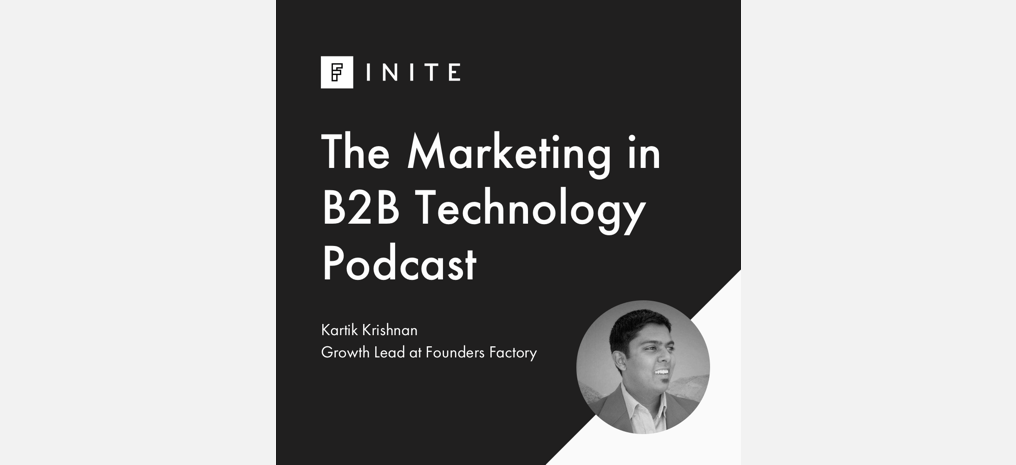
In this episode of the FINITE B2B marketing in technology podcast, we sit down with Kartik Krishnan.
Kartik is an experienced B2B marketer, and currently leads B2B growth marketing at the Founders Factory incubator, working as an advisor to lots of interesting B2B technology companies.
CRM is a challenge for nearly all marketers and businesses of every size, and Kartik has developed a great framework for breaking down CRM to make it as straightforward as possible that you can read more about by clicking here.
Our host Alex Price sits down with Kartik to hear about his work and the CRM framework he has developed for leveraging CRM.
This episode covers:
- Kartik’s background in marketing from Google to startup
- Building a CRM piece and an automation piece in a startup
- How businesses are incubated at Founders Factory
- Why CRMs are vital to B2B marketing
- How a CRM can align marketing and sales teams
- Why CRM packages are based on the number of contacts in a database
- How to use automation software effectively
- Should you start with cheaper CRMs?
- How to effectively test different CRMs
- How to communicate attribution and manage expectations around it
- Monitoring touch points through campaigns on a CRM
Listen to the full episode here:
And once you’re done listening, find more of our B2B marketing podcasts here!
Full Transcript
Alex (00:07):
Hello and welcome to the FINITE podcast. So today I’m sitting down with Kartik Krishnan. Kartik, I met originally at one of our FINITE events here in London that we were hosting. I think actually our first FINITE event. He’s one of those people that when you sit down with someone and you have a conversation and you just feel like you’re both on the same page, I just thought this guy knows what he’s doing, we need to get him on the FINITE podcast.
Kartik’s really interesting, he started his career at Google, working pay-per-click, and managing some really big accounts there, have led demand generation at Onfido, Honcho, a range of other technology businesses, and now is the growth lead at Founders Factory, which was started by Brent Hoberman, Henry Lane Fox and offensively helps lots of really interesting businesses scale as an incubator.
Kartik really overseas and is solely responsible for focusing on the B2B side of things at Founders Factory. And we had a chat a little while ago about how important CRM is and how Kartik’s developed this really fascinating framework for leveraging CRM without getting completely bogged down, overwhelmed, over-complicating things. So, I’m really looking forward to sitting down with Kartik, hearing about what he’s been up to, his story, but then also digging into CRM for B2B tech companies. So enjoy!
FINITE (01:22):
The FINITE community and podcast are kindly supported by 93x, the digital agency working exclusively with ambitious fast growth B2B technology companies. Visit 93x.agency to find out about how they partner with marketing teams and B2B technology companies to drive digital growth.
Alex (01:44):
Hi, thank you for joining us.
Kartik (01:46):
My pleasure.
Alex (01:47):
Looking forward to talking with you. We’re going to be talking a lot about CRM today and this great framework you’ve been developing for leveraging CRM, but before we dive into the detailed stuff, I want to start just with a bit of background about yourself and how you ended up getting into marketing and kind of where you stopped off along the way. So I’ll let you start wherever you think is most relevant.
Kartik’s background in marketing from Google to startup
Kartik (02:09):
Sure. As I think I was telling you offline, it’s a fairly serendipitous story in some ways. I did chemistry and molecular physics and then a one-year mathematical finance degree on the back of that.
Alex (02:21):
I know the sort of thinking, box ticked.
Kartik (02:23):
Yeah. However, not at all in the marketing line of things. This was at Nottingham University but this was also in 2008/2009, when the Lehman brothers went down and therefore there was very few finance jobs, if any. And so job hunting was difficult.
I was just traveling in India, ended up randomly going to the Google offices, seeing it’s a wonderful place. Kind of just applying to get interview practice almost because I enjoyed the interview process, I said alright. I got the job.
Alex (02:55):
Which office? Which city?
Kartik (02:56):
Hyderabad in the Southern part of India. So I went there to work on what was to me like a completely new product, new concept, Ad-words. But I guess that was the foundations in digital marketing. That’s where I got my digital marketing, and it was fun.
Google’s a great place to work and AdWords is obviously we all know how important a tool it is. And these were the early days, 2010, where it had been established to some extent, but I think it was going much more mass market. Like people were shifting budgets away from other offline channels to, “we should be using ad-words.” And I was part of that journey of educating them on how to use it from SMEs to enterprises. Three and a half years into that I just thought there’s more, I want to do more broad things.
So I did my GMAT got into doing an MBA at Cambridge, did my MBA and figured that actually startups were the place for me, just being able to bring like a broad range of skills and not just do day-to-day marketing bits, but actually see the bigger picture and work with co-founders and things. And that’s where I finally ended up working with Onfido significantly.
Onfido at that time had only 15 people, I was employee number 16 and it was in the space of background checking. And if you looked at their old logos and stuff, look fairly boring. I don’t think the co-founders will mind me saying that, very corporate focused and things like that. But as they’ve scaled, they’ve gone to having a very cool startup vibe. They also turn from just doing background checks to ID verification, which has been used by Uber, Deliveroo and all these other new age on demand companies. So that was all really fun.
But what that meant for me was going from being this Ad-words and Facebook and paid social, lead generation, inbound lead generation guy to really more understanding the source of the leads and understand the quality of the leads and also doing some outbound work.
So I had an outbound team, an outbound sales team, not your typical job description of a marketer, but great learning experience. Again, I got to see exactly what makes a business tick, what drives that revenue at the end of the day. And so that was really valuable.
Alex (05:04):
Interesting. So you quite quickly went from specialist in one channel in terms of paid acquisition to a much broader set of responsibilities.
Kartik (05:13):
Yeah. I guess I’d always shown, well you mentioned it, some analytical capabilities. So when I was driving leads in the question was always, well that was a tiny mom and pop shop what’s the point? We’re going to get two cheques out of them, that’s not going to move the needle in terms of the revenue we need.
And so I was incentivised to move us towards getting bigger leads that would be more meaningful. And I figured that the only way we could almost be able to do that meaningfully is by having a good CRM to understand the source of different leads and then what those leads end up doing with us.
Alex (05:45):
Interesting. And what was the, I mean, we’re going to dive into CRM in a lot more detail, how big was Onfido when you first started? What was there in terms of CRM? Were you really building from the ground up, and there was very little?
Building a CRM piece and an automation piece in a startup
Kartik (05:57):
Yeah, there was very little. They were using a thing called Candy, which is more of an IP address tracking tool, which had some kind of list building functionality. I did quite a bit of extensive research at that point to see, and I think I’m glad that I was able to quickly understand that there is a CRM piece and there’s a marketing automation piece, and we’ll come into this later, but I’m glad that I had that distinction in my head. Because oftentimes when you try and do both with one thing, you end up doing neither.
So for the CRM piece, I knew I was optimistic, I scaled it to being a very big company. And we wanted to have the most robust platform that’s used by as many as possible: Salesforce. So that began our relationship with Salesforce on that side.
On the marketing automation side, I again wanted to be able to do email nurturing and be able to understand sources of leads. But, I wasn’t sure that this was going to be the perfect fit for us. So we used a thing called Act-On, which was one of the few ones that would give us a month to month contract. And 6/8 months of that was, well, first we went through “email nurturing is helping us” to “we can do a little bit more with this” and all then “oh we’ve reached our limits of using Act-On without doing a heavier, bigger integration. What do we want to reconsider?”
And that’s when we adopted HubSpot back in 2015. So again, quite a while ago, and I’ve seen HubSpot evolve from being pretty much just on the marketing automation side for inbound marketing, to now of course they’ve enabled CRM with the whole service hub and things like that. So that’s been my journey with HubSpot.
Alex (07:32):
Cool. So take us through to the here and now where you’re working at Founders Factory, tell us a bit about the role, basically what Founder’s Factory is and what you do with the businesses that are incubated or accelerated at Founders Factory.
How businesses are incubated at Founders Factory
Kartik (07:47):
Yeah. So I’ve been working here since Jan 2018, at Founder’s Factory and it’s actually an accelerator incubator for startups backed by eight big corporates as of now, but soon to expand further. That includes the likes of Aviva, Easy Jet, Guardian, M&S most recently.
And essentially we’re trying to scale some startups that are in those company’s sectors. So retail, finance, travel, and at the same time also build new companies from scratch. So almost the idea is how can these companies innovate? What can they learn from us? What can we help them do that will help them be innovative and not be disrupted in their spaces?
Alex (08:26):
And your day to day is focused on the B2B side of things? And really advising businesses in Founder’s Factory on the growth side of things?
Kartik (08:33):
Yeah. So we have a team of four senior growth marketers and a brand marketer. And I’m one of the growth marketers, as I’m more focused on the B2B side as you rightly guessed. So what that looks like on a day-to-day basis, on the one hand we are helping.
So when I say accelerating some companies, those are startups which have like 2 to 10 or 15 people typically, and have probably found some product-market fit and looking to scale those operations. So then it’s putting in more campaigns, giving them the plumbing and the infrastructure, typically a lot of CRM also to help them scale that.
Then on the other hand, there’s also these incubator companies where it’s almost like this is what the initial concept is like, this is where we have somewhat found some validation, but how can we improve this even further? How can we better product-market fit understanding? How can we do some competitor analysis? What can we do to find our own niche? And how do we then take that to the market? So go to market strategies, all of those pieces.
Alex (09:29):
Cool. So very diverse. And I guess you get to see so many businesses from the inside and watch them scale in different ways.
Kartik (09:35):
Yeah, absolutely. That’s one of the best parts of the job in terms of, that cliche of no two days are the same. But specifically, I get to see different types of businesses, different business models, different types of co-founders as well. So that’s also an entertaining piece of like, very junior founders doing this for the first time versus some seasoned, they’ve started multiple companies in the past.
Alex (10:02):
So when we first chatted about recording this podcast a few weeks ago, just before you had sent me the piece you’d written on LinkedIn, which was called, ‘Framework for leveraging CRM without getting intimidated by the possibilities‘. I think the word intimidated is pretty apt.
I know that for us, whenever we were working with CRM with clients, it’s one of those things that often times people just don’t know where to start. And it’s the biggest thing that keeps them up at night across the whole of their organisation. And it really feels like the blocker to getting marketing right. And it’s such an integral piece of the puzzle.
So we’ll dig into this in some more detail, but I think you’ve managed to create something which actually makes it pretty easy to figure out what the route forwards is with CRM. Tell me a bit about how you came about creating this as a framework and why you were inspired to kind of package it up and try and distill it down so effectively.
Why CRMs are vital to B2B marketing
Kartik (10:59):
So it comes from, as I told you guys, my journey with Onfido, understanding what CRM could do, what it would take to get there and understanding what the marketing automation side of that looks like. And then now having access to like all sides of the startups. And I can see that challenge as well.
When companies get invested in they’re often asked, what is your CAC, cost of acquisition, but in a B2B context, that is a hard thing to say, because you could spend only 10 or 15 pounds getting some kind of leads per lead, but you might be needing to spend 100, 200, 300 pounds to get the kind of leads that you really need that are going to be the deals in elephants and whales.
So it’s, it’s hard. And also the other thing you have to move away from is single touch attribution, right? There’s almost no B2B sale that can ever happen, that is based on one ad, it’s always going to take multiple touches. In fact, my theory on this is that it’s not just true in B2B, it’s almost true in B2C if you really get granular with it, right?
So with all of that, the backing needs to be, this lead came from here, these are the other things that have happened to the lead since then, and now they’re at this advanced stage and that’s what we’ll call a success for the marketing side of things. Indeed, if you want to even take it further, this is in a B2B context, but if you wanna take it further then this is where the lead came from, this is all we did to push it through the opportunity stage, this is all that it took to get it to sales.
And now it’s a revenue generating client in the first year it raised this much money, now let’s understand the attribution that we’ve had. And now let’s therefore say that these channels are working. Now definitely let’s repeat on those but in the meantime, we might have to be experimenting on all kinds of other channels as well.
Alex (12:45):
Yeah. So for you, it’s really getting the business in a perspective where it knows what works and what doesn’t, and that’s the key to CRM for you. I guess you working at Founders Factory, particularly with so many businesses of different sizes and scales at different stages in their journey, that carries different value at different stages.
Kartik (13:05):
Yeah, absolutely. And seeing companies that are trying to do SME sales to doing enterprise sales, I can tell that across the board this is important. Across the board you need to know that your top of the funnel is being filled up and that you have a good process for how to handle leads in the middle of the funnel.
And then the other piece on CRM is this often forgotten category of we engage with them, either we spoke to them and then they dropped away, or they’ve just gone cold for one reason or the other whenever through the process. What can you do with them? Well, too often they are just disregarded, there’s too much of, let’s get a hundred new leads every month and stuff like that.
Well, you’ve got some people who you’ve spoken to in the past who are engaged, who know what you’re about, the timing wasn’t right then for one reason or the other, you need to be finding a way to keep them warm and go back to them. And the only way to do that is by having a clean well-thought-through database where it is the single source of truth for your sales and marketing teams, such that they’re able to understand who is in what bucket and those buckets need to be well-defined.
Alex (14:02):
Maybe we should jump to that now. I know it’s towards the end, but I think it’s one of the most interesting things. And actually had our last FINITE event last week, the whole sales and marketing alignment thing just kept coming up. And I think there’s so much demand for that as one of our next topics.
But interestingly, at Onfido it sounds like you had outbound salespeople in your team, as well as inbound marketers. What’s your perspective on how an effective CRM implementation can really help bridge that gap between marketing and sales teams and get them working more effectively together?
How a CRM can align marketing and sales teams
Kartik (14:32):
Oh yeah. I’ve had reasonable success with just sitting down with sales and marketing teams and trying to clearly define what is a lead? What is a marketing qualified lead? What’s a sales qualified lead? And when does it become an opportunity such that we hand over the baton? And that is a very powerful foundation. That is the kind of foundation which founders sit and think about this, business leaders sit and think about this.
They have a very clear picture of we’re going to get 50 leads in this stage and then we’re going to try and convert that many. No, let’s break it down further. And then also as you sit and you have these different buckets, and as you understand who’s going in what bucket, the conversions that generates no, those people cannot be sales-qualified because these are these criteria.
It tells you a lot about your product-market fit. It tells you who you’re really trying to sell to, and when sales are saying, no we can’t sell to those guys, marketing gets a lot about, okay, this is the kind of customer that we’re actually going towards. And I think that helps a lot with redefining shaping those personas, the target audience, quite, quite well.
Alex (15:34):
Yeah. I know whenever we start a new website project or marketing project, we have a sales questionnaire that we send to the sales team. And obviously all of our projects are led by marketing, but the amount of insights we get from sales teams is just phenomenal. And it really feeds back into the content strategy. It tells marketing where they need to be, and what kind of content they need to be producing, what questions they need to be answering.
Yeah, I’ve definitely seen the power of the two being closely aligned, but what happens when you come up against maybe a more traditional organisation where sales might be slightly more old school and sales might think that sales happens first and marketing is just kind of on the sidelines or actually we don’t even need marketing, we’re happy just hitting the phones?
Kartik (16:13):
Firstly, I’ll be honest and say that I’ve been fairly lucky in working with what you call new age companies, where there’s less of that rigidity. But even when that does come up, I’ve always felt like prove the value of use cases and show early wins. So in that sense, it’s always a good conversation around, look you have these sales targets, I’m only going to be here to enable you to hit those targets, what kind of leads do you really want?
And then literally again, having that close foundation around it might just be that one particular lead, we handed it over, we were pretty excited about having done this work. You know, we patted ourselves on the back for getting this lead in, all our paid marketing was considered a success that week because “we got 10 of these leads in and one of them has been handed over to you, why didn’t it progress?”
And that back and forth will hopefully yield a reason it didn’t progress. “But if you gave me slightly different types of leads, I would be able to be successful.” And that I think bridges that gap quite well.
Alex (17:07):
Interesting. So coming back to the framework and the posts that you’ve done, and I’ll make sure that there’s a link to this in the notes around the podcast, but you effectively are segmenting how people should implement CRM based on number of contact records really as the lens through which to look at how to approach CRM. Tell me a bit more about that kind of approach.
Why CRM packages are based on the number of contacts in a database
Kartik (17:29):
So there’s two elements to this I think. One is, firstly if you think about how a lot of the successful companies in the CRM space are pricing their own packages, it’s on a per contact basis. So that gave me a clue when I was thinking of B2B SaaS stuff, like what is a sensible way to bucket these things, as I’ve been saying a lot about bucketing things.
But you know, if you want to start grouping things, do it in the way that the successful companies are doing it. They’re basing on contacts because look, the more contacts means more leads, means more chances for you to scale and grow if the leads are good. So that’s why on a contact level basis.
The other reason, I guess that also sits well for me is that well, I’ve been exposed to all these small companies, but they all come with notions that are like, we’ve heard that with CRM we’ll know exactly who’s done what on the website and we’ll know exactly who has engaged with us when. And we can start firing off these amazing personalised campaigns.
Or the other piece that we’ve mentioned a few times, the attribution side of things we want to know who came from where, and we should have this full, clear picture.
Well, definitely it’s one of these instances of garbage in garbage out. You’ve dumped a whole lot of contacts. You don’t know why you actually put them into your CRM. You certainly don’t know much about what’s happened on their journey since then. You’ve got a few data points about their visit to your website, but that’s quite meaningless really. And you certainly don’t know a clear picture of what were the different touch points that you won’t attribute back to it.
So with all of those things in mind, I thought I’ll break it down by contacts and start to define what you, and again at the early days you don’t need a Ferrari to be driving along on one of London’s roads. Sorry for all the super rich who have Ferraris. But then you probably want a Prius and you scale up when you’re starting to access the better roads you’re trying to get onto the motorways.
So when you have thousands of contacts and you have to do really scaled marketing campaigns, you need all the bells and whistles. You need to have proper automation firing, but only at that stage. In the early days, it’s almost beneficial to really think about doing things in a slightly more manual way, because then you really get to see, I fired out that email, what was the impact of it? Learn those lessons in those early stages.
Alex (19:44):
So you started by segmenting on maybe 100 to 500 contact records, then 500 to 2000, and then really it’s in the 2000 plus or beyond that you’re talking about introducing more complex workflows and automation and segmenting more personalised journeys.
I guess what’s been your experience of implementing those much more automated workflows? And when have you started to see them be most effective?
How to use automation software effectively
Kartik (20:10):
So definitely you need that scale. You need to be sending to a few hundreds, if not thousands through workflow before you can see the impact of the workflow. So before that, you’d rather be sending them out one-to-one, trying to personalise as much as possible and not building this sophisticated machine for it and rather doing it and seeing what works, what is resonating.
Trying to, you know, optimise your emails in that stage. All your touch points calls, and all those kind of pieces. But as you start to scale, you just don’t have the time to sit and engage with hundreds of people separately. So you kind of have to rely on some level of automation, but yeah, as I say, you pushed through hundreds, several hundreds of contacts. You start to get a flavour of this is what the conversion percentage for this is.
So this is, you know, HubSpot has it well where you set a goal for each workflow, right? Or in any of these automation softwares, you’re encouraged to keep looking at the results of what your workflow is generating. So then you slowly get a sense of when I have these three touch points overall, it produces this.
What if I tweak two of the touch points, the ones that have the higher open rates, and then you start to optimise that and you can start to get to a point where without having to do too much, you haven’t sent out a hundred emails, you’ve just hit a few buttons.
But you’re starting to be able to tweak and improve your message, improve your machine. So that over a three to four month time span, it’s not going to happen overnight, you are starting to build out what can be quite a sophisticated machine, that’s doing this while you sleep as well. And that’s the benefit.
Alex (21:33):
Yeah, that’s the dream.
Kartik (21:36):
Automate ourselves all out of a job.
Alex (21:41):
I guess I know that for us as an agency, the landscape of tools and technology that exists out there is enormous. And we all know the, I forget the name of the big graphic that the guy produces every year with like 7,000 different things on there. And then only a few years ago there was like 10 or something.
Kartik (22:01):
I actually refer to these numbers in a slide that I did recently. It was 150 in 2011, it’s 7,000 this year, MarTech companies. So you can imagine the crowded density of the landscape.
Alex (22:12):
Yeah. So I mean, there’s a whole another debate to be had around are marketers becoming technologists? And what’s the modern day role of a marketer? But in the short term, how do you begin to start wading your way through all of these tools and technologies?
And as you’ve already talked about, we’ve got sales CRMs, we’ve got marketing automation and all of these products and are kind of trying to bring everything under one roof and overlap them. And I guess different tools come in at quite dramatically different price points based on functionality.
It might be appropriate at different stages of the journey, but are you better off just getting the superpowers, Salesforce, Pardot set up from the offset? If you know that you’re going to be hitting the right levels of growth eventually anyway, versus Autopilot, which is like a cheaper version of HubSpot, for example. Where do you even begin?
Should you start with cheaper CRMs?
Kartik (22:56):
Yeah. So I walked a few companies through that journey here and for one thing, by the way we’ve refined our set because at the end of the day, you can keep digging and as you said, there’s always overlapping tools. Some companies use InterCall, which you wouldn’t think of as CRM, but if you think they aggregate all your leads in one place, you can do a bit of lead data. You know, you can put in more information, you can do segmenting.
So definitely it can start to act like a CRM, but I would say for like a bit more offline data inputting for doing collaborative work, it’s not great. So what I’m going to say is, and by the way I touch upon this in my article, as best as I can. But, if you can cull down the potential options, start to think so you get a sense of the top in a particular category. Then if you can, try and understand where they came from.
So we know that HubSpot started as inbound marketing, if you think inbound marketing is going to be the life and blood of your company, probably go with it from the early days. But if you don’t think that that’s going to be such a big piece.
So you’ve got a very enterprise deep tech kind of sale where the universe of companies is only about 300, 500. There’s no point in you trying to ramp up to getting 10,000 leads a month, right? Or even annually. So you’re almost looking at a smaller, more simple CRM sales, CRM focused thing.
So at Founders Factory we’ve got some discounts at play. So that also helps, that changes the dynamic a bit. So we pretty much are varying between kind of using PipeDrive with a bit of MailChimp or something for the very enterprise companies where even in the long run, unless they completely pivot, their universe of potential leads is not in the thousands.
If their universe of potential leads, or if they’ve already got a significant marketing team and they have the ability to put a lot of content out there, start to do more inbound stuff, we talk about HubSpot and only in rare cases, when we think that there’s a specialised use case, you’ve got some complex products and stuff which will not sit well within the HubSpot framework, which is pretty rigid in some ways, Salesforce with its unbelievable customizability, therefore quite intimidating.
It can be handy to tread carefully and you’ll probably spend quite a bit of money and time configuring it. So that for me is like three different buckets. Please don’t by any means disregard any of the other options. If you have a discount from any of the other ones, go for it, but this is the way I look at it in my head.
Alex (25:23):
Interesting you talk about discounts and something that came up at our last event on the panel was actually just getting inside these tools and playing with them and getting to use them. And often in the context of marketers having to sell their solutions back into founders or CEOs at CCP level, they’re looking for budgetary sign-off on using different tools and tech.
And a lot of these platforms operate a kind of freemium model, which is quite accessible and allows people in. Do you find that’s a good way of just building the business case and exploring the different solutions?
How to effectively test different CRMs
Kartik (25:52):
Well, it can be dangerous, right? That’s the whole point of freemium, right? You get roped in and then next thing you know, you’re paying a five pound a month bill. And HubSpot can be dangerous like that, but really what I’m trying to say with my article as well, is that only buy certain features. So by the ones that allow you certain access.
If you go back to my part about Onfido, I think it was good that we only bought Act-On, which was only going to give us a month to month thing. So that kind of kept us honest about is this really producing value? It’s not like we signed up for a 12 month contract and we may as well have it on in month 8. If it’s not producing any value, we will shut it down. So that is one piece to it.
And then the other thing is around, what are they about? Where did they originate, the origin story for them? And therefore what clientele have they got so far? And the best case scenario is, so HubSpot does set you up with another company of a similar ilk and get you to speak to them. That can be quite powerful because you can really learn a lot about what you could potentially do by what similar companies are doing. So use that.
And finally, I think there’s another piece which is around, so we talked about freemium and stuff. So a lot of our B2B companies that we work with are SaaS. And what you want to be doing is, I mean SaaS is a hugely dynamic space, you’re always competing. So you want to be working with best in class in some ways to be learning from them.
If you can take lessons about how to turn freemium customers into paid, activated customers from a marketing SaaS company, then that’s only going to be meaningful for you. So kind of like if they’re doing well in their spaces, what can you learn those lessons for yourself? And also more broadly if they’re servicing customers like you, then you can probably learn some other things at meet ups or by one-to-one interactions once in a while. And that’s all the way you decide. Do you agree? Do you disagree?
Alex (27:42):
I do agree I think. Yeah. I think everything you say makes sense. I think it’s just gradually working your way in and getting used to these tools and working your way up is the key. But I want to talk about attribution because we mentioned it already.
I guess the fascinating thing for me about attribution talking to clients so often is that, and even today I had a pitch where the marketing manager literally said to me, we pick and choose the metrics that we show the C-suite because actually they don’t really understand digital anyway. And so they’re actually kind of fine with that. And we pick month to month what works for us, which is kind of staggering somewhat in itself. But I think it’s not uncommon across pretty much the vast majority of businesses.
So I think this is kind of a two-fold question around communicating attribution and I guess kind of KPIs and metrics more generally, but also managing expectations internally, both above and below and to the sides. How do you approach that?
How to communicate attribution and manage expectations around it
Kartik (28:37):
Yeah. I completely sympathise with this person. I’ve probably been there myself and the truth is, yeah, it’s a hard concept sometimes. So we all know paid marketing can get you all kinds of leads.
But then I think if they have more of those conversations around, “hey sales guys, we brought these leads in, name them. What has happened with them?” That really like granular conversation can open up a lot of insights, right? So that’s one piece that’ll give you the connectivity with sales and probably sales is probably closer to revenue. So you can build a better story from that, right?
The other piece is that, particularly in B2B marketing and to a large extent, even in B2C marketing, things are not instantaneous anymore. I mean, in B2B, it never was. You have a bit of consideration, awareness, and then only after a while of consideration, do they actually go ahead and buy. So there’s cohorting that you need to do. Your leads that you generate today are not going to turn into customers anytime soon.
So if you’re producing a report at the end of the month, there is a sense of like, we have generated these leads, what is the value of them? Well, not so much right now, but last month leads have produced more value. So this starts to become the more complex side of things.
But again, salespeople I think will be your partners in this. They will tell you that you should have that honest conversation with them. We generated these leads and we can understand that you haven’t been able to convert them into customers overnight or in the two weeks even – some enterprise sales cycles are 6 months, 10 months.
But at least when you have established the conversations, like a running joke within you guys, like what’s happened to that one particular lead that we’re very keen on. That’s a huge deal for all of us. Well, 6 months down the line they’ll say, oh that guy who brought in that lead or helped bring that lead through all their campaigns, that’s proving valuable. And when that conversation happens, I think you’ve just unlocked a bit more, you’ve proven your value and you’ve unlocked potentially new budget.
Alex (30:23):
Yeah. Interesting, I agree. It’s communication isn’t it? It sits at the heart of this and being open and transparent.
Kartik (30:29):
And if the communication is not there, then at least a good CRM will help you do this, where you log that that lead originally came from this source and three months down the line, where is it sitting? Well it’s halfway down the pipe as expected almost.
Six months on and it’s still not happening yet because it’s an enterprise sales and there’s so many varying, moving pieces here, it’s just not happened. But ten months down the line, it does happen, you go right back to it and you say this is the touch point. I know it was painful, we want to reduce that 10 months down to 8 months next time. But let’s at least say that these channels, these very, these specific touch points are quite meaningful.
Alex (31:02):
Yeah. So one other thing that you covered in the post which I really liked, and I am a massive believer in is approaching things in campaigns and kind of breaking things down so they’re bite sized. Tell me a bit more about why you think that’s effective and the way forwards.
Monitoring touch points through campaigns on a CRM
Kartik (31:19):
I think that again, sorry I’ve said this a few times, but relevant, definitely coming from a B2B mindset. But as I interact with companies here that are working in B2C, I think it’s relevant in B2C as well. It’s the notion that again, because journeys aren’t instantaneous, paid search does not directly lead to sale instantaneously, there are multiple touch points.
The more you understand the different touch points, the better. And one of the ways to bring together the touch points is to team them, is to have campaigns, is to have that notion that in this week we were majoring on these messages and those messages had to be distributed, not just with a piece of content that we just left, or we put on our block, we need to push out emails on the back of it, the workflows need to kind of be there to email our people.
We need to be putting it on social media. We might even run an event around it. Those three, four things sit under one campaign. And when you, again, 10 months down the line, when you close that big, huge client, and everyone’s celebrating you say it was because of that event that we ran 10 months ago. That was part of the touch points.
We also did a lot of emails in the interim. We kept sending our newsletters and that’s what’s kept them warm. So now obviously we continue doing all of those things. The campaign was that event, let’s give a lot of success back to that, and that’s also to the newsletter’s that had been ongoing and all those pieces. So these different campaigns have come together, but they’re all branched under various campaign umbrellas.
Alex (32:47):
I think you had it in the notes, stop doing things for the sake of doing them, which I think is a real risk in any marketing, right? Like it’s so easy to just go off and suddenly find yourself doing something that actually isn’t delivering much of a return on investment. And I think today with so many channels and so many different mediums through which people can communicate as marketers. It’s like where do you start?
That sense of prioritisation is so, so hard. But I think if you break it into campaigns, you can very quickly look back on what you’ve just done and reflect on whether it’s worked. And month by month, even week by week, you can learn. Whereas if you’ve just got everything kind of ongoing side by side as separate channels and workflows, then at what point do you reflect on what’s been successful?
Kartik (33:26):
I mean, who’s the marketer in the fifties who said, I know 50% of my marketing budget is doing something, the rest is not, but I don’t know which 50%. Well, I say to you that now thanks to attribution tools, we can get closer to knowing which of the 50% and indeed let’s only spend on the 50% that is actually generating.
But at the same time, as you say, there’s so many more channels, there’s so many more touch points, attention spans are shrinking. So we got some or we lose some, so attribution’s better, but know that there’s more channels and know that there’s much more you have to do to engage the user, to engage a potential customer.
So you better be aware of splitting your budget, knowing that you have to try different channels. And campaigns is your one way to kind of be on top of that and at least accumulate things under these teamed umbrellas of this is all to do with this kind of content, or this is all to do with this type of this week or months worth of pushing.
Alex (34:19):
Yep. I think that’s a great way of approaching things. Cool. Well, I’m going to make sure that we’ve got a copy of this framework saved and linked to from the podcast. I think it’s a really, really awesome way, I think for anybody that’s either at the very beginning as a business, but you know, even a lot of our clients are much more established, but still at the start of that CRM journey. And I think this is a super effective way of looking at things and making things bite sized.
Kartik (34:43):
It’s interesting or ironic that you asked me to be on this podcast and I had just written this article almost completely separately. It aligns well.
Alex (34:55):
It does indeed. I’m massively grateful for you giving up your time to chat through it. I’m sure everybody in the community is going to enjoy listening to it. So thank you.
FINITE (35:02):
Thanks for listening. We’re super busy at FINITE building the best community possible for marketers working in the B2B technology sector to connect, share, and learn. Along with our podcast, we host a series of events here in London. So make sure you head to finite.community to subscribe and keep up to date with upcoming events.