- Some additional information in one line
- Sep 21 2020
Podcast: The B2B Marketing Objectivity Trap with Rory Sutherland
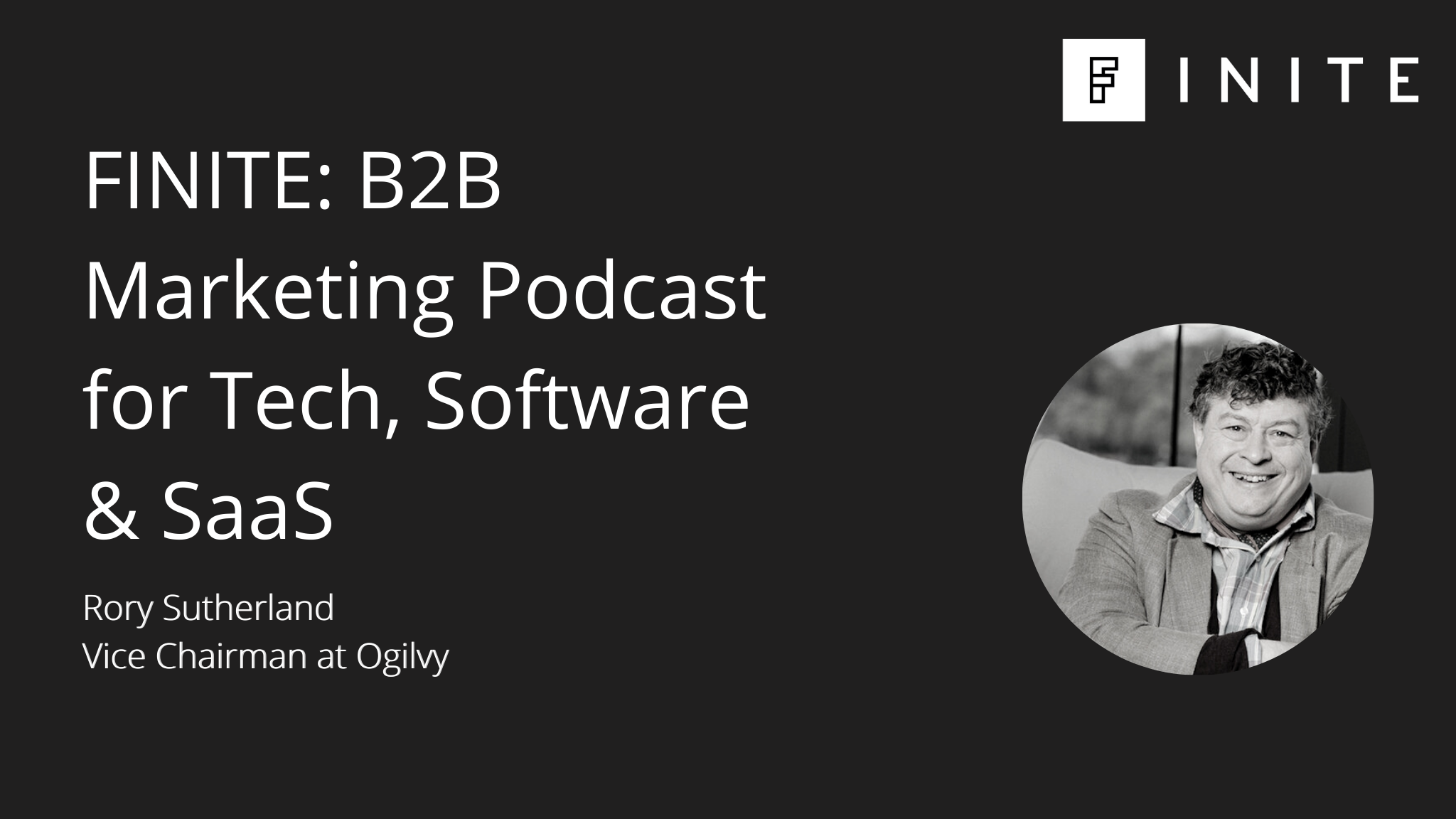
Rory Sutherland needs little introduction for most marketers.
Rory has recently produced a B2B marketing report called The Objectivity Trap in partnership with LinkedIn’s think tank The B2B Institute, where Alex Price, FINITE Founder, had a chance to sit down with him to talk through some of the findings.
As Vice Chairman of Ogilvy UK, Rory also heads up their Behavioural Science Practice along with being a seasoned author and speaker.
This episode is a must listen for any B2B marketer interested in how people think, and what it means in a B2B context.
This episode covers:
- Why B2B decision making is definitely not exempt from psychological analysis
- What is the objectivity trap?
- Adding value is a product of perception, not adding objective qualities
- How Covid-19 has proved that innovation in tech should be embraced
- The key to B2B as understanding business people’s problems
- Why marketers should care about status, certainty, autonomy, relatedness, and fairness
- Why B2B buyers make their decisions to avoid blame; defensive decision making
- How B2B companies are tackling risk adversity with the idea of ‘freemium’
- What B2B marketers can do in lieu of face to face events
- How unlimited seating capacity will greatly impact online events
- Why spreadsheets and data can’t read human emotions
- Why the reward for thinking weird is greater than the risk
- Organising senior management to focus on the psychology of a business
- Using the right kind of science in marketing – biology!
Listen to the full podcast here:
And once you’re done listening, find more of our B2B marketing podcasts here!
Full Transcript
Alex (00:07):
Hello everyone and welcome back to another FINITE podcast episode. I’ve been looking forward to this episode for a while now, and that’s because I got to sit down with Rory Sutherland. Rory is the Vice Chairman of Ogilvy UK, an advertising agency. He’s an author, he is a fantastic marketing speaker.
If anyone’s been to a marketing event or conference of any kind over the last few years, you will almost definitely have bumped into him on the speaker list in some form or another. He has some fascinating views to share and specialises in the application of behavioural science to marketing. And that’s the practice he heads up at Ogilvy in an agency he founded there.
Rory has recently written a report in partnership with LinkedIn’s B2B Institute called The Objectivity Trap. And this podcast is a chance to sit down with Rory and dig into some of the findings of the report, the challenges and opportunities within the world of B2B marketing. So I hope you enjoy listening to this as much as I enjoyed the conversation with Rory.
FINITE (01:09):
The FINITE community and podcast are kindly supported by 93x, the digital agency working exclusively with ambitious fast growth B2B technology companies visit 93x.agency to find out about how they partner with marketing team and B2B technology companies to drive digital growth.
Alex (01:30):
Morning Rory, thank you for joining me.
Rory (01:31):
Oh, it’s a huge pleasure. It’s an area that fascinates me, B2B, precisely because I think it offers so much in the area of untapped possibilities.
Alex (01:42):
There’s a lot to talk about. We’re going to cram it in. I think before we dive into the report and everything, with all the insights you’ve got, give us a very quick, 30 seconds on yourself, where you spend your time and where you focus your energy at the moment.
Rory’s role at Ogilvy
Rory (01:53):
Yeah, of course. I’m the vice chairman of Ogilvy. I’ve been there for about 30 years and nine years ago, I founded a behavioural science practice, which strikes me as being the kind of lost continent of Atlantis for marketing and marketing services. And the reason is that so much of marketing now is concentrated on what people ostensibly think. That we need a complimentary discipline to concentrate on the things that people do without even thinking about it.
Why B2B decision making is not exempt from psychological analysis
And the majority of human behaviour, including I would argue B2B behaviour, comes into that category. We make decisions based on heuristics and assumptions and we follow them. The reason I think B2B is so important is that those emotional forces at work on decisions are no less present in B2B than they are in consumer marketing. In fact, I would argue they may actually be stronger forces in consumer marketing after all, you know, people’s individual biases and quirks tend to cancel out in the marketplace.
In business because of things like fashion and the need to explain your decision making, biases such as “I’ll come to this later” defensive decision-making tend to be compounding biases rather than self-counselling biases. But the other reason why I think it’s so important in B2B, the kind of things we do without thinking about it, is not because those forces are any less present in B2B, it’s that we make far greater efforts to disguise them.
What is the objectivity trap?
Because your role in a business is heavily dependent on what I call the objectivity trap: the myth, but more convenient fiction you could call it. That once we put on a suit or formal business attire and sit behind a desk, we become completely rational in our decision making. And therefore we are essentially interacting with people who are thinking in exactly that same kind of rational way we are.
In reality, the way humans make decisions in the real world and the way humans are supposed to make decisions in this world of faux rationality, are quite often miles apart.
I’ll give you a lovely story, which I often use as a B2B illustration of this. I don’t know if anybody listening has had to go through one of those procurement exercises where you evaluate suppliers or competing tenders on a balanced scorecard. And you’re given, if it were an ad agency presenting, you will be given a certain number of points adding up to 100, 10 would be on chemistry, 20 would be on strategic vision, 20 would be on creative, et cetera, et cetera.
Now that in theory is how we’re supposed to choose an ad agency or a supplier. If you ask anybody after they’ve been through this process, which is usually mandated by procurement, particularly if you asked them after a couple of drinks, how do you really decide on the supplier? Did they actually use the balance score card? Did they bollocks? What they really did is they made an emotional decision on which agency or entity they’d prefer to work with. And they backfilled the numbers in order to get the result they wanted.
And I think a lot of business activity is like that. We’re actually producing numbers and charts and things, not for illumination, but for support to defend our reasoning, more like showing the working out in maths rather than to arrive at a better answer. And I think the gap between what you might call the charade of business rationality and it’s everyday real world reality is quite a wide gap and one well-worth marketers exploring.
And especially now, and I’ll come to the especially now and Coronavirus inevitably a little later on, but I think it’s brought marketing very much to the fore and marketing needs to step up to the plate precisely because most really big disruptions turn everything into a behaviour problem.
Alex (05:59):
Let’s talk about that in a sec. So one area I want to dig into which came out of the report that made me do some thinking, was that B2B technology businesses, particularly at their earlier stages are so focused on the quantifiable aspects of often what you would describe as product marketing, in terms of talking about what their product does and its features and its specifications and here’s a product spec sheet and all of those kinds of things.
And they’re not really, I think, particularly at the earlier stages, they really think that tapping into, or attempting to practically tap into the emotional side or potentially as you say, not cover up the emotional side as much, seems so far off people’s radar that it’s just never going to happen.
And I guess you’ve also got the bigs of the B2B tech world, of the IBM’s and the Salesforces and these huge businesses who I guess you could argue in some respects, they tap into an emotional side of marketing, but actually come across as quite corporate and dry in a lot of other respects. And so they kind of set the tone for lots of smaller businesses looking to emulate them.
So is it possible to invest in brand and the emotional side of marketing, even at potentially an earlier stage in the journey?
A universe that would not need marketing
Rory (07:04):
Yeah, the difficulty is not that these things don’t work, it’s that these things aren’t supposed to work, and the distinction is quite important because if you look at standard economic theory, which has quite a strong, and I would argue pernicious influence on business decision making, and that’s kind of neoclassical economics, you know, the supply demand curve sloping one way. And the assumptions of that economic model by the way, are quite terrifyingly stupid.
When you delve a little bit deeper and that’s because economics assumes that every actor in a model is possessed to begin with with their various assumptions, like transitive preference, for example, but two of the biggest assumptions are perfect information and perfect trust. Now, what that means is that marketing is exogenous to the model because if you had a world where everybody knew exactly what they wanted, they knew how much they were prepared to pay for it. And they completely trusted the person they were dealing with. You wouldn’t need marketing at all.
I freely admit that in this weird parallel universe, where for some reason people’s brains have such spectacular processing power and everybody was completely honest. Now, by the way, those universes sort of exist in things like ants and social insects, I think to a degree. But if you had such a world, you wouldn’t need marketing at all.
And so as a result, marketing value doesn’t get included in the model which most businesses adopt. They think if I need to sell more, there are two ways I can do it. I can reduce the price of my product because then more people will buy it, or I can make the product more desirable in terms of added functionality, because then more people will buy it. But the third way, which is to help people understand the value of my product in a completely new and revealing way, in other words, the informational solution, doesn’t even get included into that model because we already know everything already.
You know, I mean, come on. Okay. I mean, no physicist would ever come up with a model that was that dumb or that relied on such fatuous assumptions. And yet economists have been getting away with it for years and then spreading that poison through business schools.
Value as the product of perception
And so now there are dissenting and what we called heterodox schools of economics. The Austrian School, which understands marketing, the Austrian School of Economics, value is believed to be the product of perception and therefore adding perceptual value to something is as much a source and creation of economic value as adding objective qualities to that same thing.
There’s a wonderful phrase I always quote from Ludwig von Mises where he says the value created in a restaurant, it’s not possible to distinguish the value created by the man who cooks the food and the value created by the man who sweeps the floor. One of them produces the good that’s being consumed. The other one creates the conditions in which it’s possible to appreciate. And so the Austrians are big marketing fans, at least acknowledging its value.
Covid-19 has proved that innovation in tech should be embraced
And increasingly, by the way, I think we look at innovation, particularly in the tech world, which is a big powerhouse, of course, in B2B marketing. We look at things like the adoption of video conferencing by businesses, which took a frigging pandemic before this screamingly useful, unbelievably beneficial in every respect, in terms of quality of working life, in terms of the environment, in terms of cost savings, in terms of breaking down silos, in terms of not having the pissing problem of finding a meeting room.
Here, you had Zoom and Teams basically solving those problems in a stroke and did businesses sit down and go, we need to have a really big discussion about how we use this and how we drive? No, they didn’t. They waited for a bloody virus to do the job for them.
And so I think that argument that in the adoption of innovation, marketing is now in fact decisive. Bill Gates said something, when he said, people don’t know how to want the things we can offer them. During lockdown, it’s not only technology like Zoom.
During lockdown, because of my habit of when bored I consume electronics, which is a bit of a default behaviour of mine, I bought a little Olympus USB dictation. What you would have called in the 1990s, a Dictaphone, okay? I started practicing voice dictation of everything I wrote and then plugging it in, uploading it to Otter.ai. I’ll give them a plug, which is an AI based voice recognition and transcription service. And on my first occasion, I burbled on not very coherently, you get better over time, for five minutes until my astonishment in those five minutes, I produced a thousand words.
I was thinking, you read about 150. Oh yeah. Hold on a second. Speaking is inordinately faster than typing. Theoretically, if you were the world’s most lucid man or possibly two very lucid people in conversation, what this means is you could produce a hardback book, 120,000 words in a frigging day. Okay? In terms of productivity improvement, voice dictation over typing is literally, it’s a moonshot. It’s a 10x. Are people exploring it? No.
Understand people’s problems
Business People just basically copy each other as far as I can see. And you have this problem obviously, and this is an interesting question, which is where does marketing begin and complexity theory end or vice versa? You know, you have that problem with things like Zoom with any network the adoption is always slowed down because it takes a while for the technology to reach a critical mass of users. Okay?
But market, I think that comes under marketing, understanding those problems. It comes under what you might call market research as distinct from consumer research. But let’s take a thought experiment here. I’m a big fan of the thought experiment. Imagine if mobile phones had been invented exactly when they were, but because of some legal or technological downfall, mobile phones had only been able to call other mobile phones, they weren’t interoperable with the preexisting landline network. Then I think you would confidently say that the adoption worldwide of the mobile phone would have taken another 10 to 15 years.
I had a mobile phone very early. The interesting thing with it is I can still remember in 1991 using a mobile phone on Oxford Street and having people shout wanker at you from cars. I do not exaggerate this. This really happened thirty years ago, if you used a mobile phone in public, you got abuse. Okay? It was a Motorola, great big brick I was holding to my head. So I was a bit of a wanker let’s be honest about it. It may of course been nothing to do with the mobile phone. I never really thought that.
The other fascinating thing is I think very few of my early calls were ever to other mobile phones. In fact, when you made a mobile to mobile call in the early 90s, you commented on it like “ooh we’re both on our mobiles”. Okay? And you didn’t do it very much just virtually nobody in you had another mobile phone. And it was only the interoperability that massively accelerated the adoption. And so those market dynamics come within in my view, the realm of marketing, and we may need to ask questions like how do we accelerate critical mass by perhaps geographically concentrating usage, for instance, you know?
The SCARF model
And so those things which I described marketing as being the science of those things, which economics is wrong about, or which economics doesn’t fully understand, it doesn’t understand trust. It doesn’t understand this is from David Rock, a neuroscientist, a Kiwi neuroscientist in New York. He has a thing called the SCARF model, which I frequently use, which is five things that aren’t in economics or standard thought, but which we as bald chimps really really care about and it’s status, certainty, autonomy, relatedness, and fairness. Okay?
So none of those really have any place in the standard economic cannon, but we’ve evolved for various reasons to care really, really bitterly at many cases. But I’ll tell you a wonderful story of my own experience. I’ve worked at Ogilvy for 32 years. The time I was most close to leaving in a half was not when I didn’t get a pay rise. It wasn’t when you know, I was slightly unfairly treated in a bonus round. It was when my mobile phone broke, I put in for a replacement and they sent me a refurbished Samsung galaxy S6, when I’d requested a Samsung galaxy S9. That was the point at which I was closest to going swivel.
And so, you know, patently, these things have an incredibly potent for status sensitivity, for example, incredibly potent force within business. Relatedness is really interesting because I think procurement tends to follow the economic model where you buy ad hoc, wherever it’s cheapest. And I think procurement is both very, very good and very, very bad because of that. Because in many cases, capitalism is relational. It’s not transactional by which I mean, the reason you’d want to a relationship with a professional services firm is the same as if you live in a town in England, you use the same taxi firm all the time.
Why? Because you want them to see you as a valuable source of future revenue, which means that they will be disproportionately incentivised, not to cheat you, not to lose your business, not to piss you off and under exceptional circumstances will go the extra mile. If I use 10 different taxi firms in Seven Oaks, okay? When my wife breaks down in the snow, I’m going to ring all 10. Are they going to go “terribly sorry, mate, we’re busy.” If only other hand I put all my business in one place. And this is an understanding of information.
And of course, essentially what you’ve got to remember is that standard economics treats information as a given. It’s already there and it’s complete. And now in the case of my taxi firm, if I spend a lot of money with one taxi firm they ain’t going to rip me off because they see this as a long term value play. If I use a taxi firm once, they may go, “this guy looks a bit prosperous he doesn’t even know where he’s going.” Bang, let’s tick another six quid on.
So those are the kinds of distinctions that I think all marketers instinctively understand, but we’re contending with a business world and particularly a boardroom culture, which is entirely preoccupied with this fake certainty that’s created by pretending that economics is true.
Alex (17:58):
In the report that I think is really interesting because one area that, that jumped out at me was this concept that the personal and individual loss from making the wrong decision can actually be far greater in B2B than in B2C. So tell us a bit more about this, because I think everyone perceives B2C as being straightforward, you have a need, you make a purchase and we will talk about B2B as I guess, more complex.
B2B buyers care about the blame game
Rory (18:20):
This is a gross generalisation, like, okay, I’m going to have behavioural scientists or neuroscientists, particularly kind of attacking me for such a simplification, but simplifications as with system one and two they’re useful.
And bluntly put when a consumer buys something, the emotion he’s trying to avoid, and this is very important, by the way, we’re much more driven in many ways by aversion than we are by desire. Not always, if we’re in a hot state, you know, this is why people who are sexually aroused or pissed will do totally bonkers things. But by and large, we’re driven by fear more than we’re driven by greed in a sense. Okay?
And the thing that a consumer’s trying to avoid when they buy something is probably regret, an internal force. In a B2B context the thing you’re really frightened of is not regret, it’s blame and that’s an external force. And that’s why lines like no one ever got fired for buying IBM, encapsulates so much of what Gerd Gigerenzer calls, defensive decision making. And the reason it’s important, this disconnect or this misalignment between personal incentives and corporate incentives.
I’ll give you a lovely story from Daniel Kahneman here, he was presenting to a board of a very large company, which I guess might’ve been GE okay? And he goes around the various heads of all the divisions and said, would any of you take a decision which had a 70% chance of increasing your revenues and profits by 30%, but having a 30% chance of reducing your revenues and profits by 20% and all the one or two of them said, no, because 30% of the time I’m going to lose my job, and I’m going to look like an idiot. And the Chief Executive, who of course benefits from not the individual decisions, but the aggregate to their odds, but hold on, I want all of you to take that call.
And this actually comes down to an issue which is closely related to ergodicity in mathematics, which is another thing that economics is wrong about. Which is that the ensemble outcome for 10 people taking a bet is not the same as the time series outcome for one person taking the same bet 10 times. You can have a bet, which is on average beneficial for a group of people taking it, but which is deleterious for one person repeatedly making the bet with the same odds.
And so the ergodicity problem is one that’s very interesting because it makes the silo problem in business, mathematically tractable. Which is that everybody’s really, and I’ve seen this by the way, once or twice, the worst thing I’ve ever seen in companies, which I haven’t seen very often. I mean Ogilvy has pretty good clients for the most part. He said, blowing smoke up their asses. But once or twice, I’ve seen the client culture where if someone in a competing division has a disaster, the people in that division are actually ecstatic.
I have seen cases of that where essentially, you know, someone in the recruitment division is absolutely delighted because the person in the retention division totally ballsed up. Okay? And that’s where you get this misalignment.
It’s really important, not just in business, it’s really, really important in medicine. And the go to guy here on defensive decision making in academia without a shadow of doubt is Gerd Gigerenzer at the Max Planck Institute in Berlin. And Gerd basically says, this is not just a problem in business decision making. It’s a problem in medicine. Okay? Which is doctors are not necessarily consciously, not deliberatively. They’re making decisions where they’re suggesting an intervention, because they know if you suggest doing something, you don’t get sued. If you suggest doing nothing, it may be the better advice overall.
But if everything goes wrong, you’re now at risk of litigation. And so a lot of unnecessary medical procedures are often performed for reasons of defensive decision making. And this misalignment, by the way, is, and I said the blame thing, what percentage? I had Gerd onstage two years ago.
And I said, what you’re basically saying is that a huge amount of business activity is ass covering, okay? It’s not finding out information, doing market research, going through procedures in order to arrive at a better decision. It’s doing it in order to defend the decision that you’ve already made. So that in the event that things go wrong, you’re kind of bulletproof.
Alex (22:56):
Does this kind of risk adversity feed, and I’m just trying to think of tech companies, some of them are defining new categories. They’re in FinTech or in cybersecurity. Risk adversity is a huge problem. Does this feed the argument of allowing people to have some access to your product or solution?
Tackling risk adversity with ‘freemium’
Rory (23:13):
So marketing has got to get back out of the Marcomms ghetto, where it’s seen as a support function. If you happen to need something colourful while you’re pursuing your economically driven agenda. And it needs to get back into areas like the psychology of pricing, for example, and it needs to get back into exactly that point of trust.
So, I mean, you know, one of the very, very rapidly discovered breakthroughs, I think in consumer tech was the idea of freemium. In other words, you have a product which is no risk because it’s free, it’s not no risk cause you could mess up your machine, but it’s relatively low risk in terms of use at a fairly basic level. Zoom of course, if you think about it is a freemium product, it’s 40 minutes, 40 minutes I think is the maximum for free or a one person to person conversation can go on indefinitely. If you want more than two people talking for more than 40 minutes, you’ve got to divvy up.
Zoom is a fantastic case, by the way, where it’s a B2B example of a business, which no rational person would have thought stood a chance of success, in that it was in a mature category, competing with established offerings from Microsoft, Skype, and Teams actually. Mature offerings from Google mature offerings from Apple albeit not interoperable… Idiots right? Okay. And offerings from Facebook and everybody else. And the logic that most of the objections to early stage investment in Zoom were precisely that “look you’re taking on the big boys who offer free products and you’re product that you charge for, and you really think you’re going to succeed?”
And I think the reasons they did succeed are partly technological, it’s cloud designed for the cloud. But I think a large part of it was psychological as well. They just got the psychology, right? In particular, the URL link for the meeting, behaviourally and decisive, in the same way that for Uber the map was psychologically decisive in getting people to act. You know, if you remember the David Rock model uncertainty is something we hate. And so the Uber map basically destroys the psychological pain of waiting for a cab. Not because it makes it arrive any quicker, but because of the level of uncertainty and ambiguity you have to experience during the wait is significantly reduced.
Alex (25:33):
Let’s talk about the face to face side of things. Cause we talked just briefly before we started recording about obviously the impact of coronavirus. I think nearly every technology company I’ve spoken to or have been working with has lost a huge amount of pipeline from events and conferences and face to face activity of all different kinds. And face to face has traditionally been a big B2B driver. So how do you see that shifting?
Without face to face events, what are B2B marketers to do?
Rory (25:52):
Well, it is a glorious period of Schumpeterian disruption. I mean, I will not basically, unless there’s an extraordinary good reason or I can stay for a week. I’m not going to engage in any business travel much anymore, not to give talks because I’ve suddenly discovered that the, although I would be an idiot to suggest that there isn’t an incremental value to face to face, I’m merely suggesting that the cost benefit thing, for most instances, doesn’t really pay off.
If I can go to a country for two weeks and immerse myself in the place and get to know people really well. I think there’s a massive value to air travel. I’d also say in leisure travel the weekend break, you know, I mean, okay. I think a lot of it’s done for Instagram purposes, but you know, it’s here’s me in Budapest, right? I only for environmental reasons, for economic reasons and for reasons of personal sanity, but also for reasons of productivity, I’m an insane and fanatical member of the provisional wing of the Zoom army. You know, in that I think we need to reinvent our business around it.
And I think we need to ask some questions about who’s going to get hurt, including me, probably as someone who used to, I gave all my speaker fees to Ogilvy historically, which makes me a little more robust. But the speaking market isn’t going to be paid the same way it was. The speaking market might turn and the conference market may well turn into a winner takes all phenomenon where you get fewer but bigger events. But there’s one thing which we’ve got to remember here, which is that there’s one huge benefit of the virtual conference, which is there’s no limit to seating capacity.
No limits to seating capacity
We held Nudgestock as a conference on behavioural science and ended up with a peak time viewing audience of 120,000 people. That’s the stadium audience for the Super Bowl. And then some, okay. Imagine speaking to a stadium that size, I mean, unless you’re an evangelist or a rock star, you don’t get to do that. Now the efficiency, now here’s a question, the efficiency, but also the desirable wastage. But to me, there’s no marginal cost of an additional attendee. Okay. There’s no catering you’ve got to provide, there’s no venue that has a constraint on size. And so the obsession with narrowly targeting your target audience in B2B, it’s gotta be relaxed.
And when we did this behavioural science conference, loads of people sent in photographs of themselves watching the conference with their kids. So their kids are taking the morning off schooling to watch some academics. And I said, this is glorious because no one ever would have said, who’s our target audience. Oh yeah. It’s kids. Right? But these are the behavioural scientists of the future. If 20 of them end up studying this and one of them ends up working for Ogilvy, that’s a big deal. And so there’s something that fascinates me.
The obsession with F to F was all about the quality of very targeted relationships. And here we’ve got to start thinking about the quantity of less targeted relationships and how do you price it, right? How do you price it now? I think you’ve got to do a kind of Kid Rock on this. I mean, Kid Rock innovated significantly in stadium pricing. So he made concerts were very big, but the tickets were very cheap. Okay? So what he did is he made the money on merch, okay? Selling Kid Rock tee shirts and other stuff at the concert.
And he wanted the numbers to be big, to maximise the merch profit potential, but he did something really weird. He had five rows, the very best seats were $200. They were massively expensive. And he said, there’s a market for people who just want to take their girlfriend and show off and have really good seats or corporate entertainment. And I’m going to charge a huge amount of money for the very best seats and then make the remaining seats cheap. But I’m going to do something really weird. The front two rows of the best seating area are going to be allocated at random to people who bought the cheap tickets, because I want the real fans at the front.
It’s only one idea. I’m not suggesting we all win, but the way we invent conferences where you have, you know, a kind of freemium model where you get as big as possible, a low cost audience. I’m speaking for The Spectator, okay? Online this evening. And I think the tickets are 6.65 I don’t know why they are price that level. That seems about right to me. Okay? In that, you know, it would’ve been 15.20, if it had been a physical event, but we make our money back either with merch or we make it back in other ways.
Maybe what we should have done is had an intimate zoom chat for 20 people who paid a hundred quid. It’s me and Matt Ridley, by the way, it’s this evening, too late for your podcast I’m afraid. But maybe what we should have done is we should have them practiced kind of distillery, where you have various add-on breakout groups of increasing degrees of intimacy and personalisation for which you charge disproportionately more.
Zoom replacing air travel
But one of the interesting things, by the way about replacing F to F with the, you know, screen to screen, S to S marketing, which is a phrase I’ve just invented at this very moment. And I would like to lay claim to, but S to S is quite interesting because one of the things we never realised, okay, now I’ve got British airways as a client. So I’m gonna be a bit careful here, but air travel as a form of transportation, jet air travel, which is a very peculiar form of travel because you essentially teleport from one major city to another major city without going through the intervening countryside.
You know, a train from London to Manchester can stop at a few places like Stockport or Watford, but a plane doesn’t. And one of the effects of the world air travel network, if you believe a guy called Ricardo Houseman, who essentially says that air travel exists to facilitate extraordinarily valuable tacit information exchange between businesses, both an individual business in multiple locations, or indeed client businesses and agency businesses let’s say.
Now he values that at some number of trillions of pounds a year. And he says that even if we get a fallback in business air travel of 20%, he forecasts a corresponding level of lost economic value. Now he’s a great guy. And I think he, his thoughts on information transfer are hugely valuable. He’s completely failing to do what he should do, which is a cost benefit analysis. Yes, that’s true.
But Zoom will in many ways, take up the slack and in a different and complimentary way. Cause it’s, you know, it’s not as if, well, you know, when I travel to Bombay to give a talk, sometimes if people need to smell me, I’m a 54 year old man, you know, you know, I can get the fact that you might want to see Mick Jagger in the flesh, but me? I mean, really?
Alex (32:55):
I want to ask you something else once I’ve got you around, short term, as in, within B2B marketing, this idea that, you know, the marketer armed with a spreadsheet, forecasting something is always going to beat the marketer with the big, bold, big bang idea?
Spreadsheets and data can’t read human emotions
Rory (33:08):
I mean, because if you’re in a board meeting, you can’t use adjectives. You notice that it’s just the rules. And I know even when I went onto the Ogilvy board a few years ago, I noticed that if someone said, we’ve got this problem, and I said, well, you could solve that. And then insert psychological solution here. I almost felt I’d soiled myself.
You were supposed to use incentives and punishment as a standard economic model suggests. And that’s a danger because in some ways we don’t have SI units for human emotions, right? There’s no SI unit of uncertainty. There’s no, you know, we can measure weight and time and we can measure size and we can measure all those things. But they do not map neatly onto the emotions generated in the human head by objective reality.
So as I said, what we didn’t know, I suppose you could have done standard deviation or something, but what we really liked about Uber wasn’t the fact that the cabs arrived faster. It’s the fact that we knew when the cab was going to arrive. FedEx tracking okay? It’s really interesting because I think a lot of UPS tracking to be a bit Ogilvy loyalist here, but UPS tracking is interesting because a lot of people I think sent things overnight at very, very high speed. Not because they wanted to reduce the duration of travel, but reduce the period during which both sender and recipient were in a state of uncertainty.
And you might argue that, I don’t know if you’re an Amazon fan, occasionally, Amazon or DPD said, you know, your driver is making delivery number 107. You are 128 of 150. He is approximately X minutes away from you. That’s a complete game changer. Okay? I would pay a pound for that goddamn service cause Amazon seems to offer it rather sporadically, but I would pay for that because I can now go into the garden for the morning and go, you know, Julian isn’t arriving until between two and three, suddenly I’m no longer under house arrest.
And so, so few of the things that really matter to people in their emotions and therefore their behaviour cause it’s perception, emotional reaction behaviour, right? Reality has been mapped several times by the peculiarities of human perception, the human peculiarities of human emotional response, and so forth. Okay? Trying to actually solve for the real world in understanding marketing problems, is basically a category area, you’re using the wrong kind of science that’s physics. Okay?
Alex (35:39):
How’d you break free of that though, if you’re a marketer in an organisation, which, and I’m sure you’ve worked with clients and come across plenty of organisations whereby I guess it feels like in some attempts these things start at the top culturally and they’re hard to break free of.
Why the reward for thinking weird is greater than the risk
Rory (35:51):
What you need to say is beautifully put where we’re a probabilistic organism living in a deterministic world. Okay? And first of all, we’ve got to use the language of probability more, rather than the language of expectation value. Because I would argue that one of the things you need to factor in business is that when you do slightly nonsensical things, the chance of success may be reduced. But the level of success in the event of success is disproportionately high, which is why so many new business ideas are kind of bonkers.
You know, the Starbucks, there was no consumer demand for Starbucks was there? Why can’t I spend $4.50 on a cup of coffee? I was taking the piss out of a planner the other day by saying, okay, what we’ve noticed in the UK is that Turks and the Turkish barber has taken over men’s barbering. It hasn’t been much remarked on.
I said, yes, of course, that was because five years ago, there was a lot of market research done among men and haircutting. And they said, I really like my current barber, but I just wish he’d flick burning methylated spirits into my ears. Nobody was saying that, right? There, wasn’t a single voice demand for that totally weird behaviour.
And so weird shit has a lower chance of success, which then means of course, that your risk of blame is increased. The compensation for weird shit is the reward in the event of success is much higher. But again, misaligned incentives, if you do succeed spectacularly in business, you don’t get much of the gains, which is why entrepreneurs are essential to the process of innovation or are, unless we change corporate governance and metrics significantly because the entrepreneur will get the size of the games. And what’s more, he’s less frightened of blame because he doesn’t have to defend himself to 76 other people.
And so I think we can explain the Schumpeterian process, probabilistically using a mix of behavioural science and you know, why are you buying this stock? You said, you thought the stock was likely to go down this afternoon. I think that the stock is most likely to go down. So why are you buying it? You should be selling it. No, because I think that there’s a one in three chance that the stock will go up in value.
And if the stock goes up in value, it will go up a lot. Whereas if it goes down, it will only go down a little. So you have to make this trade off between scale and probability. And I think we’ve just got a mathematical model here, which explains why very large companies with the almost solitary example of Nespresso coming out of Nestle, but why the rate of innovation among large corporations as relative to, you know, garages in Silicon Valley seems to be, you know, disappointingly small.
Maybe their problem is they know too much. You see that there can be a huge advantage in ignorance. If you go into a category because you don’t carry with you all the baggage that all your competitors have come to share. I mean, one of the weird mechanisms of capitalism is it’s not very meritocratic because it rewards people for being lucky. And sometimes you’re more likely to get lucky if you’re kind of an idiot. Okay?
Because you do things that no sane person would think of doing, right? Because you’re either very stubborn or cranky or you’re kind of dumb, but you stumbled into this space. Now, of course it is a feature, not a bug of the system that it rewards luck because the system that only rewarded well reasoned discoveries would have discounted penicillin.
Fleming, okay? Off the record. I didn’t say this, but there were people who said that Fleming wasn’t actually that great a doctor, but he was a. lucky and b. really, really noticed the right thing. And here’s a really interesting distinction, okay? And Matt Ridley taught me that he’s a biologist.
I think basically the trick is in marketing is everybody else in the business thinks like physicists. So we think like biologists. They’re all trying to be Newton and we’re trying to be Darwin. That’s the problem that you have as a B2B marketer. And once you see the world as a complex interrelated system, which is why marketing needs to be a holistic discipline, not a narrow specialism.
Once you see a business in its entirety through a psychological lens and understand it as a complex system, one, you’re looking for patterns. You’re not looking for rules. Okay? So the science Darwin was looking for patterns. He wasn’t looking rules. And the second one, which Matt Ridley supplied to me a week ago, which is that biology is the study of exceptions.
So people in a Newtonian mental frame, are looking to confirm the reliability of universal laws okay? And apply them more and more broadly. In biology you do the opposite. You look for what’s weird and you see what it tells you. Okay?
And so if you think about it, if Alexander Fleming had been an economist, not a biologist, he would look to the Petri dish and say ah shit, all these bacteria seem to have died. That’s not supposed to happen on a Petri dish. This is an anomaly. I’ll throw it away. Okay? Now because Fleming was at least trained in medicine. He’s trained in a mindset that goes, that’s weird. I wonder why that is.
And tragically economics, despite the best efforts of Hayak and Veblen, and lots of other people, economics has become trapped in the attempt to become a Newtonian science of universals rather than being a biological science of exceptions. So Fleming as an economist is telling you when you think about it, well we can safely discount that because it doesn’t fit with our model. You know, Petri, I don’t know if it was a Petri dish, I really don’t give a bit shit, but you know, Petri is supposed to cultivate bacteria. All these shits have died, bugger, chuck it away.
Alex (41:54):
Within the B2B world, and I wanted to get your view on this kind of decision making unit. So I think so many technology companies I talk to are obsessed by selling to the C suite, the CIO, CFO, whatever it might be. And obviously within a decision making unit, and even at the research stages within marketing, there’s actually much more junior people driving some of the early stage research and decision making and the balance of power isn’t always, as it might see them in terms of someone that’s the CIO might be the kind of exec sponsor of some kind.
But I just wondered if you had any insights for B2B marketers on navigating the complexity of that decision making unit as it’s so called and the number of roles within that and this misconception. I think that it’s always the top of the tree. That’s the final decision maker when actually sometimes a certain degree of power lies with the user.
How to organise senior management to focus on the psychology of a business
Rory (42:41):
The tragedy is that there are sort of what you might call hacks that can help solve this. One of mine was the director of detail, which is that senior people tend to be in the mood to do expensive things. “Let’s invest in a MarTech stack.”
And my argument is there are very small things you can do, which have inordinately large effects. Okay? And so having a director of detail would have someone with immense power, but no budget. And their job was to go around fixing all the small things that were beneath the dignity of people who normally have the power to fix them because their budgets are too large.
I also think you could have two boards for a company. You can have an externally focused board, which focuses on the psychology of investors, the psychology of employees and the psychology of customers. And then you have an internal board, which is a Newtonian board, not a biologist board. And that focuses on the logistics, the efficient running of the operation as a machine, as opposed to the operation as a God.
You know, because the mentality of a gardener, the mentality of an engineer are not the same. I speak as someone who, basically my pot plants all die. So I’m not an advertisement as a gardener, but nonetheless, that’s the kind of thing I’d look at. And I think there are things we can do to improve that.
And I think the fact that the only time the whole company gets together across silos is in a board meeting, which is a mostly financial discussion and the only person with the power to actually direct two people in a silo to do something that’s complimentary is the CEO is undoubtedly a structural failing that we need to address and correct. Okay?
I mean, it’s very interesting in the software industry, someone said, you know, you need a very particular kind of culture to produce software. Cause you need to have a culture where the coder can tell his boss he’s being an idiot. Okay? So it’s very different to produce software with a very top down hierarchical culture, simply because you need the power of the guy who’s actually going to write the stuff to say, “yeah, you could do that boss if you wanted this to be 2005, but I know how to do what you want me to do. And there’s a better way of doing it.”
So excessive amounts of direction are highly damaging. But there are a whole bunch of other things we can ask about once we actually understand this distinction between the right kind of science and the wrong kind of science, okay.
Using the right kind of science in marketing – biology!
If you’re building a bridge, you’re an engineer, that’s the right kind of science. So, you know, if you’re painting the lines on the road of the bridge to help motorists not hit each other, that’s a different kind of problem. Because you can define a bridge in non-human terms up until the point when you paint the lines on the road, okay?
You can say, it must survive this level of seismological shock. It must take this way for vehicles for this length of time and engineers cracked that one, all credit to them. They progressed a lot faster than, you know, the biologists have in some respects, But, and it’s a big, big but.
This is why I think biologists should run the world because actually politics is really an area for biologists not economists, because it’s a complex system where you need to understand the whole. So just two things, we’ve taken digital marketing. I’m going to talk about this very specifically.
And we’ve adopted a Newtonian optimisation approach to it, not an experimentation approach. What we should be doing with our digital, there’s a ratio between explore. We should be taking a third of our digital marketing budgets and say, the whole point of this budget is not to be efficient. It’s to discover interesting exceptions and anomalies.
So we’re going to do a lot of very strange creative work out here, and some of it’s going to succeed and we’re going to try and work out why and see if we can replicate that. Then the other 70% you do the standard stuff we’re doing now.
We’ve pissed away the opportunity of digital to be a discovery space by turning it into an optimisation space. Why? Because the people in charge of digital are basically rewarded on optimisation metrics, not on discovery. So you see the same problem of defensive decision-making in microcosm within a particular marketing space.
Why would that guy want the far too little creative experimentation and far too much targeting experimentation by the way. Cause it’s the creative experimentation that are going to kick up the real anomalies. How do you sell dollar fries for KFC in Australia online? Do you know the most powerful line in experimentation maximum four per customer. That’s what drives purchase. It’s completely counterintuitive.
And somebody who was only interested in improving their efficiency measure incrementally wouldn’t take the risk. Would they? Cause they know it’s a stupid thing. Why on earth would you buy more of something by being told that you can’t okay? That’s what works.
Alex (47:27):
Well on that note we should wrap up. Yeah. As say hugely grateful for you sharing your insights with our audience. So a massive thank you for your time and yeah, I’m sure this is an episode that will travel far and wide. Thank you.
Rory (47:37):
It’s a joy. Thank you very much, indeed. And keep up the good work.
FINITE (47:41):
Thanks for listening. We’re super busy at FINITE building the best community possible for marketers working in the B2B technology sector to connect, share, and learn. Along with our podcast, we host a series of online events, so make sure you head to finite.community to subscribe and keep up to date with upcoming events.