- Some additional information in one line
- Nov 16 2020
Podcast: Product-market fit is a broken concept with Rand Fishkin
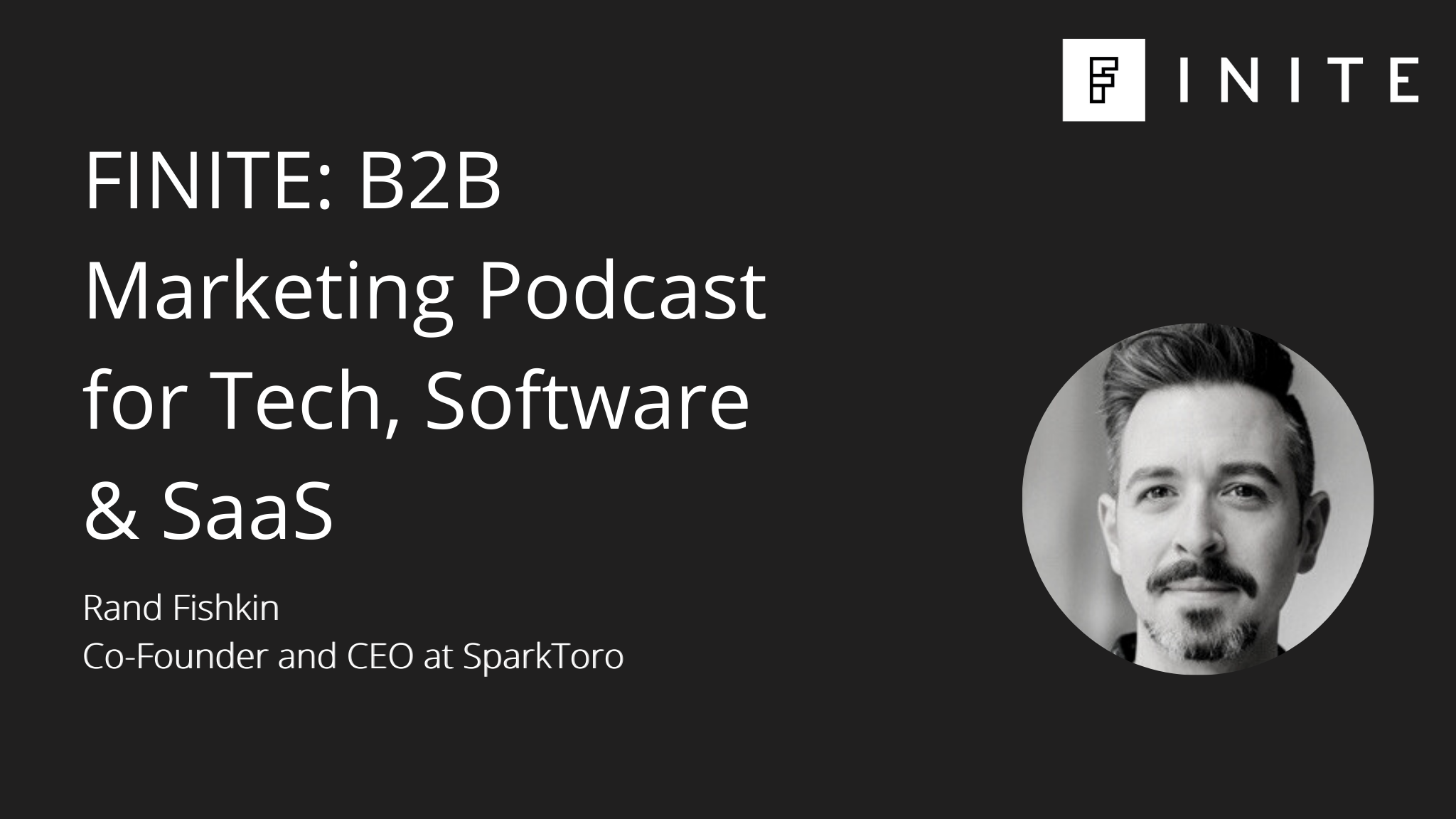
Rand Fishkin is the Founder of SparkToro. Previously Founder and CEO of SEO software platform Moz, Rand is a seasoned entrepreneur and founder, as well as the author of Lost and Founder.
Rand has observed just how much the startup ecosystem loves to hype the concept of product-market fit, but also seen first hand just how broken it is as a concept. Rand recently wrote a blog post by the same title, and so we invited him on to the FINITE podcast to talk through it with FINITE Founder Alex in some more detail.
This episode covers:
- About Rand’s background in B2B tech and his current role
- Using email to create a personal connection
- Why product-market fit calls for criticism
- What is product-market fit and why it doesn’t really exist
- How product and marketing teams are hurt by product-market fit
- Product development as a continuous process
- When should you invest money in marketing as a startup
- How product-market fit started as a tool for investors
- Why a good product does not determine success
- What should we do instead of product-market fit?
- Finding a niche audience vs. appealing to the masses
- Monopolies as a problem in venture capitalism
Listen to the full episode here:
And once you’re done listening, find more of our B2B marketing podcasts here!
Full Transcript
Alex (00:07):
Hello everyone and welcome back to the FINITE Podcast. My episode today, I’m super excited about, because we’ve got Rand Fishkin on the show. Rand, you may know from his days as the SEO expert, the founder and CEO of Moz and the SEO platform, but he’s now founded a new product called SparkToro, a really cool market research and audience intelligence platform, which I definitely recommend you checking out.
But the reason I invited Rand on the show is to talk through a blog post he wrote recently around product market fit. He wrote a post describing why he believes product market fit is a broken concept. That really resonated with me and I’m sure it will do the same for you. So I hope you enjoy this episode.
FINITE (00:45):
The FINITE community and podcast, are kindly supported by 93x, the digital agency working exclusively with ambitious fast growth B2B technology companies visit 93x.agency to find out about how they partner with marketing teams and B2B technology companies to drive digital growth.
Alex (01:06):
Hey Rand, thanks for joining me today.
Rand (01:08):
Yeah, thanks for having me Alex.
Alex (01:09):
I’m looking forward to talking. I think you probably, of all of our guests, one of those people that doesn’t need that much introduction for a lot of our audience. I think many people will know you as the SEO guy in some way or another, but you’re obviously working on some really interesting stuff now.
I will let you, as we always do introduce yourself and tell us a little bit about your background, but also what you’re working on at the moment.
Rand’s background in B2B tech and his current role
Rand (01:30):
Sure, sure yeah. So I’m a few years out from the SEO world now, although I think you’re right, I am mistaken every day on Twitter and in my email for being someone that you should ask SEO questions to. And that is because I started a company called Moz, which was big in the SEO space for a long time.
It’s a very big content site and blog. It started as a consultancy and then became a software company and raised a bunch of rounds of venture, grew to somewhere around $50 million in revenue. It’s done some acquisitions. I was the CEO there for a long time, sort of the first seven years of high growth and then stepped down from the CEO role. I was there a couple more years and then I transitioned out and in 2018 raised this very unique round of funding and started this new company SparkToro, which is also a marketing software company. But in the audience intelligence and market research space as opposed to SEO.
And so that’s been my focus and field of specialisation for the last few years, spent a lot of time doing the classic things, interviewing and talking to customers and getting a product ready for launch. And we launched in April 2020, aka the worst time to launch in a hundred years. But have managed to do okay. September was actually our first break even month. And then October was a little better and we’re hoping that growth continues. So it’s going okay despite the terrible year everyone’s having.
Alex (03:10):
Yeah. It’s a very cool product. I must say I’ve used it and it’s pretty cool what it can do. So, yeah, and I guess although April may not be the best timing, maybe like a really good period for marketers and anyone else using the tool to really think deeply about who their audience is right? At a whole other level or needing to do so given the state of the world.
Rand (03:31):
Potentially, yeah. I think there’s so much upheaval and so many challenges of people switching where they work and how they work and who they work with. And the marketing industry had a massive amount of layoffs in March and April. I think it’s actually somewhat recovering, but we could see with our email list, we had this big invite list of maybe 15, 16,000 people who had basically signed up to get notified when the product launched, which I would strongly encourage every other company to do.
I think those launch lists are really powerful, but we started sending those out in buckets of a few thousand every week, basically starting at the end of February into the beginning of April. And what we discovered, ‘reply to’ address was my personal email. So every morning I would wake up to a hundred out of office messages, but they weren’t out of office. They were so-and-so has been laid off, so-and-so has been let go, so-and-so is no longer with the company. It’s like, oh my God, right? Just brutal to watch real time in your inbox. I think it made me panic even more so than the news did.
Alex (04:45):
I can imagine, yeah. And actually another tip in there, I think I’ve seen you get some good feedback and praise in having your email addresses as the reply to. I think that’s something that a lot of founders or anybody else wouldn’t do.
Using email to create a personal connection
Rand (04:56):
Yeah. I really dislike almost all the mainstream startup launch advice, especially in sort of VC tech world. I think a lot of the indie startup advice is great, but one that I really do like is do things that don’t scale. I think that is excellent advice generally, it’s a competitive advantage.
And for me, email and a personal connection is one of those. And I’ve built tens of thousands of relationships over the years through that. And I really enjoy it. And I think that people I’m interacting and engaging with do too. And I’m pretty fast at email. So I don’t have other communication channels as a result, right? In order to be really good at email, what I have to do Alex, is focus really deeply.
And I think that’s another challenge for many founders is to be able to find that thread and not feel overwhelmed by all the channels that they could pay attention to or do pay attention to. I don’t have a separate task list, I don’t use Slack, I don’t use messenger, I have like two phone calls a week with Casey, my co-founder. Really, everything comes through email and calendar. If my email is empty and my calendar has nothing on it, I can go play video games, like I’m done. I’ve basically finished, granted that rarely happens, but still.
Alex (06:19):
Yeah, yeah, yeah. Good tips on focus. I can definitely relate to that feeling of just endless Slacks and things to monitor, but good advice. So the reason we’re talking today is to dive into this topic of product market fit in a little bit more detail.
I said to you before that you wrote a blog post on the SparkToro site, diving into why you believe product market fit as a broken fit is a broken concept. And how there’s a better way. And I think I saw this traveling across Twitter and getting shared and it looked like you had some pretty good engagement.
And as I mentioned this, I’ve been looking for a chance to get you on the podcast for a while. And so I thought this is the one that pretty much every marketer listening will be able to relate to in some way or another. So I guess let’s set the scene first. What really prompted you to write the blog post to begin with?
Why product-market fit calls for criticism
Rand (07:11):
I think two things, one was obviously we are incrementally growing SparkToro’s customer base and product. And also I had seen, I think it was just a bunch of hacker news threads, right? That were just this obsession with product market fit and VC Twitter, which for some reason, Twitter is convinced that VC Twitter is what I want to pay attention to even though I swear.
Alex (07:37):
I’m the same, just you can’t. Yeah. I know what you mean, it’s overwhelming right?
Rand (07:42):
I think there’s something to do with, if you follow indie startup stuff, they assume you must be chasing VC as well or the algorithm does. So in any case, there’s just a ton of conversation about who has product market fit, whether they have it, when they had it, whether they lost it, how to get to it.
People who are foolishly trying to scale or do marketing before they find product market fit, all this kind of junk, and the realisation as a multi-time founder and a marketer with a reasonable reputation and historically a lot of success, right? I mean, Moz obviously did not get to the exit that our investors would have wanted, but it’s not a horrible company.
And the reality is that the more I thought about it, the more that product market fit struck me the same way that generations in segmenting human beings strikes me, which is it’s a useless concept that persists only because it is popular and well-known. And I think it sort of slides into those mental models of, I believe this because it’s easy to believe and I haven’t critically thought about it.
So just as an example, technically I am gen X, I assume technically you’re gen Y/millennial? I don’t know how old you are, Alex.
Alex (09:15):
I’m 27 so I don’t know where I fall.
Rand (09:17):
I think that’s either millennial or gen Z, something like that, right? But the real question is, is there a, is there a massive cliff of a gap in some sort of statistical data about people who were born after January 1st, 1981 that is massively different from people born before December 31st, 1980. And I can’t see it, right? There’s no stats that suggest this.
It’s an arbitrary cutoff. People from those age cohorts don’t behave in certain ways. Some age cohorts, like the greatest generation and baby boomers are 20 year cohorts. But then gen X is 15 and then millennial is 20. And I think gen Z is going to be 15 again. Why? It’s all completely arbitrary, there’s no rhyme or reason to it, it’s not a useful shorthand. Why do you want to describe people in 15 year age gaps or 20 year?
Anytime you see that in an article, you should say to yourself, aha, here’s a person who does not know what they are talking about, or who chooses not to think about what they’re talking about.
Alex (10:24):
It’s easy. Right? We can just force everything into some kind of two by two framework. I mean, wherever you look across business marketing it’s everywhere, right? Easy concepts that go viral on forbes.com and those kinds of articles that make things too simple. So I guess the ease of understanding may be one side of it.
Rand (10:43):
Yeah, and this is my challenge, right? It is easy to understand, right? You’re born before 1980 you’re this, you’re born after 1981 your that, but what is it good for? What purpose does it serve? Like what intelligent decision did you make about your marketing segmentation or your cohort targeting, or your audience intelligence? I don’t know, persona building or whatever it was, what intelligent decision did you make by using that language and that specific age range? If there wasn’t one, why are you doing it? As a shorthand for something useless? I don’t get it.
So product market fit to me sits in that same bucket of inapplicable relatively useless terminology that is popular mostly because it’s popular, right? And so we can break down all the different things, right? Cause what I’m excited about is I’m sure there are listeners who are listening, who are going “he’s full of crap. Product market fit is hugely important because before product market fit, you do this. And after product market fit, you do that. And if you don’t find it, you can never do the thing that you’re supposed to do after.”
I’m sure there are people who are angrily thinking to themselves, “no, it’s so useful for me.” But I don’t think it actually is. So let’s dive into that.
Alex (12:06):
Yeah, let’s do it. So I guess you’re saying that the key issue with it is more that it’s presented as binary, it’s black away, it’s a one or a zero, it’s done, or it’s not done. Whereas in reality, it’s more nuanced than that. And it’s not as simple, it’s not a cliff.
There’s not a turning point at which it suddenly has happened. You could be at various points on the journey, but actually, maybe there’s a completely different way, we should throw it out completely. And just look at all of this through a completely different lens.
What is product-market fit and why it doesn’t really exist
Rand (12:35):
I’m much more in the latter bucket than the former, right? So my suggestion is not, product market fit is a nuanced concept with a sliding slope and there’s a range of outcomes. That’s not true at all. I don’t think it exists, I don’t think it’s useful. I don’t think almost any startup should use the core concept behind it.
So for those who aren’t familiar, or might not be familiar, right? The idea of product market fit, which was popularised by Eric Ries in The Lean Startup, is that there’s a period during which you are building your product and discovering through R and D, through interviews and surveys, through maybe some amount of market traction, whether you have a product that can scale to whatever, an outcome that your investors will be excited about, or that you’ll be excited about if it’s just your company.
And that before, you know whether you’ve hit this mark, of which the metrics are some combination of unknown, unknowable, arbitrary, or set in stone by some investor but malleable. They can change the goalposts at any time, before you’ve reached that whatever goal post it is, you should not be investing in sales and marketing, in scaling up your team and your customer attraction, because you might not have a product market fit product. What that means is arbitrary and so I won’t try and explain it because I don’t think anybody ever does.
But after you’ve reached this arbitrary metric, right? You’ve crossed some sort of threshold or line, then supposedly your job is to iterate on the product, but not change it massively because you’ve found a product-market fit and your customers are sort of happy and delighted.
And so now your job is to scale, right? Grow marketing, grow sales, grow the capability and capacity of the platform, the product that you’ve built. Grow your infrastructure, raise money, and go to market, all those kinds of things. And don’t do those things before you find this arbitrary thing.
And my contention is that there’s no such thing as product market fit. And if you go into startup building, product, building product, scaling with that mindset, with this idea of a finite line, or even a range of things where you shouldn’t be scaling and marketing and branding, and sort of building excitement around your product. And we’ve reached some arbitrary metric and now we should do those things, you’re going to have a bad time. The core concept is not just useless, it will work against your goal of having a company that can do well.
Alex (15:27):
And your blogpost breaks this down into everything you’re talking about is the impact can be organisation-wide, but you look at this in terms of the objectives of the product and a product team, and then marketing too. How do you think this negatively impacts a product, people, product teams, and then marketing, marketing people?
How product and marketing teams are hurt by product-market fit
Rand (15:45):
So I think product and product teams are really hurt by this because very often when I see this, what I see is a concept of, let’s chase this particular audience, we’re going to get a few people in and we’re going to try and build the product for them. And only after will we realise whether there were indeed as many of them as we thought there were, and whether they all behave like these early customers and whether we could get marketing traction with it.
The ability to sort of, would they spread it would they talk about it? Would we have ways to reach this audience? Would it be profitable in terms of how we scale it? What if the next set of customers need different features or positioning or different things resonate?
Then we’ve passed the point of R and D and it’s not that you can’t go back, but when you set your mental model for this, then you assume two things, two terrible things happen, right? One is you set your product people up for failure, right? For this idea of we’re going to find this, there’ll be a fine line. Once you find it, then golden goose is coming and you also set up your marketing people for failure, right?
Because it’s basically wait, wait, wait, wait, wait, wait, wait, okay, fine line crossed, now go, now go market. And both of those are broken. Both of those will harm your team and your product’s potential. So, as I’ve built products over the years, as I’ve seen many, many successful products, because a lot of people ignore this advice, they never try it, they don’t do it. And that’s a really good thing, right?
And so what happens is instead they try and do marketing around the problem space, around their brand, company, personal brand, areas of interest, talking about the field that they’re in, helping people in that field.
And so they build up this marketing capacity, which is essentially like lots of people who follow and listen to you, who think that Alex’s podcast is amazing and so they listen to the FINITE podcast and then eventually a product comes out, and maybe it’s not the perfect product for them, but that product gets better over time and the marketing keeps growing around it and the community around it keeps growing and the community helps the product and the product helps the community. And it’s a wonderful flywheel that you build.
Or you could separate them entirely and get none of those knock on effects. And the effects of those two working together. I think that’s relatively crazy.
Alex (18:26):
In the blog post you dive into what you carefully described as four dumb things people do, because they believe in product market fit. I think we’ve maybe touched on number one in terms of product builders taking a different approach based on before.
And I guess marketers too, but this first point is around product builders not viewing product development as a consistent process. And yeah, I guess taking one approach before they’ve hit this arbitrary point and then another one. I mean, is there anything else to add to that point?
Product development as a continuous process
Rand (18:58):
Well, if we move further in the process, right? So let’s talk about product people and the product process, product people are often just the founder or founders of the early stages, but then you might hire a team and all that kind of stuff.
All along the way, especially in software, but this is also true in hardware and it’s especially true in anything tech related, it’s barely a belief, my experience, I think what all of us have seen is that there is no, you find fit and then you never lose it. I’m trying to think of one, what’s the example that VCs always use?
It’ll be like, Airbnb is the example of, you find product market fit, and then you scale. And yet, you know, I’ve spent some time with the founders, that never happened! It is all, pardon my language, but frankly, it is bullshit if they’ve described their journey publicly that way, I’ve never heard it. Privately, they certainly don’t. And anyone who puts that on them, I think is cherry picking examples, right?
Because what happened was, the early iterations of the product were nothing like what Airbnb is today. They’ve continued to add features. Everything from here’s how to structure trips to, we’re going to have lux. And we’re going to have a plus, and we’re going to have this separate hosting style. And we’re not going to deal with regulations. Oh, never mind, we are going to deal with regulations. We’re not going to allow any hotels on a platform. No, never mind we are going to allow some hotels on our platform.
Just everything sort of has iteratively changed over time. And that is because they refused to believe this false myth that you find product market fit and then the product changes or iterates very little as you scale, right? It was a constant process of let’s keep learning about markets and changing things and scaling.
Google is another great example. There has never been a year in which Google has made fewer changes to their search engine than the year before. It’s always more right? They are always iterating on the product as though the product were relatively early stage, brand new, and they hadn’t yet found product market fit.
But on the marketing side, it’s the opposite. They pretend that they found product market fit the whole way. And that is exactly what Airbnb did, right? They ignored the idea that there was a R and D phase and then after that, there’s a scale phase. They scaled from day one and they kept iterating on product long after they were past what an investor would call a product market fit moment.
I think you can do this with companies from B2B like HubSpot and Salesforce and ExactTarget and Marketo, and you know, Microsoft, anything you want. I think you can do it on the consumer side with virtually every product out there that’s had success, depending on your definition of success, right? I worry a little bit about the classic let’s talk about WeWork and Uber, and I don’t know if those are the greatest ones, but I think that this is also true.
The only place Alex, where I really found it to be accurate and applicable was with consumable brands that have achieved some level of an association that is almost nostalgic. So a Snickers bar. Like Snickers bar probably right? The Mars company probably should not iterate too much on the product of the Snickers bar because people have a taste association and a texture association and a flavour. You can see what happens when some of those classic products are messed with and it doesn’t go well.
There are counterexamples of a few of them, but I think that’s maybe the only area I can possibly think of, which is so funny cause it’s so far from VC invested tech. And yet that’s the only thing. But it’s very challenging for me to think of anywhere else where it’s truly applicable.
Alex (23:13):
The marketing side’s really interesting. And obviously with our audience mainly being marketers, the way you phrase it in terms of point number two, around marketers taking your hands off, or kind of brand only approach to marketing before so-called product market fit taking place, I guess playing devil’s advocate, the response might be, we don’t want to invest loads of money in marketing until we know that we’ve got something and we know that it’s going to scale. So what would you say the response is to that?
When should you invest money in marketing as a startup
Rand (23:38):
I 100% agree. I am very passionate and I love the idea of, we don’t invest money in marketing, we invest time and energy and effort in marketing, but in primarily organic and free channels, right? So we build up community or content or a social presence or relationships, or we invest in SEO, or we invest in email marketing.
Like all these other organic channels produce 90+ percent of all web traffic anyway. That’s a great place to invest in the early stages. And then as you prove to yourself, with your own metrics, we’re now making money, if we spent $5 per customer conversion or $10 or $50, we would still be quite profitable.
Now it’s time to, let’s mix some paid in there and see where we can get to. And I think maybe you have significant opportunities. That’s great, I’m not telling you to pour money into a product before you’re ROI positive or before your cost of customer acquisition can be relatively high and still affordable and profitable.
I would say that’s divorced from the conversation about the product market fit fine line, or even the range of product market fit things. The only way I could really say like, okay, I see some value in this idea is that, over a very long time span, is it true that as a percent of company effort, like you’re two founders or three founders, are you spending a higher percent of your time on R and D in early stages than you are on marketing and brand building? And depending on the company that you are, that might be true.
For Casey and I it wasn’t, I was spending almost a hundred percent of my time on marketing and community building and like 10%, I dunno 15% on product iteration and Casey was the opposite. And now that we have a product and it’s doing somewhat well, has that changed? It has not changed. I think that’s probably right for us, but there may be companies where the founders should spend all their time on R and D until they reach a certain point and then they should start balancing it out. And then okay, now we’re spending more time on, maybe Airbnb’s marketing division is bigger than their product divisions at this point. Sure, fine. You know, don’t come to me with an arbitrary product market fit, there’s some marker, and then things change on one side or the other of it.
Alex (26:12):
You’ve talked already about investors, but we can’t have this conversation without having to talk a little bit about VC Twitter in some more detail. You mentioned some of these models that they create. I mean, I think you alluded to the fact that in some instances you feel as though these intangible metrics are just quite an easy excuse to turn some companies down and they they pick and choose them as and when it suits them, but they themselves probably don’t even know exactly what they mean or when they should be using them.
How product-market fit started as a tool for investors
Rand (26:41):
And I think worse than that, the entire concept was created as a shorthand excuse. So it’s frustrating to me that it was picked up and then believed by entrepreneurs. So I think generally, if you go back in the history of like, you know Silicon Valley tech world, where did this concept of product market fit come from?
And it was basically, it started as an investor, I’m not going to say excuse because I don’t mean to make it sound like they meant it as a way to get out of investing without giving a real reason. I do think that there’s a real reason behind it, which is that these early investors, they looked at many companies and products and said, you have not yet reached a point where we think our investment will make sense. You haven’t proven, I don’t feel convinced by whatever progress you’ve made that you have the billion dollar company that I want to invest in.
But that’s a very different thing to say than, there is an unassailable, arbitrary mark that is distinct and definable that all people would agree on. And it is not an opinion of mine, it is a fact that you haven’t reached this status and that is almost never true, right?
So they basically took the one concept, the truth, which was it’s my opinion that you’re not enough of the way there to prove to me. And they turned it into a, I don’t have the chutzpah to call you out in that way or to own my own opinion, so I’m going to create some arbitrary metric or guideline. My opinion is that sucks.
They should own the reality of it.
That’s far from my top complaint about venture capitalists or the asset class as a whole. I actually don’t think the people in there are all that bad. I think much like politics, it’s just the incentive structure. And the system is really broken.
Alex (28:44):
It sounds like we’ve got a whole another episode on that at some point.
Rand (28:49):
Incentives govern behaviour, right Alex? So this is fundamentally, I think as marketers, you know this more than anyone, there’s no one in marketing who doesn’t understand that incentives govern behaviour, that branding changes behaviour, that positioning is a huge part of how people think about things.
And so just make sure that you are reflecting that back on yourself, right? Why am I making decisions? Am I making those decisions because they’re the most logical and right ones, or have I been biased and sort of conditioned in my environment from investors, from Silicon Valley tech world, from the press and media, from reading hacker news, from following all these people, that I believe these things, which on reflection may not be true and I should question them.
Alex (29:34):
There was a question that came up for me from the marketing perspective, which was, I don’t know whether this was the case, but it’d be good to hear your view on, was whether there was an implication from this that a lot of businesses should be doing marketing in air quotes, but doing marketing earlier than they might do otherwise.
I mean, you’ve mentioned some of the organic channels and how much opportunity there is around some of them at relatively low costs in the grand scheme of things potentially. But, I come across this a lot where not much marketing is happening until a certain point, and I’m not saying that’s always a product-market fit from a founder’s perspective, but they’re waiting for something before they start doing marketing. Is that kind of what you’re getting at?
Why a good product does not determine success
Rand (30:13):
I almost always agree, not always, but I almost always agree that most startups I’ve talked to start doing marketing too late and that most of them would find massive benefit if they invested earlier, built a flywheel, a marketing flywheel of some kind, whether that’s press and PR or that’s a content flywheel or an SEO flywheel, or a paid media flywheel, social media marketing email, I don’t care.
But at the core of that problem, I think there’s a misunderstanding or misconception that products are judged on their merits alone. Right. That when you pick up that Snickers bar, you are saying, is this good quality chocolate? And do I like the crunchiness of the nut? And do I enjoy how creamy the caramel is and whatever. And is it salty enough? And dah dah dah.
And in fact, my friends, what’s really going on is that you, your taste buds, your mind, your product consumption cannot process that Snickers bar separately from all of the branding and marketing that’s been done to you around it.
And there’s a false belief that is so heavy in Silicon Valley tech world and the ecosystems far beyond that geography that it’s influenced, that people choose the best product, that the best product wins. That if you get a better product, you will have more success, when in fact this is provably false.
I’m just going to say two words. And I think you will agree with me after this. You know, people say the best products tend to win out in the end, Adobe PDF. It’s a totally crap product, it has been for 25 years. It’s awful, it’s clunky and cloogy and ugly to use and problematic in a million ways. I don’t know if you’ve ever tried using the PDF editor. I bought a license to do it. Everything about it is such garbage. It’s so bad, it’s so bad as a product. And yet it has dominated its field such that it’s hard to even name a real competitor.
I think this is true for dozens and dozens and dozens of fields, but a combination of traction and marketing and community, and brand presence and influence that Adobe has over other things, ecosystem involvement, partnerships and connections that they built, right? All these sorts of marketing and marketing related things that were done, and sales things, over the past 20 years have ensured that product remains its market leader. It became and remains its market leader.
And I think that we would do well to learn from Snickers, from Adobe PDF, from a lot of products that it is far less about the product’s features and quality than it is about the complete ecosystem that surrounds a product, which includes its sales and its marketing and its partnerships and its branding and its positioning and everything else around it.
When you take that to heart, I think the only conclusion that a reasonable product builder or founder could make, or CEO could make is I should never be investing only in product, because product is not just product.
Product is marketing. Product is branding. Product is positioning. Product is sales. Product is channel. Product is partnerships. Product is repetition. Product is way more than product. So maybe if you want to have a we should invest in product early, just think about what that really means and all the ways that you should be investing.
Alex (34:04):
I think we’ve reached the point in the conversation where I have to ask the question, if we’re not talking product market fit, where should we be looking? And I know you wrap up your blog post with what you put forward as a new way of thinking and improving on the product market fit mindset with, I think what’s your own kind of what you described as the customer adoption spectrum. But this is something that you’ve put together yourself, right?
What should we do instead of product-market fit?
Rand (34:27):
Look, it’s not a meme. So I don’t think it’s going to have nearly the traction, but that’s okay. I think that smart, critical thinking folks will adopt not necessarily my version of it, but their own version of the idea, which
Alex (34:42):
It’s too complicated for VC Twitter, right? That’s what we’re saying.
Rand (34:46):
Worse than that invented by someone who doesn’t like VCs and is not a VC. And the not created here mentality of VC Twitter is pretty bad. So the concept that I presented around this customer adoption spectrum is that any given customer group for your product has some describable traits that separate them from other groups of customers, and that correlate with how much they like your product and how much traction you’re getting with them.
And they predict how much they need your product, the value they’re getting and their behaviour, not perfectly, but you’re going to make these groups of customers. And then you’re going to say, how are we doing with group a? Are we doing pretty well? Is group a, a big market size? Do they have brand awareness of us already? What’s their conversion rate or success rate? Or how much are they buying the product and sticking with it and are they referring other people to it? All those kinds of things.
No hard metrics here, all of this is a range of outcomes and you split it up by the types of customers you have. When you’re early, you may have only one customer type. That’s great. That’s very, you can focus on that, you can concentrate on that. I like that a lot.
Now you can take, as you get more customers, you can say we have our customer groups over here, group ABC and their market sizes. Well, this one’s big, this one’s pretty small, this one’s medium-sized and here’s how much brand awareness they already have of us. And maybe in the early stages it’s pretty low, very low, this tiny group is reasonably aware of us, right? And then how are they performing in terms of signing up or whatever.
And now you can do things like, what should we prioritise in terms of product investment? New features, improving capacity, improving whatever, whatever group a thinks is wrong. Cause they’re the most high opportunity group for us right now.
And likewise, we can go well group B, we think they’re looking pretty strong, we just don’t have a lot of awareness with them. We need to do a lot more marketing to group B to reach them because look, their conversion rate’s good, we’re just reaching very, very few of them.
That’s where marketing is going to focus their attention and brand awareness and yada yada, yada. That process is super useful, right? Like that is truly applicable as opposed to the product market fit concept, which just isn’t. It doesn’t guide your decision-making as an executive or a founder. It doesn’t tell you where to invest and with whom and how, and when, and it biases you to stop making certain kinds of investments and start making other kinds at an arbitrary point. And none of that’s good.
With any given customer group, you’ve got some level of this thing is going at some certain pace. And that pace could be amazing, like we’re doing so amazing with this customer group. Well should we stop investing for them or should we keep investing? Well, let’s look at how big they are and how many of them we’re reaching and what level of success they’re having. Oh no we should just keep investing in this group.
Like let’s not stop doing that and focus on a new group yet, because look we have nowhere near exhausted our opportunity. Or the opposite, this group is doing well, we’ve kind of exhausted our opportunity with them. Let’s move on to the next one.
Alex (38:09):
I think you’ve touched on something important there which I observe a lot, which is that, and I think it’s a founder trait too, an entrepreneurial kind of mindset where you want to go and take as big a chunk of a market as quickly as you can.
But actually there’s a huge amount of value in doubling down sometimes even more into a niche tha where you already are. And I guess it’s going in a direction that doesn’t feel natural sometimes to an entrepreneurial mind, to say no to so much and to turn down so much and to narrow your market, can feel so counterintuitive, I think for certain founders.
Finding a niche vs. appealing to the masses
Rand (38:40):
That’s a case where the backing of an institutional investor, venture, private equity, or whatever, really changes your behaviour. And it should feel unnatural to go very broad because you have to chase huge markets, and it should feel very natural to focus in and to serve one customer group extraordinarily well and to keep dominating in that one space and become very profitable. And that’s what I think a natural entrepreneur should do.
And then there’s the unnatural behaviour that is biased by the need for massive, we’re either a billion dollar company or we die trying mentality. And frankly, this is what I hate about venture and institutional money as an asset class, is that I think it biases entrepreneurs and even people who just are sort of around that world to be like, this thing, which is totally unnatural and probably will hurt my odds of getting to profitability, staying profitable, being successful long-term, surviving for a long time, having a good survival curve. I need to do those things because that’s what it means to be an entrepreneur.
If I could change that conversation, if we could change that conversation Alex, I would love that. I do not want this world to be the way it is. It is totally backwards and messed up. Look at it from a macroeconomic perspective, right? Basically what venture capital as an asset class has done over the last 40/50 years is build a few huge winners that have gone on to become dominant monopolies in their space that have then created all sorts of other problems in terms of a lack of opportunity for other entrepreneurs and other businesses, and contributed massively to income inequality, and done a ton of political lobbying that none of us like, and misinformation and disinformation and you name it. All of those things you can connect up to that.
As opposed to when capitalism and democracy work really well, right? Assuming you want to keep those two systems. Or you don’t think that they can be changed. When capitalism and democracy work really well, you have tons of small and medium businesses and very few or no big monopolies, and they’re all competing, and they can all survive for a long time.
And because you have lots of market competition, you have lots of innovation and you have lots of strength to survive recessions and depressions. And you have tons of people who are making good money, but very few billionaires and whatever Jeff Bezos is now. And that is the market that you want.
If you’re designing a system, that’s the market you want that creates the most opportunity and happiness and productivity and innovation for a society. We can do that. We can do that by saying no to this idea of billion dollars or bust, and saying yes to how do we get to five-year company survival rates that look more like restaurants or better, right? The restaurant business, I think in the US has a five-year survival rate of just about 50% and tech startups, once you raise or attempt to raise venture, it’s like 20% or 18%.
So what the hell are we doing? We are much less successful than restaurants, but we have a few billion dollar companies and so we think we’re hot shit. That’s pretty dumb.
Alex (42:10):
Yeah. That is pretty off balance. Well, I think for everybody listening we’re on the, I was going to say, it’s election day. It’s not election day, we’re two days after election day and we still don’t know exactly what’s happening. So there’s never a better time than now for a lot of what you’ve just been describing. I think there are admirable objectives and goals and how easy they’ll be to change, is another discussion.
Monopolies as a problem in venture capitalism
Rand (42:31):
Well, this is the beautiful thing. You don’t have to concentrate on changing everything as a society and worrying about the venture asset class. If you focus, if we focus on building businesses that can survive for a long time and get to profitability and then keep iterating and iteratively improving, you can build massive businesses this way or tiny ones that make you a ton of money or anything in between.
But if you focus instead on how do we become a billion dollar company or die trying, because the only thing that’s interesting to venture investors is, you know unicorns, you are going to have an awful time. Statistically speaking, I think it’s a 94%, 95% of venture invested businesses fail to return the minimum required rate of return. So that’s nine out of 10 at least, maybe eight out of 10 entrepreneurs who start a company who get venture, never mind all the ones who failed to raise, who get venture and have a terrible time.
Alex (43:34):
And I am one of them, right? Like I built a company that when I stepped down as CEO, was doing $40 million a year in revenue. And Alex, I made very little money, relatively speaking, very little money from that. I made my salary, I sold a little bit of stock in one of our transactions and used it to pay off my grandparents’ house. When I started SparkToro, I did not even have the capital to do it myself.
Like I’m comfortable, I’ve got an okay deal. But if I had been a junior software engineer at Microsoft for all of my career, I would be so much richer, I would be so much richer. It’s pretty weird that we’re biased into believing if you do all these things that you’re gonna get there. So anyway, I just want to tell you, you don’t have to change the system. You only have to change your own behaviour, which is kind of beautiful.
Alex (44:32):
It is. And on that note, we should wrap up. I will say a huge thank you for your time, because I think you’re obviously very generous in sharing your time and your thoughts and I’m really excited to tap you on the podcast and sharing this episode. So thank you. I hope it’s been a welcome break from just refreshing Twitter and looking at updating election statistics, but I’ll let you get back to that.
Rand (44:50):
Yeah. I need to go back to Politico and just keep hitting F5. Alex, thank you so much for having me really appreciate it.
Alex (44:59):
Awesome. Thanks Rand.
FINITE (45:01):
Thanks for listening. We’re super busy at FINITE building the best community possible for marketers working in the B2B technology sector to connect, share, and learn. Along with our podcast. We host a series of online events, so make sure you head to finite.community to subscribe and keep up to date with upcoming events.