- Some additional information in one line
- Jan 11 2021
Podcast: No Forms. No Spam. No Cold Calls. with Latané Conant, Chief Market Officer at 6sense
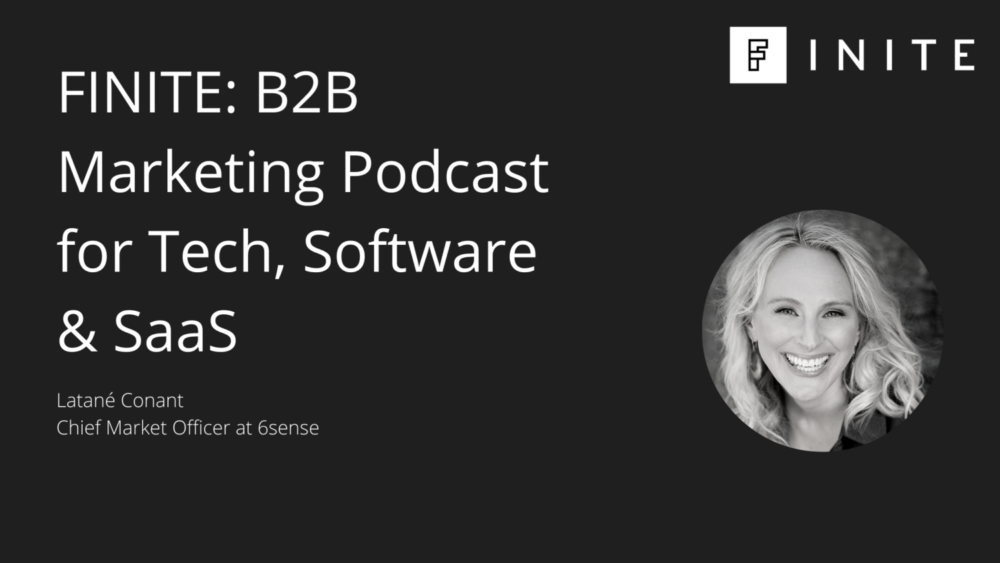
On today’s episode Alex is talking with Latané Conant. Latané is currently Chief Market Officer at 6sense, an account engagement platform for marketing and sales teams.
Latané has quite literally written the book on modern day B2B sales and marketing, and so we sat down to talk through her book which is called No Forms. No Spam. No Cold Calls.. It offers some really refreshing perspectives on how we can all rethink our approach to enterprise marketing, and the next generation of account-based sales and marketing.
You can find Latané’s book on Amazon by clicking here.
This episode covers:
- About Latané’s background in marketing
- About Latané’s current position as Chief Market Officer at 6sense
- What inspired Latané to reject traditional marketing and write a book
- How the book reflects Latané’s own approach to consulting
- Why we should reject the notion of MQLs
- The difference between a chief market officer and a chief marketing officer
- What is a customer-first tech stack?
- Best MarTech for different channels
- Latané’s story with ABM- challenges and solutions
- The importance of rev ops for marketing
Listen to the full episode here:
And once you’re done listening, find more of our B2B marketing podcasts here!
Full Transcript
Alex (00:07):
Hello everyone, and welcome back to the FINITE Podcast. On today’s episode, I am talking with Latané Conant. Latané is currently Chief Market Officer at 6sense, an account engagement platform for marketing and sales teams.
Latané has quite literally written the book on modern day sales and marketing, so we sat down to talk through her book, which is called No Forms. No Spam. No Cold Calls.. As you can probably tell from the title, it offers some really refreshing perspectives on how we can rethink our approach to enterprise marketing and sales. So I hope you enjoy.
FINITE (00:39):
The FINITE community and podcast are kindly supported by 93x, the digital agency working exclusively with ambitious fast growth B2B technology companies. Visit 93x.agency to find out about how they partner with marketing teams and B2B technology companies to drive digital growth.
Alex (01:01):
Thank you for joining me today.
Latané (01:03):
What’s up Alex, I’m happy to be here.
Alex (01:07):
Welcome to the podcast, I’m looking forward to talking. We have a really interesting one today. I think you’re, maybe we’ve had another author on the podcast before, but you might be my second author.
But I’m always fascinated by people that have put the, I can only imagine, countless hours of time and energy into writing a book, like the one that you have. So I’m looking forward to diving into the details of it.
Latané (01:31):
Well, it nearly killed me, but I’m here, I’m here on the other side. In college or as I think you call it university, I purposely would not take a class that I had to write a paper for. So here I was writing a book but you figure it out.
Alex (01:53):
Cool. You’re better for it now. But before we dive into the details of the book, tell us a little bit about your background and your experience to date and a little bit about the current role that you’re in, and team and that sort of thing. I’ll let you introduce yourself and set the scene.
About Latané’s background in marketing
Latané (02:06):
Sure. So I would say a non-traditional background, but I don’t know if there’s such a thing as a traditional background anymore. You know, it’s not a ladder, it’s a jungle gym, careers are. So I was in accounting again because I didn’t want to have to write a paper. And then I ended up in consulting and I’m a recovering software salesperson.
And then lo and behold, I found myself in marketing and the rest is history. At Appirio our CEO gave me a shot and asked me to help with marketing and I fell in love and here I am.
Alex (02:47):
Very cool. I think everyone I’ve spoken to probably out of all the episodes we’ve done, maybe one, maybe two actually studied marketing formally at college or university. I’ve had a nuclear physicist by training on the show, I’ve had people from all kinds of backgrounds. Which I think is one of the great things about marketing as a role.
Latané (03:06):
Well the thing is, once it’s printed in some sort of textbook and taught, it probably doesn’t work anymore. That’s the reality. And that’s why things like the community that you have, Revenue Collective‘s a great one, I’ve got a CMO coffee talk that we host every Friday. You really have to stay on the pulse and constantly be learning. So if you’re a curious person and you love learning, it’s a great role.
Alex (03:30):
Definitely. So, tell us a little bit about the current role that you’re in and the business you’re in at the moment and your marketing function, your team, those kinds of things.
About Latané’s current position as Chief Market Officer at 6sense
Latané (03:40):
So I am the chief marketing officer at 6sense. We’re an account engagement platform, we are all B2B SaaS. So similar to the listeners out there, every quarter for us is a beaten race. So we’ve consistently doubled the last two and a half years, quarter over quarter. And we’ve been able to do that with an industry leading CAC and we sell them to marketers and sellers.
So there’s really three people that use 6sense: digital marketers, revenue, operations, BDRs and sales teams and as well as demand generation. So we are really a platform for that revenue team.
And the big claim to fame with 6sense is if you believe a lot of the research out there, and most of the buying journey is anonymous, so 92% of the people that come to your website are not going to fill out a form. And that’s if you’re lucky and they’re on your website, they’re probably doing a lot of their research on the broader web and review sites and things like that.
And as sellers and marketers, there’s so much rich data out there, but we call that at 6 cents your dark funnel. So once it hits CRM, that’s a very small percentage of your real funnel, which is this dark funnel. And so what we want to be able to do is help sellers and marketers really understand the dynamics of buying teams within that dark funnel.
So they can do a much better job targeting and leveraging their scarce marketing and selling resources to make sure they’re talking to buying teams at the right time with the right message. And they’re talking to buying teams that are a good fit for them. So that’s the tip of the iceberg of what we do here at 6sense, but kind of the crux of it. And it’s pretty game changing for folks once they are able to tap into that.
So it’s not uncommon for our customers to see double pipeline numbers, but more importantly, the things that they see are larger deal sizes and faster cycle times and better win rates, because when you’re targeting the right customers for you at the right time, obviously you’re going to be much more efficient.
Alex (06:05):
Cool, let’s talk about this book. You said it nearly killed you. Tell us a little bit about it, give us the title, set the scene, and then a little bit about why you decided to write it to begin with.
What inspired Latané to reject traditional marketing and write a book
Latané (06:17):
So the title is No Forms. No Spam. No Cold Calls.: the next generation of account-based sales and marketing. And I’m actually a very positive person for those who know me. So having a title that’s all ‘no’s is kind of interesting, but I also think you gotta be bold and sometimes shock the system. And so for people that have worked with me, they know I like to make bold claims and I know people tend to rise to the occasion.
The biggest gift I think you can give someone is high expectations. So, the crux of the book was, I came from a company called Appirio and Appirio’s entire business was based on experiences and helping people optimise their customer and their employee experiences with cloud technology. So, I was there almost a decade, so I believe that it’s in my blood.
And then I came to 6sense and I was thrown into the world of MarTech and Scott Brinker’s 8,000/10,000, who knows how many thousand tools to market and sell. And I felt completely inadequate. And just, what am I doing? Honestly, if you asked me to name five things on one of those sheets, I probably couldn’t if my life depended on it.
So I’m crying and feeling sorry for myself and my husband was like, you gotta play to your strengths, you know? And I’m like, I have no strengths! But seriously, you’ve got to put your big girl pants on, or in the age of Corona, our big girl yoga pants on and get on with it. And I realised I do have strengths. I really understand customer experience and understand employee experience. And I’m just going to apply what I know to this new job.
And that’s when I had this light bulb and I’m like, oh my gosh, we deliver such a… and when I say we, it’s kind of the proverbial we, if you take a step back and you look at how our technology and processes are set up, they are not set up to deliver a great experience. Alex, do you like filling out forms? Do you enjoy getting a bombardment of emails that have nothing to do with nothing. And how about a cold call?
Alex (08:45):
The worst, that’s the worst of all three.
Latané (08:46):
So we don’t like any of these things yet this is what we’ve set up to apply to the people that we want to treat the best. So if you take a step back it makes no sense. So I just walked into a team meeting and fortunately we’d had a birthday party the night before. So I think everyone was really, really hungover.
And I said, “guys, I’ve had this epiphany. We are going to change the game. We’re going to develop a process with no forms, no spam and no cold calls. And we’re going to put prospects at the centre of the experience, and we’re going to see what happens. And maybe it’s a colossal failure, and if that’s the case, experiment done. But maybe we can prove that there’s a much better way to generate results. And if we do, gosh, I bet a lot of people would want to know about that.”
Alex (09:43):
So it didn’t start out like, “Hey, I want to write a book.” It started out as, “Hey, I feel we have to do something significant. I feel we have to do something different.” And I’m the CMO of 6sense and I’m sitting on this amazing technology. Like if I can’t figure it out, no one can, yoga pants on, let’s go.
So that was kind of the genesis of it. And it was hard, it was hard. And I didn’t run around saying, no spams, no phone at first. We just sort of quietly went, and we knew what we were doing, but we just sort of quietly went about getting after it. But there’s still a lot of doubters and that’s okay, maybe it’s not for everybody. But for the folks that have adopted it and have bought into this movement, there’s been a significant change in their results.
Alex (10:37):
It sounds like you didn’t start with the book as being, you didn’t wake up and say, I want to write a book. You came across this opportunity and I guess the book was a way of consolidating it and getting it in a form.
Does this book almost serve as your internal marketing plan almost within 6sense? As much as it is a kind of outward looking to some extent, a marketing resource for you as a business too. But I guess it kind of spans both how you operate internally but also your views to your customers.
How the book stemmed from Latané’s own consulting
Latané (11:09):
So that’s a great question, Alex. So, what ended up happening was we ended up really doing some great work and seeing some great results. And so we started talking about it. I announced it and some of our preliminary results a year ago at our customer conference. And so they all wanted to know what we were doing. And then I started advising companies.
And through that advisory work, I was telling them the things that we were doing, and I found myself writing the same emails and putting together the same templates over and over and over again. And I’m like, we just got to get this all in one place. We gotta make this easier just for our own selves. Because I’m tired of walking through the same matrix.
And so the idea of the book is to be a very practical guide. And I hope whenever someone gives me the feedback, “gosh, that was so practical. And I love the template that you put on page 120” or whatever, that is music to my ears. There’s a lot of books out there that are heavy research and stats, which is great, that’s one angle. I just wanted something to help people do their jobs better. That’s the kind of stuff I read and so that’s what we tried to put together.
Alex (12:35):
Cool. And so you start, I believe in the book by effectively confronting the reality that typical B2B sales and marketing tactics generate marketing qualified leads, but not necessarily great experiences. I mean, you’ve touched on this a bit already, but maybe in a bit more detail, explain what you mean by that.
Why we should reject the notion of MQLs
Latané (12:54):
So the villain of my story is actually not forms, spam and cold calls, it’s the MQL. You’re absolutely right. That is Gargamel, if you ever watched Smurfs. Like that’s the problem, in my opinion. And because the desire to hoard and amass MQLs creates the need for forms, spam and cold calls, right?
We put the form up so we can get a form fill so we can send them lots of emails. And if they happen to open an email, we deem some points that they’re engaged and none of that stuff works very well. So then sales is left holding the bag, making a bunch of cold calls, and I’m exaggerating a little bit. But I think it helps to exaggerate to start to really put a mirror up against what we’re doing.
And so one of the things I want to be careful of Alex is, because I don’t like people that hate on something, but don’t give you a better alternative, right? That’s not fair, that’s just complaining, that’s not helping. And so I believe there is a much better alternative to an MQL and there’s a better dashboard and there’s a better way to articulate what marketing is doing and also articulate the health of the business than an MQL.
And so what I talk a lot about is a qualified account. And so the challenge with a lead or an MQL is a couple of things. One, a lead is one contact, one person. Depending on who you ask there’s anywhere from 3 to 15 people involved in a buying decision.
So obviously when we’re just focusing on one lead or contact, that’s setting us up for failure. We need to be focused on multiple leads, multiple contexts that make up a buying center, right? If you have two or three people engaged from an account, it is statistically way less random that there’s something going on there, than someone who just thinks that ebook could be interesting. So that’s the first challenge with it.
The second challenge with an MQL is the scoring is usually pretty arbitrary. You know, we’ve all sat in the sessions where we’re like “pricing page, give pricing page 10 points.” You know what I mean? We’re just arbitrarily scoring and it’s all known activity for the most part. And I just said is it 50% anonymous? 90% anonymous? No, but there’s a lot of anonymous activity that needs to be factored into the score.
And then you want to look at fit. So is this an intern or is this a CFO? If you sell finance software, right? Who is buying? Does this fit a typical buying team that buys from us? And then there’s also account fit, right?
Like, can we make money off this account? Can we do a good job? Can we service this account? And so when those things come together all of a sudden, and that’s what you’re kind of qualifying and working collectively as a sales and marketing team, that’s when the magic happens: 50% better ASP’s, 40% faster cycle times, 75% better win rates.
Like this is the stuff that drives revenue, and because it’s all back tested and using AI, it’s very scientific. I can, as a marketer, have a lot more confidence in the way that I’m sort of future-proofing our bookings because it’s just math. So that’s what I talk a lot about. I talk about in-market being the new inbound and that in-market is really that qualified account that’s in market because Alex, if you go and you fill out a form, you might be just really wanting the ebook. And in that case, it’s too early, you’re probably not ready.
Or if you request a demo from me, I bet you’re requesting a demo from me and other competitors, that’s too late. So your MQLs are either having you too early or too late. I want you in this sweet spot when the buying team is doing enough research to show there’s interest there, but you can be the first vendor in the door that they talk to because they’re not going to talk to every vendor at that time. They only really engage with a few.
And so that’s what we’re teaching and helping people understand and helping them know how to get accounts in market, once they’re in market triggering the right activity to get that first meeting and then continuing to keep engagement high throughout the life cycle.
Alex (18:09):
You mentioned a few ‘aha’ moments in the book that really made you realise things could happen differently. I mean, you just referenced the meeting where everyone agrees which pages get certain scores, and that sounds like one of them, but I mean, did you arrive at 6sense and everyone was really focused on MQLs at the time? Was this something that you’ve seen in all your other roles, what really drove you to think, okay this MQL really is, as you put it, the bad guy in your book?
Latané (18:39):
So I come from sales and when I moved from sales to marketing and running the marketing team at Appirio, I never understood why MQLs mattered so I just ignored them. I’ve had the same dashboard for 10 years and I just thought that I didn’t get it well enough, but I’m kind of a simplifier. And if I don’t understand it, then I’m like not gonna… I only embrace what I really understand.
And I kept asking and never getting a good answer. So I just said, well we’re just going to track pipeline. If you guys want to keep tracking that on your own, fine, but my dashboard, this is my dashboard. So I’ve always kind of had that mindset and that was all well and good. And then fast forward to 6sense, I implemented the same thing.
But again, when you start selling to your own persona and you start being out there talking, it was evident that people really feel they need to report on MQLs and even boards ask for MQLs, right? So there is a systemic change that has to happen in our industry to help people a) unpack that that’s not a great measure, but again you can’t throw something out without giving something better.
And so that’s a big part of what I hope the book does, and I know what we do every day with our clients. Because it’s about predictability and MQLs do not deliver great predictability.
Alex (20:26):
One of the things you talk about in the book is the difference between a chief marketing officer and a chief market officer. I noticed you introduce yourself as chief market officer, and that’s what you refer to yourself as. What’s the difference from your perspective and why is it important to make the distinction between the two?
The difference between a chief market officer and a chief marketing officer
Latané (20:42):
I think it’s a subtle, but very important difference. So do you call the CFO, the chief financing officer?
Alex (20:51):
No.
Latané (20:52):
Do you call it the chief sales officer, the chief selling officer?
Alex (20:57):
No.
Latané (20:57):
So the ‘ing’ connotates activities, not a functional understanding. And I think that when we define ourselves as leaders of the marketing function by activities like MQLs, we honestly start out at not a very respected and authoritative place. And so that’s short tenure.
There’s a lot of reasons why that’s bad for us, but there’s also a lot of reasons why that’s bad for a company. So Alex, if you create a product and it’s an amazing product, but there’s no market for that product, how successful is your company going to be? Not very.
I can write blogs about it and I can get it out on Facebook Ads. And I mean, everyone can know about the product, but if there’s no problem market fit and we haven’t created a market for the product, it doesn’t matter. And so that’s the most important thing. And that seat at the table sometimes I think gets missed and it has to do with everything.
And you really have to be the seat at the proverbial table that represents the market if you want to be a chief market officer. I’m not saying that everyone should go and change your title, if you’re not doing that kind of work. If you’re not changing markets, thinking about markets, understanding segmentation, driving strategy within your company, then you don’t need to be a chief market officer. But if that’s the type of work you want to do, I think that your title should represent that.
Alex (22:44):
I like that. That resonates with me. The technology side of all of this is really interesting. You refer to a customer-first tech stack in the book. I think every marketer listening will be able to resonate with the fact that choosing the right technology is a big, big challenge. And you refer to Scott Brinker’s map, it becomes more of a challenge every single year I think. What does a customer first tech stack mean to you and how do you approach the technology side of things?
What is a customer-first tech stack?
Latané (23:13):
So it’s funny one of my many COVID projects. So not only did I write the book, but I redid my kitchen and I just wrote an article on how redoing your kitchen is a lot like your marketing tech stack. And so a couple of concepts, like first of all, you can pick out the fanciest most amazing hardware and granite on the planet. If you don’t have good lighting or plumbing or something like a disposal, disposal is a game changer, right? Who cares? It’s not practical.
And so to me, the marketing tech stack, and again, back to my desire in being a chief market officer, I need data. I need really, really good data. I need customer insights. I need future customer insights. I need a unified view of accounts. I need to be able to segment based on accounts that are a good fit for me in Canada or whatever, right?
I need to really understand what keywords my ideal customer profile cares about. And so the foundation of a customer-first technology stack is great data and the ability to segment, and that’s where being a chief market officer, a lot of it starts, and that earns you the right to bring decisions to the table.
When you can say, “Hey, I’ve been looking at this segment and I am noticing that we don’t make money on this segment.” There’s not enough accounts like this left in this segment. We need to think about a new segment. And here’s the three places for the next horizon of growth. And here’s what those accounts look like. So it starts with data.
And then, the other thing that from my kitchen project I found over time, we had developed all these like Tupperware things and some had a lid that matched and some didn’t and mugs that didn’t look the same. And that drives me crazy. So you gotta think about interoperability, right? Like how are all these pieces going to work together? And the easier they work together and the easier you can mix and match, the less random crap you’re going to amass.
And then the last thing to think about is, just like you can end up with a collection in your junk drawer, you can end up with you know, I had a cherry pitter, okay? That someone had given me, I am not making cherry pies. I don’t need that. You know?
So I think you have to do an audit and really look at, okay maybe I went through a pie making phase, but we’re not doing that anymore. We don’t need this. So, being able to rationalise and really distill down into the applications that you need that work together with that data layer at the foundation. That’s how I think about a tech stack.
Alex (26:33):
And which was more difficult? The kitchen project or writing the book?
Latané (26:37):
Oh, definitely writing the book. The kitchen project was a gas, are you kidding me? And that sparked a bunch of other house projects. My husband wants to kill me. He’s like, “so when are you going to write your next book?” He’s like, “all this energy needs to go somewhere.”
Alex (27:00):
Can you give us a sense of what you use, I assume you’re using 6sense yourselves as a platform, but are there other MarTech products and things that fit into the ecosystem for you as a marketer and as a business?
Best MarTech for different channels
Latané (27:11):
Yeah. So 6sense is the foundation of our tech stack. And again, it provides that data, but it also provides orchestration. So if you think about going back to the points and the MQL, the other thing that we used to do in those types of sessions with the post-it notes is we would build these journey maps.
And the only people that won with the journey map sessions were 3M we used a lot of post-it notes, but the reality is it’s impossible to anticipate, call it nine people on a buying team, 22 touches, anonymous, known, it’s impossible for us to really flow that out. And so when you have the data and then you layer on orchestration capabilities, which is what we have, so we can put in a goal and then the AI derives the right tactics and experience.
All of a sudden things get really interesting and you can start to connect things up. So for example, you’re in a segment Alex that knows your account, knows your persona and knows your top keywords, knows a bunch of things about you. You come to my website because 6sense is hooked up to my website and my chat bot, we’re going to greet you. We’re going to know the account you’re in. We’re going to know your keyword.
We’re going to say, “Hey, we see you’re researching predictive analytics. We have a ton of content on predictive analytics. We created this content hub for you.” You click that, that content hub is dynamically adjusting to your behavior. So I have one hub, but depending on who the hub gets served to, it’s dynamically adjusting.
And so a lot of digital channels we’ve connected up and actually have partnerships that make them easy to snap in to 6sense. Same with email, same with cadences, from a sales engagement perspective, like being able to easily trigger a cadence at the right time based on a keyword. So those are some of the things that connect up well and that we use to deliver an awesome experience.
Direct mail, I love direct mail, but we have a 70% better response rate on our direct mail than the industry average because we send it only at a specific time. We send it when we know someone is in market and hasn’t responded to other things. That’s when we trigger a personalised store via our partner Alice. So it’s being able to attach these execution channels to 6sense.
Alex (30:08):
You’re quite open in the book about how you’ve had some ups and downs and a difficult journey within account based marketing. I guess ABM is just becoming ever-increasingly popular. I think more and more marketers within the community are looking at how to approach ABM, even if they haven’t done it before, or run ABM campaigns previously, can you tell us about some of the ups and downs and the lessons learned and how you approach scaling ABM now? Because I think that’s a big challenge for a lot of marketers.
Latané’s story with ABM- challenges and solutions
Latané (30:38):
Yes. So, the term ABM is misunderstood. And so I don’t know if what I’m doing is ABM or not, but I’ll tell you how I think about account-based, everything that we do as account based, because everything we do starts with a segment of accounts and we portion out how we treat accounts based on their financial impact to us.
So to me, ABM is as much about who you proactively go after and send bottles of champagne, as the accounts that you don’t go after. And you have a very low touch model and everything in between. And I think when people came out of the gates with ABM, it was oh it’s only enterprise, it’s only for our top accounts, it’s 10 accounts.
To me, ABM is not a campaign, it’s a overarching strategy. So that’s the first thing. And what happened with the original, if ABM has 10 accounts in a campaign and this is what happened to me, is it’s like, “Oh guys, this is going to be so cool. We’re going to do this thing called ABM. And we’re going to take these top accounts and we’re going to like, show him so much love. We’re going to go, Oh, it’s hot for these accounts.” And so every RVP, every sales leader says, well I need my account in that mix.
So you end up, Takashi in Japan tells you you gotta have Fujitsu in the mix, okay? Cause that’s his top account. EMEA says that you got to have HSBC, they gotta be in there and AstraZeneca, top accounts, they gotta be in there. And then the top rep just did a deal with Target so he thinks you should vote Walmart in there too. And on and, and on. And we’re seeing a lot of traction in higher ed. Let’s put a bunch of universities in that mix too.
So you literally end up with this hodgepodge, I call it the potluck dinner. Cheeseballs and 10 veggie plates, and nothing goes together, and you’re supposed to create a campaign from this. And there’s the notion of is that account in market? There’s no, are they even showing the right behaviour? And I think that puts us in a challenging spot and we end up over investing and being very quote-unquote personalised because it’s literally, it’s not one ABM campaign of 50 accounts, it’s 50 campaigns that may or may not pay off. And I just don’t like those odds, honestly.
And, we ended up spending a lot of resources and time and energy just to shut it down. And that was on me because my team said, “Hey, we need to get data. We need a platform.” And I said, “no, you can do it. We don’t need that. We don’t need another tool.” And lo and behold it didn’t work, so they were right. And you learn from your mistakes.
Alex (33:59):
I want to wrap up by talking about, I guess the whole rev ops outlook on the world of sales and marketing, and I guess sales and marketing alignment. Is it a subject that comes up all the time and that we talk about regularly on the podcast and at our events and everything else.
And I think the revenue operations outlook seems to be growing in popularity, the chief revenue officer, as a title seems to be increasing in popularity. I have mixed opinions on whether that’s the title that should be sat above all of sales and marketing, but what’s your perspective on rev ops and what are the downsides and is rev ops the future?
The importance of rev ops for marketing
Latané (34:39):
So let’s be clear. I think rev ops is a really important function. We have rev ops here, but I think if your company is of any size and scale, then marketing should never report to sales. There’s always situations, but if you’re trying to, you want to understand your market, you want to shape your market, you want to build a category, you want to align product strategy and go to market, you need a strong CMO.
Alex (35:13):
I guess the challenge is we so often hear, and then rightly so how marketing should be focused on pipeline and revenue and as close to the numbers in dollars or pounds or whatever else is possible. And so that naturally feeds the chief revenue officer type role. But then at the same time, and I agree with you, there should be a chief market officer and marketing shouldn’t be reporting to sales, but I guess that’s the tricky balance, right?
Is that we keep talking about marketing being revenue focused. And then at the same time, we don’t think marketing should report into a revenue title. So we’re effectively saying we need a chief market officer still, but one that’s really in touch with the revenue.
Latané (35:55):
I mean, sales is just a channel. There’s lots of channels that drive revenue, and depending on your emotion, sales might be a big one or not, right. But I think as a chief market officer, you need to be thinking about all of the channels and how you optimise the revenue operating model, which is why I do love revenue ops because revenue ops works with me and with sales and with customer success and with our channel program to create the revenue operating model.
All of the assumptions for how 6sense is going to make money and make our number. And then I watch that thing like a freaking hawk. And if we thought 20% of our pipeline was coming from a channel and it’s not, okay, what do we need to do? Either we need to dial up, maybe there’s I understand why, and we are where we are so we’re going to dial up this other channel to make up for that. But like, it’s the freakin matrix of understanding.
I talk about finding the red. You need to understand that operating model, know your trends, know your assumptions, know where you’re red, yellow, and green, and be able to adjust to keep the company whole. And that’s what’s critical. So I think that sales and marketing alignment, everyone likes one another, everyone gets along, everyone wants the same thing.
Where misalignment happens is when there’s not great data, because we’re arguing over opinions, right? If you show someone the data, “hey, 90% of our bookings come from this type of account. Hell yeah. Let’s focus on that.” Then all of a sudden I call it data alleviates debate and delay, and then we’re all on the same team trying to get after the commercial opportunity in front of us. And I think that’s just a great way to work.
So I love revenue operations. I think it’s an important glue. I wouldn’t make the leap that revenue operations means that there’s a CRO though. And I think a lot of times CROs don’t have, I mean, I see a lot of CROs that are just the head of sales. They don’t have marketing, but they’re the head of sales. So I think if you want to call yourself CRO fine. I just, I think marketing should report to the CRO.
Alex (38:29):
I think we’re going to wrap up there, it’s been great. I mean, I feel like we could keep talking and we’re just scratching the surface of the book that you’ve produced. But I guess that’s another reason for people to actually go and get the book. So tell our listeners where they can actually get a copy of the book.
Latané (38:42):
So it’s on Amazon, so you can definitely get it there. It’s also just now on Audible. So you get to hear my voice for like four hours or whatever it is, if you do the Audible that’s now released, which is kind of fun. That was just last week. And you can also go to 6sense.com/the book backslash or forward slash one of those ‘the book’ and get it there as well.
Alex (39:11):
Cool. Well, we’ll make sure we include a link to it when we share this episode, but yeah, it’s been awesome talking to you. I appreciate you sharing all of your thoughts and insights. There’s definitely some stuff there that I’m going to reflect on and you’ve challenged some of my thinking, which is what we like. So a huge thank you for giving up your time.
FINITE (39:29):
Thanks for listening. We’re super busy at FINITE building the best community possible for marketers working in the B2B technology sector to connect, share, and learn. Along with our podcast we host a series of events. So make sure you head to finite.community to subscribe and keep up to date with upcoming events.