- Some additional information in one line
- Apr 5 2019
Podcast: Exploring culture as a part of marketing with Hannah Voss, Fluidly
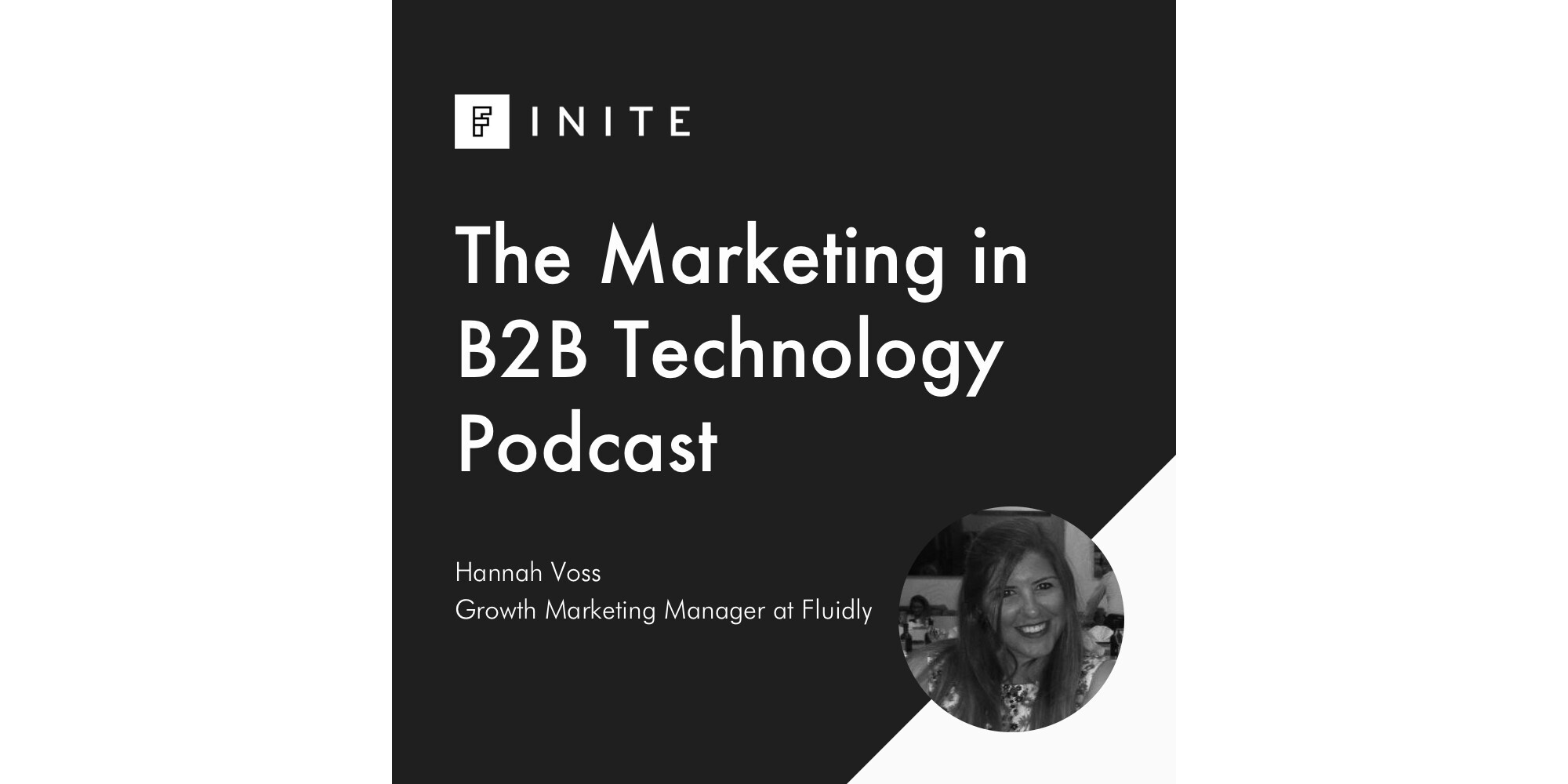
In this episode of the FINITE B2B marketing in technology podcast, we sit down with Hannah Voss.
Hannah transitioned from B2C marketing at Post Office before joining Fluidly as Growth Marketing Manager, an intelligent AI cashflow forecasting software helping small businesses to better manage their finances.
Our host Alex Price sits down with Hannah to hear about how Fluidly have worked on their company culture as a team, how this forms a part of marketing and potentially even becomes a strategic competitive advantage within Fluidly’s marketing strategy.
This episode covers:
- About Fluidly and its marketing function
- Hannah’s transition from B2C to B2B
- What is company culture and is it owned by the marketing team?
- The importance of culture as a start up
- How to actively create culture through group exercises
- How culture is maintained as a company grows
- How culture affects a marketing strategy through content and proving authenticity
- The importance of authenticity in marketing
- Telling a growth story as a way to be authentic
Listen to the full episode here:
And once you’re done listening, find more of our B2B marketing podcasts here!
Full Transcript
Alex (00:07):
Hello everybody and welcome back to the FINITE podcast. Today I’m going to be sitting down with Hannah Voss. Hannah leads growth marketing at Fluidly.
Fluidly is a super cool fast growing FinTech business that’s really transforming the way that small businesses manage their cash flow forecasting and finances more widely with a really cool product that integrates with your accounting package and just gives you a lot of insights and automation that helps manage lots of different elements of finances.
We’re actually a Fluidly customer ourselves, I think we’re one of the first actual Fluidly paying customers and Fluidly have actually since become a client of ours too at the agency. So I’m really looking forward to sitting down with Hannah, hearing about her experiences so far. She’s actually transitioned from B2C into B2B marketing. And if you were at one of our last FINITE events, we were talking about that as a subject and Hannah was on the panel.
But I’m looking forward to digging into culture today with Hannah and really talking a bit about how culture feeds into marketing, how culture could maybe be a competitive advantage within marketing and some of the recent exercises and the journey that they’ve been on recently as a business to define what’s important to them and think about their values and think about their culture as they continue to grow.
So they raised a series A funding round in November last year. I think a fair number of people have joined the business since then. And obviously culture is one of those things that is really key to the business generally, but I’m really excited to hear Hannah’s perspective on how it feeds into marketing. So I hope you enjoy.
FINITE (01:35):
The FINITE community and podcast are kindly supported by 93x, the digital agency working exclusively with ambitious fast growth B2B technology companies visit 93x.agency to find out about how they partner with marketing teams and B2B technology companies to drive digital growth.
Alex (01:55):
Hi Hannah, thanks for joining us.
Hannah (01:56):
Hi, thanks for having me.
Alex (01:58):
No worries. So we’re going to be talking today about culture and how that drives a part of B2B marketing, which is a fascinating subject. You lead growth marketing at Fluidly. Do you want to start by telling us a bit about what Fluidly is? And then we can talk a bit about how you’ve ended up leading the B2B marketing side of things there?
About Fluidly and its marketing function
Hannah (02:16):
Yeah, absolutely. So Fluidly is a B2B SaaS company. We act as an intelligence layer for small businesses. So we provide them with automated cash flow forecasting and credit control, which helps them to make better financial decisions and help them control their finances more easily.
Alex (02:33):
Cool. So lots of AI and clever technology is being used to help businesses predict the future.
Hannah (02:38):
Yeah, absolutely. We use machine learning to kind of do all the heavy lifting with the data. Say the cash flow forecast is produced pretty much instantly, which is kind of a big improvement on the way that most people do it using an Excel spreadsheet and lots of number-crunching.
Alex (02:51):
Which is actually where we were before we were a fluidly customer. I think we were one of your first actual signups through the platform itself. First paying customers I think. I remember Luke giving us a call when we signed up, but we love it, it’s a very powerful tool. And I know it’s definitely transformed our cashflow forecasting, which is great.
So you’ve had a really interesting background in transitioning to where you are now, leading the growth marketing side of things at Fluidly. Tell us a bit about where you were before, and I know you at one of our last FINITE events, you were talking about how you transitioned from B2C in to B2B. Kind of what you’ve taken with you from that. But yeah, it’d be great for the listeners to understand.
Hannah’s transition from B2C to B2B
Hannah (03:27):
Yeah, absolutely. So I had only worked on the B2C side before I joined Fluidly. I started my career at a health and fitness startup called Pay As You Gym. It’s an e-commerce site that sells gym day passes, say that you don’t have to buy gym memberships if you’re traveling, or if you just don’t go to the gym very often. I started out there working in paid search and set up all their AdWords accounts. From there I moved into a much more general role.
So I did a lot of SEO, email marketing, and getting involved in the content marketing side of things. After Pay As You Gym I moved over to AXA Insurance where I worked on their home and motor insurance. Again, an SEO role that was kind of new to them at the time. They’d never really concentrated on organic search too much.
So there was a lot of kind of getting the basics right and doing technical things on the website, as well as starting to produce content that would bring in kind of relevant qualified traffic to them. And then after that, I worked for the post office in their head office, that was on the financial side as well. So I worked a lot on their travel money and mortgages. And that again was in kind of an SEO content role with also some web project management in there as well.
Alex (04:35):
Interesting. So you actually started quite specialist rather than general, and then actually kind of become more general over time, but you’ve got some deep specialisms in different areas of SEO and content and paid search.
Hannah (04:45):
Yeah, absolutely. At Pay As You Gym, because it was a small start up, my role changed. I was there for two years and my role changed a lot over that time, depending on what the particular needs of the business were.
So yeah, I started in a very very specialist area and then broadened out to become much more general. And then as the kind of SEO need became more pressing in the business and I kind of specialised in SEO along with kind of basically everything else along the way.
Alex (05:08):
Interesting. And now I guess you are managing a bit of everything at Fluidly, been a super exciting journey so far, recently raised series A, when was it? In November of last year, which is exciting. And you mentioned that you think was it eight, 10 people have joined the last three months or about? So the growth trajectory is obviously, you’re flying along and everything seems to be going in the right direction.
And this is a great opportunity to talk about culture. So something I’ve always been fascinated by in marketing, we talked before this about how I’ve always looked at different companies that have a really strong culture and how that really feeds into marketing eventually.
Obviously the short-term view is that having a strong culture just helps you attract more talent to the business, but actually with a longer term view and thinking more holistically, having a strong culture surely attracts the right businesses and customers to you as well and helps you ultimately win more work and scale the business in a, I guess in an indirect way.
I’m looking forward to diving into a bit more because I know that as you’re growing, you’ve been investing a lot of time and energy and thought into how you create a culture that kind of helps support the growth but also takes people with you. And I think as you grow a bigger business I guess you have to think a bit more actively about how the culture works. But then yeah, I’m looking forward to hearing how you think that’s going to really feed into the bigger kind of marketing picture and marketing strategy.
So I guess setting the scene at a top level, when we talk about culture in this context, what do we actually mean? Because I think it’s a word that gets thrown around a lot and there’s lots of different ways of approaching it and all kinds of different workshops and values and missions and visions and whys and hows and whats and everything else. What’s your take on that?
What is company culture and is it owned by the marketing team?
Hannah (06:49):
Yeah. So I completely agree that there’s a thousand different words or ways to understand culture. I think for us at Fluidly at the moment, it’s a lot based around the norms than the beliefs of the team and that shades the way that we should behave internally and also externally. So it’s not just between team members, but also how we as a business kind of present ourselves to the world and how we interact with customers and how we make decisions.
Alex (07:15):
Okay, interesting. And so I guess there’s then, as a sub section of this, is culture something that’s actually owned by and the responsibility of the marketing team? To some extent, obviously in any business the leadership, the CEO founders are always heavily involved in, even if they don’t actively try, are kind of setting the college to some extent, by the way they act, and it trickles down across the business. But do you think it’s something that is the responsibility of marketing to look after as such?
Hannah (07:48):
So I think Fluidly, when we’ve spent kind of a lot of time thinking about this for the last six months and we’ve grown from six months ago, we were kind of 15 people and we’re now 30, so we’ve moved from a position where culture was something that was kind of tacitly understood, to something, to a place where culture needs to be kind of explicitly said.
And as we’ve been going along that journey, and we’ve done a lot of work talking to the team about how they feel the culture is and what they’d like the culture to be. One thing we’ve got from that is that we work in a place where everybody is really interested in building the culture and everyone’s willing to work hard at building the culture because everybody believes it’s really important to building a successful business.
Alex (08:27):
Do you think that’s part of working in a tech startup almost? Cause I guess you could argue that in a lot of much bigger established businesses, there’s plenty of people who maybe just don’t care that much about culture. Their job is a nine to five, you know, it ticks the basic boxes for them, but do they care that much?
The importance of culture as a start up
Hannah (08:43):
Yeah, definitely. And I think joining a startup shows that you’re more likely to be that type of person that doesn’t just want to come nine to five. And I think it is also more difficult when you’ve got a business that’s hundreds or thousands of people too, for all of them to kind of build the culture individually and understand the culture and feel the culture to be true. But because we realise that it’s something that everybody’s invested in working hard at, then that’s something that everybody takes responsibility for.
Everybody understands the culture and everybody works hard to make sure that we embody the culture. And that, as we grow, is one of the reasons I hope that we’ll continue to have such a strong culture because the individuals within the company are taking responsibility. And I think the part that marketing can play in it is tying the culture back to the brand and also articulating the culture in a way that everybody feels to be true.
Alex (09:37):
Yeah, interesting. We can talk a bit more about that, but I know that you’ve recently been through some exercises to help define what your culture is, to some extent? And really think in a reflective way as a group, as a team, what do we value? What’s important to us at work? So tell us a bit about those kinds of exercises and how you plan those out and what you went through on the day or days?
How to actively form a culture through group exercises
Hannah (09:58):
Yeah. Well, before we even started the work, there was a sense that everybody knew what the culture was.
Alex (10:07):
Which is a great place to start I think.
Hannah (10:09):
Even though it had never been said out loud or written down anywhere and we wanted to test that out and make sure that we hadn’t got that completely wrong. So we did the initial ideas gathering session with the whole team where we did a few exercises, some kind of more serious and reflective, some were a bit more lighthearted.
We did an exercise that was called more like X than Y, where you picked two brands or two people and then you rate the sentence. Fluidly is more like X than Y. So it could be something like Fluidly is more like Coca-Cola than Pepsi or anything.
Alex (10:42):
So you can do people or brands, famous people, objects.
Hannah (10:48):
And we came back with some really good things and that was a good way of first getting down how people saw the brand. And then we went through and discussed why we’d pick those things and what it was about particular things that we’d written down. So then we had a list of words with how to describe what we see our culture as. And from there we split that out into, thankfully the words all kind of made some distinct territories. So we then had our five territories.
Alex (11:16):
Do you do a lot of post-it note grouping?
Hannah (11:17):
Alot of post-it note grouping. Love a good post-it note.
Alex (11:17):
And did you do this offsite? You left the office and had a refreshed view? Or how did you structure it?
Hannah (11:28):
It was an offsite, but it was an offsite that’s onsite. So in our office building, but on a different floor.
Alex (11:33):
Okay. So just about enough to get out the office. Cool. And was that the bulk of the day? Was there other stuff that fed into it either before or after to kind of wrap it up afterwards?
Hannah (11:46):
Then at a later session after we’d established those territories, then we did some work on articulating them a bit more clearly. And from there we kind of took it to sort of the C team and marketing and firmed up how we saw the territories.
Alex (12:03):
And so was the C-suite and such involved in that earlier territories exercise as well?
Hannah (12:08):
Yeah it was everybody in the team.
Alex (12:08):
Then it was more just about distilling it down and turning it into something tangible almost? That you could have in five slides in a deck.
Hannah (12:18):
Yeah. And then more recently we’ve played that back to the team, and then worked on actually bringing the values to life as such by volunteering stories about how we think the values.
Alex (12:29):
Okay. So this is fascinating for me, because I think when you’ve got your culture and your values defined to some extent, it’s so easy for them to then just slightly disappear, or you stick them on the wall in one of your meeting rooms and that’s kind of it. And so this bringing them to life bit, I think is fascinating. So talk a bit more about how you’ve done that, and any initiatives you’re thinking you might be planning to do.
Hannah (12:52):
Yeah. So when we kind of played the values back to the team, then we did an exercise where people thought of different examples of ways that they’d seen the values embodied at work.
Alex (13:02):
By other people in the business?
Hannah (13:04):
By other people in the business, or an interaction between someone in the business and the customer, or just in the way a decision was made or in the way that we articulated something externally or internally, or the way that we recruited. And we came up with all these stories.
So one of mine, for example, one of our values is about stepping up and not leaving people in the lurch. And as a one person marketing team, a lot of my job revolves around carrying really heavy boxes of notebooks around the office that we give out as slag. And when I have to do that, I never have to ask for any volunteers to help carry the boxes. People look around and they see what needs doing and who needs help. And then they just jump in and step up for people.
So it was things like that and some of them were more serious and some of them are more light hearted. And from there it kind of colours them and brings them back from big, inspirational words down into actual interactions day to day.
Alex (13:56):
Okay. That makes sense. So is that something you envisage you’ll keep doing on a monthly basis? Something you’ll reflect on, who’s lived up to values and like stories you can tell that reflect those values.
Hannah (14:07):
I think so. I mean, we’re growing really quickly at the moment, so I think it’s natural that the culture will develop and change slightly over time. But I think that stories is a good way to bring it back to each team member and for them to think about individuals, to avoid it becoming just words on the wall, as you say, that people don’t really relate to.
How culture is maintained as a company grows
Alex (14:28):
That makes sense. Yeah. So I guess you just mentioned the fact that you’re growing so fast and we talked about how many people have joined recently. Do you think it’s more difficult to actually control the culture or maintain a culture across everybody asked as you go?
And I think obviously if we look at businesses of any size as they get to thousands of employees or more globally with any kind of serious pace of growth it’s hard to keep track of all of that and keep it all tied together. Do you feel like just going from 15 to 20 to 25 people, I mean, obviously you’ve been through this exercise recently, so maybe reading between the lines you felt the need to actually get it on paper a bit more?
Because I think I know when we were a smaller team, it felt like everybody was kind of wrapped around the same thing. And there was just this sense of what was important quite naturally. And then as we grow and people get busier and people spread out a bit more, you lose that kind of sense of connectivity and everyone being tied together. Is that kind of how you felt things as they’ve progressed?
Hannah (15:29):
I think going back to what I was saying earlier about the team being invested in the culture and taking it seriously and wanting to work at it. I think that helps us out a lot because we don’t have to work hard to get people kind of interested in the culture, the interest is there already.
But that said, as we grow, as with a lot of things, I think you need to be more clear about processes and company documents. And rather than things just being understood between a group of people, I think it’s more important, the more people you have coming in that you need to be able to communicate that to them in a quick and easy way that’s the same for every person, so that people don’t get a slightly different version of events depending on who told them.
Alex (16:08):
And it’s about on boarding, right? When people join to begin with, it’s about really making clear what those values are and trying to, with any new person joining business that first few week period is such a critical one, that will really define the rest of their journey with you. So getting that worked in early on is important. Okay, cool that’s really interesting.
So I guess now understanding the journey that you’ve been through and how you’ve got to defining what you have so far, then it’s really about how do you work that into marketing? Like, does it become part of your content strategy? Does it govern how you service customers?
Do you define whole marketing campaigns around those values? I’m really interested to, I guess we’ve talked about how culture is indirectly something that’s attractive to new customers potentially, but in a more direct way, how does it start to feed into what you actively do as a marketing team?
How culture affects a marketing strategy
Hannah (17:03):
I think it really informs a lot of our decisions because it allows us to be really authentic as a marketing department and everything that we put out can reflect the values and be another way to show customers or potential recruits or anyone that this is who we are, and this is what we’re doing, and this is how we’re going to do it.
So I think having that clarity makes it actually easier in some ways, because in terms of take, for example, content strategy, our values can inform how we write about things, what we write about. One of our values is around being straightforward. So that obviously can inform content in that we wouldn’t write something that was really inaccessible to people. We would always want to make things clear and straightforward.
So in all sorts of different ways, it kind of informs the marketing department and their activity.
Alex (17:52):
Interesting. Yeah, because I think there’s just so many ways that you can then start to work, particularly on the content side of things that you’ve talked about. You’ve been telling stories about how people, that’s a great piece of blog content too right?
And I guess really feeds back into how people perceive the brand. And the authenticity side of things you mentioned is really interesting too.
Obviously we’re in this Simon Sinek age of talking about why you do what you do rather than the how or the what, and you know, there’s that emotional more human side of decision-making that’s really important. How do you see this feeding into the authenticity side of things in a bit more detail?
Hannah (18:28):
I suppose it’s so we can show our customers what we’re about and the people who, the customers relate to that and also agree with what our kind of view of the world. They’ll see that we’re kind of a good option for them. And we want to attract people who see that machine intelligence and human intelligence can come together to create things that are kind of bigger than the sum of the parts.
And if we show that through our values, but also through everything we put out, then the people who relate to that and see that and see us will naturally gravitate towards us.
Alex (19:02):
Interesting, yeah. That makes sense. And I guess if you look at a marketing funnel almost as the top, which is just about acquisition and getting people to your site and explaining what the product does and then there’s this decision-making stage of content and this layer of content, which is actually about almost putting Fluidly and some other products side-by-side and comparing them, does it integrate with Xero and all these things that probably all tick similar boxes and it’s quite hard to differentiate. But what’s key in that decision making stage, is then that you can stand out based on your culture, which is really, really interesting.
I think something that’s so often overlooked. So I think it would be great to talk about that, how it can form a part competitive advantage within marketing. And there was an article that I shared with you from Forbes, I’m just going to read a quote from it. I thought it was quite cool.
It said “the C-suite is thinking too short term or too small, which is where marketing comes in. We think big for a living. Culture changes and bean bags, overhauling internal communications, creating mentorship programs, offering better training for new technology, launching platforms for employee advocacy, giving employees a voice in the brand conversation, it’s empowerment and support. It’s bringing the best out of each employee, which in turn brings the best out of the brand.”
I thought that was such a powerful kind of almost manifesto for how culture can be almost central to marketing. We talked about how, you know, there’s elements of culture that can just support decision-making and help drive new business. But then I guess, is there a place for culture being like the leader of marketing? Like, is it almost like everything becomes wrapped around the fact that you are a great place to work for?
You know, you win loads of awards for it, people love working for you, people are really behind this mission and actually it’s almost like the product itself and the product specs and the integrations are just second or third tier in that in comparison. Do you think that resonates at all?
Hannah (20:53):
Yeah, I definitely do. I think it’s definitely something that we want to show the passion and the vision for the future. And we almost want to have a great product, but at the same time, we want people to understand that our mission is bigger and better than that. And will carry on going beyond and breaking new frontiers in terms of business finance. So definitely I would say…
Alex (21:20):
In terms of ambition…
Hannah (21:21):
Yeah, and I think the other thing as well, and the other way in which culture can act as a competitive advantage is that the culture that we’ve developed and the values we’ve set, I think the team genuinely believe that it will help us to make better decisions and to grow faster and to do the right thing and build the best products based on the culture that we have and the way that we work internally.
The importance of authenticity in marketing
Alex (21:42):
Interesting. We talked a bit before about how, I guess in B2B marketing generally, there’s often a real lack of that emotional side of decision-making and we all forget that just because we’re a SaaS based tech startup or something that there’s not a human being sat on the other end of the computer or reading your recent blog post or something.
And I think for us as an agency, I reflect on it a lot when occasionally a client will come in and say, oh yeah, we read your meet the team interview with someone, and it really makes you think that people do. Sometimes you become a bit detached and you kind of think are people are actually reading this, is it important?
And particularly, I think for you guys in a more tech focused world, it’s about the future of the product and how it works and how it connects and all of the things it actually does. And it’s so easy to get distracted by what it does and how it works and the AI and all the wizzy stuff.
But then this Simon Sinek view of the why over the what or the how. What do you think about the emotional side of decision-making? We look at decision making and it plays a part in B2B marketing generally, but also for you guys at Fluidly. And I assume that based on discussion that culture’s going to be a part of that in terms of values.
Hannah (22:51):
Yeah, definitely. I think at the end of the day it’s humans within businesses that you’re marketing to and humans respond to things that are real and that ring true. And we all like genuine relationships, not just people paying lip service to things. I think that is maybe best illustrated through our customer support, which is we care as another one of our values.
And I think showing genuine care, not just saying that we do, but also embodying it through the interactions that we have with people and showing people. We get a lot of feedback on the fact that we’ve got our phone number very readily accessible on our website so that people can phone us if they want to talk about a problem.
And so many tech companies don’t have that and you can’t get in touch with them, but for us, we want to make sure that we’re kind of accessible and that people, if they’ve got a problem or they’ve got a concern then they can get in touch with us really easily. So I think it’s things like that show genuine commitment to the values, will have the biggest impact on people.
Alex (23:48):
Interesting. And I guess you’re talking there about people actually getting in touch if they’re already a customer, or also when they’re thinking about buying, but a bit of a segue, I guess do you see the customer service side of things as falling somewhat under the marketing’s responsibility?
And a big part of, obviously for you, retention is a metric that I assume you’re measuring, customer lifetime value and making sure that people stay engaged with the product and keep using it. So that’s something that I gather from your perspective, marketing wise, it’s on your agenda and it’s not just getting new people through the door.
Hannah (24:22):
Definitely. I work really closely with the customer success team at Fluidly. And again, it’s as much about presenting a sort of united front where people don’t have the sense of having got through the door and then left alone.
But the handoff between the acquisition side and the retention side is kind of seamless, but also reflects our values the whole way through and so people are getting a sense of our culture all the way through the customer journey. It’s not just something that marketing is doing off on their own. And then actually when you get to using the product or if you need help or support, then it is impacting there as well.
Alex (24:56):
Yeah. And that’s fair enough, I guess, to nearly finish up that storytelling side that we’ve touched on, we’ve talked about the emotional side of decision making and how powerful that can be. Culture’s a part of that, but also just telling the story of how you were founded and growth.
And I think with a lot of any startup, I guess you naturally have good foundations for that story because you’ve come from nothing to something quite quickly almost.
Do you spend time thinking about how you tell that story and paint that picture of growth? Because I think that can be a really effective way of just taking people with you both internally in terms of the team, but also clients who are probably often attracted to people that are successful.
Telling a growth story as a way to be authentic
Hannah (25:37):
Yeah. I think the Fluidly story is one that we don’t have to put too much work into making resonate with small business owners as our audience because Caroline Plumb our CEO was a small business owner. The reason she started Fluidly was because she was so fed up with having cashflow problems in the business.
And wondering whether she’s going to be able to make payroll or worrying about what was going to come up in the financial future. And there was no kind of easy solution to that pain point. So I think having Caroline who’s really been through that experience that so many of our customers relate to makes it really authentic and really real for people.
Alex (26:15):
Yeah. Literally been there, done it, felt the pain. That’s pretty powerful, definitely authentic on the end of the authentic scale. That’s really interesting. Well, I think it has been an absolute pleasure chatting through stuff. I think it’s one of those areas that I don’t think many marketing teams I’ve met have actually reflected on that much in terms of how culture and values feed into the bigger marketing picture.
So it’s really interesting to hear about how you’re driving it forward and I’m looking forward to seeing Fluidly continue to grow and thrive and keep on booming. So thanks a lot for joining us and giving up your time.
Hannah (26:49):
Great. Thanks very much for having me.
Alex (26:53):
Thanks for listening. We’re super busy at FINITE building the best community possible for marketers working in the B2B technology sector to connect, share and learn. Along with our podcast, we host a series of events here in London, so make sure you head to finite.community to subscribe and keep up to date with upcoming events.